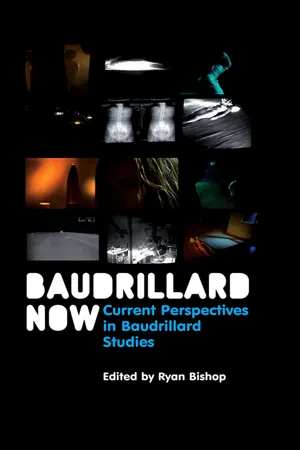
The writings of Jean Baudrillard have dramatically altered the face of critical theory and promise to pose challenges well into the 21st century. His work on simulation, media, the status of the image, the system of objects, hyperreality, and information technology continues to influence intellectual work in a diverse set of fields. This volume uniquely provides overviews of Baudrillards career while also simultaneously including examples of current works on and with Baudrillard that engage some of the many and varied ways Baudrillard's work is being addressed, deployed, and critiqued in the present. As such, it offers chapters useful to the novice and the well-versed in critical theory and Baudrillard Studies alike. Contributors to the volume include John Armitage, John Beck, Ryan Bishop, Doug Kellner, John Phillips and Mark Poster.
No less controversial today than he was in the past, Baudrillard continues to divide intellectuals and academicians, an issue this volume addresses by re-engaging the writing itself without falling into either simplistic dismissal or solipsistic cheerleading, but rather by taking the fecundity operative in the thought and meeting its consistent challenge. Baudrillard Now provokes sustained interaction with one of philosophy?s most important, provocative and stimulating thinkers.
- English
- ePUB (mobile friendly)
- Available on iOS & Android
eBook - ePub
About this book
Information
1
Jean Baudrillard (1929–2007):
A Critical Overview
A Critical Overview
Douglas Kellner
On March 6, 2007 Jean Baudrillard died in Paris at the age of 77 after a long fight with cancer. Associated with postmodern and poststructuralist theory, Baudrillard is dificult to situate in relation to traditional and contemporary philosophy.1 His work combines philosophy, social theory, and an idiosyncratic cultural metaphysics that reflects on key events of phenomena of the epoch. A sharp critic of contemporary society, culture, and thought, Baudrillard is often seen as a major guru of French postmodern theory, although he can also be read as a thinker who combines theory and social and cultural criticism in original and provocative ways and a writer who has developed his own style and forms of writing. He is an extremely prolific author who published over 50 books and commented on some of the most salient cultural and sociological phenomena of the contemporary era, including the erasure of the distinctions of gender, race, and class that structured modern societies in a new postmodern consumer, media, and high- technology society; the mutating roles of art and aesthetics; fundamental changes in politics, culture, and human beings; and the impact of new media, information, and cybernetic technologies in the creation of a qualitatively different social order, providing fundamental mutations of human and social life.
For some years a cult figure of postmodern theory, Baudrillard moved beyond the discourse of the postmodern from the early 1980s to the present, and developed a highly idiosyncratic mode of philosophical and cultural analysis that could be described as a post-poststructuralist mode of thought, although Baudrillard’s theorizing is hard to categorize and pin down and often undergoes surprising mutations. Of postmodern and poststructuralist thinkers, he has consistently gone his own way and avoided fads and intellectual turns of the moment. In retrospect, he emerges from within the perspective of contemporary theory as one of the most radical post-poststructuralist thinkers who undermines key categories of Western philosophy and contemporary theory.
Baudrillard was born in the cathedral town of Reims, France, in 1929. He told interviewers that his grandparents were peasants and his parents became civil servants. He also claims that he was the first member of his family to pursue an advanced education and that this led to a rupture with his parents and cultural milieu. In 1956, he began working as a professor of secondary education in a French high school (Lyceé) and in the early 1960s did editorial work for the French publisher Seuil. Baudrillard was initially a Germanist who published essays on literature in Les temps modernes from 1962–3 and translated works of Peter Weiss and Bertolt Brecht into French, as well as a book on messianic revolutionary movements by Wilhelm Mühlmann. During this period, he met Henri Lefebvre, whose critiques of everyday life impressed him, and Roland Barthes, whose semiological analyses of contemporary society had lasting influence on his work.
In 1966, Baudrillard entered the University of Paris, Nanterre, and became Lefebvre’s assistant, while studying languages, philosophy, sociology, and other disciplines. He defended his “These de Troisiême Cycle” in sociology at Nanterre in 1966 with a dissertation on “Le système des objects,” and began teaching sociology in October of that year. Opposing French and US intervention in the Algerian and Vietnamese wars, Baudrillard associated himself with the French Left in the 1960s. Nanterre was the center of radical politics and the “March 22 movement,” associated with Daniel Cohn-Bendit and the enrageés, began in the Nanterre sociology department. Baudrillard said later that he was involved in the events of May 1968 which resulted in massive student uprisings and a general strike that almost drove French President Charles de Gaulle from power.
During the late 1960s, Baudrillard began publishing a series of books that would eventually make him world famous. Influenced by Lefebvre, Barthes, Georges Bataille, and the French situationists, Baudrillard undertook serious work in the field of social theory, semiology, and psychoanalysis in the 1960s and published his first book, The System of Objects, in 1968 (1996), followed by The Consumer Society in 1970 (1998), and For a Critique of the Political Economy of the Sign in 1972 (1981). These early publications are attempts, within the framework of critical sociology, to combine the studies of everyday life initiated by Lefebvre and Debord and the situationists with a social semiology that studies the life of signs in social life. This project, influenced by Barthes, centers on the system of objects in the consumer society (the focus of his first two books), and the interface between political economy and semiotics (the nucleus of his third book).
Baudrillard’s early work was one of the first to appropriate semiology to analyze how objects are encoded with a system of signs and meanings that constitute contemporary media and consumer societies. Combining semiological studies, Marxian political economy, and sociology of the consumer society, Baudrillard began his life-long task of exploring the system of objects and signs that forms our everyday life.
Baudrillard distanced himself from Marxism in The Mirror of Production (1975 [1973]) where he argues that Marxism, first, does not adequately illuminate premodern societies which were organized around symbolic exchange and not production. He also argues that Marxism does not radically enough critique capitalist societies and calls for a more extreme break. At this stage, Baudrillard turns to anthropological perspectives on premodern societies for hints of more emancipatory alternatives. Yet it is important to note that this critique of Marxism was taken from the Left, arguing that Marxism did not provide a radical enough critique of, or alternative to, contemporary productivist societies, capitalist and communist. Baudrillard concluded that French communist failure to support the May 1968 movements was rooted in part in a conservatism that had roots in Marxism itself. Hence, Baudrillard and others of his generation began searching for more radical critical positions.
His next book, Symbolic Exchange and Death (1993 [1976]), attempts to provide ultraradical perspectives that overcome the limitations of an economistic Marxist tradition. This ultra-leftist phase of Baudrillard’s itinerary would be short-lived, however, though in Symbolic Exchange and Death Baudrillard produces one of his most important and dramatic provocations. In this text, Baudrillard posits a divide in history as radical as the rupture between premodern symbolic societies and modern capitalism. In the mode of classical social theory, he systematically develops distinctions between premodern societies organized around symbolic exchange, modern societies organized around production, and postmodern societies organized around simulation.
Against the organizing principles of modern and postmodern society, Baudrillard valorizes the logic of symbolic exchange, as an alternative organizing principle of society. Against modern demands to produce value and meaning, Baudrillard calls for their extermination and annihilation, providing as examples Mauss’s gift exchange, Saussure’s anagrams, and Freud’s concept of the death drive. In all of these instances, there is a rupture with the logic of exchange (of goods, meanings, and libidinal energies) and thus an escape from the logic of production, capitalism, rationality, and meaning. Baudrillard’s paradoxical logic of symbolic exchange can be explained as expression of a desire to liberate himself from modern positions and to seek a revolutionary position outside contemporary society. Against modern values, Baudrillard advocates their annihilation and extermination.
Symbolic Exchange and Death and the succeeding studies in Simulation and Simulacra (1994 [1981]) articulate the principle of a fundamental rupture between modern and postmodern societies and mark Baudrillard’s departure from the problematic of modern social theory. For Baudrillard, modern societies are organized around the production and consumption of commodities, while postmodern societies are organized around simulation and the play of images and signs, denoting a situation in which codes, models, and signs are the organizing principles of a new social order where simulation rules. In the society of simulation, identities are constructed by the appropriation of images, and codes and models determine how individuals perceive themselves and relate to other people. Economics, politics, social life, and culture are all governed by the logic of simulation, whereby codes and models determine how goods are consumed and used, politics unfold, culture is produced and consumed, and everyday life is lived.
Baudrillard’s thought from the mid-1970s to the present revolves in its own theoretical orbit and provides a set of challenging provocations to modern theory. During the 1980s, Baudrillard’s major works of the 1970s were translated into many languages and each new book of the 1980s was in turn translated into English and other major languages in short order. Consequently, he became world-renowned as one of the master thinkers of postmodernity, one of the major avatars of the postmodern turn. Hence, he became something of an academic celebrity, traveling around the world promoting his work and winning a significant following, though more outside the field of academic sociology or philosophy than within any particular discipline.
At the same time that his work was becoming extremely popular, Baudrillard’s own writing became increasingly difficult and occasionally hermetic. Baudrillard’s new metaphysical speculations are evident in Fatal Strategies (1983, translated in 1990), another turning point in his itinerary. This text presented a bizarre metaphysical scenario concerning the triumph of objects over subjects within the “obscene” proliferation of an object world so completely out of control that it surpasses all attempts to understand, conceptualize, and control it. His scenario concerns the proliferation and growing supremacy of objects over subjects and the eventual triumph of the object. In a discussion of “Ecstasy and Inertia,” Baudrillard discusses how objects and events in contemporary society are continually surpassing themselves, growing and expanding in power. The “ecstasy” of objects is their proliferation and expansion to the Nth degree, to the superlative; ecstasy as going outside of or beyond oneself: the beautiful as more beautiful than beautiful in fashion, the real more real than the real in television, sex more sexual than sex in pornography. Ecstasy is thus the form of obscenity (fully explicit, nothing hidden) and of the hyperreality described by Baudrillard earlier taken to a higher level, redoubled and intensified. His vision of contemporary society exhibits a careening of growth and excrescence (croissance et excroissance), expanding and excreting ever more goods, services, information, messages or demands – surpassing all rational ends and boundaries in a spiral of uncontrolled growth and replication.
Yet growth, acceleration, and proliferation have reached such extremes, Baudrillard suggests, that the ecstasy of excrescence is accompanied by inertia. For as the society is saturated to the limit, it implodes and winds down into entropy. This process presents a catastrophe for the subject, for not only does the acceleration and proliferation of the object world intensify the aleatory dimension of chance and non-determinacy, but also the objects themselves take over in a “cool” catastrophe for the exhausted subject, whose fascination with the play of objects turns to apathy, stupefaction, and an entropic inertia.
In retrospect, the growing power of the world of objects over the subject has been Baudrillard’s theme from the beginning, thus pointing to an underlying continuity in his project. In his early writings, he explored the ways that commodities were fascinating individuals in the consumer society and the ways that the world of goods was assuming new and more value through the agency of sign value and the code – which were part of the world of things, the system of objects. His polemics against Marxism were fueled by the belief that sign value and the code were more fundamental than such traditional elements of political economy as exchange value, use value, production, and so on in constituting contemporary society. Then, reflections on the media entered the forefront of his thought: the TV object was at the center of the home in Baudrillard’s earlier thinking and the media, simulations, hyper-reality, and implosion eventually came to obliterate distinctions between private and public, inside and outside, media and reality. Henceforth, everything was public, transparent, ecstatic, and hyperreal in the object world, which was gaining in fascination and seductiveness as the years went by.
And so ultimately the subject, the darling of modern philosophy, is defeated in Baudrillard’s metaphysical scenario and the object triumphs, a stunning end to the dialectic of subject and object that had been the framework of modern philosophy. The object is thus the subject’s fatality and Baudrillard’s “fatal strategies” project a paradoxical call to submit to the strategies and ruses of objects.
In The Fatal Strategies and succeeding writings, Baudrillard seems to be taking his unique form of theory into the realm of metaphysics, but it is a specific type of metaphysics deeply inspired by the pataphysics developed by Alfred Jarry. Like Jarry’s pataphysics, Baudrillard’s universe is ruled by surprise, reversal, hallucination, blasphemy, obscenity, and a desire to shock and outrage. Thus, in view of the growing supremacy of the object, Baudrillard wants us to abandon the subject and to side with the object. Pataphysics aside, it seems that Baudrillard is trying to end the philosophy of subjectivity that has controlled French thought since Descartes by going over completely to the other side. Descartes’s malin genie, his evil genius, was a ruse of the subject that tried to seduce him into accepting what was not clear and distinct, but over which he w...
Table of contents
- Cover
- Half Title
- Title
- Copyright
- Contents
- Notes on Contributors
- Acknowledgments
- Introduction: The End of Baudrillard and Beyond
- 1 Jean Baudrillard (1929-2007): A Critical Overview
- 2 Baudrillard and the Evil Genius
- 3 Baudrillard, Death, and Cold War Theory
- 4 Swan’s Way: Care of Self in the Hyperreal
- 5 Et in Arizona Ego: Baudrillard on the Planet of the Apes
- 6 Pursuit in Paris
- 7 What is a Tank?
- 8 Some Reflections on Baudrillard’s “On Disappearance”
- 9 Humanity’s End
- Index
Trusted by 375,005 students
Access to over 1.5 million titles for a fair monthly price.
Study more efficiently using our study tools.
Frequently asked questions
Yes, you can cancel anytime from the Subscription tab in your account settings on the Perlego website. Your subscription will stay active until the end of your current billing period. Learn how to cancel your subscription
No, books cannot be downloaded as external files, such as PDFs, for use outside of Perlego. However, you can download books within the Perlego app for offline reading on mobile or tablet. Learn how to download books offline
Perlego offers two plans: Essential and Complete
- Essential is ideal for learners and professionals who enjoy exploring a wide range of subjects. Access the Essential Library with 800,000+ trusted titles and best-sellers across business, personal growth, and the humanities. Includes unlimited reading time and Standard Read Aloud voice.
- Complete: Perfect for advanced learners and researchers needing full, unrestricted access. Unlock 1.5M+ books across hundreds of subjects, including academic and specialized titles. The Complete Plan also includes advanced features like Premium Read Aloud and Research Assistant.
We are an online textbook subscription service, where you can get access to an entire online library for less than the price of a single book per month. With over 1.5 million books across 990+ topics, we’ve got you covered! Learn about our mission
Look out for the read-aloud symbol on your next book to see if you can listen to it. The read-aloud tool reads text aloud for you, highlighting the text as it is being read. You can pause it, speed it up and slow it down. Learn more about Read Aloud
Yes! You can use the Perlego app on both iOS and Android devices to read anytime, anywhere — even offline. Perfect for commutes or when you’re on the go.
Please note we cannot support devices running on iOS 13 and Android 7 or earlier. Learn more about using the app
Please note we cannot support devices running on iOS 13 and Android 7 or earlier. Learn more about using the app
Yes, you can access Baudrillard Now by Ryan Bishop in PDF and/or ePUB format, as well as other popular books in Literature & Literary Criticism Theory. We have over 1.5 million books available in our catalogue for you to explore.