In this book, Bruno Latour pursues his ethnographic inquiries into the different value systems of modern societies. After science, technology, religion, art, it is now law that is being studied by using the same comparative ethnographic methods. The case study is the daily practice of the French supreme courts, the Conseil d'Etat, specialized in administrative law (the equivalent of the Law Lords in Great Britain). Even though the French legal system is vastly different from the Anglo-American tradition and was created by Napoleon Bonaparte at the same time as the Code-based system, this branch of French law is the result of a home-grown tradition constructed on precedents. Thus, even though highly technical, the cases that form the matter of this book, are not so exotic for an English-speaking audience.
What makes this study an important contribution to the social studies of law is that, because of an unprecedented access to the collective discussions of judges, Latour has been able to reconstruct in detail the weaving of legal reasoning: it is clearly not the social that explains the law, but the legal ties that alter what it is to be associated together. It is thus a major contribution to Latour's social theory since it is now possible to compare the ways legal ties build up associations with the other types of connection that he has studied in other fields of activity. His project of an alternative interpretation of the very notion of society has never been made clearer than in this work. To reuse the title of his first book, this book is in effect the 'Laboratory Life of Law'.
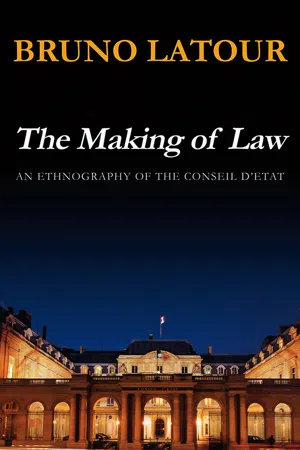
- English
- ePUB (mobile friendly)
- Available on iOS & Android
eBook - ePub
About this book
Information
1
In the shadow of Bonaparte
In which we introduce the readers into the bicentennial celebrations, in order to get them warmed up – In which larcenous pigeons allow us to meet the commissioner of the law, who is a main character in this story – In which we discover the importance of a missing signature to a decree, and in which we familiarize ourselves with the ‘review meetings’ of a ‘sub-section’, which are the main empirical sources of this work – In which an editorial in the newspaper Le Monde allows us to introduce the distinction between civil or criminal law and administrative law – In which the readers begin to experience the particular force of the law, thanks to two contrasting cases discussed in the ‘Counsel Section’ – In which we show the readers the workshops of the ‘General Assembly’ where legal texts are written – All of which does not leave the author completely unperturbed as he ascends the main staircase of the Council
Two rather unfortunately chosen symbols
To mark its second centenary, which was celebrated on 13 December 1999 in the main amphitheatre of the Sorbonne against the backdrop of Puvis de Chavanne’s wonderfully kitsch frescos, the Conseil d’Etat (from now on, ‘Council of State’) chose to represent itself by means of a very peculiar symbol. An impressive Doric column emerged from nowhere to support a piece of architrave upon which rested the detached fragment of a majestic cornice, which jutted forward like the prow of a ship about to part the seas.
This stylized blue sketch appeared very peculiar to the ethnographer: by depicting this beautiful and moving Greek ruin from below, it suggested that the Council was somehow suspended in mid-air with no support or foundation, as though the column drew from within itself the power to support a monument which might have been a temple, but whose purpose could not be discerned without a view either of the whole edifice or of the landscape which it would have surveyed. Sitting in the public gallery, on the fringe of this illustrious gathering, the ignorant ethnographer could not help but ask himself why such an image had been chosen to celebrate the anniversary of the institution. What was the point of designating the foundations of the State by means of this kind of unidentified flying object? What was signified by this pillar with no roots and no support, which held up a ruin? Why return to the ancient Dorians to locate the emblem of an institution that wished to project itself forwards into the twenty-first century?
Figure 1.1

The ethnographer’s astonishment did not diminish when he found out from his neighbour that this was not a ruin but a rendering by the painter Ernest Pignon-Ernest of a corner of the monument which enclosed the courtyard of the Palais-Royal, which is the seat of the ‘Haute Assemblée’, as it is often called somewhat pompously in the press. And, if anything, his surprise increased when he found that none of the counsellors, auditors1 or civil servants with whom he raised the question during the interval shared his surprise: ‘But really, why does that surprise you?’ Apparently, this fragment of power suspended in mid-air and seen from below needed no particular explanation. Had the ethnographer conducted his research over the past four years so badly that he was still unable to predict what should surprise the members of the institution he had been studying?
The uncomfortable feeling that he had so completely misunderstood his field intensified when he received New Year’s greetings from some of those who had put up with him so patiently and for so long. In order to celebrate both the beginning of the year 2000 and the beginning of its third centenary, the representatives of the Council had had the even more peculiar idea of illustrating their greetings card with a painting which depicted Bonaparte standing on a rostrum in the shiny uniform of the Premier Consul. Standing ahead of Cambacérès and Lebrun, who remain discreetly in the background, the author of the coup d’état receives the enthusiastic tributes of the newly appointed counsellors, who are themselves opulently dressed in uniforms designed by the revolutionary painter David, while behind, barely visible against the sunlight, arms raised in a collective solemn gesture, the whole of the Council pledges its loyalty to the new Constitution in a single voice.
Our observer asked himself whether this was not a rather clumsy choice of painting. At the very moment when Europe and European law were acquiring increasingly greater importance, the somewhat embarrassing founder of the Council of State is moved centre-stage. As far as we know, Napoleon is not seen overseas as the model of a democrat, but rather as a bloodthirsty tyrant! And whereas the very notion of a specific body of administrative law as something distinct and separate from civil and criminal jurisdiction still provokes unease, irony or indignation in the press, among elected politicians and among jurists, what was set before the eyes of the public here was a gesture of submission to the personal power of a man who claimed to incarnate a State which brooked no opposition. Even more remarkable is the fact that the very Council whose bicentennial was being celebrated had, throughout France’s troubled history, unwaveringly pledged its complete and absolute fidelity to a succession of regimes which each in their turn sought to suppress it, but which it had always outlived – as had France itself – but only at the price of quite a few palinodes.2 Is it really so clever to put the finger on a gesture of fidelity that could be pledged at one moment and will be abjured the next?
Figure 1.2

It need hardly be said that the ethnographer was again alone in his surprise. Those members of the Council who were kind enough to send him this card were not being in the least bit malicious, and that is exactly what he should have understood.
In order to create a portrait of the Council of State, we will have to redraw Pignon-Ernest’s pencil sketch a little. Although it is true that the Council is a pillar of the State, it is still improbable, for reasons that have to do with simple mechanics and the resistance of materials, that it could anchor itself in the void in this way! So, unlike the painter, we will seek to multiply the ties which, despite their fragility and insignificance, form entanglements and multiply weak links in such a way as to explain the solidity of the edifice. As for this monument itself, rather than treating it as a fragment of neoclassical temple mysteriously hovering above an astounded citizenry, our objective is to restore to it its materiality, its colours, its textures and its opulence, but also its fragility and perhaps its relevance, and – why not? – its utility. The picture will lose some of its solemn splendour and majestic isolation, but it will gain the vascularization and numerous connections that allow an institution to breathe.
In distancing ourselves from this architrave and ruined pile of Doric columns, we are also distancing ourselves from Bonaparte and from the occasionally sensational history that, from the Restoration through to de Gaulle by way of Vichy, allowed the Council to believe itself to be unchanging, as immune to the passage of time as the Platonic Idea of the Republic. We are interested neither in the version of this history that is tirelessly reworked by members of the Council, nor in its scholarly revision by (the somewhat rare) historians of the institution.3 We are not going to follow the path of the archives, but rather that of patient observation by someone who was initially entirely ignorant of legal method and who had not even the most minor responsibility in the State. It so happens that the person whom we shall call the ethnographer – for reasons that will be made clear further on – was able for a period of fifteen months spread over four years to enjoy privileged access to the work of the Council, like a sort of internship carried out under the supervision of eminent members of the establishment, as a result of which he found himself in the position that newer methods in anthropology sometimes describe as impossible, not to say indecent, that of being ‘a fly on the wall’, an observer reduced to silence and invisibility, but equipped with a notebook and a laminated card giving him access to the Council library …
A small matter concerning pigeons
The voice resonates across the room whose wooden furnishings have been polished by years of use:
Although pigeons can be enchanting for the users of public squares, they are a plague on the cultivators of sunflowers. This is the case of Mr Delavallade, who has tried unsuccessfully to obtain compensation of 100,800 francs from the commune of La Rochefoucauld for the damage done to his crops by the town’s pigeons.
Today, he asks you to overrule the decision of 3 December 1991 in which the commune was held not liable on the basis that it had committed no serious wrong.
As in a children’s story, these ‘cases’ always begin by evoking some more or less picturesque place, place-names that recall a history or geography lesson, or the more or less painful or comical incidents of a daily life that is far removed from the plush atmosphere of the place du Palais-Royal, which is situated between the Louvre and the famous theatre called La Comédie Française. We are now in the ‘Section du Contentieux’ (from now on, ‘Litigation Section’), one of the two roles of the Council, the other being composed of what are called ‘les Sections administratives’ (from now on, ‘Counsel Sections’),4 though nothing in the complicated layout of corridors, hidden doorways and formal or obscure staircases, or in the arrangement of contrasting carpets, really allows one to separate the building into these two functional sides, which are entangled in a hundred different ways, and whose subtle ecology we will describe further on.
The speaker is standing on a rostrum, reading aloud from a carefully drafted document that is called his ‘conclusions’ because it always ends with the following formula:
And for these reasons, we conclude:
- that the decision of the appellate administrative court of Bordeaux be annulled;
- that the appeal of Mr Delavallade, and the remainder of his conclusions of appeal, be rejected.
The speaker is called ‘le commissaire du gouvernement’, but we should not be misled by the term: the main characteristic of this character, with whom we are going to spend quite some time, is precisely that he is not the official representative of a government; rather, he is one of the twenty members of the Council to whom are entrusted the task of advising the judicial body as to the proper grounds for decision, according to his particular view of administrative law.5 Because everything happens as if he was commissioned by the Law itself to speak to his colleagues, we will call him from now on ‘the commissioner of the law’ thus retaining the origin of the word and taking out some of the ambiguous connotation of the French.
Although he is the only person standing, his role is not that of a public prosecutor because he does not bring proceedings in the name of the State, nor does he control the procedure of review in any way. And although he stands to the left of the adjudicating body, his role is not that of a defence counsel either. In this assembly, lawyers never speak, or they do so only in the rarest of cases, and although a bench facing the judges is reserved for them, they sit in silence, giving only a terse nod when their file is announced, at which time they mumble something like ‘I refer to my written conclusions on this matter’. The function of the commissioner of the law is more like that of an independent academic. Some weeks ago, his colleagues of the ‘sous-section’ (from now on, ‘sub-section’)6 to which he belongs handed file no. 133-880 to him, on which he is presenting his conclusions today, 25 October 1995.7
Figure 1.3

However, nothing compels his judicial colleagues, who listen to him more or less attentively, depending on the importance of the case and the prestige of the commissioner, to follow his conclusions. He himself is free to publish them, as would a researcher, because they remain valuable even if the deciding judges end up preferring a very different solution. Case reporters, law professors, amateurs of litigation, and litigants themselves learn to scrutinize these conclusions for the first signs of a ‘reversal of precedent’, rather like weekend sailors searching for a breeze on a becalmed sea. But let us not rush to present the reader with terms that are better introduced slowly. For now, what is essential is the point that, in this preserve of administrative law, no one but the commissioner of the law ever speaks publicly.8 The rest of the procedure is conducted entirely in writing. Let us try to understand the content of the text that he is reading in his neutral voice, which is occasionally enlivened by a touch of humour that might bring a shadow of a smile to the faces of his interlocutors:
The battle against the nuisance caused by birds unquestionably falls within the powers of the municipal police, which, according to article L 131-2 of the Code of communes, are exercised so as ‘to ensure order, safety, security, and public health’, and, more especially, within heading 8 which refers to ‘the task of preventing or remedying the mishaps caused by the straying of harmful and wild animals’. In these terms, although pigeons are not wild animals, they are certainly harmful ones.9
Between the paragraph on p. 16 and this one an important operation has been performed. The pigeons which so delighted people in public squares with their displays of aerial ballet have now become ‘harmful animals’ ‘according to article L 131-2 of the Code of communes’, which makes them the responsibility of the Mayor and which ‘unquestionably’ authorizes Mr Delavallade to bring a complaint in the form of an appeal. The ‘requérant’ (from now on, ‘litigant’) – a name which is given to plaintiffs in administrative law – could have taken his gun to the pigeons in the sunflower fields of La Rochefoucauld and served them up as roasts; he could have hated the Mayor in his heart of hearts, or insulted him in public, but as soon as he assumed the dignity of the ‘litigant’ by posting the piece of stamped paper in which he made his complaint to the administrative tribunal of Bordeaux, we find ourselves on this cold autumn afternoon linked by a thread which allows his pigeons, his sunflowers, his resentments and his Mayor to ‘produce law’. It will take us the whole of this book to grasp the nature of this very particular operation, which we must for now be careful not to consider as a simple and homogeneous operation.10
The commissioner of the law continues:
The municipality did not do nothing. It preferred to use the ‘gentler’ method of sterilizing the pigeons, which did not have particularly convincing results.
Curiously, the litigant does not attack the decision on the basis that it incorrectly interpreted the law, which led it not to find fault, but only for the legal error that led it to look only for the presence of a...
Table of contents
- Cover
- Title page
- Copyright page
- Preface to the English edition
- 1 In the shadow of Bonaparte
- 2 How to make a file ripe for use
- 3 A body in a palace
- 4 The passage of law
- 5 Scientific objects and legal objectivity
- 6 Talking of law?
- Glossary of technical terms
- Bibliography
- Index
Trusted by 375,005 students
Access to over 1.5 million titles for a fair monthly price.
Study more efficiently using our study tools.
Frequently asked questions
Yes, you can cancel anytime from the Subscription tab in your account settings on the Perlego website. Your subscription will stay active until the end of your current billing period. Learn how to cancel your subscription
No, books cannot be downloaded as external files, such as PDFs, for use outside of Perlego. However, you can download books within the Perlego app for offline reading on mobile or tablet. Learn how to download books offline
Perlego offers two plans: Essential and Complete
- Essential is ideal for learners and professionals who enjoy exploring a wide range of subjects. Access the Essential Library with 800,000+ trusted titles and best-sellers across business, personal growth, and the humanities. Includes unlimited reading time and Standard Read Aloud voice.
- Complete: Perfect for advanced learners and researchers needing full, unrestricted access. Unlock 1.5M+ books across hundreds of subjects, including academic and specialized titles. The Complete Plan also includes advanced features like Premium Read Aloud and Research Assistant.
We are an online textbook subscription service, where you can get access to an entire online library for less than the price of a single book per month. With over 1.5 million books across 990+ topics, we’ve got you covered! Learn about our mission
Look out for the read-aloud symbol on your next book to see if you can listen to it. The read-aloud tool reads text aloud for you, highlighting the text as it is being read. You can pause it, speed it up and slow it down. Learn more about Read Aloud
Yes! You can use the Perlego app on both iOS and Android devices to read anytime, anywhere — even offline. Perfect for commutes or when you’re on the go.
Please note we cannot support devices running on iOS 13 and Android 7 or earlier. Learn more about using the app
Please note we cannot support devices running on iOS 13 and Android 7 or earlier. Learn more about using the app
Yes, you can access The Making of Law by Bruno Latour in PDF and/or ePUB format, as well as other popular books in Politics & International Relations & American Government. We have over 1.5 million books available in our catalogue for you to explore.