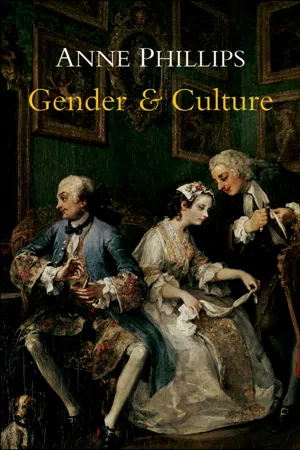
The idea that respect for cultural diversity conflicts with gender equality is now a staple of both public and academic debate. Yet discussion of these tensions is marred by exaggerated talk of cultural difference, leading to ethnic reductionism, cultural stereotyping, and a hierarchy of traditional and modern. In this volume, Anne Phillips firmly rejects the notion that 'culture' might justify the oppression of women, but also queries the stereotypical binaries that have represented people from ethnocultural minorities as peculiarly resistant to gender equality.
The questions addressed include the relationship between universalism and cultural relativism, how to distinguish valid generalisation from either gender or cultural essentialism, and how to recognise women as agents rather than captives of culture. The discussions are illuminated by reference to legal cases and policy interventions, with a particular focus on forced marriage and cultural defence.
- English
- ePUB (mobile friendly)
- Available on iOS & Android
eBook - ePub
Gender and Culture
About this book
Information
1
Introduction
Twenty years ago, a book titled ‘Gender and Culture’ might have suggested an exploration of the sex/gender distinction, an analysis of the cultural understandings of gender that get attached to (small) natural differences of sex, and illustration of this via the different understandings of masculinity and femininity in cultures around the globe. It is likely that the unwary reader would have found her expectations confounded. Feminists were already questioning that particular use of the nature/culture distinction, arguing that it falsely represents the body as passive recipient of cultural meanings, and that a seemingly biological distinction between female and male is as socially constructed as a gender distinction between women and men.1 Those debates continue, though they play only a supporting role in this book. Today, a rather different set of issues attaches to the coupling of gender with culture. Looking at the title, many readers will now anticipate (rightly, as it turns out) a discussion of tensions between feminism and multiculturalism, between the pursuit of gender equality and recognition of cultural diversity.
The notion that gender equality is in conflict with multiculturalism is now a staple of public as well as academic debate. Much of the recent retreat from multiculturalism – especially notable across Europe, and speeding up markedly from the beginning of the century – has invoked the patriarchal treatment of girls and women in minority cultural groups as a key justification for abandoning more inclusive models of multicultural citizenship. Multicultural policies are said to have shored up the authority of socially conservative cultural leaders and sacrificed the rights of women to the preservation of cultures. In the name of equality between cultures, the guardians of conservative gender roles have been provided with public funds and offered an amplified voice on the public stage. Exaggerated notions of cultural sensitivity are said to have paralysed teachers, social workers, even police officers, and encouraged public officials to turn a blind eye to abuses of women and girls. Mistaken notions of cultural respect are said to have silenced criticism of sexually inegalitarian practices.
It is not only feminists who have noticed the opportunism in this, and the implausible blossoming of support for gender equality in societies that find it difficult to deliver even on long-established promises like equal pay. Women tackling problems of violence against women – and particularly those working within minority cultural communities – were among the first to sound the alarm on multiculturalism, noting that respect for cultures too easily became power for cultural spokesmen. Having anticipated the arguments was little consolation, however, when their warnings were turned to such different effect. Much of the feminist criticism had still taken as its background assumption that feminism and multiculturalism were natural allies. Both, after all, spoke for groups marginalized in existing hierarchies of power. Both challenged simplistic associations of equality with sameness, arguing that the pursuit of equality sometimes meant treating people differently rather than the same. Both exposed the complacencies of a formalistic liberalism that seemed to consider the official equality of rights as much as anyone needs. Even Susan Moller Okin, the feminist most commonly cited as considering multiculturalism bad for women, still saw the two projects as ‘in some ways, related struggles’, because both sought ‘the recognition of difference in the context of norms that are universal in theory, but not in practice’. ‘What we need to strive toward’, she argued in 1999, ‘is a form of multiculturalism that gives the issues of gender and other intragroup inequalities their due – that is to say, a multiculturalism that effectively treats all persons as each other’s moral equals’.2
Okin’s modest endorsement of at least some multicultural goals is out of step with current media and political opinion. The problems feminists have identified with the workings of multiculturalism are now more commonly taken as demonstrating the complete incompatibility between the two. American disenchantment with multiculturalism rumbled along all through the so-called ‘culture wars’, but US multiculturalism was primarily associated with education and matters of curriculum, so the policy consequences of this have been relatively limited. European disenchantment dates from the mid-1990s, when multiculturalism was being blamed (erroneously, on the whole) for failures of economic and social integration, differential employment rates, differential crime rates and high levels of residential segregation between ethnocultural groups. The focus on gender came slightly later, but, by the beginning of the twenty-first century (and mostly predating 9/11), much discussion of multiculturalism had come to revolve around matters of sex and sexuality: girls and women wearing hijab; girls subjected to genital cutting; young people forced into unwanted marriages; young women murdered by family members for behaviour said to offend principles of community honour; the repudiation of homosexuality by leading Muslim clerics.3 (Repudiation by leading Christian clerics has not, on the whole, been viewed as a multicultural issue.) Multiculturalism is increasingly described as a misguided failure of nerve in liberal democracies that need more confidently to assert their own identities and values. Equality between the sexes is widely cited as one of the boundary-marking values.
In this charged political context, sustained by wars on terror and fears of unstoppable migration, it has been particularly challenging to work through the theoretical and political issues associated with gender and culture. The elevation of gender equality to a defining feature of liberal democracies is to be welcomed, as are more concerted policy interventions (some of them discussed in this book) to tackle matters such as forced marriage or ‘honour’ crime. But when the rights of women figure as a marker of modern liberal societies – part of what differentiates them from ‘traditional’, non-Western, illiberal ones – this constructs a stereotypical binary between Western and non-Western values that represents people from ethnocultural minorities as peculiarly resistant to gender equality. Moreover, when violence against minority women becomes a preoccupation in political discourse, this tends to produce merely symbolic actions, like legislation specifically criminalizing female genital mutilation and forced marriage, accompanied by a dearth of serious funding for agencies working on the ground to tackle such problems.4 Instead of promoting a more defensible multiculturalism that addresses both the hierarchies of culture and the hierarchies of gender, the preoccupation with women’s rights often ends up justifying more restrictive immigration agendas and feeding stereotypes of minority groups. Real support for minority women remains a low priority.
Feminists hoping to sustain the vision of two related, if often conflicting, projects have pursued a number of strategies to mitigate the starker oppositions. (It has been a somewhat salutary experience in putting this collection together to realize that I dabbled in a variety of them before settling on my preferred combination.) One approach is to identify key principles of gender equality that set the limits to cultural accommodation: certain non-negotiable rights or equalities that must be respected in any pursuit of multicultural citizenship. This is most clearly represented in Susan Okin’s work, and has, in my view, been too readily dismissed in some of the contemporary feminist literature.5 A second approach divides things up according to different jurisdictions, identifying distinct spheres of influence within which different principles will hold sway. This is most fully developed in Ayelet Shachar’s work, which argues for a system of ‘joint governance’ in which states delegate certain regulatory powers to minority groups, but secure at the same time a diversity of alternative jurisdictions. Shachar argues that this forces groups and states alike to compete for the loyalty (one might almost say, custom) of women by offering increasingly favourable gender equality terms.6 A third approach appeals to democracy and democratic deliberation, with a view to enhancing understanding between cultural groups, identifying areas of common ground, and moving to mutually acceptable accommodations. The specifically feminist aspect is the insistence that such deliberations must involve women equally with men, young alongside old, cultural dissenters as well as cultural conservatives, so as to avoid the ‘communities talking to communities’ syndrome that tends to empower established – mainly older, usually male – leaders.7 A fourth approach takes issue with the very notion of ‘culture’, challenging the reifications that understate diversity and contestation within cultures, exaggerate differences between cultures, and manufacture deep value dissonance where none such exists.8 In its interrogation of categories of culture, this has strong affinities with the critique of gender essentialism that became an important part of feminist theorizing in recent decades. It informs much of the argument in the book I published in 2007, Multiculturalism without Culture.9
A key theme running through this volume is that debate about tensions between gender equality and cultural diversity has been marred by misleading stereotypes of culture, and that an exaggerated language of cultural difference has lent itself to ethnic reductionism, cultural stereotyping and a hierarchy of ‘traditional’ and ‘modern’. In this process, the really important issues have often been sidelined. Cultures have been misdescribed as organized around static defining values; misrepresented as more distinct from one another than they really are; and wrongly conceptualized as ‘things’ that determine the actions and attitudes of their members. This last has been especially important to my argument, for I have sought to drive a wedge between two very different understandings of culture. It seems unexceptional to say that each of us is shaped by the norms and conventions of our cultures (I use the plural here, because most of us participate in a number of cultural arenas, including the smaller sub-cultures associated with our neighbourhoods or places of work). It seems unexceptional and important to say that our ways of acting and thinking often have a cultural specificity of which we are unaware. But this is not to be confused with saying that the things we do or think are practices or traditions of ‘our culture’, as if, to adopt Lila Abu-Lughod’s evocative phrase, we were simply ‘robots programmed with “cultural” rules’.10
I have come to be deeply sceptical of the uses of the terms ‘cultural practice’ and ‘cultural tradition’, and the tendency to apply these exclusively to people from minority or non-Western cultural groups. Those associated with majority groups are rarely thought of as having cultural practices and traditions. They might, at most, be influenced by their social location, or affected by their society’s traditions, but society is, by implication, more open and flexible than culture, and ‘social’ influences are rarely thought to undermine the capacity for independent action or thought.11 As currently deployed, the language of cultural practice and tradition contains within it a hierarchy of cultures. It also tends towards cultural determinism. Describing something as a cultural practice misrepresents what is frequently a contested activity as if it were slavishly followed by all those associated with particular cultural groups. I find myself particularly irritated when forced marriage, which is regarded with horror by most parents from the communities that supposedly practise it, is described as a ‘cultural practice’.
In Multiculturalism without Culture, I argue the importance of recognizing cultural specificity and context (if you did not think this mattered, there would be no reason for multiculturalism at all), but against the reification of culture as catch-all explanation of what individuals from minority or non-Western groups do. I draw on established feminist arguments about recognizing women as agents not victims, and apply these to the multiculturalism debates. This delivers what I describe at one point as both more multiculturalism and less: more, in insisting on the validity of the diverse choices individuals make about their lives and rejecting many social policies that seek to protect women for their own good; less, in resisting the corporatist claims sometimes made in the name of multiculturalism and opposing policies that cede authority to the self-proclaimed leaders of cultural groups.
One obvious question is whether this – or any of the other approaches noted above – is more than an attempt to square the circle. Do attempts to sustain a vision of related if conflicting projects offer more than a pretence of resolution? Do they just offer the pretence that we can moderate incompatible claims by declaring certain rights non-negotiable or arranging a division of responsibilities between distinct jurisdictions? Is there a naïvety here that fantasizes well-intentioned and restrained representatives of multiple communities coming together in dialogue and either discovering their mutually acceptable ground or agreeing to disagree? Perhaps most self-deceiving of all, is there a notion that re-describing deep value conflicts as not nearly so fundamental somehow makes them disappear? Why not just accept what critics – and some defenders12 – of multiculturalism have argued: that there is a choice to be made here, and that we cannot have it both ways?
As regards my own position on these issues, I think there are three important worries or objections. The first is that I exaggerate the extent of cultural essentialism in current discourses of multiculturalism. Who exactly is it that conjures up false and misleading images of cultures as things? Does anyone really say this? Who or what is the object of this critique? The second worry is that I do not leave myself enough of a basis in notions of cultural difference or cultural specificity to justify even a minimal multiculturalism, and that my critique of culture, cultural community and cultural group then forces me in a resolutely individualist direction. This individualism seems at odds with arguments I have pursued elsewhere in respect of political representation, where I have supported measures to address group exclusions on grounds of gender, ethnicity and race.13 How do I deal with this seeming inconsistency? The third worry is that the emphasis on agency leads me to understate the cultural and other pressures operating on women, and thereby understate the need for policies that protect women from cultural oppression. These are all serious questions, and the last two, in particular, continue to cause me concern. Though it is somewhat back-to-front to respond to criticisms before readers have had the chance to try out the arguments, I want to take this opportunity to address them.
‘Culture’ and Culturalism
James Tully was criticizing what he called the billiard-ball conception of culture from the mid-1990s onwards, and drawing on developments in anthropology to inform a more fluid understanding.14 Will Kymlicka, probably the most influential theorist of multiculturalism, makes a distinction between ‘culture’ and ‘cultural community’ from his earliest writings; he seeks to sustain communities, not cultures, through policies of multicultural citizenship, with a view to providing individuals with the social and moral resources that will enable them, among other things, to question and change a culture’s practices and beliefs.15 Susan Moller Okin, often criticized for failing to register the intense internal contestation that takes place within what she misrepresents as oppressive monoliths, might more fairly be said to argue the opposite, for much of her argument is directed at the self-proclaimed cultural leaders who falsely claim to speak for an entire group.16 Theorists of multiculturalism now routinely pay their respects to the idea that cultures are plural, fluid and overlap with other cultures. So who are the dangerous essentialists whose rigid and reified understandings of culture have generated a false opposition between respecting cultural diversity and ensuring women’s rights? Where is the supposed essentialism? What exactly is my problem?
In a recent public lecture, Kymlicka suggested that my main target is a pervasive but amorphous daily discourse of cultural difference, and argued that it is inappropriate to represent multicultural theory as carrying any responsibility for this.17 That is, indeed, part of my target, for daily discourse, refracted through the media, has a significant impact on politicians preoccupied with their chances of re-election, and almost certainly more impact than academic writing. I do not accept, however, that multicultural theory can be absolved from any role in sustaining that discourse. First, it is determinism, ...
Table of contents
- Cover
- Title page
- Copyright page
- Acknowledgements
- 1 Introduction
- 2 Multiculturalism, universalism and the claims of democracy
- 3 Dilemmas of gender and culture: the judge, the democrat and the political activist
- 4 What is ‘culture’?
- 5 What’s wrong with essentialism?
- 6 When culture means gender: issues of cultural defence in the English courts
- 7 Free to decide for oneself
- 8 Consent, autonomy and coercion: forced marriage, public policy and the courts
- Bibliography
- Index
Trusted by 375,005 students
Access to over 1.5 million titles for a fair monthly price.
Study more efficiently using our study tools.
Frequently asked questions
Yes, you can cancel anytime from the Subscription tab in your account settings on the Perlego website. Your subscription will stay active until the end of your current billing period. Learn how to cancel your subscription
No, books cannot be downloaded as external files, such as PDFs, for use outside of Perlego. However, you can download books within the Perlego app for offline reading on mobile or tablet. Learn how to download books offline
Perlego offers two plans: Essential and Complete
- Essential is ideal for learners and professionals who enjoy exploring a wide range of subjects. Access the Essential Library with 800,000+ trusted titles and best-sellers across business, personal growth, and the humanities. Includes unlimited reading time and Standard Read Aloud voice.
- Complete: Perfect for advanced learners and researchers needing full, unrestricted access. Unlock 1.5M+ books across hundreds of subjects, including academic and specialized titles. The Complete Plan also includes advanced features like Premium Read Aloud and Research Assistant.
We are an online textbook subscription service, where you can get access to an entire online library for less than the price of a single book per month. With over 1.5 million books across 990+ topics, we’ve got you covered! Learn about our mission
Look out for the read-aloud symbol on your next book to see if you can listen to it. The read-aloud tool reads text aloud for you, highlighting the text as it is being read. You can pause it, speed it up and slow it down. Learn more about Read Aloud
Yes! You can use the Perlego app on both iOS and Android devices to read anytime, anywhere — even offline. Perfect for commutes or when you’re on the go.
Please note we cannot support devices running on iOS 13 and Android 7 or earlier. Learn more about using the app
Please note we cannot support devices running on iOS 13 and Android 7 or earlier. Learn more about using the app
Yes, you can access Gender and Culture by Anne Phillips,Anne Phillips in PDF and/or ePUB format, as well as other popular books in Social Sciences & Gender Studies. We have over 1.5 million books available in our catalogue for you to explore.