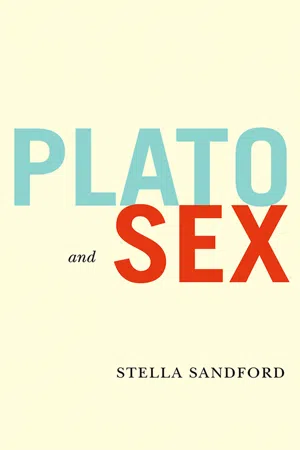
What does the study of Plato's dialogues tell us about the modern meaning of 'sex'? How can recent developments in the philosophy of sex and gender help us read these ancient texts anew?
Plato and Sex addresses these questions for the first time. Each chapter demonstrates how the modern reception of Plato's works Ð in both mainstream and feminist philosophy and psychoanalytical theory Ð has presupposed a 'natural-biological' conception of what sex might mean. Through a critical comparison between our current understanding of sex and Plato's notion of genos, Plato and Sex puts this presupposition into question. With its groundbreaking interpretations of the Republic, the Symposium and the Timaeus, this book opens up a new approach to sex as a philosophical concept.
Including critical readings of the theories of sex and sexuation in Freud and Lacan, and relating such theories to Plato's writings, Plato and Sex both questions our assumptions about sex and explains how those assumptions have coloured our understanding of Plato. What results is not only an original reading of some of the most prominent aspects of Plato's philosophy, but a new attempt to think through the meaning of sex today.
eBook - ePub
Plato and Sex
About this book
Information
1
Sex and Genos (Republic)
When Socrates said, well over 2,000 years ago, in Book V of the Republic, that he and his interlocutors were about to rouse ‘a swarm of arguments’ (450b), he was certainly not mistaken, although the angry buzzing did not reach its height until the second half of the twentieth century. The provocation comes in the form of three well-known proposals concerning the Guardian class of the Republic: the holding of wives and children in common, the equal education of men and women, and the participation of women in all aspects of governance. Although the history of written responses to these proposals begins with Aristotle, it is the debates within the context of second-wave feminism, from the 1970s onwards, that will be the focus here. This chapter critically investigates what I identify as a basic shared assumption in the different positions within these debates and – moving away from this assumption – offers a new interpretation of the relevant sections of the Republic, an interpretation that suggests why these already heavily commented passages claim our attention today.
Although there has been some sympathy for Socrates’ first proposal, to the extent that it prefigures proposals for the abolition of the bourgeois family,1 the idea that women should be awarded as sexual prizes to men, denied the freedom of choice of sexual partner, mated like animals and then denied access to their offspring has, not surprisingly, found little support among feminists. Disagreements in the feminist literature have therefore largely centred on the second and third proposals. As the second (a radical transformation of education in its broadest sense of upbringing and acculturation) is the condition of possibility of the third (participation in governance) these two proposals are part of a single programme of social and political transformation which, mutatis mutandis, is recognizable in the actual transformations that have taken place since the nineteenth century – regional, national and continental variations notwithstanding.
Whatever Plato’s2 intentions in its initial presentation, various forms of one crucial aspect of his main argument in favour of these proposals have been central, either implicitly or explicitly, to both liberal and socialist feminism. Concomitantly, as feminists of a different theoretical and political persuasion have criticized aspects of these liberal and socialist variants, so too have they criticized the assumptions animating Plato’s argument.
Before investigating this argument, and the fundamental presupposition, hitherto, of all the feminist responses, one might summarize their popular forms as follows. According to Socrates in Plato’s Republic, the difference between the sexes (which is not, in itself, denied) is not such that men or women, qua men or qua women, are suited to any one kind of work or any distinct social or cultural existence. The difference between the sexes is reduced to the different roles of men and women in reproduction and is said to be irrelevant to their capacities for work. Plato’s generalized sexism notwithstanding – his apparent belief that men are superior to women in all things – the argument seems to support the view that it is the different treatment and cultural expectations of boys and girls and men and women that produce many of the differences in capacity and character that people are wont to ascribe, erroneously, to the ‘natural’ differences between the sexes.
Those in agreement with a modern version of one crucial part of Plato’s argument – that culture, not nature, is the relevant arena here – have nevertheless disagreed profoundly in their interpretations of Plato’s position and its wider implications. For some, Plato anticipates the chief demands and assumptions of modern feminism; for others, the underpinnings and intention of his argument are either non- or anti-feminist. These interpretations fall into three main groups. The first, broadly liberal position, arguing for Plato’s proto-feminist credentials, draws its strength from the favourable comparison of Plato’s proposals with the actual legal and social position of women in classical Athens, and from the obvious parallels between Plato’s emphasis on education and access to public and political life and the same emphasis in the history of feminism.3 The second position is also broadly liberal but interprets Plato as a non- or anti-feminist, pointing to the lack of or hostility to other concepts central to the history of feminism (notably those of rights, equality and happiness), to the excessively utilitarian impetus of Plato’s argument, and to the many passages elsewhere in the Republic and in other dialogues in which women are denigrated, pronounced inferior or held in contempt.4 For the third position, associated with the so-called ‘feminism of difference’ largely inspired by Luce Irigaray, Plato merely demonstrates (according to some, even inaugurates) a disregard for sexual difference that is not only inimical to, but destroys the foundations of, feminism in the ‘de-sexing’ of women and an overemphasis on equality according to a masculine ideal.5 Support for this interpretation can be drawn from Plato’s denial of any specifically feminine excellence or capacity, from the masculine, military emphasis of the proposed education for women, and its relation to the profoundly horrible treatment of motherhood and nurture in the first proposal.
What is at stake in these different and often opposed interpretations and arguments? There is no single thing at stake in them all; rather, it is because different things are at stake for different readers that there are different interpretations. They all, however, share a common assumption, which I shall contest in what follows: namely, the assumption of the role of a modern concept of ‘sex’. I use the term ‘modern’ in a very broad sense here, in distinction from the ‘ancient’. Looking again at the famous proposals in the Republic the main claim in this chapter is that this modern concept of ‘sex’, as the general term for the categories of male and female which ground the categories of men and women ontologically, plays no role in the relevant arguments concerning women in Plato’s Republic. Reading the Republic from the standpoint of this claim the familiar passages in Book V take on a different hue and invite a new interpretation. At the same time the peculiarity of the function of this modern concept of sex is thrown into relief. In what follows, then, I shall first examine Plato’s main argument for the second and third proposals from the standpoint of some of the most familiar English translations and feminist responses. I shall then attempt to justify the claim that the modern concept of sex presumed in these translations and responses is, strictly speaking, absent from the Republic, re-examining the argument and some related passages from the Laws accordingly. Finally, I shall consider some of the broader implications of this claim.
The relevance of sex
The most contentious of Plato’s proposals first surfaces explicitly in Book IV...
Table of contents
- Cover
- Dedication
- Title page
- Copyright page
- Acknowledgements
- Introduction
- 1 Sex and Genos (Republic)
- 2 The Origin of Sex: Aristophanes, Freud and Lacan (Symposium)
- 3 ‘Erōs’ and ‘Sexuality’, Plato and Freud (Symposium)
- 4 ‘I, a Man, am Pregnant and Give Birth’ (Symposium)
- 5 Of Gods and Men: The Natural Beginning of Sex (Timaeus)
- Coda: The Idea of ‘Sex’
- Bibliography
- Index
Trusted by 375,005 students
Access to over 1.5 million titles for a fair monthly price.
Study more efficiently using our study tools.
Frequently asked questions
Yes, you can cancel anytime from the Subscription tab in your account settings on the Perlego website. Your subscription will stay active until the end of your current billing period. Learn how to cancel your subscription
No, books cannot be downloaded as external files, such as PDFs, for use outside of Perlego. However, you can download books within the Perlego app for offline reading on mobile or tablet. Learn how to download books offline
Perlego offers two plans: Essential and Complete
- Essential is ideal for learners and professionals who enjoy exploring a wide range of subjects. Access the Essential Library with 800,000+ trusted titles and best-sellers across business, personal growth, and the humanities. Includes unlimited reading time and Standard Read Aloud voice.
- Complete: Perfect for advanced learners and researchers needing full, unrestricted access. Unlock 1.5M+ books across hundreds of subjects, including academic and specialized titles. The Complete Plan also includes advanced features like Premium Read Aloud and Research Assistant.
We are an online textbook subscription service, where you can get access to an entire online library for less than the price of a single book per month. With over 1.5 million books across 990+ topics, we’ve got you covered! Learn about our mission
Look out for the read-aloud symbol on your next book to see if you can listen to it. The read-aloud tool reads text aloud for you, highlighting the text as it is being read. You can pause it, speed it up and slow it down. Learn more about Read Aloud
Yes! You can use the Perlego app on both iOS and Android devices to read anytime, anywhere — even offline. Perfect for commutes or when you’re on the go.
Please note we cannot support devices running on iOS 13 and Android 7 or earlier. Learn more about using the app
Please note we cannot support devices running on iOS 13 and Android 7 or earlier. Learn more about using the app
Yes, you can access Plato and Sex by Stella Sandford in PDF and/or ePUB format, as well as other popular books in Philosophy & Philosophy History & Theory. We have over 1.5 million books available in our catalogue for you to explore.