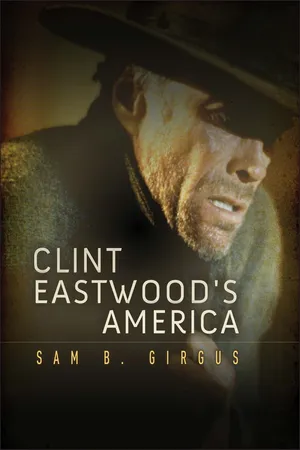
The steady rise of Clint Eastwood's career parallels a pressing desire in American society over the past five decades for a figure and story of purpose, meaning, and redemption. Eastwood has not only told and filmed that story, he has come to embody it for many in his public image and film persona. Eastwood responds to a national yearning for a vision of individual action and initiative, personal responsibility, and potential for renewal. An iconic director and star for his westerns, urban thrillers, and adventure stories, Eastwood has taken film art to new horizons of meaning in a series of masterpieces that engage the ethical and moral consciousness of our times, including Unforgiven, Million Dollar Baby, and Mystic River. He revolutionized the war film with the unprecedented achievement of filming the opposing sides of the same historic battle in Flags of Our Fathers and Letters from Iwo Jima, using this saga to present a sharply critical representation of the new America that emerged out of the war, a society of images and spectacles.
This timely examination of Clint Eastwood's oeuvre against the backdrop of contemporary America will be fascinating reading for students of film and popular culture, as well as readers with interests in Eastwood's work, American film and culture.
- English
- ePUB (mobile friendly)
- Available on iOS & Android
eBook - ePub
Clint Eastwood's America
About this book
Information
1
The First Twenty Years: Borderline States of Mind
A Western State of Mind
The Western part of Clint Eastwood's decades-long struggle into the upper echelon of leading American and world directors begins with a long ride on a dapple-gray horse into the town of Lago in High Plains Drifter. To many, becoming a director of outstanding artistic achievement seemed like the last place Eastwood was headed at that point in his career, at least as based on the evidence of this particular Western, his second effort as a director following Play Misty for Me.
An international celebrity with great box-office appeal for his roles as “The Man With No Name” in Sergio Leone's spaghetti Westerns and as “Dirty Harry” in Don Siegel's films, Eastwood generated attention for directing and acting in his own films. Although High Plains Drifter, like Play Misty for Me, clearly exhibits the flaws of a new director, in this Western, the ride into Lago not only advances a journey of redemption that continues for the rest of Eastwood's career as a director; it also develops an artistic process for structuring and enacting the complex ethical geography of his artistic imagination. On this aesthetic and ethical venture, the Western becomes more than a classic genre and narrative form that Eastwood can tinker with, from High Plains Drifter to Unforgiven. The Western as a projection of the American and world imagination sustains the contours and development of Eastwood's world view.
So, for Eastwood, the Western provides a structure for the expression of the border state of mind that characterizes much of his work. Moreover, Eastwood's West as a border state of mind can be enlightened by discussing it in terms of Julia Kristeva's extensive examination throughout her work of the meaning of borders. As different as they are, Eastwood, the iconic rebel American roughneck, and Kristeva, the quintessential European thinker of seminal importance to the world of ideas, intersect at crucial points. Eastwood and Kristeva can inform each other. As an acutely modern artistic and cultural consciousness, Eastwood in his work dramatizes a border state of mind that explores much of the same philosophical and psychological condition of borders that Kristeva expatiates upon with persuasive eloquence and systematic analysis.
The concept of borders and boundaries suffuses Kristeva's writings. Kristeva maintains “border states of the mind” include “borderline personalities,” more specifically the modern narcissist for whom “subject/object borders” collapse into a “border region” of reality and fantasy “that is psychosis.”1 She says modern man “is a being of boundaries, a borderline, or a ‘false self’ ” who is part of “the growing number of narcissistic, borderline, or psychosomatic patients.”2
Admittedly, Eastwood's Western state of mind at first seems quite removed from Kristeva's theory. At its most immediate level of meaning, the West as a border state of mind for Eastwood retains the conventions that historically have defined it in the literary and cultural imagination. The West cultivates independence, self-reliance, hostility toward civilization, alienation, and violence. The West develops a border personality type with a divided psyche that reflects the untamed, unruly environment.
The West of Eastwood's early films, however, also intimates other levels of meaning. A closer look at the West as a state of mind in Eastwood reveals a psychic and cultural space that boils over with ambiguities and tensions that reflect modernity. Questions of religion, naming and language, sacrifice, unspeakable emotion and violence, purification, gender identification, sexuality, murder, and death infuse this Western state of mind in Eastwood's films, all also essential matters of intrinsic importance to Kristeva's project. Images and signs in Eastwood's films resonate with meaning related to these same subjects in Kristeva's writings.
The transcendent nature of Eastwood's Stranger hero in High Plains Drifter, Pale Rider, and in other films as well exemplifies the border state of mind and being. Eastwood's use of transcendent figures resembles Mark Twain's attraction to superhuman figures who transcend the limitations of mind, spirit, and character of ordinary human beings.3 For Eastwood, the Stranger's identity, mind, and body entail a borderline between the human and the superhuman, between immanence and transcendence. The ontology of the Stranger is problematic. Without a known name and place of origin, he lacks a clear empirical identity. He exceeds existential boundaries.
Eastwood's representation as director and actor of such a transcendent figure in High Plains Drifter keeps the film together as an artistic totality. Eastwood's Stranger provides continuity for the film, often making up through the force of his presence and personality for incoherent, awkward, and undeveloped aspects to the film such as the surreal atmosphere of Lago in the opening sequence that seems more bizarre than authentic as a rendering of the town's psychology. Perhaps the Stranger's superhuman powers explain how he overcomes and kills others without being hurt himself. He also escapes bullets fired directly at him while he bathes by Callie (Marianna Hill), whom he earlier raped. He eludes the bullets by simply immersing himself in the water so that only his cigarillo peeks out above the water like a weird periscope.
Eastwood associates the Stranger in High Plains Drifter with a vague form of divine power that entitles the transcendent figure to stand in judgment of the people. After demanding that the townspeople paint the entire town red, the Stranger leaves Lago behind with a sign that changes its name to “Hell,” reaffirming the people's collective guilt, shame, and punishment, as well as the Stranger's power to condemn them to a living purgatory.
The Stranger's putative godlike power resonates through his parting words at the end of the film to Mordecai (Billy Curtis), the midget who has become his agent and ally in the town. Mordecai says, “I never did know your name.” The Stranger responds, “Yes, you do,” presumably hinting at his connection to an other-worldly force.4
Entering Lago from the high desert like some kind of dedicated prophet on the margin of society, the Stranger embodies the outsider, appearing initially in a long shot out of a misty, hazy background, accompanied by an eerie soundtrack. The image and sound immediately implant an aura of suspenseful foreboding about him. He arrives to punish the community for their corruption and bad deeds, as seen in flashbacks of the whipping and killing of a Marshal Duncan, who in fact may be related by family and name to the Stranger. He soon demonstrates a primary concern with his own moral authority as opposed to any responsibility for the reform of others, although some appear ready for an ethical turn that distinguishes them in Lago. The narcissism, self-indulgence, and self-absorption of the transcendent Stranger ultimately will change in Eastwood's later films to evidence the experience and ability to escape from the enclosure of the same to concentrate on the relationship and the importance of the other.
In her ethical and psychoanalytical theory, Kristeva delineates historic rituals for meaning that also can be discerned in Eastwood's journey of the Stranger, elements that have been dramatized and narrated in the Bible and other cultural sources. Kristeva helps to place events, occurrences, and relationships in High Plains Drifter in a greater context of meaning for the film. She articulates the psychoanalytical roots of the ethical endeavor.
Kristeva argues that throughout history the essential purpose of “sacred literature” has been to “use various forms of sacrifice” as a means “to enunciate murder as a condition of Meaning” (NMS: 119–20). Similarly, Kristeva writes elsewhere that at the “dawn of religion, the sons of the primitive horde commemorated their share in the Death of the father by partaking of a totemic meal. In fact, the father's Death was a murder denied.”5
Eastwood as the mysterious Stranger with transcendent powers in High Plains Drifter begins his journey of reform and retribution. (High Plains Drifter, 1973, Universal Pictures, The Malpaso Company, dir. Clint Eastwood.)

Such defining murders and acts of cleansing and purification soon occur in High Plains Drifter. In an early sequence, the Stranger's killing of three thuggish, bullying cowboys constitutes, in Kristeva's terms, the sacrifices and murders that create meaning. The Stranger's shootings follow the process of basing a new beginning on slaughter. His actions continue the pattern of murder and sacrifice set by the town with the killing of Marshal Duncan for trying to stop pervasive illegal activities.
The Stranger also immediately mixes murder and purification at the beginning of the film. He enacts a crucial ritual of purification that will distinguish him from the profanity of others. After having a drink at the bar where he encounters the three thugs he soon will kill, he leaves the bar and crosses the street to the barber's shop for a shave and a bath, followed by the thugs. Covered by the barber's sheet and shooting from the barber's chair, the Stranger kills the three men. The dramatic action of killing in the midst of the shave to be followed by a bath, as described earlier, has special significance, emphasizing the Stranger's ritual of purification and murder.
In terms of the rituals of meaning in High Plains Drifter, the shave and bath as a process of purification constitute the abjection and distancing that Kristeva describes as basic to creating identity. Cleansing inheres in the sacred. She writes, “The Bible's obsession with purity seems then to be a cornerstone of the sacred. Nevertheless, it is merely a semantic variant of the need for separation, which constitutes an identity or a group as such, contrasts nature with culture, and is glorified in all the purification rituals that have forged the immense catharsis of society and culture” (NMS: 116).
In High Plains Drifter, cleansing also helps define the Stranger's killings as sacrificial murders to sanction his power and actions. Through a kind of metonymy, killing the thugs extends the cleansing and purification process from the self to a new social authority. The killings certify through blood the Stranger's transcendence to another realm of meaning and approval beyond the ordinary. Thus, in a discussion of the relationship between purity and sacrifice, Kristeva emphasizes that in Leviticus in the Hebrew Bible “a communication from the Lord seems to indicate that the sacrifice ‘in itself’ cannot assume the status of a divine covenant, unless the sacrifice is already inscribed in a logic of pure/impure distinction.”6
By condoning the Stranger's actions, the town leaders accede to the moral and ethical superiority of the Stranger's transcendent powers and being. Their sanction confirms the murders as sacrifices for the safety of the community, thereby attesting to the Stranger as a special presence in Lago. Kristeva argues the law “curtails sacrifice” and “restrains the desire to kill” so that “homicide becomes the object of a sacred law that changes murder into defilement.” She says, “The sacrifice has efficacy then only when manifesting a logic of separation, distinction, and difference that is governed by admissibility to the holy place, that is, the appointed place for encountering the sacred fire of the Lord Yahweh” (PH: 97, 112).
Leaving the barber's shop after the shootings, the Stranger encounters Callie, who had noticed his arrival and seems intent on a mean argument with him that leads to her rape. The rape, which begins with Callie's furious resistance but ends with her obvious sexual satisfaction, becomes a kind of public event in that Mordecai the dwarf, who assumes a clownish, childlike role for the Stranger, enjoys secretly witnessing the act.
Given his childlike body, Mordecai, hiding in the shadows of the barn, can be seen as re-envisioning on a psychoanalytical level a parental scene, a family re-enactment, that injects meanings into the sexual assault that complicate its significance as a sexualized counterpart to murder, both being acts of ultimate violation and domination. The situation projects Oedipal issues onto the Stranger's actions. The violence also unsettles the meaning for Eastwood in this film of male subjectivity and sexuality and the situation of women and the feminine in his world view.
One obvious question stands out. Other than being a largely gratuitous sign of extreme, transcendent masculine domination and power, what serious value could there be in such a horrible rape scene? Callie, allegedly the town whore, proclaims with justified outrage, “Isn't forcible rape in broad daylight still a misdemeanor in this town?” Even Eastwood has come to separate himself somewhat from the act, confessing that, as Schickel says, “He has no good explanation for why he went ahead with the sequence anyway.” His admission that he knew while making the scene that it was “ ‘politically incorrect,’ ” hints at his own puerile wish to shock and offend and perhaps to directly challenge the growing feminist movement at that time. He told Schickel, “ ‘I might do it differently if I were making it now. I might omit that.’ ”7 One sign of Eastwood's maturation can be found in his next Western, The Outlaw Josey Wales, in which Josey (Eastwood) demonstrates a charisma for attracting outcasts, such as Lone Watie (Chief Dan George), and enables them to form a family that replaces the family he lost in the beginning of the film in a Civil War massacre.
The unmitigated violence of the rape scene in High Plains Drifter contrasts with the Stranger's relationship with Sarah Belding (Verna Bloom). The wife of one of the men most responsible for the murder of the marshal and for the town's corruption, Sarah sleeps with the Stranger, in part as a demonstration of her contempt for her husband. The Stranger's influence encourages her to leave her husband to start a new life as the one other person in town beside Mordecai with a sense of conscience and moral awareness of the town's bloody past. Sarah's conscience and responsibility contrast sharply with Callie's crude indifference to others.
The scene between the Stranger and Sarah, however, plays as awkwardly in its own way as the earlier rape scene. She clearly desires him and wakes up with him in the morning with a renewed ...
Table of contents
- Cover
- Series page
- Title page
- Copyright page
- Dedication
- Acknowledgments
- Abbreviations
- Introduction: Eastwood's America — From the Self to a World View
- 1: The First Twenty Years: Borderline States of Mind
- 2: Unforgiven: The Search for Redemption
- 3: Mo Cuishle: A New Religion in Million Dollar Baby
- 4: Cries from Mystic River: God, Transcendence, and a Troubled Humanity
- 5: Flags of Our Fathers/Letters from Iwo Jima: History Lessons on Time and the Stranger
- Index
Trusted by 375,005 students
Access to over 1.5 million titles for a fair monthly price.
Study more efficiently using our study tools.
Frequently asked questions
Yes, you can cancel anytime from the Subscription tab in your account settings on the Perlego website. Your subscription will stay active until the end of your current billing period. Learn how to cancel your subscription
No, books cannot be downloaded as external files, such as PDFs, for use outside of Perlego. However, you can download books within the Perlego app for offline reading on mobile or tablet. Learn how to download books offline
Perlego offers two plans: Essential and Complete
- Essential is ideal for learners and professionals who enjoy exploring a wide range of subjects. Access the Essential Library with 800,000+ trusted titles and best-sellers across business, personal growth, and the humanities. Includes unlimited reading time and Standard Read Aloud voice.
- Complete: Perfect for advanced learners and researchers needing full, unrestricted access. Unlock 1.5M+ books across hundreds of subjects, including academic and specialized titles. The Complete Plan also includes advanced features like Premium Read Aloud and Research Assistant.
We are an online textbook subscription service, where you can get access to an entire online library for less than the price of a single book per month. With over 1.5 million books across 990+ topics, we’ve got you covered! Learn about our mission
Look out for the read-aloud symbol on your next book to see if you can listen to it. The read-aloud tool reads text aloud for you, highlighting the text as it is being read. You can pause it, speed it up and slow it down. Learn more about Read Aloud
Yes! You can use the Perlego app on both iOS and Android devices to read anytime, anywhere — even offline. Perfect for commutes or when you’re on the go.
Please note we cannot support devices running on iOS 13 and Android 7 or earlier. Learn more about using the app
Please note we cannot support devices running on iOS 13 and Android 7 or earlier. Learn more about using the app
Yes, you can access Clint Eastwood's America by Sam B. Girgus in PDF and/or ePUB format, as well as other popular books in Social Sciences & Media Studies. We have over 1.5 million books available in our catalogue for you to explore.