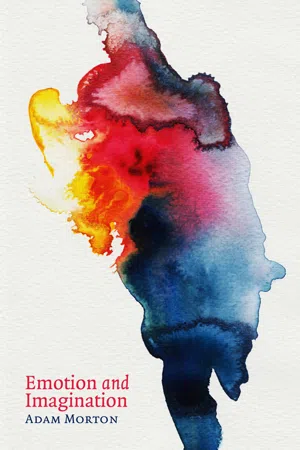
Recent years have seen an enormous amount of philosophical research into the emotions and the imagination, but as yet little work has been done to connect the two. In his engaging and highly original new book, Adam Morton shows that all emotions require some form of imagination and goes on to fully explore the link between these two important concepts both within philosophy and in everyday life.
We may take it for granted that complex emotions, such as hope and resentment, require a rich thinking and an engagement with the imagination, but Morton shows how more basic and responsive emotions such as fear and anger also require us to take account of possibilities and opportunities beyond the immediate situation. Interweaving a powerful tapestry of subtle argument with vivid detail, the book highlights that many emotions, more than we tend to suppose, require us to imagine a situation from a particular point of view and that this in itself can be the source of further emotional feeling. Morton goes on to demonstrate the important role that emotions play in our moral lives, throwing light on emotions such as self-respect, disapproval, and remorse, and the price we pay for having them. He explores the intricate nature of moral emotions and the challenges we face when integrating our thinking on morality and the emotions.
This compelling and thought-provoking new book challenges many assumptions about the nature of emotion and imagination and will appeal to anyone seeking a deeper understanding of the role that these concepts play in our lives. The book also has far reaching implications that will spark debate amongst scholars and students for some time to come.
- English
- ePUB (mobile friendly)
- Available on iOS & Android
eBook - ePub
Emotion and Imagination
About this book
Information
Part I
The range of emotions
Refined emotions
We refine our emotions. From the rough sludge that comes naturally to us we distil the whole varied range of feelings that we can have, including some that are rare and delicate and some that are crude essential fuel. A central factor here is the relation between emotion and imagination. The central aim of this book is to explain the close link between the two, and how this allows us to have the wide range of emotions that we do, enabling us to direct ourselves towards emotions that fit our situations.
All emotion involves imagination. This is true of the basic emotions we share with mice, as well as the sophisticated and finely differentiated emotions that test the limits of our capacities to express ourselves in words and to relate to one another in complicated social projects. Or so I claim, and defend at some length. The claim may seem strange, since we think of emotion as common to animals of many kinds, while we may think of imagination as depending on human intellect and social sense. No – a fearful mouse imagines the dangers facing her, and people can imagine in ways that need little refined human capacity. The point can be put in a more cautious and less direct way. ‘Emotion’ and ‘imagination’ are both very loose words. Both can cover things that have little in common: the hope that your grandchild will behave herself on her birthday, and the foul mood with which you wake up on yours; the thought of how gold prices may react to a change in the property market, and the anticipation of how this spoonful of soup will taste in a moment. So in discussing them we will find ourselves tidying up their boundaries and making some arbitrary distinctions. The more cautious claim is then that we can draw the boundaries of emotion and imagination so that they fit together in a nice coherent jigsaw, one that is true both to the facts as we know them and to our experience as emoters and imaginers.
In defining the boundaries and arguing that the fit is a good one, I will appeal to imagination as well as to fact. That makes this an imaginative book on imagination: I ask readers to follow stories and consider the emotions they would feel in possible scenarios, and how they would describe them. (Of course, evidence, analysis, and argument are essential too. The notes at the end of the book have references to relevant empirical work, and to other authors and sources I am drawing on.) In imagining emotions, you will come to appreciate more how imagination and emotion fit. This method is inevitable, given my aim and given how little we know about many of the relevant areas. I am sure that people’s fundamental attitudes are affected more by their emotions and experiences than by argument, so telling stories and evoking reactions gives me a chance of influencing my readers more deeply. But it does have dangers, some of which are brought into focus by following the method itself. In particular, the section ‘Imagining invented characters: fiction and philosophy’, in part II, discusses the danger that in philosophy and everyday life, as in fiction, we may imagine emotions that simply do not exist.
One result of distillation is the emotions that are central to our moral lives. Not that all of these are very refined: simple moral outrage is not that far removed from anger and disgust. The emotions of morality play a large role in the later parts of this book. To give a taste of those later parts now, here is a curious question about the persistence of sludge. Imagine a good person, who has emotions helping her generally to do the right thing. She is upset by the sufferings of homeless people, appalled by the self-indulgence of some young professionals, disapproving of cruelty to animals, and proud of her ability to balance her obligations to her family against the demands of generosity to others. What you might expect. Now ask whether there are less admirable emotions that could easily accompany, support, and fit with emotions like those I have listed.
It might seem that we would need to know a lot about this person’s psychology, and perhaps a lot about the psychology of human moral behaviour in general, to say anything helpful. But consider the following list of soiled moral emotions: smugness, self-satisfaction, sanctimoniousness, and those associated with hypocrisy, priggery, prudery, selective moral blindness. There’s quite a long list: they are epithets thrown by the rest of the world at those whose self-conception centres on morality. None of these describe emotions that our person has to have. But they are labels that can be hard for her to avoid, as they connect so closely to the valuable emotions I have listed. In later sections I describe systematic ways in which morally focused people can become prey to these emotions. You might take this as undermining moral pretensions. I prefer to think of it as a stab at how to take seriously issues of what we ought to do and feel while avoiding some of the traps that accompany being someone who thinks about their responsibilities.
Consider our person’s morally more relaxed cousin (‘backsliding’, ‘irresponsible’, she will say). Suppose that, tired of being compared to his disadvantage with his cousin, he describes her as smug. How can she defend herself? It is true that she thinks that she has done the right thing on many occasions when others have not. It is true that she thinks that he lacks some qualities that people ought to have and that she by chance or control does exhibit. And are these thoughts not smugness? For all that she may protest that she knows she is not perfect, and that she values him as another flawed human being, she cannot deny that she thinks that there is something wrong with him that is a lot less wrong with herself. So the charge is hard to evade.
Hard to evade, but not impossible. The relaxed cousin is pointing to thoughts that our good person almost certainly thinks. But thoughts are not emotions, so he has not yet shown that she feels smug or self-satisfied. He has a point, though. The emotions of a conscientious person will generate a pressure, as I say below, to these thoughts, and the thoughts create a pressure to smugness. More is needed for smugness, and I discuss this extra content later, in parts III and IV. But there does seem to be a facilitating relation between the emotions. Feeling disapproval of others and feeling morally satisfied towards oneself dispose one to smugness. Virtue has its dangers. There is more to say about this.
Imagining in emotion
When we fear something, we often imagine awful possibilities involving it. And at a more fundamental level we prepare for such possibilities and are alert for more. We look over our shoulders. When we are angry at someone, we have vivid quarrels with them in our minds. When we feel guilty, we create an imaginary accuser who points an imaginary finger. The imagining can take many forms, from vivid mental images to simple verbal thoughts to preparedness for perception and action. If you think imagination needs images, you may think that there is often no imagining at all. But on my approach to imagination, images and words are just one way in which we can grasp possibilities that might be important. This allows a close connection between emotion and imagination.
When we imagine, we represent something to ourselves: a fact, a thing, or a possibility. Sometimes we make a mental picture of it and examine the picture, turning it around and trying different approaches to it. Sometimes all we are aware of is thoughts about what we are imagining; sometimes we are not aware of anything, as when you are confused during your first walk in the southern hemisphere: you had not been aware that you expected the sun to travel clockwise, and that your sense of the way morning turns to afternoon depended on it. Imagination is a process rather than a result, something people do rather than something they get or experience. It is a process of searching for representations suitable for a specific purpose. Pictures and verbal descriptions are all-purpose representations and can be used in many kinds of thinking. The representations I am concerned with are purpose-specific. For example, you are holding a baby on your right hip while walking towards a step; you move your left hand over to steady the right wrist around the baby while changing your stride so that you come up to the step with the baby well supported. No words or pictures cross your mind, but you prepare for a very particular possibility, stumbling so the baby slips. I will say that you imagined this possibility and were apprehensive about it. You searched for ways of coping with the feared situation and found one, ending up in a state in which you were ready to notice the danger and ready to counteract it. This is why I am happy to assume that non-humans imagine, taking imagination to be a purposeful relation to a possibility, rather than images or words. A mouse imagines the cat that might be around the corner.
When we imagine, we are trying to achieve something with the representation, trying to get it to do some job. So if you are trapped in a building and thinking, imaginatively, how to get out, you mentally walk down one way and then another, hoping to find an exit. You are not representing the hallways and staircases in just any way, but making yourself attend to those features which are relevant to escape. The same is true if it all happens in words. You are going to a meeting where you expect someone will make an attack on your motives in supporting a project and you are considering how to reply. You think of various things the person might say and you turn them over in your mind, looking for flaws and openings for replies. You are not just thinking about what she might say but thinking of it in a certain light. If you find yourself representing her opinion as the interesting or informative one, you suspend that line and try another, which allows you to represent it as vulnerable or flawed. Almost all imagining has a purpose.
We can imagine actions as well as scenes and events. Of course we can picture what we intend to do and what might result, and we can describe these in words. But we can also form representations of the actions we are going to perform, as actions. That is, we can keep copies in our minds of the instructions we will send to our bodies if and when we perform an action. The standard example of this is planning to grasp an object of a particular shape. Before doing this you prepare by readying your control of your fingers to take the positions they will need. The fingers may not move and the muscles may not even tense, but the neural preparations for tensing and moving are ready. There can be some conscious awareness of this pre-movement, but typically much of it is unconscious. We not only represent the instructions we may send to our bodies, but we plan whole sequences of actions, together with anticipations of the sensations that will guide them and the feedback from muscles and limb-position sensors that may occur. We do this routinely. The easiest way to convince yourself in an intuitive unscientific way that this is so is to think of planning a complex action that will have to be performed quickly. You are beginning a ski run and you will have to turn at a particular pole, or you are planning to cycle along a narrow winding path, or you are preparing to dart your hand into a fireplace and retrieve a piece of paper that has fallen near the flames.
In cases like this, one has a sense of doing the action before doing it. Sometimes one rehearses the action mentally to get it more nearly right before launching the actual deed, and sometimes one just anticipates and then acts. In both cases it feels as if a model of the action has occurred mentally before the bodily action. Now this is one’s sense of what it is like to act, which can be very different from what in fact happens. But there is also experimental evidence that we do form ‘motor images’, which are part of a complex integration of motor control, proprioception (our information about what our limbs are doing), and sensation.
Representations of actions are important for my purposes because they are at the heart of many emotions. You see a movie in which a child is being beaten and you have an impulse to reach out and shield him. Aggressive dogs behind a solid fence rush barking towards the fence as you walk by, and though you keep to your path you can feel your impulse to get away. A person with an abusive boss develops back problems, which are diagnosed as a reaction to her unconscious rage, and the suppressed impulses to violent action that it motivated. Of course you can represent an action for many reasons, not just in connection with an emotion. Emotions make us focus on the representation rather than the action because often, as in the cases just described, the action is not performed. In fact, the presence of a variety of representations of action, together with other representations, is essential to emotions.
Images do not make an experience into imagination. Nor do auditory experiences, nor do as-if actions. As I am using the term it is not imagination unless representations are being made and searched through in order to meet some criterion: the organism is doing something that makes it more likely that it will make some possibilities real and take note of other possibilities. Suppose that a very vivid image of your childhood home flashes into your mind, seen from behind the back porch at about two in the afternoon. You are not imagining it but remembering it or having a flashback of it. You wonder how you could have got up the steps and through the door pulling a toboggan, and you mentally approach the porch from various angles and see the outer and inner doors swing open in various angles and sequences. Then you are imagining, once you are doing something with the representations.
It is also worth pointing out that it is not a simple matter what is being imagined. Suppose that there was a picture above your bed as a child that you always thought was your grandmother. Sometimes you put yourself to bed and had no story or goodnight kiss, and then you would imagine that woman coming out of the picture, giving you a hug and whispering a short reminiscence from her life. You do not imagine her being grandmotherly, and in fact you have no information about your grandmothers, but just as being as she is in the picture, and being nice to you. You think that you were imagining your grandmother putting you to bed, but in fact the picture was of her sister, so you were imagining your great-aunt. Cases like this show that the content of imagination is often not transparent to the person who is imagining. This is also so when the imagining is unconscious. Suppose, to add to this series of imagination-describing imaginative exercises, that you are warned to be careful in dealing with the meter reader, who is short-tempered and potentially violent. The electric company truck stops outside your house and there is a knock at the door. You open the door, keeping it on the latch, and then have to look three times to see the meter reader, who is a small young woman. With a shock you realize that you have been mentally preparing for an encounter with a large middle-aged man. Between the warning and the meeting you have been imagining without knowing it.
Imagination, as I have been describing it, is in some ways rather like emotion. It pushes in a certain direction; it is going to a particular end. So the frightened mouse that anticipates carnivores leaping from unexpected places is imagining them, probably as inaccurately as we imagine many of the fates that await us, by setting in place a structure of responses to possible threats. When a plant moves, the mouse is prepared to freeze, smell, listen; her motor control is preparing to dash for shelter. This is like you in the meter reader case, when you half-open the door, prepared to see a heavy boot inserted to jam it open, and find your shoulder ready to jam the door shut, all without any images or words passing through your consciousness. The mouse and you are producing representations of possible situations, in order to be prepared for trouble.
Imagining is unlike emotion too, in a way that suggests how the two fit together. We can imagine very specific things, such as the story that a bore may tell us for the hundredth time or the path that leads from the washroom to the back door. These are different acts of imagination, though someone could perform them simultaneously. You would, if you were dreading that Uncle George might corner you and tell you the story yet again and you were thinking of ways you could escape before he had the chance. Emotions directed at a topic will drive imagination of associated facts, possibilities, and actions. They have many of their powers by driving, pressuring, us to imagine, and imagination is important in part because it expresses and responds to our emotions.
Here is what I take to be essential to emotions. An emotion is a state which generates a range of representations on a given theme, usually with respect to particular objects. These include representations of actions towards the objects, representations of situations that might develop, and representations of results that might be produced. It is crucial that the representations concern both facts and actions. Emotions are like little belief–desire packages, with linked effects on how one interprets the environment and how one acts towards it. This is why a single emotion can serve as a short-cut version of a complex system of motives. The range of representations is held together by the theme. For example, a person feels horror at seeing a kitten killed by a dog. She represents ways she might have intervened, though she did not, and represents the kitten safe. She represents the actions of impulsively not observing the scene. She represents the scene itself, emphasizing its more disturbing moments. She replays her experience leading up to the event, comparing it to possible variations that might show it to be an illusion or a dream. Another person feels contempt for a colleague. He represents the colleague’s actions in comparison with better alternatives; he represents crudely humiliating actions that he does not take, and more subtle dismissals, some of which he may actually act on. He thinks of how he would have done duties that he takes the other to have bungled, and he emphasizes unsatisfactory aspects of the colleague’s performance.
Think of simple fear and anger, where representations of running away or attacking are combined with representations of the harm that the feared object might do or damage that might be done to the object of the anger. Some of these representations, for example those of means of escape and what one would have to do to take them, are very primitive and are similar to those of other creatures with which we share our basic emotions. We all have certain basic motivational packages that we use when the environment provides an appropriate theme.
In all of these we have a large range of representations, in which representations of actions and representations of situations are tied together by the theme of the emotion. Many of the representations are exploratory, such as various ways of escaping a threat, or hypothetical, such as kinds of harm that could come from a worrying situation. Many of them are anticipations of possible developments in the situation as it is, and thus represent dispositions to interpret the situation: the innocuous person who reveals a nasty agenda, the half-seen corridor that leads outside. There is no single representation that must accompany any emotion: a person who fears a stranger may imagine the stranger attacking her, or imagine herself running away with the person in pursuit. Many of the situations represented have little relation to the beliefs and desires that govern the person’s deliberate actions: the terrify...
Table of contents
- Cover
- Half Title
- Title
- Copyright
- Content
- Preface
- Part I The range of emotions
- Part II Imagining vile emotions
- Part III Memotions
- Part IV Families of emotions
- Notes
- References
- Index
Trusted by 375,005 students
Access to over 1.5 million titles for a fair monthly price.
Study more efficiently using our study tools.
Frequently asked questions
Yes, you can cancel anytime from the Subscription tab in your account settings on the Perlego website. Your subscription will stay active until the end of your current billing period. Learn how to cancel your subscription
No, books cannot be downloaded as external files, such as PDFs, for use outside of Perlego. However, you can download books within the Perlego app for offline reading on mobile or tablet. Learn how to download books offline
Perlego offers two plans: Essential and Complete
- Essential is ideal for learners and professionals who enjoy exploring a wide range of subjects. Access the Essential Library with 800,000+ trusted titles and best-sellers across business, personal growth, and the humanities. Includes unlimited reading time and Standard Read Aloud voice.
- Complete: Perfect for advanced learners and researchers needing full, unrestricted access. Unlock 1.5M+ books across hundreds of subjects, including academic and specialized titles. The Complete Plan also includes advanced features like Premium Read Aloud and Research Assistant.
We are an online textbook subscription service, where you can get access to an entire online library for less than the price of a single book per month. With over 1.5 million books across 990+ topics, we’ve got you covered! Learn about our mission
Look out for the read-aloud symbol on your next book to see if you can listen to it. The read-aloud tool reads text aloud for you, highlighting the text as it is being read. You can pause it, speed it up and slow it down. Learn more about Read Aloud
Yes! You can use the Perlego app on both iOS and Android devices to read anytime, anywhere — even offline. Perfect for commutes or when you’re on the go.
Please note we cannot support devices running on iOS 13 and Android 7 or earlier. Learn more about using the app
Please note we cannot support devices running on iOS 13 and Android 7 or earlier. Learn more about using the app
Yes, you can access Emotion and Imagination by Adam Morton in PDF and/or ePUB format, as well as other popular books in Philosophy & Philosophy History & Theory. We have over 1.5 million books available in our catalogue for you to explore.