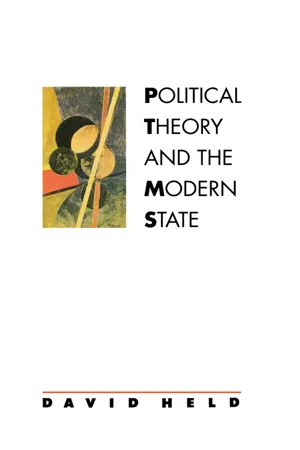
Political Theory and the Modern State is an ideal resource for students seeking an introduction to modern politics and political sociology. It is also an original statement about the many competing perspectives in political thought today.
- English
- ePUB (mobile friendly)
- Available on iOS & Android
eBook - ePub
Political Theory and the Modern State
About this book
This volume offers an incisive overview of central issues and controversies in political thought and analysis. It includes major discussions of the idea of the modern state, contemporary theories of the state, problems of power and legitimation, new forms of democratic ideal, citizenship and social movements, the direction of public policy and the fate of sovereignty in the modern global system. While analysing these topics, the author critically assesses the thought of many of those who have contributed decisively to political discussion. Among those whose works are discussed are classic figures such as Hobbes, Locke, Mill and Marx, as well as contemporary writers such as Habermas, Offe and Giddens.
Information
1
Central Perspectives on the Modern State
The state – or apparatus of ‘government’ – appears to be everywhere, regulating the conditions of our lives from birth registration to death certification. * Yet the nature of the state is hard to grasp. This may seem peculiar for something so pervasive in public and private life, but it is precisely this pervasiveness which makes it difficult to understand. There is nothing more central to political and social theory than the nature of the state, and nothing more contested. It is the objective of this essay to set out some of the key elements of the conflict of interpretation.
In modern Western political thought, the idea of the state is often linked to the notion of an impersonal and privileged legal or constitutional order with the capability of administering and controlling a given territory (see Skinner, 1978; cf., Neumann, 1964). This notion found its earliest expression in the ancient world (especially in Rome) but it did not become a major object of concern until the early development of the European state system from the sixteenth century onwards. It was not an element of medieval political thinking. The idea of an impersonal and sovereign political order, that is, a legally circumscribed structure of power with supreme jurisdiction over a territory, could not predominate while political rights, obligations and duties were closely tied to property rights and religious tradition. Similarly, the idea that human beings as ‘individuals’ or as ‘a people’ could be active citizens of this order – citizens of their state – and not merely dutiful subjects of a monarch or emperor could not develop under such conditions.
The historical changes that contributed to the transformation of medieval notions of political life were immensely complicated. Struggles between monarchs and barons over the domain of rightful authority; peasant rebellions against the weight of excess taxation and social obligation; the spread of trade, commerce and market relations; the flourishing of Renaissance culture with its renewed interest in classical political ideas (including the Greek city-state and Roman law); the consolidation of national monarchies in central parts of Europe (England, France and Spain); religious strife and the challenge to the universal claims of Catholicism; the struggle between church and state – all played a part.1 As the grip of feudal traditions and customs was loosened, the nature and limits of political authority, law, rights and obedience emerged as a preoccupation of European political thought. Not until the end of the sixteenth century did the concept of the state become a central object of political analysis.
While the works of Niccolo Machiavelli (1469–1527) and Jean Bodin (1530–96) are of great importance in these developments, Thomas Hobbes (1588–1679) directly expressed the new concerns when he stated in De Cive (1642) that it was his aim ‘to make a more curious search into the rights of states and duties of subjects’ (quoted in Skinner, 1978, vol. 2, p. 349). Until challenged by, among others, Karl Marx in the nineteenth century, the idea of the modern state came to be associated with a ‘form of public power separate from both the ruler and ruled, and constituting the supreme political authority within a certain defined boundary’ (Skinner, 1978, vol. 2, p. 353). But the nature of that public power and its relationship to ruler and ruled were the subject of controversy and uncertainty. The following questions arose: What is the state? What should it be? What are its origins and foundations? What is the relationship between state and society? What is the most desirable form this relationship might take? What does and should the state do? Whose interest does and should the state represent? How might one characterize the relations among states?
This essay focuses on four strands or traditions of political analysis which sought to grapple with such questions: (1) liberalism, which became absorbed with the question of sovereignty and citizenship; (2) liberal democracy, which developed liberalism’s concerns while focusing on the problem of establishing political accountability; (3) Marxism, which rejected the terms of reference of both liberalism and liberal democracy and concentrated upon class structure and the forces of political coercion; and (4), for want of a more satisfactory term, political sociology, which has, from Max Weber to Anglo-American pluralism and ‘geopolitical’ conceptions of the state, elaborated concerns with both the institutional mechanisms of the state and the system of nation-states more generally. None of these traditions of analysis, it should be stressed, forms a unity; that is to say, each is a heterogeneous body of thought encompassing interesting points of divergence. There is also some common ground, more noticeable in the work of contemporary figures, across these separate traditions. I shall attempt to indicate this briefly throughout the essay and in my concluding remarks. It is important to appreciate that, in a field in which there is as vast a range of literature as this, any selection has an arbitrary element to it. But I hope to introduce, and assess in a preliminary way, some of the central perspectives on the modern state.
A distinction is often made between normative political theory or political philosophy on the one hand, and the descriptive-explanatory theories of the social sciences on the other. The former refers to theories about the proper form of political organization and includes accounts of such notions as liberty and equality. The latter refers to attempts to characterize actual phenomena and events and is marked by a strong empirical element. The distinction, thus, is between theories which focus on what is desirable, what should or ought to be the case, and those that focus on what is the case. The political writings of people like Hobbes, Locke and Mill are generally placed in the first camp, while those of, for instance, Weber are put in the second; Marx occupying sometimes one domain, sometimes the other, depending on the writings one examines. But it will become clear that, while this distinction should be borne in mind, it is hard to use it as a classificatory device for theories of the state. For many political philosophers see what they think the state ought to be like in the state as it is. Social scientists, on the other hand, cannot escape the problem that facts do not simply ‘speak for themselves’: they are, and they have to be, interpreted; and the framework we bring to the process of interpretation determines what we ‘see’, what we notice and register as important.
The essay begins with the thought of Hobbes, which marks a point of transition between a commitment to the absolutist state and the struggle of liberalism against tyranny. It is important to be clear about the meaning of ‘liberalism’ (see Habermas, 1962; Pateman, 1979). While it is a highly controversial concept, and its meaning has shifted historically, I will use it here to signify the attempt to define a private sphere independent of the state and thus to redefine the state itself, that is, the freeing of civil society – personal, family and business life – from political interference and the simultaneous delimitation of the state’s authority. With the growing division between the state and civil society, a division which followed the expansion of market economies, the struggle for a range of freedoms and rights which were in principle to be universal became more acute. Gradually, liberalism became associated with the doctrine that freedom of choice should be applied to matters as diverse as marriage, religion, economic and political affairs – in fact, to everything that affected daily life (see Macpherson, 1966, ch. 1; cf. Giddens, 1981, chs 8 and 9). Liberalism upheld the values of reason and toleration in the face of tradition and absolutism (see Dunn, 1979, ch. 2). In this view, the world consists of ‘free and equal’ individuals with natural rights. Politics should be about the defence of the rights of these individuals – a defence which must leave them in a position to realize their own capacities. The mechanisms for regulating individuals’ pursuit of their interests were to be the constitutional state, private property, the competitive market economy – and the distinctively patriarchal family. While liberalism celebrated the rights of individuals to ‘life, liberty and property’, it should be noted from the outset that it was generally the male property-owning individual who was the focus of so much attention; and the new freedoms were first and foremost for the men of the new middle classes or the bourgeoisie. The Western world was liberal first, and only later, after extensive conflicts, liberal democratic or democratic; that is, only later was a universal franchise won which allowed all mature adults the chance to express their judgement about the performance of those who govern them (Macpherson, 1966, p. 6). But even now, the very meanings of the terms ‘liberalism’ and ‘democracy’ remain unsettled.
Sovereignty, citizenship and the development of liberalism
Hobbes was among the first to try to grasp the nature of public power as a special kind of institution – as he put it, an ‘Artificiall Man’, defined by permanence and sovereignty, the authorized representative ‘giving life and motion’ to society and the body politic (Leviathan, p. 81). He was preoccupied, above all, with the problem of order, which resolved itself into two questions: Why is ‘a great Leviathan or state’ necessary? and What form should the state take? Through a theory of human nature, sovereign authority and political obligation, he sought to prove that the state must be regarded as ultimately both absolute and legitimate, in order that the worst of evils – civil war – might be permanently averted (see Plamenatz, 1963, pp. 116–54).
In so arguing, Hobbes produced a political philosophy which is a fascinating point of departure for reflection on the modern theory of the state; for it is at once a profoundly liberal and illiberal view (see Dunn, 1979, pp. 23, 42–3, 50; cf. Skinner, 1966). It is liberal because Hobbes derives or explains the existence of society and the state by reference to ‘free and equal’ individuals, the component elements, according to him, of social life – ‘men as if but even now sprung out of the earth and suddenly, like mushrooms, come to full maturity, without all kind of engagement to each other’ (De Cive, p. 109). It is liberal because Hobbes is concerned to uncover the best circumstances for human nature – understood as naturally selfish, egoistical and self-interested – to find expression. And it is liberal because it emphasizes the importance of consent in the making of a contract or bargain, not only to regulate human affairs and secure a measure of independence and choice in society, but also to legitimate, that is, justify, such regulation. Yet Hobbes’s position is also, as I shall attempt to show, profoundly illiberal: his political conclusions emphasize the necessity of a practically all-powerful state to create the laws and secure the conditions of social and political life. Hobbes remains of abiding interest today precisely because of this tension between the claims of individuality on the one hand, and the power requisite for the state to ensure ‘peaceful and commodious living’, on the other (cf. Macpherson, 1968, p. 81; or for a fuller account Macpherson, 1962).
In Leviathan (1651), Hobbes set out his argument in a highly systematic manner. Influenced by Galileo, he was concerned to build his ‘civil science’ upon clear principles and closely reasoned deductions. He started from a set of postulates and observations about human nature. Human beings, Hobbes contended, are moved by desires and aversions which generate a state of perpetual restlessness. Seeking always ‘more intense delight’, they are profoundly self-interested; a deep-rooted psychological egoism limits the possibilities for human cooperation. In order to fulfil their desires, human beings (though in different ways and degrees) seek power. And because the power gained by one ‘resisteth and hindreth the power of another’, conflicts of interest are inevitable: they are a fact of nature. The struggle for power, for no other reason than self-preservation and self-interest (however disguised by rationalization) defines the human condition. Hobbes thus emphasizes ‘a generall inclination of all mankind, a perpetuall and restlesse desire of Power after power, that ceaseth only in Death’ (Leviathan, p. 161). The idea that human beings might come to respect and trust one another, treat each other as if they could keep promises and honour contracts, seems remote indeed.
Hobbes desired to show, however, that a consistent concern with self-interest does not simply lead to an endless struggle for power (see Peters, 1956, ch. 9; 1967, pp. 41–3). In order to prove this he introduced a ‘thought experiment’ employing four interrelated concepts: state of nature, right of nature, law of nature and social contract. He imagined a situation in which individuals are in a state of nature – that is, a situation without a ‘Common Power’ or state to enforce rules and restrain behaviour – enjoying ‘natural rights’ to use all means to protect their lives and to do whatever they wish, against whoever they like and to ‘possess, use, and enjoy all that he would, or could get’ (see Leviathan, part 1, chs 13–15). The result is a constant struggle for survival: Hobbes’s famous ‘Warre of every one against every one’. In this state of nature individuals discover that life is ‘solitary, poore, nasty, brutish and short’ and, accordingly, that to avoid harm and the risk of an early death, let alone to ensure the conditions of greater comfort, the observation of certain natural laws or rules is required (Leviathan, ch. 13). The latter are things the individual ought to adhere to in dealings with others if there is sufficient ground for believing that others will do likewise (see Plamenatz, 1963, pp. 122–32, for a clear discussion of these ideas). Hobbes says of these laws that ‘they have been contracted into one easy sum, intelligible even to the meanest capacity; and that is, Do not that to another which thou wouldest not have done to thyself’ (see Leviathan, chs 14 and 15). There is much in what he says about laws of nature that is ambiguous (above all, their relation to the ‘will of God’), but these difficulties need not concern us here. For the key problem, in Hobbes’s view, is: under what conditions will individuals trust each other enough to ‘lay down their right to all things’ so that their long-term interest in security and peace can be upheld? How can individuals make a bargain with one another when it may be, in certain circumstances, in some people’s interest to break it? An agreement between people to ensure the regulation of their lives is necessary, but it seems an impossible goal.
His argument, in short, is as follows: if individuals surrender their rights by transferring them to a powerful authority which can force them to keep their promises and covenants, then an effective and legitimate private and public sphere, society and state, can be formed. Thus the social contract consists in individuals handing over their rights of self-government to a single authority – thereafter authorized to act on their behalf – on the condition that every individual does the same. A unique relation of authority results: the relation of sovereign to subject. A unique political power is created: the exercise of sovereign power or sovereignty – the authorized (hence rightful) use of power by the person or assembly established as sovereign.2 The sovereign’s subjects have an obligation and duty to obey the sovereign; for the position ‘sovereign’ is the product of their social contract, and ‘sovereignty’ is above all a quality of the position rather than of the person who occupies it. The contract is a once-and-for-all affair, creating an authority able to determine the very nature and limits of the law. There can be no conditions placed on such authority because to do so would undermine its very raison d’être.
The sovereign has to have sufficient power to make agreements stick, to enforce contracts and to ensure that the laws governing political and economic life are upheld. Power must be effective. Since, in Hobbes’s view, ‘men’s ambitions, avarice, anger and other passions’ are strong, the ‘bonds of words are top weak to bridle them . . . without some fear of coercive power’ (see Leviathan, ch. 14). In short: ‘covenants, without the sword, are but words, and of no strength to secure a man at all’ (Leviathan, p. 223). Beyond the sovereign state’s sphere of influence there will always be the chaos of constant warfare; but within the territory controlled by the state, with ‘fear of some coercive power’, social order can be sustained.
It is important to stress that, in Hobbes’s opinion, while sovereignty must be self-perpetuating, undivided and ultimately absolute, it is established by the authority conferred by the people (Leviathan, pp. 227–8). The sovereign’s right of command and the subjects’ duty of obedience is the result of consent – the circumstances individuals would have agreed to if there had actually been a social contract. Although there is little about Hobbes’s conception of the state which today we would call representative, he argues in fact that the people rule through the sovereign. The sovereign is their representative: ‘A Multitude of men, are made One Person, when they are by one man, or one Person, Represented’ (Leviathan, p. 220). Through the sovereign a plurality of voices and interests can become ‘one will’, and to speak of a sovereign state assumes, Hobbes held, such a unity. Hence, his position is at one with all those who argue for the importance of government by consent and reject the claims of the ‘divine right of Kings’ and, more generally, the authority of tradition. Yet, his conclusions run wholly counter to those who often take such an argument to imply the necessity of some kind of popular sovereignty or democratic representative government (cf. Peters, 1956, ch. 9). Hobbes was trying to acknowledge, and persuade his contemporaries to acknowledge, a full obligation to a sovereign state. As one commentator usefully put it:
Hobbes was not asking his contemporaries to make a contract, but only to ackn...
Table of contents
- Cover Page
- Title Page
- Copyright
- Contents
- Preface
- Introduction
- 1 Central Perspectives on the Modern State
- 2 Class, Power and the State
- 3 Legitimation Problems and Crisis Tendencies
- 4 Power and Legitimacy
- 5 Liberalism, Marxism and the Future Direction of Public Policy
- 6 The Contemporary Polarization of Democratic Theory: The Case for a Third Way
- 7 Citizenship and Autonomy
- 8 Sovereignty, National Politics and the Global System
- 9 A Discipline of Politics?
- Index
Trusted by 375,005 students
Access to over 1.5 million titles for a fair monthly price.
Study more efficiently using our study tools.
Frequently asked questions
Yes, you can cancel anytime from the Subscription tab in your account settings on the Perlego website. Your subscription will stay active until the end of your current billing period. Learn how to cancel your subscription
No, books cannot be downloaded as external files, such as PDFs, for use outside of Perlego. However, you can download books within the Perlego app for offline reading on mobile or tablet. Learn how to download books offline
Perlego offers two plans: Essential and Complete
- Essential is ideal for learners and professionals who enjoy exploring a wide range of subjects. Access the Essential Library with 800,000+ trusted titles and best-sellers across business, personal growth, and the humanities. Includes unlimited reading time and Standard Read Aloud voice.
- Complete: Perfect for advanced learners and researchers needing full, unrestricted access. Unlock 1.5M+ books across hundreds of subjects, including academic and specialized titles. The Complete Plan also includes advanced features like Premium Read Aloud and Research Assistant.
We are an online textbook subscription service, where you can get access to an entire online library for less than the price of a single book per month. With over 1.5 million books across 990+ topics, we’ve got you covered! Learn about our mission
Look out for the read-aloud symbol on your next book to see if you can listen to it. The read-aloud tool reads text aloud for you, highlighting the text as it is being read. You can pause it, speed it up and slow it down. Learn more about Read Aloud
Yes! You can use the Perlego app on both iOS and Android devices to read anytime, anywhere — even offline. Perfect for commutes or when you’re on the go.
Please note we cannot support devices running on iOS 13 and Android 7 or earlier. Learn more about using the app
Please note we cannot support devices running on iOS 13 and Android 7 or earlier. Learn more about using the app
Yes, you can access Political Theory and the Modern State by David Held,David Held in PDF and/or ePUB format, as well as other popular books in Politik & Internationale Beziehungen & Geschichte & Theorie der Politik. We have over 1.5 million books available in our catalogue for you to explore.