Spike Lee has directed, written, produced, and acted in dozens of films that present an expansive, nuanced, proudly opinionated, and richly multifaceted portrait of American society. As the only African-American filmmaker ever to establish a world-class career, Lee has paid acute attention to the experiences of racial and ethnic minorities. But white men and women also play important roles in his movies, and his interest in class, race, and urban life hasn't prevented his films from ranging over broad swaths of the American scene in stories as diverse as the audiences who view them. His defining trait is a willingness to raise hard questions about contemporary America without pretending to have easy answers; his pictures are designed to challenge and provoke us, not ease our minds or pacify our emotions. The opening words of his 1989 masterpiece Do the Right Thing present his core message in two emphatic syllables: "Wake up!"
Spike Lee's America is a vibrant and provocative engagement not only with the work of a great filmmaker, but also with American society and politics.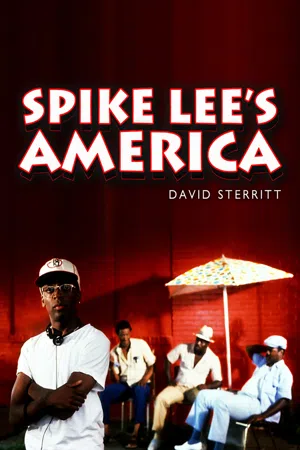
- English
- ePUB (mobile friendly)
- Available on iOS & Android
eBook - ePub
Spike Lee's America
About this book
Information
1
THE EARLY JOINTS
Shelton Jackson Lee, nicknamed Spike by his mother as an infant, entered the world in Atlanta on March 20, 1957. His mother was Jacquelyn Shelton Lee, a schoolteacher, and his father was Bill Lee, a musician. Deciding he could have a more successful career if he lived in Chicago, the “jazz Mecca” of the period, Bill Lee moved the family there, and then joined the throng of jazz musicians who relocated to New York in the late fifties. Putting down stakes in Brooklyn, the family settled first in Crown Heights, then in Cobble Hill – where they were the first African-Americans to live – and then in Fort Greene, a neighborhood seen by many outsiders at that time as less than desirable, if not actually dangerous or disreputable. Spike’s mother was an important influence on his childhood, exposing him and his siblings to mainstream and African-American culture by way of books, plays, museums, and art exhibitions.
Music was an important part of the picture as well, and Spike sometimes heard his father play the bass at the Blue Note and other New York clubs. His three younger siblings – sister Joie, born in 1962, and brothers David and Cinqué, born in 1961 and 1966 – went to Saint Ann’s School in Brooklyn, a predominantly white private institution where their mother had become the first African-American teacher. Ever independent, though, Spike had already chosen to attend the John Dewey High School, a public school in the Coney Island neighborhood of Brooklyn with a largely black student body. Ever consistent, moreover, after graduating in 1975 he enrolled at the historically black, all-male Morehouse College in Atlanta, where his grandfather and father (a classmate of Martin Luther King Jr. there) had gone. His tuition was paid by his grandmother, Zimmie Shelton, an alumna of the all-female Spelman College across the street from Morehouse, which Spike’s mother had also attended.
SPIKE STARTS OUT
Seeing a lot of movies for diversion after his mother’s sudden death in 1977, Spike became seriously interested in the possibilities of film for the first time. “I had gotten a Super 8 camera,” he recalled later, “so I spent the whole summer just going around New York City and filming stuff. That was really when I decided that I wanted to be a filmmaker” (Lindo 165). Back at Morehouse with two years still to go for his degree in mass communication, he continued his experiments and made Last Hustle in Brooklyn, his debut short, before graduating in 1977. Returning to New York, he put an official stamp on his commitment to film, becoming one of very few black students in the graduate film program of the Tisch School of the Arts at New York University, where he spent three years earning an MFA in production. He was not overly fond of NYU, to put it delicately: professors there questioned his grasp of “film grammar,” and he sensed an unspoken racial bias in their criticisms. “Any time a black person is in a white environment,” he remarked later, “and they are not always happy – smiling, eating cheese [ – ] then [others] say he’s a militant or has an attitude.” His first-year film, The Answer (1980), did not change that impression. Discussing it with Nelson George, an African-American critic, Lee described it as the story of “a black screenwriter hired to direct a fiftymillion-dollar remake of Birth of a Nation. We included clips from Birth of a Nation. They didn’t like that thing at all. How dare I denigrate the father of cinema, D.W. Griffith?” George responded by observing that The Answer indicts Griffith’s epic Civil War movie as a “racist” work, which of course it is, and Lee replied, “Yeah. No shit, Sherlock.” George further observed that the film must have “offended” people to elicit such negative responses, and Lee answered, “Yeah. I didn’t care” (Lee 1987, 33–4).
In sum, Lee was ready from the start to work against the grain of mainstream white cinema. Aware that Los Angeles is allegedly the motion-picture capital of the world, he dutifully gave it a shot, traveling west and taking an internship at Columbia Pictures, which he soon left for several reasons: he didn’t know how to drive, he “didn’t have the resources [there] to make films,” and he simply “wanted to come home” (Lee 1987, 33–4). The idea of laboring on money-driven projects dreamed up by other people must also have grated on his sensibility.
SPIKE CUTS HEADS
His dissatisfaction with NYU notwithstanding, Lee made three movies while studying there, including his 1983 thesis film, Joe’s Bed-Stuy Barbershop: We Cut Heads, a seminal work that sets forth three important clues to his future career. For one, the movie cuts heads – not in the barbering sense but in the sense of revealing and excising the inherited ideas, reactionary fantasies, and unexamined prejudices that Americans too often carry around in their minds. For another, it taps into areas of interest that Spike has been investigating and building on ever since: humor, gangster films, and “the incorporation of negritude” into a familiar movie genre (Lee 1987, 34). For the third, Joe’s Bed-Stuy Barbershop is very much a New York movie, signaling that Lee’s ongoing analysis of America’s complicated, mercurial character would always be informed by his experiences in that city, the country’s most protean and multifarious urban zone.
Joe’s Bed-Stuy Barbershop centers on Zachariah Homer (Monty Ross), who takes over a barbering business after proprietor Joe (Horace Long) dies in a mob-related hit. Zach fares poorly at “head cutting” and his economic future looks grim until he meets the criminal who had set Joe up in the numbers game, a long-established racket whereby people bet on their predictions of the last three digits of the day’s total racetrack-gambling figure. Learning that his barbershop will now be a base of operations, Zach has to choose between stooping to their level or standing by his principles.
Spike’s decision to make this “semi-gangster” picture was guided partly by the real-world nature of the subject. Numbers-running is a billion-dollar business, he explains in his autobiographical book Spike Lee: That’s My Story and I’m Sticking to It, and it has “always been a key part of the African-American community” (18). Lee also takes the opportunity to revise the blaxploitation and black-mobster genres, taking them in a more humanistic direction, and to profile some of the character types he encountered in Brooklyn on a regular basis. The movie’s attentive portraits of Zach and his social-worker wife, Ruth (Donna Bailey), provided “some of the first sympathetic and detailed glimpses of the borough’s African American faces, personalities, and communities,” in the words of film scholar Paula J. Massood (125), who also notes Lee’s effective use of rap music and break dancing to pinpoint the story’s time and place.
Although the story is set squarely in Brooklyn – at the intersection of Flatbush Avenue and Myrtle Avenue, to be precise – Joe’s Bed-Stuy Barbershop proved anything but parochial in its appeal. It won a student Merit Award from the Academy of Motion Picture Arts and Sciences, shared a prize at a Swiss film festival, and made Spike the first student filmmaker to earn a slot in the highly selective New Directors/ New Films event, presented each year by the Film Society of Lincoln Center and the Museum of Modern Art, two of New York’s most important cultural institutions. Spike acquired an agent at the powerful William Morris Agency on the strength of the film. And he had demonstrated his talent for collaboration, a key ingredient in the filmmaking process: Joe’s Bed-Stuy Barbershop was photographed by Ernest Dickerson, who went on to shoot every Lee picture from She’s Gotta Have It in 1986 to Malcolm X in 1992; the cast included She’s Gotta Have It costar Tommy Redmond Hicks; and the sound was recorded by assistant director Ang Lee, later to become a major American filmmaker in his own right. Spike’s accomplishments with Joe’s Bed-Stuy Barbershop gave his morale a major boost at a time when prospects for African-American cinema – and for his own career in the industry – seemed, as usual, highly uncertain.
BROOKLYN
Woody Allen is provincial about Manhattan, as reflected in his work; and I am provincial about Brooklyn in mine. Maybe one’s [sports] fandom was part of it. Sensibilities must start somewhere. – Spike Lee (Eliot 107)
A winning element in Lee’s filmography is his loyalty to Brooklyn, the city within a city where he grew up, began his career, and maintains his professional nerve center, 40 Acres & A Mule Filmworks, to this day. We should therefore visit Brooklyn before traveling farther into Spike’s America as a whole.
Welcome Back, Kotter (ABC, 1975–9), a popular classroom sitcom starring Gabe Kaplan and John Travolta, started each episode with a montage that included a highway sign reading “Welcome to Brooklyn: 4th Largest City in America.” The boast is still justified. According to the United States Census, more than two and a half million people lived in Brooklyn in 2010, and although projections suggest that Houston, Texas, may acquire the fourth-largest-city title by 2030, for now it is safely in Brooklyn’s hands. All of this comes with the obvious caveat that Brooklyn is not an independent city at all: it is the most populous of the five boroughs that constitute New York City, and the second largest (after Queens, its near neighbor) in geographical size. It is isomorphic with Kings County, one of five counties within New York City, and its population is strikingly diverse. Around 35 percent of its residents are non-Hispanic whites and a slightly smaller percentage – about 877,000 persons – are African-Americans, followed by Hispanics and Latinos at 20 percent, Asians at 10 percent, and others at 2 percent. About 25 percent of Brooklyn’s residents have yearly incomes that place them below the official poverty line.
Fort Greene, the uptown neighborhood where Lee’s family settled, is in northwestern Brooklyn, not far from the Brooklyn Bridge, which connects the borough with Manhattan to the west. Free blacks lived there long before the Civil War – the slaves in New York State were emancipated in 1841 – and during the Civil War period its largely working-class population was joined by upper-class people moving north from downtown, drawn partly by Fort Greene’s reputation for high-grade educational institutions. For about thirty years beginning in the early 1960s, Fort Greene suffered badly from the epidemic of crime, drugs, and poverty that weighed heavily on New York and many other American cities. But reclamation, gentrification, and urban preservation helped the neighborhood regain its footing in the second half of the 1980s, and 40 Acres & A Mule, founded in 1986, was a pioneer in this effort, sparking comparisons between Fort Greene’s rising artistic star and the legendary Harlem renaissance of the 1920s and 1930s.
A few years later a sociologist described Fort Greene as “a tolerant, relaxed neighborhood, not a homogeneous one that resists strangers” (Jackson 1). Today it is known for its architecture in the Eastlake and Italianate styles, dating from the middle of the nineteenth century; for such major cultural facilities as the Brooklyn Academy of Music and its annex, the BAM Harvey Theater; and for schools including the Brooklyn Technical High School and the nearby Pratt Institute, which trains creative professionals and artists. Spike moved himself and his family to Manhattan in 1998, buying an Upper East Side townhouse when he and his wife, Tonya, became parents and felt the need for a more secure and secluded residence than they were able to find in their Brooklyn neighborhood. “Here we are much more anonymous,” Tonya Lee said in 2004 (Allon). Spike’s heart and production company are still in Fort Greene, however, and will probably remain there for good.
SHE’S GOTTA HAVE IT
The Color Purple . . . is weak . . . but that was no surprise. WE, I, GOTTa MAKE OUR OWN GODDAMN FILMS. FUCK HAVING THESE WHITE BOYS FUCK UP TELLING OUR STORIES. WE GOTTA TELL OUR OWN AS ONLY WE CAN. – Spike Lee (1987, 253)
Dangerous Combination
Brooklyn has not always been as friendly to Lee as he has been to the borough. He has spoken candidly about the difficulties he ran into while shooting She’s Gotta Have It there in 1986, and he has been equally frank about his unhappiness with some aspects of the film itself. As he later recalled,
We were cashin’ in bottles for change, because we had so little money. I remember, we were shootin’ in [a] loft in the middle of the summer – it musta been a hundred and four degrees up there. . . . We only shot for twelve days, but every night . . . I had to think about tryin’ to go out and raise money for the very next day.
As for the end result, “the acting was bad. . . . I didn’t really know how to direct” (E. Mitchell 46–7).
Artists are not always the best judges of their own work, and while box-office profits are a poor indicator of artistic quality, the success of She’s Gotta Have It marked Lee’s emergence as a notable independent filmmaker and consolidated 40 Acres & A Mule Filmworks, Inc., as a viable enterprise. (According to Box Office Mojo, the film parlayed its $175,000 budget into returns of well over $7,000,000.)1 It also linked Lee with what Massood calls a “Brooklyn chronotope,” using theorist Mikhail Bakhtin’s term for a unified construction of narrative time and space. Before we see characters we see the Brooklyn Bridge, then the Brooklyn building where the heroine lives. Manhattan, the star of so many Hollywood movies, plays a bit part – it is an Elsewhere that only one of the film’s dramatis personae finds appealing. The movie strikingly integrates its story with the sights, sounds, folkways, and mores that would surround a young Brooklynite in the mid-eighties. Depicting a “black urbanscape . . . different from any other African-American space screened thus far,” as Massood writes (126), the film replaces such iconic locations as Manhattan’s fabled Apollo Theater and 125th Street bustle with Brooklyn shots of “identifiable subway stops, the Fulton Mall, the Promenade along the East River, and Fort Greene Park” (129), all filmed on location.
The result is a Brooklyn movie par excellence, making up in authenticity what it lacks in budget and polish. Looking back on She’s Gotta Have It two years after its premiere, the African-American author and Fort Greene resident Thulani Davis observed that the film “took place in a black neighborhood [and] was about black people and . . . was from a black perspective, but nobody said anything about that within the context of the narrative. It was taken for granted,” and a New York Times article called the picture “a turning point for both the neighborhood and for Fort Greene’s younger generation of creative artists.” Lee himself saw the neighborhood as the launching pad for his career as “a black nationalist with a movie camera – and that’s a dangerous combination” (Shipp 1988, 3, 5).
The woman who’s “gotta have it” in the film is Nola Darling (Tracy Camilla Johns), a freewheeling Brooklynite with an active sex life that signals her refusal of double-standard morality. She begins the story by speaking direc...
Table of contents
- Cover
- Halftitle
- Authornote
- Title
- Copyright
- Dedication
- Contents
- Acknowledgements
- Introduction: Challenging Questions, No Easy Answers
- 1 The Early Joints
- 2 The Right Thing and the Love Supreme
- 3 Deeper into Politics
- 4 Brownstones in the Nabe, Projects in the Hood
- 5 Women and Men, Blacks and Whites
- 6 Crime, War, Miracles
- Epilogue: Expanding Horizons
- Notes
- Filmography
- References
- Index
Trusted by 375,005 students
Access to over 1.5 million titles for a fair monthly price.
Study more efficiently using our study tools.
Frequently asked questions
Yes, you can cancel anytime from the Subscription tab in your account settings on the Perlego website. Your subscription will stay active until the end of your current billing period. Learn how to cancel your subscription
No, books cannot be downloaded as external files, such as PDFs, for use outside of Perlego. However, you can download books within the Perlego app for offline reading on mobile or tablet. Learn how to download books offline
Perlego offers two plans: Essential and Complete
- Essential is ideal for learners and professionals who enjoy exploring a wide range of subjects. Access the Essential Library with 800,000+ trusted titles and best-sellers across business, personal growth, and the humanities. Includes unlimited reading time and Standard Read Aloud voice.
- Complete: Perfect for advanced learners and researchers needing full, unrestricted access. Unlock 1.5M+ books across hundreds of subjects, including academic and specialized titles. The Complete Plan also includes advanced features like Premium Read Aloud and Research Assistant.
We are an online textbook subscription service, where you can get access to an entire online library for less than the price of a single book per month. With over 1.5 million books across 990+ topics, we’ve got you covered! Learn about our mission
Look out for the read-aloud symbol on your next book to see if you can listen to it. The read-aloud tool reads text aloud for you, highlighting the text as it is being read. You can pause it, speed it up and slow it down. Learn more about Read Aloud
Yes! You can use the Perlego app on both iOS and Android devices to read anytime, anywhere — even offline. Perfect for commutes or when you’re on the go.
Please note we cannot support devices running on iOS 13 and Android 7 or earlier. Learn more about using the app
Please note we cannot support devices running on iOS 13 and Android 7 or earlier. Learn more about using the app
Yes, you can access Spike Lee's America by David Sterritt in PDF and/or ePUB format, as well as other popular books in Media & Performing Arts & Film History & Criticism. We have over 1.5 million books available in our catalogue for you to explore.