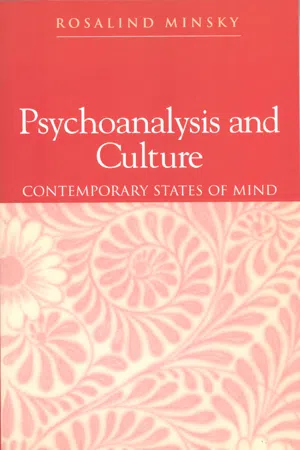
Written in a readable, accessible style, with plenty of up-to-date examples Psychoanalysis and Culture provides a brilliant introduction to key issues in the area of application of psychoanalytic theories to culture. The author argues that we cannot grasp the complexity of contemporary global issues without understanding some of the unconscious processes which underlie them. After introducing some major modern and postmodern psychoanalytic approaches, Minsky offers a broad-ranging critique of Lacan's theory of culture and the unconscious. She explores a range of crucial and topical questions: how should we explain women's historical subordination and what is now often seen as a crisis in male identity? What constitutes 'masculinity' apart from power and control? How important is the father, actually and symbolically in children's development in the context of lone-parent families? Why is contemporary culture often still so violent and destructive? Why is consumer culture so attractive to so many and why is it so difficult to put limits on economic growth in the interests of preventing environmental disaster?
This book will be of great interest to students and scholars in sociology, women's studies, cultural studies, psychology and history as well as psychoanalytic studies. It will also appeal to the general reader interested in the psychology of cultural change.
- English
- ePUB (mobile friendly)
- Available on iOS & Android
eBook - ePub
About this book
Information
Part I
Psychoanalytic Perspectives
Psychoanalytic Perspectives
1
Freud: sexuality and the unconscious
The unconscious
Freud invented the theory and practice of psychoanalysis. In his work, which spans nearly fifty years, he suggests that we are never in a position to know the whole ‘truth’ about ourselves or the world of culture we produce. He argues that this is because of the existence of a largely unknowable unconscious dimension in us all, which creates a radical split in who we are. This is a rift between a consciousness which is knowable through language and a hidden, wordless unconscious. In Civilisation and its Discontents, written late in his career in 1930, he takes the view that culture is inevitably the reflection of the unconscious conflicts which inhabit individuals.
Freud argues that the concealed unconscious dimension of our identity is created as the result of repression. This is a blocking mechanism through which consciousness shuts off potentially painful aspects of our early experience and produces an entirely separate place in our psyche which Freud refers to as ‘another scene’ of our existence. However, although these unpleasurable, unacceptable parts of who we are cannot be articulated consciously in language, they remain in a dynamic state in the unconscious. They constantly threaten to sabotage the apparent coherence and stability of who we take ourselves to be with sudden eruptions of unconscious loss and desire. Rather than expressing themselves in the symbols of ordinary language these feelings often emerge as physical or psychological ‘symptoms’ but most strikingly, in the symbolic language of dreams which Freud regarded as the ‘royal road’ to the unconscious. He thought that dreams, but also jokes and bungled speech and action all share the same kind of symbolic structure as neurotic symptoms such as anxiety, depressions, obsessions, phobias and psychosomatic illnesses. Frozen or ‘paralysed’ meanings which derive from memories of very early childhood emerge in two complimentary symbolic forms, condensation and displacement, which, Freud suggests in The Interpretation of Dreams (1905), represent the invisible structuring rules or patterns of unconscious meanings. Condensation occurs when one idea with several associations is symbolized by a single symbol or metaphor. For example, in a dream, a derelict house might symbolize the body, feelings of insecurity and fragility or an unreliable project. Displacement occurs when one idea is displaced onto other ideas which originally had less intensity but which are related to the first idea through a chain of associations. Freud thought, for example, that ladders and staircases represented sexuality (see Minsky 1996: 28–9). Later, Lacan was to relate the crucial structuring role of condensation and displacement in the creation of unconscious meaning to the two principles of metaphor and metonymy which provide the underlying pattern for the conscious meanings of language.
In his paper ‘The Unconscious’ (1915), Freud elaborated further on his ideas about the relationship between consciousness and the unconscious and distinguished carefully between two kinds of memories characteristic of these different domains. The unconscious stores memories as ‘thing-presentations’ whereas memories can enter language or consciousness only as ‘word-presentations’. Repression prevents the painful ‘thingpresentations’ in the unconscious from being translated into words so that they remain attached to the unpleasurable idea in the unconscious. But Freud suggests that these unconscious representations of memories can suddenly be mobilized by some wish or desire. Only when we convert the silent ‘thing-presentations’ into ‘word-presentations’, that is into the conscious words of language, can they lose their potential for the subversion and disruption of who we are. The process of speaking what previously remained ‘unthought’ in the unconscious forms a significant part of what happens in the psychotherapeutic session.
Freud suggests that we can have access to the ‘truths’ of the unconscious through the medium of what he calls ‘free association’ in the course of the experience of psychoanalysis or, more usually nowadays, psychoanalytic therapy. This means that the patient is invited to begin wherever she or he chooses and to say whatever comes into his or her head. In the production of this narrative, which in some ways is very like the artist creating or telling a story, the patient creates a self out of the unconscious disruptions and repetitions which emerge in this narrative within the emotional context of the therapeutic relationship.
Freud constantly re-worked, elaborated and changed his ideas and these have been used subsequently in different ways by others to produce new theories. But Freud’s theory, in both its modern and postmodern dimensions, has given us infinitely rich, complex and subtle ways of thinking and speaking about identity, difference, sexuality, the body, knowledge, language and culture. These underlie many of the theoretical developments which came after him despite their different ways of conceptualizing the construction of identity and their changes in focus and emphasis. Despite its imperfections, limitations and omissions, even in the light of powerful later developments, Freud’s theory has opened up crucial and momentous insights about how we come both to be and not be ourselves and, jointly with others, create and be created by the meanings of language and culture. In particular, Freud’s theory, taken as a whole, suggests not simply that from our earliest childhood we are driven by a variety of biological drives as some have suggested but, in a much more complicated way, how we construct ourselves and culture out of what we unconsciously ‘make’ of our earliest bodily experiences and, crucially, the passionate emotional entanglements which arise out of these experiences within our particular historically and culturally situated families. Freud’s theory allows us to begin to imagine how we create and live out our gendered identities as ‘masculine’ and ‘feminine’ men and women in culture, to a greater or lesser extent divided within ourselves, as a result of these experiences. The unthought and unconscious part of who we are (sometimes referred to as the id) together with the part of us which can be expressed within language or consciousness (the ego) are always embedded together within the contingencies of history and place. This does not exclude the possibility that some elements of the unconscious dimension of who we are may well be universal human phenomena because almost all of us had our earliest experience of intimacy, love and separation with our mother or substitute mother who was female. However, it is probably wiser to argue that since Freud’s theory grew out of European culture his theory as a whole is likely to apply particularly to individuals brought up in that culture. Analytical psychotherapists working with patients from Indian and African cultures frequently comment on their difficulties in thinking about these patients from within a Freudian framework; there is always a sense, they suggest, that ‘something else is going on’.
The difficulty with Freud’s concept of the unconscious (which, as he himself observed, existed in a less rigorously defined form before him in the work of many writers and poets) is that we cannot have direct access to it because, by definition, the nature of the unconscious is to protect us from what is too painful for us to live with consciously. Sometimes, when we catch a glimpse of the unconscious in ourselves, it feels as if we both know and don’t know the content of it at the same time. We may suddenly recognize it when we hear the cry of loss and longing in a popular love-song (which may be as much about separation from and loss of the mother as it is about a later lover), in a haunting visual image, or a line in a poem, play or novel which makes us catch our breath and throws us momentarily off balance because it hooks up with something in us that we didn’t know we knew.
Sexuality and infantile sexuality
Freud’s focus was primarily on what we ‘make’ imaginatively of bodily drives and sensations rather than on relationships. (The latter forms the basis of the object-relations-based psychoanalytic theory which came after him.) Freud argued that the unconscious, sexuality, and the body are intrinsically interwoven. He thought the central moment which achieved the vital conjunction of these different dimensions of our identity is the Oedipal crisis, which occurs when the child is between three and five years old. This is the moment when we emerge from our phantasies around the body of the mother into fully fledged human beings. Before this time, we shared a fused identity with the mother which is initially supported by primitive sensations of pleasure associated with what Freud called ‘component instincts’ or drives connected with particular areas of our bodies – mouth, anus and penis or clitoris. At first, Freud, for whom sexuality means something much broader than what most of us mean by this term, very controversially described these drives and their potential for pleasure as infantile forms of sexuality because they are associated with both pleasure and our earliest sense of having an existence or identity (Minsky 1996: 31–3). In The Three Essays on the Theory of Sexuality, Freud systematically describes these overlapping drives (Freud 1905). Oral pleasure is associated first with the baby’s sucking or ‘incorporation’ of both milk and the comforting idea of the breast (and later fingers and other more controllable objects). Anal pleasure is derived from the satisfaction the baby derives from ‘holding on’ or ‘letting go’ of faeces, what Freud sees as the baby’s ‘gift’ of its internal contents to the mother. Phallic pleasure is associated particularly with masturbation in the context of phantasies of having total control and dominion of the mother whose care is associated with so much pleasure that it imagines the power of its love can captivate her for ever. During this phase, Freud tells us children of both sexes assume the mother has a penis because, as the centre of their world, she seems so powerful. Only later, at the end of the Oedipal crisis, do they discover their mistake. As he pointed out to his critics, the adult sexual practice of fetishism seems to bear this out. This is pursued by men who have, in phantasy, partly disavowed the meaning of sexual difference, that is that their mother does not have a penis. Something, such as a shoe or item of clothing, comes to stand in for the penis on the body of their female lover whose lack of a phallus is experienced as terrifying even though, contradictorily, this absence is partly consciously recognized. It is as if the unconscious negotiation of the reality of sexual difference is still going on and cannot be fully accepted so for love-making to be possible, a substitute for the phallus must be present on the body of the woman.
In thinking about Freud’s theory of infantile sexuality, it is very important to remember that the different oral, anal and phallic forms of bodily pleasure, like adult sexuality, yield not only pleasure but also a crucial sense of having an existence, of feeling alive, that is of having an identity capable of spontaneity and creativity. So, in the adult, orality (for example, drinking, smoking, comfort eating, mindless watching of television and video), anality (a pre-occupation with control through meanness with money, food or heat, dieting, over-exercising, excessive tidiness, being a workaholic) and being phallic (omnipotent, dominating ‘macho’ behaviour which involves showing off, being exhibitionist, pushy and ‘ostentatious’) are defences learned in earliest childhood and are concerned, crucially, with not just pleasure but the business of ‘self ’ preservation or the survival of a sense of having a viable self. If the baby experiences a level of trauma which interferes with the oral, anal or phallic pleasures of infancy, the baby and later adult may be left with a destructive residue of feelings of emptiness, worthlessness, humiliation, inferiority or shame, rather than with the capacity to ‘take in’ good experiences freely, ‘let go’ spontaneously and creatively and enjoy sexual experience without guilt or inhibition.
Narcissism
In 1915, long after the publication of The Three Essays in 1905, Freud developed his theory of identity to include the concept of narcissism which became central to his theory and those of his followers. He suggested that what he called ‘narcissism’ represents a form of identity which exists between one based on pleasure from the baby’s own body (auto-eroticism) while it is still merged with the mother and one which is separated from the mother in a successful outcome of the Oedipal crisis. He argued that the child’s narcissistic identity is based on a middle position in which the child projects its self onto the mother. Then, because it is already in a state of fusion with her, the baby takes an identity from the mother which already contains a substantial part of its self. In this way the child achieves a sense of identity but one which is very dependent on a reflection from outside itself in the external world which, paradoxically, is already suffused with its self. If, as adults, we still rely, for our sense of identity and coherence, primarily on the approval of other people or things onto whom or which we have already projected ourselves, we cannot avoid constructing ourselves out of reflections or shadows of ourself which lie outside us. This means that disapproval, rejection or disappointment always threaten us with a potential collapse of identity because our inner world is so dependent on the world outside. It has no filling or inner resources of its own. Most of us carry round vestiges of narcissism, although Christopher Lasch (1980) suggests that we have constructed a culture which actively encourages narcissistic identities in the form of ‘quick fix’ instant cultural gratifications which we mistake for ourselves. This leaves us in a blind alley of projections without the capacity to make authentic relationships with people who we can see as distinct and separate from ourselves.
Since the Oedipal crisis is so often incompletely resolved, Freud recognized the widespread potential for narcissism. He thought it could be seen in our relationships with children or partners who may become extensions of ourselves, with much younger lovers who may represent what we once were or would have liked to have been, and in the mechanisms involved in bereavement and loss. In the latter case of loss, we have to free ourselves of the inner object (the part of the loved and lost person who has become part of our self ) before we can let go of the person in the external world who has been lost (see Minsky 1996: 39). The concept of narcissism is elaborated in chapter 9 on consumerism where it forms a central part of the discussion.
For Freud, what he calls the ego or largely conscious self (except for that part of the ego, the super-ego, which is unconscious) forms the basic building block for identity and represents the means by which we become a human subject. The ego or self is constructed out of the child’s earliest emotional ties or what Freud calls ‘identifications’, together with the symbolic remains of abandoned attachments to other people and things, what Freud calls ‘objects’ which subsequently form part of the internal world. Identification with another person or someone we would like to be becomes the means by which we come into being through the successive internalizations of the qualities and attributes of these objects. The ego therefore is part of both the past and the present and must be anchored in ‘word presentations’, those memories which are grounded in language which provide it with a degree of mastery against the symbolic ‘thing presentations’ which characterize memories which remain unconscious (see Minsky 1996: 28–9). However, he thought that this makes the ego permanently precarious because the unconscious always contrives to be heard in the stumblings and hesitations of language. This emphasis on the construction of the ego through identification with other people, ideas and things, and the role of language in this process, are crucial to Lacan’s re-working of Freud’s ideas.
But it is the Oedipal crisis that, Freud argues, allows us to make the transition from our merged, narcissistic identity with the mother, and our passionate phantasies about keeping her to ourselves for ever, into human beings capable of being able to lead a relatively creative, selfreflective, autonomous existence.
The Oedipal crisis
Freud argues that we are precipitated into the Oedipal crisis by falling in love with the mother who has cast a spell over us through her care and love and all the touching, wiping, stroking and hugging this entails. But this new stance in relation to the mother, now phantasized as a potential lover we can steal from our father, and, if possible, siblings and anyone else, coincides with another tumultuous discovery in the child’s so far body-preoccupied experience – the discovery of sexual difference. For Freud, largely on the basis of what his many female patients told him, the child’s first awareness of sexual difference is based on the visual perception of the presence or absence of the penis on the bodies of those around it among whom it must eventually find its place. However, it is at the moment of discovery of bodily difference based on the presence or absence of the penis that Freud introduces the most dynamic concept in his theory of the construction of gendered identity, the castration complex and the role of the symbolic father. At this point let us look at the experience of the boy and girl separately.
In the context of both his guilt in relation to his father, who is perceived as a rival for his mother, and his perception of the mother’s or girl’s lack of a penis, the boy falls prey to the terrifying idea that girls have been castrated and that therefore he may fall victim to the same fate. This, he phantasizes, is likely to be at the hands of his father as a result of his sexual ambitions to steal away his mother. It is important to understand that, for Freud, the small boy’s fear of castration is experienced symbolically and not only as the threat of being physically mutilated. At the symbolic level, castration anxiety is the threat of the extinction of his fragile and emergent sense of identity which at that time centres around the pleasure derived from his penis. Castration anxiety threatens the small boy with a potentially overwhelming catastrophe, that of psychical annihilation. It also threatens those adults who remain in a state of residual, unresolved castration anxiety as some, perhaps many, men do. As Freud recognized, large numbers of us emerge from the Oedipal crisis with infantile conflicts which, for a variety of complicated emotional reasons, have not been fully resolved.
Desperate to avoid potential annihilation, Freud argues that the small boy is finally persuaded by his castration anxiety to give up his mother and reconcile himself to the deferment of his phantasies about her until he is an adult and can find a woman of his own as a substitute. From this moment on, if all goes smoothly, the small boy gives up both his earliest identification with his mother and his desire for her and at the same time makes an alternative identification with his father. This is someone of the same sex, that is someone with a body like his own who may be able to fill the void left by the loss of his mother. Although Freud does not elaborate on this aspect of the boy’s experience, if his Oedipal crisis is resolved successfully, in order to achieve his cultural ‘masculinity’, and the power this confers, the boy has to lose his mother in two ways – both as his first source of identity and as his first love-object (phantasized lover). In her place, he identifies with his father, although highly ambivalently, because he has to internalize someone who is both loved and feared at one and the same time. The internalized father continues to inspire murderous feelings and guilt but now the boy is under surveillance from within rather than from outside. In this sense the small boy’s new identity is composed of a potentially divisive mixture: both himself as potential victim and his father as potential executioner. Henceforth, the father exists in the psyche of the boy as what Freud describes as the super-ego, as an internal representative of the external laws of culture and moral authority, not least the law forbidding incest and the law of who belongs to whom within families. It is through the child’s crucial identification with the symbolic father, someone beyond the enticements of the mother’s body and being (or what Lacan calls the place of the father, that is, language and cultural representation), that culture makes its unconscious impact on the child’s identity through its entry into the symbolic world of language. For Freud, this entry into the laws and values of culture represents the child’s entry into its humanity, its vital transition from phantasy to reality and the setting of boundaries on its desire. But, crucially, it eventually also offers us the only opportunity, emotionally, of ‘growing up’ through gaining access to the creative possibilities of language and symbolization (see Minsky 1996: 42–5).
It is at this crucial and emotionally fraught time, Freud argues, that the unconscious is formed out of the repression of the boy’s love for and loss of the mother. The formation of the unconscious allows the pain of this loss to be concealed from consciousness but results in a divided subject.
This means that consciousness, what we think we know about ourselves and the world, is always vulnerable to sabotage from the sudden eruption of hidden desires and loss. If the boy is unable to identify sufficiently with the father for him to feel able to separate from the mother, Freud argues that he will continue to be dominated by phantasy involving possession of the mother and castration anxiety which will inhibit his ability to cope with the demands of reality and relationships. What Freud does not emphasize is that early separation from the emotional, bodily world of the mother entails the boy being permanently cut off also from this vital dimension of himself. The small boy has to survive the double l...
Table of contents
- Cover
- Dedication
- Title page
- Copyright page
- Epigraph
- Preface
- Acknowledgements
- Abbreviations
- Introduction
- Part I: Psychoanalytic Perspectives
- Part II: Control or Containment?: Making Sense of Experience
- Bibliography
- Index
Trusted by 375,005 students
Access to over 1.5 million titles for a fair monthly price.
Study more efficiently using our study tools.
Frequently asked questions
Yes, you can cancel anytime from the Subscription tab in your account settings on the Perlego website. Your subscription will stay active until the end of your current billing period. Learn how to cancel your subscription
No, books cannot be downloaded as external files, such as PDFs, for use outside of Perlego. However, you can download books within the Perlego app for offline reading on mobile or tablet. Learn how to download books offline
Perlego offers two plans: Essential and Complete
- Essential is ideal for learners and professionals who enjoy exploring a wide range of subjects. Access the Essential Library with 800,000+ trusted titles and best-sellers across business, personal growth, and the humanities. Includes unlimited reading time and Standard Read Aloud voice.
- Complete: Perfect for advanced learners and researchers needing full, unrestricted access. Unlock 1.5M+ books across hundreds of subjects, including academic and specialized titles. The Complete Plan also includes advanced features like Premium Read Aloud and Research Assistant.
We are an online textbook subscription service, where you can get access to an entire online library for less than the price of a single book per month. With over 1.5 million books across 990+ topics, we’ve got you covered! Learn about our mission
Look out for the read-aloud symbol on your next book to see if you can listen to it. The read-aloud tool reads text aloud for you, highlighting the text as it is being read. You can pause it, speed it up and slow it down. Learn more about Read Aloud
Yes! You can use the Perlego app on both iOS and Android devices to read anytime, anywhere — even offline. Perfect for commutes or when you’re on the go.
Please note we cannot support devices running on iOS 13 and Android 7 or earlier. Learn more about using the app
Please note we cannot support devices running on iOS 13 and Android 7 or earlier. Learn more about using the app
Yes, you can access Psychoanalysis and Culture by Rosalind Minsky in PDF and/or ePUB format, as well as other popular books in Psychology & Clinical Psychology. We have over 1.5 million books available in our catalogue for you to explore.