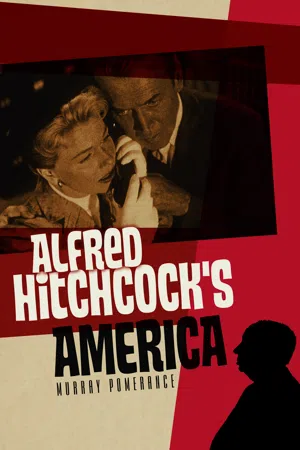
Murray Pomerance works from a basis in cultural analysis and a detailed knowledge of Alfred Hitchcock's films and production techniques to explore how America of the 1940s, 1950s, and 1960s is revealed and critically commented upon in Hitchcock's work. Alfred Hitchcock's America is full of stunning details that bring new light to Hitchcock's method and works. The American "spirit of place," is seen here in light of the titanic American personality, American values in a consumer age, social class and American social form, and the characteristic American marriage. The book's analysis ranges across a wide array of films from Rebecca to Family Plot, and examines in depth the location sequences, characterological types, and complex social expectations that riddled American society while Hitchcock thrived there.
- English
- ePUB (mobile friendly)
- Available on iOS & Android
eBook - ePub
Alfred Hitchcock's America
About this book
With a sharp eye for social detail and the pressures of class inequality, Alfred Hitchcock brought to the American scene a perspicacity and analytical shrewdness unparalleled in American cinema.
Information
1
HITCHCOCK’S AMERICAN SCAPES
When from a strategic promontory in the twenty-first century we look upon the cultural space of America, it seems preponderantly urban and to a significant degree internationalized. The American modern spatial form, largely agglomerated urban development characterized by dense clusters of skyscrapers and vast surrounding tracts of suburban sprawl, is also to be found in Europe, Asia, South America, Australia, and parts of Africa, but in America it somehow seems aboriginal, natural, characteristic, unimposed. While in the United States there are pastoral regions spreading across parts of the south and the Midwest – central Georgia, southern Illinois, New Mexico, Arizona are some – the typical image of the American scene today is neither a pasture nor a tiny village nor a meandering river with paddle-wheelers churning upstream, but instead a seemingly endless interlocking chain of expressways jammed with vehicular traffic and a cityscape remarkably unchanging from Boston to Minneapolis to New Orleans to San Diego, one that features dozens of vertical glass-faced dominoes full of accountants, bankers, brokers, and lawyers shuffling to and from work in identical business garb, aboard a subway or tram system, and whisked to suburban homes each boasting a view of dozens like it. Mobility, instant readiness for communication, gregariousness, brevity of relationship, and self-doubt characterize the American character who inhabits this twenty-first century world.
The America depicted by Hitchcock between the 1940s and the early 1970s was altogether a different kind of place, one that only toward the end of that period was modulating into the vastly more complex social world we recognize today. What Hitchcock saw and understood was an American city still in the relatively early stages of development, with its foundation in a bucolic small town associated with agriculture and long-lasting human relations. Even New York, that American prototype, was a more characteristic environment then than it is today (see, for example, Berman “Too Much”). The view of Phoenix in Psycho (1960) is a good example: although real estate is booming (as per the storyline), what we are given to see is a modest, even genteel urban environment (some of it realized onscreen through rear-projection plates made in architecturally unprepossessing sections of Los Angeles). True, in North by Northwest (1959) and Topaz (1969) Hitchcock’s urban scene became at least occasionally caustic and dark, but in many ways Saboteur (1942), Shadow of a Doubt (1943), Spellbound (1945), Strangers on a Train (1951), Rear Window (1954), and The Wrong Man (1956) deploy townscapes and cityscapes still culture-bound to the nineteenth century. These films foreground interpersonal civility, living spaces intermeshed with working environments, evocative topographies, and a discreet sense of settlement and groundedness.
Los Angeles posing as Phoenix for a rear-projection plate to be used in Psycho (Universal, 1960) as Marion Crane stops her car at an intersection. Courtesy Academy of Motion Picture Arts and Sciences.

Consider the glitz-free Los Angeles of Saboteur.1 It is first presented by an aircraft factory configured like a giant barn,2 with relatively little depiction of churning machinery, mechanical grit, or regularized brutal labor; soon afterward by a community of tiny bungalows, each the shell of a warm and tightly knit family. The plot moves quickly to a lonely highway (probably in the Mojave National Preserve) – something relatively new in America in the early 1940s; it would be a decade before the substantial development of the interstate highway system – and here we discover an amiable trucker (worker bonded with the road), a territory marked by farms and ranches that bespeak an agrarian economy, and architecture set into the natural forms of the graceful hills and low mountains. Indeed, the dominance of the Californian mountainous form was conceived early on as part of the intrinsic design of this film. One farm in particular Hitchcock graces with a twinkly swimming pool; so this is a view of the West in development, a frontier heading toward a techno-topological futurity in which hard physical labor will be replaced by automation, intellectual property production and management, and leisure. Soon later, we discover a dense forest, then the stunning prospect of what was at the time a relatively new marvel of architecture and engineering – the Hoover Dam (dedicated September 30, 1935).3 When the tale finally moves to New York, it is only an abbreviated and quickly suggestive view that Hitchcock presents there, including a shot taken from a skyscraper window as a help note floats hopelessly down to the street far below. En route to the Brooklyn Navy Yard we catch a swift view (through inserted newsreel footage) of the S. S. Normandie swamped in its riverside berth, but the basic pictorial information is that of a port location with ships in place. For the climax at the Statue of Liberty, Hitchcock uses contrasty, dynamically composed establishing shots that highlight the gigantic figure as a freestanding icon, floating in a kind of patriotic-intellectual atmosphere removed from the busy streets of the city (as, indeed, the Statue is). By the time of North by Northwest, Hitchcock is revealing a different New York, plunging into those streets to find a bustling businesslike jungle.
What, then, is the America that we discover in Hitchcock, if we look at his landscapes, townscapes, and cityscapes, his ways of picturing place? D. H. Lawrence had written in Studies in Classic American Literature that there was a spirit of place, and that the spirit of America was escape. The Pilgrim Fathers “came largely to get away – that most simple of motives. To get away. Away from what? In the long run, away from themselves. Away from everything. That’s why most people have come to America, and still do come. To get away from everything they are and have been” (9). How, having gotten away himself, did Hitchcock portray that spirit?
Walden in the Woods
Saboteur was Hitchcock’s first expressly American film.4 (In Rebecca and Foreign Correspondent [both 1940], he had imposed American characters and motifs, but neither film was self-consciously about America as a place.) Not far into it, earnest aircraft worker Barry Kane (Robert Cummings), accused of setting a factory fire that killed his best friend and in flight from the police, wanders desperately into a rain-sogged California forest. This is one of those utterly primeval stands of tall densely packed conifers, a sanctum of silent darkness, eerie foreboding, and rich natural potential.5 It is the forest primeval, the source of social formations, indeed the untapped wilderness that is one of the great strengths and beauties of the American dream. It is also the domain of those who did not reach America from Europe: “Last evening,” wrote Meriwether Lewis in his journal on June 25, 1806,
the indians entertained us with seting [sic] the fir trees on fire. they have a great number of dry lims [sic] near their bodies which when set on fire creates a very suddon [sic] and immence [sic] blaze from bottom to top of those tall trees. they are a beatifull [sic] object in this situation at night. this exhibition reminded me of a display of fireworks. the natives told us that their object in seting [sic] those trees on fire was to bring fair weather for our journey. (396)
There is a log cabin – the Lincoln model! – with smoke sweetly twisting from its chimney: habitation, the rudiments of civilization, an abode built by human hands in human proportion and with the enchanting modesty of materials taken straight from nature and used according to principles of natural harmony. This America of the woods is not only rustic but also noble and purposive, forthright and upstanding, an America of principles, signaling the undergirding importance of justice, civility, tolerance, aspiration, and trust. Seen in its best light, according to an “accurate moral compass” (Hark 297), this is the America of the founding fathers; the America that beckoned to immigrant sufferers late in the nineteenth century and early in the twentieth, “Give me your tired, your poor … ”; the America that offered not only opportunities for advancement but the promise of fresh air unpolluted by tyranny, class conflict, hatred, or vice. Also, of course, it is an Arcadian space that for Hitchcock may have recalled the green zones and green men of British lore, for all its hazy black-and-white glow nothing less than a greenwood.
At the cabin,6 Barry meets Phillip Martin (Vaughan Glazer), an aging and blind Thoreau figure, a naturalist-philosopher and “the central spokesperson for true American virtue” (Hark 297), eager to offer this stranger hospitality and warm shelter from the rain outside. If he is not quite an ancestor of the British Henry Hastings, who, we are told by Simon Schama, “made a point of dressing only in green broadcloth” and whose hovel “that had been built for him in the hollow of an oak” was edged with “a carpet of half-gnawed marrowbones, while the evil-smelling chamber itself was filled with an inconceivable number of hunting, pointing, and retrieving dogs” (135), still Martin does have for company a gruffy and gregarious German Shepard and his own independent spirit nurtured by long silences in the awesome shades of this magnificent and uncivilized place. For some minutes, the shivering fugitive Kane has been able to keep the shackles that bind his wrists camouflaged from his unseeing host, but when the old man’s niece Pat (Priscilla Lane) arrives – she comes every year from New York to spend a month, after which time she “finds the quiet deafening” – young Barry, surprised by her stunning good looks (stunning in part because he has been seeing her face plastered on roadside billboards as he hitchhikes across the country), much too soon finds himself optically and morally probed. It is true that for all her surface glamour Pat is nothing if not the epitome of the fresh-faced and healthy all-American girl, but she harbors a fearful and anxious personality, a rote (and, in the face of her uncle it may be observed, blind) subservience to the brutalizing forces of order. She is on the point of detecting the handcuffs Barry presumes the blind seer has missed,7 and of being drawn into fear.
Eagerly, she blurts out that the police are searching for a runaway, a man who is “dangerous.” Although Barry is a shining epitome of innocence, she finds it possible to imagine in him a nefarious type who has crept malevolently through the woods. “The police,” replies the old man dismissively, “are always on the alarmist side.” But, presses she, they said he was really dangerous. “I’m sure they did. How could they be heroes if he were harmless?” Now, the manacled wrists cannot but announce themselves, and “he must be the man they’re looking for!” cries Pat, panic floundering in her voice. “Yes,” says the uncle matter-of-factly, “very probably.” The girl with some urgency: You should have given him to the police. “Are you frightened, Pat? Is that what makes you so cruel?” This last, surely an observation not merely of Martin’s but also of Hitchcock’s, is of great interest and significance, since rather than merely allaying the niece’s fears, rather than merely disagreeing with her, the wise old man is making bold to offer a critical, even pedagogical, comment, one that points neither to attitudes nor to rational alignment but to fundamental human nature and the vital necessity of standing upon it. He is offering a conviction and a way of seeing the social world: that to turn people over to the police based on one’s fears is an act not only of surrender and injustice but also of cruelty. Further, when Pat chides him about his civic duties, he continues to elevate his thoughts (in a way that no other character in Hitchcock ever manages to do): “It is my duty as an American citizen to believe a man innocent until he’s been proved guilty. … I have my own ideas about my duties as a citizen. They sometimes involve disregarding the law.”
Here is Henry David Thoreau, anticipating by almost ninety years what Hitchcock’s Phillip Martin would believe and aver:
It is said that Mirabeau took to highway robbery “to ascertain what degree of resolution was necessary in order to place one’s self in formal opposition to the most sacred laws of society.” … This was manly, as the world goes; and yet it was idle, if not desperate. A saner man would have found himself often enough “in formal opposition” to what are deemed “the most sacred laws of society,” through obedience to yet more sacred laws, and so have tested his resolution without going out of his way. It is not for a man to put himself in such an attitude to society, but to maintain himself in whatever attitude he find himself through obedience to the laws of his being, which will never be one of opposition to a just government, if he should chance to meet with such. (371)
“I have my own ideas about my duties as a citizen,” says Phillip Martin. Vaughan Glazer (l.) with Robert Cummings in Saboteur (Frank Lloyd Productions/Universal, 1942). On the piano at rear he will proceed to play Frederick Delius’s “Summer Night on the River” (1911–12), explaining that he sees with his ears. Courtesy Academy of Motion Picture Arts and Sciences.

How fascinating and revealing, then, that commencing his portraiture of America with Saboteur, and riding upon a fondness for that country and its customs cultured from afar, Hitchcock would apotheosize not the tycoon –
the “Titan,” as Dreiser called him; the “Tycoon,” as Fortune called him. Where other civilization types have pursued wisdom, beauty, sanctity, military glory, predacity, asceticism, the businessman pursues the magnitudes of profit with a similar single-minded drive. … “The business of America,” as Calvin Coolidge put it, “is business.” (Lerner 274)
– he who by the early 1940s had come to symbolize all that was energetic and indomitably progressive about the American plan, but instead this solitary and debilitated philosopher withdrawn into the rainy woods, a man stubbornly following the laws of his true self rather than society’s shibboleths.
Regardless of the weight and meaning of this scene in the overall plot (at the uncle’s insistence Barry and Pat will go off together, and he will cut his chains and eventually struggle hard to persuade her that he is the noble innocent he has been claiming to be), the arrangement of interactions functions to show a lambent vision of American civility and social organization that, whether or not it figured personally for Hitchcock at this time in his life, was distinctively absent from the films noirs and melodramas so profusely turned out by Hollywood studios in the early 1940s. There is a dim aura in Martin of Gregory La Cava’s noble and liberty-loving butler (William Powell) in My Man Godfrey (1936), but only an aura: Godfrey speaks out of dignity and insouciance, while Martin speaks as a victim and prisoner in a tormenting world that must be overcome and transcended with kindness.8 In this cabin in the woods, secluded, retreated from the pall mall of urbanizing modernity, he bespeaks the values and poise, the rugged assurance and indomitable yearning of a frontier America, exemplifying the dignity that is implicit in the act of treating all men as equals, all men as free, all men as ideal citizens.
One of John De Cuir’s numerous sketches anticipating the Statue of Liberty sequence that climaxes Saboteur. Fry is visible dangling from Lady Liberty’s thumb, and Barry Kane is leaning over the railing on the torch. Note how De Cuir artfully suggested wide-angle compositions, many of which would be used even though the action as Hitchcock shot the scene was reconfigured. Courtesy Academy of Motion Picture Arts and Sciences.

All around him Thoreau saw “lives of quiet desperation” (see Lerner 561). So, we might surmise, did Hitchcock. As reflected in the film, such lives include those of Pat and surely Fry (Norman Lloyd), the real saboteur and a slimy and valueless punk, and every member of the Nazi coterie for whom Fry works so slavishly and with such carelessness. Even hapless Barry is desperate – and at moments only desperate...
Table of contents
- COVER
- SERIES PAGE
- TITLE PAGE
- COPYRIGHT PAGE
- DEDICATION
- EPIGRAPH
- ACKNOWLEDGMENTS
- INTRODUCTION: ALFRED HITCHCOCK IN AMERICA
- 1 HITCHCOCK’S AMERICAN SCAPES
- 2 HITCHCOCK’S AMERICAN PERSONALITIES
- 3 HITCHCOCK AND AMERICAN VALUES
- 4 HITCHCOCK AND AMERICAN SOCIAL FORM
- 5 HITCHCOCK AND THE AMERICAN MARRIAGE
- WORKS CITED AND CONSULTED
- INDEX
Trusted by 375,005 students
Access to over 1.5 million titles for a fair monthly price.
Study more efficiently using our study tools.
Frequently asked questions
Yes, you can cancel anytime from the Subscription tab in your account settings on the Perlego website. Your subscription will stay active until the end of your current billing period. Learn how to cancel your subscription
No, books cannot be downloaded as external files, such as PDFs, for use outside of Perlego. However, you can download books within the Perlego app for offline reading on mobile or tablet. Learn how to download books offline
Perlego offers two plans: Essential and Complete
- Essential is ideal for learners and professionals who enjoy exploring a wide range of subjects. Access the Essential Library with 800,000+ trusted titles and best-sellers across business, personal growth, and the humanities. Includes unlimited reading time and Standard Read Aloud voice.
- Complete: Perfect for advanced learners and researchers needing full, unrestricted access. Unlock 1.5M+ books across hundreds of subjects, including academic and specialized titles. The Complete Plan also includes advanced features like Premium Read Aloud and Research Assistant.
We are an online textbook subscription service, where you can get access to an entire online library for less than the price of a single book per month. With over 1.5 million books across 990+ topics, we’ve got you covered! Learn about our mission
Look out for the read-aloud symbol on your next book to see if you can listen to it. The read-aloud tool reads text aloud for you, highlighting the text as it is being read. You can pause it, speed it up and slow it down. Learn more about Read Aloud
Yes! You can use the Perlego app on both iOS and Android devices to read anytime, anywhere — even offline. Perfect for commutes or when you’re on the go.
Please note we cannot support devices running on iOS 13 and Android 7 or earlier. Learn more about using the app
Please note we cannot support devices running on iOS 13 and Android 7 or earlier. Learn more about using the app
Yes, you can access Alfred Hitchcock's America by Murray Pomerance in PDF and/or ePUB format, as well as other popular books in Media & Performing Arts & Film History & Criticism. We have over 1.5 million books available in our catalogue for you to explore.