It is essential reading for anyone concerned with issues of pornography and sexual politics and related debates in literary criticism and cultural studies.
- English
- ePUB (mobile friendly)
- Available on iOS & Android
eBook - ePub
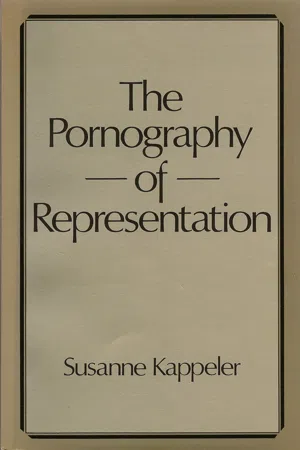
The Pornography of Representation
About this book
This book marks a radical and powerful intervention in traditional arguments about pornography. Kappeler re-examines the artistic distinctions between fantasy and reality, pornography and erotica, and challenges the legal definition of obscenity as well as the intellectual defence of 'freedom of expression'. By linking images of actual violence with the imaginative portrayal of women in the realm of the aesthetic, she establishes vital connections between modes of representation and social forms of power and domination.
Information
Problem 1
Fact and Fiction
The Guardian Weekly, in its first issue of 1984, carried an article entitled ‘A Murder in Namibia’. A white farmer, van Rooyen, aged 24, had tortured and killed the 18-year-old Thomas Kasire, a new black worker on his farm. The history is as follows: on account of the language Kasire speaks and the area he comes from, his white boss accuses him of being a supporter of the national liberation movement SWAPO (South Western African People’s Organisation). He
throws a heavy chain around the throat of Thomas Kasire. For two days the white farmer keeps Thomas chained fast in his farmyard. Eventually, Thomas is killed as van Rooyen’s drinking pals applaud and take pictures. This happens on a farm, in Namibia, in 1983.1
Three pictures accompany the article, one showing the murderer ‘as he appeared in court’, wearing a suit and tie. The other two pictures are from the ‘scene’ of crime: a close-up of Kasire’s head, bleeding, one ear half cut off, a heavy iron chain around his neck, with the white left arm of his torturer holding on to the chain, intruding from the left into the middle foreground of the picture. The third photograph has the caption: ‘The victim is forced to pose with a clenched fist (SWAPO salute), while a friend of the murderer takes photos.’2 The murderer himself is in the picture, towering over the young black man whom he holds by the chain. He is wearing farm clothes and a cap (they could also be paramilitary gear) and he is facing the camera. The young black man looks as if he were held up on his feet chiefly by the chain the white man holds.
The event is a curiosity in criminology, for the pictures were the damning evidence. Without them, the court would in all probability have acquitted [van Rooyen]. The explanations given by him and his white friends would have outweighed the statements of black witnesses. So safe are the whites in their dominant position within the apartheid system that, incredibly, the whole event was photographed at van Rooyen’s request.3
The coincidence of this kind of violence and its representation is no accident. It is no curiosity in the domain of representation. The pictures are not documentary evidence, snapped by a journalist or observer by chance in the right place at the right time. The pictures are compositions, deliberate representations, conforming to a genre. The victim is forced to ‘pose’; the perpetrator of the torture positions himself in the other picture with reference to the camera. Another white man is behind the camera, framing the picture. The picture may remind us of those taken by fishermen and hunters posing with their catch, smiling into the camera. But the catch is a human being, a victim, and thus the picture also reminds us of some of the darkest photographic memories of the Vietnam war, those pictures which break the documentary mould and where a temporary victor briefly poses for the camera with his victim vanquished, acknowledging the presence of the camera, drawing it into complicity. The picture may also remind us, or some of us, of pornography, a woman in the place of the black man, the white men in their respective positions – in the picture, behind the camera – unchanged.
The written report, too, cannot but align itself with the existing literary tradition of the genre:
Sunday afternoon – two white guests arrive at the farm. Thomas has now stood, bound, for two days without food or water. Van Rooyen suggests to his friends that they should have some drinks and soon they begin celebrating the capture of a young ‘terrorist’.The victim is fetched and forced to pose whilst one of the guests borrows van Rooyen’s Instamatic camera. A short time after the pictures are taken there is an almost inaudible sob from Thomas Kasire. After a faint shudder he falls backwards – lifeless.4
For ‘Thomas’ – the ‘boy’5 put ‘Justine’ or ‘Emanuelle’ or ‘O’ – the victim already designated by reduced identity, a first name, no family name. For ‘farm’ put ‘chateau’, retain the aristocratic patronym of its owner and you have the perfect scenario of sadean libertinism, the classic paradigm of the genre.
Experts on pornography, obscenity and censorship, experts of the law as well as experts of the arts, will argue that the issue of real violence, physical violence to people as in ‘A Murder in Namibia’, is irrelevant to the question of pornography. Real violence is a case for the courts and the criminologists: it is fact, not fiction.
Experts in law are for the most part concerned with fact, although with cases of threat, libel and with the question of censorship they are themselves concerned with a realm of representation that relates ambiguously to the realm of fact. Experts of the arts are now virtually exclusively concerned with fiction, since the modern understanding of art and literature highlights the creative and imaginative as the defining elements, coupled with an evaluative criterion of ‘excellence’.6 When the issue is pornography, both sides offer themselves as the obvious experts while at the same time effectively disowning it. Thus the arts experts, while coyly refraining from claiming pornography as an art (not ‘excellent’ enough), nevertheless recognize its affinity with their own subject and, moreover, have memories of the law interfering in the arts proper with its censorship arm, as in the famous literary obscenity trials.7 They claim, as it were, the other side of the boundary between fiction and pornographic fiction (without apparently any contradiction). Liberalism is in favour of a clear separation of expertise and of restricting the law to unambiguous fact. The law, increasingly complying, restricts its concern to the possibility of a factual relation between fiction (potential fact) and actual fact, thus placing pornography itself outside its proper domain.
Hence the present situation where protectors as well as critics of pornography face each other over the (law’s) problem of refuting or proving a causal relationship between the consumption of pornographic fiction and the perpetration of sexual crimes: does represented content lead to content being acted out? Did a sexual assailant get his crime out of a book, film or magazine? Representation itself, pornography itself, is already no longer in question, in this search for a match between contents. Sociology provides statistics: they prove nothing. Perhaps it is rather a case for the psychologists, and there are psychiatric estimates: ‘no correlation’.8 What is clear from this division of domains and competencies is that representation itself is not considered a part of the real; as fiction it is opposed to fact, and it does not apparently involve any acts, activity, action, save fictional ones in its content.
In the murder of Thomas Kasire, ‘posing’ for pictures was an integral part of his torture; in fact, it was the final cause of death. In the murdering of Thomas Kasire, taking pictures was an integral part of the act of torture and an integral part of the enjoyment of the act of torture. This particular form of violence has two parts: doing it and enjoying it, action and appreciation. Today, we loosely call it sadism. Enjoyment, according to Sade, requires a sophisticated intellectual structure, beyond sheer gratification. It requires an audience. With an audience, torture becomes an art, the torturer an author, the onlookers an audience of connoisseurs. This sophisticated structure is manifest in the present case: there is a host, the owner of the farm, and there are guests. One white man, the host, is the maître de cérémonie,9 also acting as torturer in the content of the picture, another white man, a guest, behind the camera, acting in the production of the picture. The two look at each other. The one in the picture will come out of the picture and take the place of the man behind the camera, looking at the scene he has framed. The host and his guests mingle and merge in the audience, they become one as the audience, but the host is the author of the party, and they are ‘celebrating’.
The victim does not come out of the picture, the victim is dead. In this case literally, in the general case of representation virtually, or functionally, as there is no designated role in the world, and in the continued existence of the representation, for the victim to take up. If the person filling the role of victim is not actually dead, s/he should be. In the words of the Marquis de Sade:
There’s not a woman on earth who would ever have had cause to complain of my services if I’d been sure of being able to kill her afterwards.10
An interesting use of the word ‘cause’.
The white men’s party, their action of representing the torture and death of Thomas Kasire, is disregarded by both camps of experts. In the face of the ‘real’, factual violence involved in the production of the representation, the arts experts deem that the representation ceases to be fiction and a relative of the arts. The case is handed over to the courts, where the representation becomes ‘evidence’, a chance windfall for the prosecution, who treats it as a mirror reflection of reality, the reality of the crime. Van Rooyen is tried for murder; his action of producing pornographic representations, relatives of the snuff-movies, goes unnoticed and untried.
Experts on fiction and art will say that this incident does not count, because the incident was real (the victim really died). Fiction, of course, has always had a troubled relationship with reality, its investment in realism motivated by a concern with authenticating its own enterprise in an increasingly secular culture, guaranteeing a certain relevance. But it wants no part in reality, it is the Other to the real. It is the surplus of the real, it need have no function in the real, it need serve no purpose. It is the leisure and the pleasure which complements the work and utility of the real. That is its beauty, the beauty and privilege of the arts. Gratuitousness becomes the trademark of the arts’ sublimity.
Gratuitousness is the mark of the murderer’s photography. It is for sheer surplus pleasure, as is the torture itself, which has nothing of course to do with fighting so-called terrorists or any other utility in the world. It serves the leisure and the pleasure of the white man (the incident happens at a weekend, Friday–Sunday),11 it is a form of his free expression of himself, an assertion of his subjectivity.
Van Rooyen’s production of pictures is fiction par excellence. The pictures are made (fiction from fingere = to form), careful compositions according to the laws of aesthetics and representation. The fiction exceeds fact in its representation of reality: Thomas Kasire lives on in his representation, though Thomas Kasire is dead. The fiction continues its existence in reality.
Problem 2
Human Rights
In its present, received position, the case of pornography is unanswerable. Radicals and conservatives are confused about on which side of the fence they are or ought to be; only liberals and intellectuals know their place is firmly on it. The problem, as they all see it, is that pornography is about sexuality: radicals and some liberals are ‘for’ it, and for its ‘liberation’. Conservatives are against liberation, and very concerned about ‘public morality’. There is a further problem, and this is freedom of expression. Liberals and intellectuals become almost radical when it comes to this question. Conservatives are not too sure freedom is good for everyone, and are in favour of regulating it. All of them thus happily agree that the problem of pornography is one of morality and censorship, or sexual liberation and freedom of expression, depending on the colour of the vocabulary. Feminists – radicals from the point of view of patriarchy – slot themselves uneasily into the debate in these terms: depending on their other allegiances they may come down on either side of the fence. Radically opposed to pornography, they may find themselves pleading with Mary Whitehouse for its ‘abolition’, for censorship. With an investment in intellectual liberalism or the arts (not to mention the ‘sexual liberation’ of the sixties) they may argue that pornography is not really an issue.
The Minneapolis City Council narrowly approved a new ordinance on 30 December 1983, which declares that ‘certain kinds of pornography violate women’s civil rights.’1 The importance of this new ordinance – for the drafting of which the City Council had consulted two feminists, Catharine MacKinnon, a lawyer, and Andrea Dworkin, teacher and author of a book on pornography – is that it shifts the issue of pornography from its traditional place of obscenity and censorship to a question of civil rights: the civil rights of women. What is further interesting is how this vote split up the conventional categories of conservative, liberal and radical (although in American parlance ‘liberal’ already covers a spectrum from centre to left). The Minneapolis Star and Tribune staff writers report:
If [the Mayor] vetoes it, the proposal will come up before the new council, which takes office Tuesday. Supporters [of the new ordinance] said they fear the new council will be less favorable to the proposal.The new council members are widely viewed as more liberal, particularly in the area of civil liberties, and not as amenable to the ordinance.2 (My emphasis)
Being more liberal, expecially in the area of civil liberties, apparently renders council members less amenable to the civil rights of women. The report continues:
Yesterday’s vote was basically an alignment of council feminists and people who are conservative morally. However, two feminists . . . opposed it. And two men who generally vote for conservative moral issues . . . voted against it.The Minnesota Newspaper Association released a statement opposing it and the Minnesota Civil Liberties Union also has said it will challenge the ordinance. Both are worried about censorship.3 (My emphasis)
Pornography has here become an issue of the civil rights of women, though some (most) conservatives still see in it an issue of morality and vote accordingly. Thus they vote along with feminists, who are for the radical proposition of enshrining civil rights for women in law.
However, two women (‘feminists’) oppose the ordinance; one ‘said that while she’s a feminist “I’m concerned what this does to the fight for human rights . . . It’s censorship”.’4 It is not, in fact, censorship, as a woman would sue the purveyors or producers of pornography in a civil suit. But for this woman, it is a case of women’s civil rights versus ‘human rights’, and her allegiance to the latter overrides her commitment to the former, without apparently any contradiction. Two men, who as conservatives would normally vote for the ordinance (for morality), vote against it. Their allegiance to patriarchy (the rights of men, ‘human rights’) overrides their conservative moral interests. One of them says that he and his advisers, ‘dozens of people, lawyers, civil rights commission members, a judge’ (note: experts), are ‘all concerned about pornography, but they don’t think this is the way to go . . . There would be a perception in the country if we lost that the city couldn’t do anything about pornography.‘5 The need to succeed is more important than the cause that m...
Table of contents
- Cover Page
- Title Page
- Copyright
- Contents
- Acknowledgements
- Preamble
- Problem 1 Fact and Fiction
- Problem 2 Human Rights
- Problem 3 Obscenity and Censorship
- Problem 4 Porn vs Erotica
- Problem 5 Subjects, Objects and Equal Opportunities
- Problem 6 Why Look at Women?
- Problem 7 Art and Pornography
- Problem 8 The Literary and the Production of Value
- Problem 9 The Book Business
- Problem 10 Playing in the Literary Sanctuary
- Problem 11 Collaboration
- Problem 12 Communication
- Problem 13 Sex/Sexuality
- Postscript
- Practical Perspectives
- Notes
- Index
- Back Page
Trusted by 375,005 students
Access to over 1.5 million titles for a fair monthly price.
Study more efficiently using our study tools.
Frequently asked questions
Yes, you can cancel anytime from the Subscription tab in your account settings on the Perlego website. Your subscription will stay active until the end of your current billing period. Learn how to cancel your subscription
No, books cannot be downloaded as external files, such as PDFs, for use outside of Perlego. However, you can download books within the Perlego app for offline reading on mobile or tablet. Learn how to download books offline
Perlego offers two plans: Essential and Complete
- Essential is ideal for learners and professionals who enjoy exploring a wide range of subjects. Access the Essential Library with 800,000+ trusted titles and best-sellers across business, personal growth, and the humanities. Includes unlimited reading time and Standard Read Aloud voice.
- Complete: Perfect for advanced learners and researchers needing full, unrestricted access. Unlock 1.5M+ books across hundreds of subjects, including academic and specialized titles. The Complete Plan also includes advanced features like Premium Read Aloud and Research Assistant.
We are an online textbook subscription service, where you can get access to an entire online library for less than the price of a single book per month. With over 1.5 million books across 990+ topics, we’ve got you covered! Learn about our mission
Look out for the read-aloud symbol on your next book to see if you can listen to it. The read-aloud tool reads text aloud for you, highlighting the text as it is being read. You can pause it, speed it up and slow it down. Learn more about Read Aloud
Yes! You can use the Perlego app on both iOS and Android devices to read anytime, anywhere — even offline. Perfect for commutes or when you’re on the go.
Please note we cannot support devices running on iOS 13 and Android 7 or earlier. Learn more about using the app
Please note we cannot support devices running on iOS 13 and Android 7 or earlier. Learn more about using the app
Yes, you can access The Pornography of Representation by Susanne Kappeler in PDF and/or ePUB format, as well as other popular books in Social Sciences & Discrimination & Race Relations. We have over 1.5 million books available in our catalogue for you to explore.