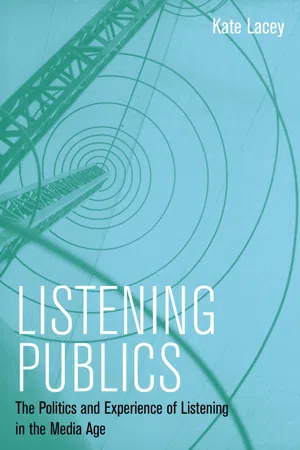
In focusing on the practices, politics and ethics of listening, this wide-ranging book offers an important new perspective on questions of media audiences, publics and citizenship. Listening is central to modern communication, politics and experience, but is commonly overlooked and underestimated in a culture fascinated by the spectacle and the politics of voice.
Listening Publics restores listening to media history and to theories of the public sphere. In so doing it opens up profound questions for our understanding of mediated experience, public participation and civic engagement.
Taking a cross-national and interdisciplinary approach, the book explores how listening publics have been constituted in relation to successive media technologies from the invention of writing to the digital age. It asks how new practices of listening associated with sound and audiovisual media transform a public world forged in the age of print.
Through detailed histories and sophisticated theoretical analysis, Listening Publics demonstrates the embodied and critical activity of listening to be a rich concept with which to rethink the practices, politics and ethics of media communication.
- English
- ePUB (mobile friendly)
- Available on iOS & Android
eBook - ePub
About this book
Information
Listening in the Age of Spectacle
3
Listening in Good Faith: Recording, Representation and the Real
Listening to the 8 a.m. news bulletin on the ‘flagship’ BBC radio Today programme on 28 March 2008, there was a hilarious moment that soon went viral when the newsreader, Charlotte Green, ‘corpsed’ in uncontrollable giggles while reading an obituary.1 It was the previous report that had set her off – the sound of the world’s first recording of the human voice. It dated to seventeen years before the invention of the phonograph, and twenty-eight years before the otherwise oldest surviving playable recording.2 The voice singing ‘Au clair de la lune’ had been recorded on 9 April 1860 by Édouard-Léon Scott de Martinville on his ‘phonoautograph’, a device that etched sound waves on smoke-blackened paper, but was not capable of playing them back. This graphical inscription had now been translated into a ten-second digital audio clip by the ‘First Sounds’ research group, and presented to the Association for Recorded Sound Collections at Stanford. The New York Times (27 March) described the result:
the anonymous vocalist, probably female [and possibly Scott’s daughter], can be heard against a hissing, crackling background din. The voice, muffled but audible, sings […] a lilting 11-note melody – a ghostly tune, drifting out of the sonic murk.
That’s not how the Today producer heard it, commenting into Green’s earpiece as the piece was playing that it sounded like a bee buzzing in a bottle – an arguably more accurate description. For audio historians this recording represents a moment of the highest significance in the story of sound media; for the contemporary listener it was literally a laughable technological failure. It was laughable for not sounding like a voice in song – for not sounding like the real thing.
Listening for Real
The expectation that recordings will sound like ‘the real thing’ runs like a red thread through the history of mediated sound and underpins the construction of listening publics in the media age. Sound recording would open up a radically new realm of representational practices which would take many forms, but it was the mimetic qualities of the new technology that were first seized upon, either in terms of reproducing the ‘original’ sound as nearly as possible, or in reproducing the ‘original’ listening experience. Inasmuch as a public is an imagined community reflected back to itself, that reflection must be recognizable, apparently transparent and trustworthy. The history of audiorealism, then, so often told in terms of technology, aesthetics or taste, can also be understood as constitutive of a new form of public experience, involving new forms of listening for the real – however defined – and listening past the processes of mediation.
Every new medium has been attended by claims that it allows reality to be differently, more persuasively and more completely ‘recorded’. Characteristically it will be claimed the new representations mark a radical departure from those available via older technologies; that they are in various ways superior and represent another stage in the inevitable march of progress; and that they allow a more direct access to reality. Media history of course doesn’t simply repeat itself but ‘our culture still speaks about new communication technologies in remarkably familiar ways’ (Spigel 1992: 182). Certainly the discourses of realism that have clustered around sound technologies, from the phonograph to digital audio, are in turn deeply embedded in familiar and powerful discourses of technological determinism, ineluctable progress and realist aesthetics. That the debates tend to focus on the science or technics of ‘reproduction’ serves to disguise how much they are also caught up in the art of representation and the conventions of listening. The dominance of the realist discourse is particularly remarkable in relation to new audio media because it runs alongside the other prevalent claim that digital audio, like other non-analogue technologies, is endlessly manipulable and therefore poses a challenge to established epistemological categories, including the codes of realism.
The modern media’s fascination with realism finds its roots in the eighteenth century, when the processes of modernization began to undermine the stable and ‘knowable communities’ which had characterized most people’s lived experience. This is the period which gave rise to new forms of social representation – from the novel to social statistics, from the encyclopedia to the newspaper; all forms which transcended the knowledge available to first-hand experience (Peters 1997). These new forms in all their variety and invention, whether presented as narrative or as information, or as something inbetween, were all somehow concerned with the documentation and representation of ‘actualities’ – contemporary events taking place in different places at the same time – that reflected the social world back to itself. The newspaper is a prime example – organizing its content by date according to narrative principles of miscellaneity and comprehensiveness. There need not be, indeed there rarely is, any connection between one story and the next, other than it having occurred in the same time frame.
The new media of film and phonograph separated out sounds and sights in ‘real’ time, as they unfolded in the world (unlike the retrospective reporting of print and other visual arts). This is what Niklaus Luhmann called realzeitliche Gleichzeitigkeit, or real time simultaneity (1996: 79). Sound recordings also unfolded in real time at the point of playback, however distant that was in time from the originating sound event. Or, to put it more poetically, ‘[t]he stream of time could be bottled and stored for later use’ (Peters 1999: 144). The storage of sound, however, does not render the perception of sound any less evanescent, notwithstanding the possibility of repetition or reversal. This tendency of sound to disappear – or rather, to dissipate into space – this sense of movement and fleetingness, means that listening is always also caught up in the moment; it is an active disposition, always straining toward the present tense, a sense of presence. Phonography tapped into deep-seated desires about letting time stand still, about becoming immortal – although ironically the commercial application of the technology, in achieving the mass production of serially interchangeable ‘hits’, far from guaranteeing ‘immortality’, produced a new ephemerality in the marketplace (LeMahieu 1988: 89; Ross 2008: 50).
The rise of modernity, then, marked the beginning of a continuing fascination with realist representations of the entire social horizon of experience from the extraordinary to the mundane. What is particularly salient is that these new realist forms of reflexive representation emerged as part of the same nexus that produced the modern public sphere. Political discourse echoed technical advances in verisimilitude, promising ‘real representation’ and ‘direct experience’. Discourses of realism thus surrounded the introduction of the new recording technologies and their later grafting on to electrical media of transmission in the form of broadcasting. The apparent connection to ‘the real’ was part of the appeal for audiences, and part of their hold over them. As Rick Altman (1992: 30) has put it, ‘Between the illusion of reproduction and the reality of representation lies the discursive power of recorded sound’.
Lisa Gitelman (2006: 26–57) has provided a meticulous account of the way Edison’s invention was publicized via a series of exhibitions across the US, in which its powers of mimicry were extolled. According to the exhibition literature accompanying the first demonstration in April 1878, Edison’s assistant ‘sung and shouted and whistled and crowed’ into the mouthpiece and then, as the next day’s Washington Star reported, ‘the same sounds floated out upon the air faint but distinct’ (Gitelman 2006: 31–2). Hundreds of exhibitions by the Edison Speaking Phonography Company followed. Usually, after an edifying explanation and demonstrations of the working principles of phonography, members of the public were invited to speak or sing or make any noise they liked into the machine, to hear ‘themselves’ back, often keeping the tinfoils as material mementoes or curiosities to show to friends and family.
Edison boasted that his phonograph could reproduce sounds, ‘with all their original characteristics at will’ (1878: 530). With no discrimination it picked up any noise within its range, including ‘the messy glissandi and dissonances of the natural world’ (Armstrong 2005: 1).3 Although the phonograph was named for its ability to ‘write sounds’, it was not experienced only, or even primarily, as a transcription device. The ‘living’ sounds it produced inspired anthropomorphized accounts of its mimicry, such as this from Harper’s Weekly in March 1878:
This little instrument records the utterances of the human voice, and like a faithless confidante repeats every secret confided to it whenever requested to do so. It will talk, sing, whistle, cough, sneeze, or perform any other acoustic feat. With charming impartiality it will express itself in the divine strains of a lyric goddess, or use the startling vernacular of a street Arab (in Heumann 1998: n.p.).
Its technical indiscriminacy allowed phonography to be understood as an egalitarian medium, ready to give voice to all and sundry – the hierarchies of taste and class preserved only in the accompanying commentaries. The mystery of the recording process and its uncanny ability to capture the idiosyncrasies and accidents of all forms of expression occupied commentators for decades to come. In its automated relation to the arbitrary, the random, the transitory and the irrational, it marked the dawn of ‘sonic modernity’, a break with the musical traditions of transcribing and reproducing sound (Kahn 2002: 180). It was precisely this inscription of the accidental, the reproductions of human frailties and imperfections that was so fascinating – and so frustrating for recording artists. Minute details, fleeting sounds, could be amplified both literally and figuratively, attracting a level of attention never possible before. Where art had sought to aestheticize and improve upon nature, this new artifice made a virtue of reproducing nature ‘in the real’. Here was a representational system without system, seemingly without any preconceived categories of selection or aesthetic priority. This radical shift in representational convention ‘effectively reversed the rational hierarchy between the essential and inessential, between substance and accident’ (Lastra 2000: 46). The phonograph, like the photograph before it, was apparently imbued with the scientific – and public – virtue of disinterested objectivity. Its relation to the ‘real’ seemed to be one of a passive and diligent recorder, a talking machine that would simply tell it like it was.
Phonography as Public Record
From the outset it was assumed phonography would have a role in documenting public life. Speaking to the Scientific American in 1877, Edison forecast the uses to which he envisaged his invention could be put:
for taking dictation, for taking testimony in court, for reporting speeches, for the reproduction of vocal music, for teaching languages […] for correspondence, for civil and military orders […] for the distribution of the songs of great singers, sermons and speeches, the words of great men and women (in Kittler 1999: 78).
Music is notably rather underplayed in this list. It has been suggested its relegation at this early juncture was to do with poor sound quality (Chanan 1995: 3), although it is only from the perspective of current recording practice that it is possible to talk of ‘relegation’ in this way (Sterne 2003: 202–4). What is more striking about Edison’s list, composed at the very dawn of recorded sound, is how much of it is devoted to intervening in the public sphere. Edison (1878: 534) was motivated by the desire to preserve sound for posterity:
to preserve for future generations the voices as well as the words of our Washingtons, our Lincolns, our Gladstones, etc., and to have them give us their ‘greatest effort,’ in every town and hamlet in the country.
The voices of the great and the good were thus to be recorded in the public interest, although there was a commercial interest too, with voices sold as souvenirs – and at a premium when a celebrated voice ‘had been stilled’. The Columbia Phonograph Company distributed the dying words of Pope Leo XIII in September 1905, but was at pains to point out in its advertising that he was ‘aged and feeble’ so the length and volume of the recording was not the same as their customers could expect from their entertainment records.4 In November 1910 the Gramophone Company took out an advert in The Times, announcing in bold type, ‘Tolstoy’s Last Message’, available for 3/6s. In copy which exploited the company’s trademark of ‘His Master’s Voice’ to merge the voice of the master writer with the voice of the company’s gramophone, the advert declared:
A master mind has passed on – but the living voice, so often raised in the cause of right, is with us still. The great philosopher took care his message should not die, and left, in the shape of a wonderful Gramophone record – spoken by himself in English – an epitome of his philosophy, as a legacy to the English-speaking world. His own words – his own voice – spoken in English – spoken by the Gramophone.5
The promise of hearing voices of the past was not met with universal enthusiasm. The first response of the Manchester Guardian on hearing of Edison’s invention was ‘That it should be possible to make a man’s words live literally for ever, is terrible’ (21 January 1878: 5). Even a quarter of a century later, in response to a campaign to have the British Museum archive the voices of the famous, a columnist railed sardonically against the prospect:
Hard enough is life in our time, but one trembles to think of the lot of our unfortunate descendants. Not only will they have the speakers of their own day, but the bottled up oratory of past generations. Are the echoes of the fiscal controversy ever to ring down the corridors of time? Are our present MPs fit to go cackling through the centuries? Is the comic singer who has wearied us to torment our posterity? Our grandchildren won’t comprehend the meaning of that delightful phrase ‘the silence of the tomb’.6
As an instrument that could store a voice for posterity, the phonograph was quickly adopted by anthropologists and linguists to put the words, voices and sounds of cultures at home and abroad literally on record, cataloguing and classifying them in pioneering sound archives (Rühr 2008: 51–2).7 The great advantage for social scientists interested in language was the technological ability to reproduce the glossolalia erased in written transcriptions. Michel de Certeau (1996: 29–30) uses this term to describe how the ‘bodily noises, quotations of delinquent sounds, and fragments of others’ voices’ erupt into ordinary conversation, disrupting ‘discursive’ expression. As sound recording and reproduction became more established, developing its own sense of institutionalized authority, so too did it increasingly follow this logic of suppressing the glossolalia of everyday speech, surrendering to the standards of scripted discourse. The more authoritative and institutionalized discourse becomes in literate cultures, for example in political, religious and academic circles, the less tolerated become the hesitations, tics and ‘drifting sounds’ of mundane conversational speech. Discourse in this sense tries to free itself from the fragility of dialogue, from these ‘noises of otherness’, a process in which the interlocutor ‘is removed to a distance, transformed into an audience’. The technological possibility of ‘retakes’ and editing underscored this logic, in a doubling of the technical search for perfection. And yet, it is precisely this potential to represent embodied speech in the public sphere that is so radical a move.
Such was the power of the idea of transparent phonographic reproduction that listeners did not at first seem too troubled by the ‘reality gap’ that is all too apparent to ears accustomed to more modern recordings. Indeed, early audiences were enthusiastic about the distortions of the sound of ‘real’ sound produced either accidentally by the machine or intentionally by running the recording backwards or at a different speed (Lawrence 1991: 13). There was also a certain egalitarian accessibility inasmuch as listening to recordings did not seem to require any particular scientific, technical or musical training of the ear. In its infancy, then, the very fact of the recording and the thrill of experiencing it was privileged over the ‘quality’ or content of the recording. Soon enough, though, the reproductive quality of musical recordings in particular came under increasing scrutiny.8
Learning Mediated Listening
Despite relentless advertising about the ‘true’, ‘perfect’ or ‘faultless’ qualities of sound (terms found in almost any advertising copy for phonographs and gramophones after 1900), recordings were often panned as ‘tinny’ or ‘canned’ by music critics. The Edison Company responded by working hard to persuade the public via advertising and on-stage ‘Tone Tests’ that the quality of their recordings could compare with live recitals (Thompson 2002: 237; Sterne 2003: 261–6). These public sound tests and other gramophone concerts indicate the lively public interest in the new technology and its claims for audiorealism, and are just one example of successive ‘high-fidelity spectacles’, that were expressions of a ‘longstanding love of the technological sublime’ (Barry 2010: 117). On the other hand, they can also be read as evidence of the extraordinary effort required to persuade the public of the fidelity of these sounds, which might indicate that the relationship between copy and source was never quite transparent. Although it is doubtful audiences were ever fully persuaded of the fidelity promised, these public events did help legitimate the comparison between recording and live performance in the minds of the general audience (Thompson 1995, 2002: 238). They are also an intriguing ea...
Table of contents
- Cover
- Dedication
- Title page
- Copyright page
- Acknowledgements
- Preface
- Listening Overlooked
- Listening in the Age of Spectacle
- Ways of Listening
- Listening in the Public Sphere
- References
- Index
Trusted by 375,005 students
Access to over 1.5 million titles for a fair monthly price.
Study more efficiently using our study tools.
Frequently asked questions
Yes, you can cancel anytime from the Subscription tab in your account settings on the Perlego website. Your subscription will stay active until the end of your current billing period. Learn how to cancel your subscription
No, books cannot be downloaded as external files, such as PDFs, for use outside of Perlego. However, you can download books within the Perlego app for offline reading on mobile or tablet. Learn how to download books offline
Perlego offers two plans: Essential and Complete
- Essential is ideal for learners and professionals who enjoy exploring a wide range of subjects. Access the Essential Library with 800,000+ trusted titles and best-sellers across business, personal growth, and the humanities. Includes unlimited reading time and Standard Read Aloud voice.
- Complete: Perfect for advanced learners and researchers needing full, unrestricted access. Unlock 1.5M+ books across hundreds of subjects, including academic and specialized titles. The Complete Plan also includes advanced features like Premium Read Aloud and Research Assistant.
We are an online textbook subscription service, where you can get access to an entire online library for less than the price of a single book per month. With over 1.5 million books across 990+ topics, we’ve got you covered! Learn about our mission
Look out for the read-aloud symbol on your next book to see if you can listen to it. The read-aloud tool reads text aloud for you, highlighting the text as it is being read. You can pause it, speed it up and slow it down. Learn more about Read Aloud
Yes! You can use the Perlego app on both iOS and Android devices to read anytime, anywhere — even offline. Perfect for commutes or when you’re on the go.
Please note we cannot support devices running on iOS 13 and Android 7 or earlier. Learn more about using the app
Please note we cannot support devices running on iOS 13 and Android 7 or earlier. Learn more about using the app
Yes, you can access Listening Publics by Kate Lacey in PDF and/or ePUB format, as well as other popular books in Social Sciences & Media Studies. We have over 1.5 million books available in our catalogue for you to explore.