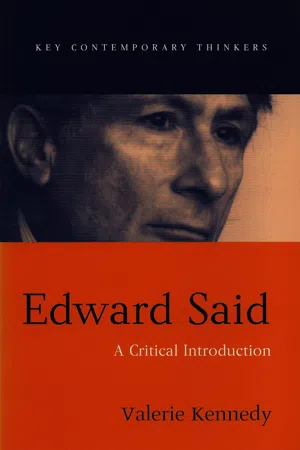
Edward Said
eBook - ePub

Edward Said

A Critical Introduction

  1. English
  2. ePUB (mobile friendly)
  3. Available on iOS & Android
eBook - ePub

Edward Said

A Critical Introduction

About this book

Edward Said is one of the foremost thinkers writing today. His work as a literary and cultural critic, a political commentator, and the champion of the cause of Palestinian rights has given him a unique position in western intellectual life. This new book is a major exploration and assessment of his writings in all these main areas.

Focusing on Said's insistence on the connection between literature, politics and culture, Kennedy offers an overview and assessment of the main strands of Said's work, drawing out the links and contradictions between each area. The book begins with an examination of Orientalism, one of the founding texts of post-colonial studies. Kennedy looks at the book in detail, probing both its strengths and weaknesses, and linking it to its sequel, Culture and Imperialism. She then examines Said's work on the Palestinian people, with his emphasis on the need for a Palestinian narrative to counter pro-Israeli accounts of the Middle East, and his searing criticisms of US, Israeli, and even Arab governments. The book closes with an examination of Said's importance in the field of post-colonial studies, notably colonial discourse analysis and post-colonial theory, and his significance as a public intellectual.

This book will be of great interest to anyone studying post-colonialism, literary theory, politics, and the Middle East, as well as anyone interested in Said's writings.

Frequently asked questions

Yes, you can cancel anytime from the Subscription tab in your account settings on the Perlego website. Your subscription will stay active until the end of your current billing period. Learn how to cancel your subscription.
At the moment all of our mobile-responsive ePub books are available to download via the app. Most of our PDFs are also available to download and we're working on making the final remaining ones downloadable now. Learn more here.
Perlego offers two plans: Essential and Complete
  • Essential is ideal for learners and professionals who enjoy exploring a wide range of subjects. Access the Essential Library with 800,000+ trusted titles and best-sellers across business, personal growth, and the humanities. Includes unlimited reading time and Standard Read Aloud voice.
  • Complete: Perfect for advanced learners and researchers needing full, unrestricted access. Unlock 1.4M+ books across hundreds of subjects, including academic and specialized titles. The Complete Plan also includes advanced features like Premium Read Aloud and Research Assistant.
Both plans are available with monthly, semester, or annual billing cycles.
We are an online textbook subscription service, where you can get access to an entire online library for less than the price of a single book per month. With over 1 million books across 1000+ topics, we’ve got you covered! Learn more here.
Look out for the read-aloud symbol on your next book to see if you can listen to it. The read-aloud tool reads text aloud for you, highlighting the text as it is being read. You can pause it, speed it up and slow it down. Learn more here.
Yes! You can use the Perlego app on both iOS or Android devices to read anytime, anywhere — even offline. Perfect for commutes or when you’re on the go.
Please note we cannot support devices running on iOS 13 and Android 7 or earlier. Learn more about using the app.
Yes, you can access Edward Said by Valerie Kennedy in PDF and/or ePUB format, as well as other popular books in Literature & Literary Criticism Theory. We have over one million books available in our catalogue for you to explore.

Information

Table of contents

  1. Cover
  2. Title page
  3. Copyright page
  4. Key Contemporary Thinkers
  5. Acknowledgements
  6. Abbreviations
  7. Introduction
  8. 1 Orientalism
  9. 2 Imperialism in the Middle East: Palestine, Israel and the USA
  10. 3 After Orientalism: Culture and Imperialism
  11. 4 Said and Postcolonial Studies
  12. Conclusion
  13. Bibliography
  14. Index