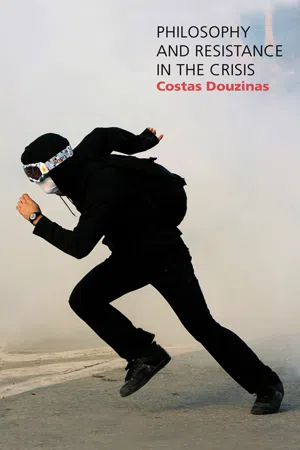
This book is about the global crisis and the right to resistance, about neoliberal biopolitics and direct democracy, about the responsibility of intellectuals and the poetry of the multitude. Using Greece as an example, Douzinas argues that the persistent sequence of protests, uprisings and revolutions has radically changed the political landscape. This new politics is the latest example of the drive to resist, a persevering characteristic of the human spirit.
The EU and the IMF used Greece as a guinea pig to test the conditions of social reconstruction in times of crisis. But the manifold resistances turned the object of experimentation into a political subject and overturned the plans of elites. The idea and limits of democracy are redefined in the place of their birth.
- English
- ePUB (mobile friendly)
- Available on iOS & Android
eBook - ePub
About this book
Information
Part I
Crisis

THE QUEEN’S QUESTION
The debt’s debt
In the summer of 1918, Constantin Cavafy and E. M. Forster met in Alexandria and became lifelong friends. Forster reports that Cavafy,
half humorously, half seriously, once compared the Greeks and the English. The two peoples are almost exactly alike, he argued: quick-witted, resourceful, adventurous. ‘But there is one unfortunate difference between us, one little difference. We Greeks have lost our capital – and the results are what you see. Pray, my dear Forster, oh pray, that you never lose your capital.’ That was in 1918. British insolvency seemed impossible then. In 1951, when all things are possible, his words make one think – words of a very wise, very civilized man, words of a poet who has caught hold of something that cannot be taken away from him by bankruptcy, or even death.1
Giorgio Agamben, commenting on Cavafy’s mysterious statement, writes in 1993: ‘The only certainty is that since [1918], all the peoples of Europe and perhaps the whole world have gone bankrupt.’2 The Greeks, the Europeans, and perhaps everyone, have been bankrupted. Greece was declared substantively bankrupt in 2010 albeit in ‘orderly fashion’ and only temporarily. Temporary default is a little like temporary death. It lasts forever unless the departed exits on the other side. Posthumous life is unlikely; the temporary is the mask of the permanent, resurrection the fig leaf of death. Formal default was avoided through loans by the European Union and the International Monetary Fund used to repay old loans, thus increasing the overall debt. They are accompanied by the harshest austerity measures and deepest depression in peacetime. All this is well known and there is no point in adding a further (and perhaps ill-informed) layer of economic analysis.3 This is perhaps the time to sit back and serve the debt of (non-economic) thought, something not in great evidence. For Right and Left, the urgent demand has been ‘act now’, ‘act decisively’, ‘this is no time for contemplation’. Everyone agrees that the overwhelming responsibility is to save the Euro/Greece/Spain/Europe whatever the cost. The humanitarian catastrophe, the huge fall in living standards, the fire sale of the remaining public assets are necessary steps towards this rescue. If ‘rescue’ means that Greece stays in the euro and keeps repaying its gargantuan debt, redemption is unlikely but not impossible.
Cavafy and Agamben may have had something different in mind. What if Greece, and perhaps Europe, have been bankrupted not economically but morally, culturally, politically? The book explores another sense of debt and bankruptcy: moral and political debt and the bankruptcy of social ethos. Every newspaper and news broadcast agonizes over the ‘euro or drachma’ dilemma. The debt of thinking, debt’s debt, poses different questions. What is the gain if Greeks keep the euro and lose their soul? We will escape temporarily and partially the endless repetitions of the economists and concentrate on what gives meaning to life: the political, ethical, semiotic and cultural aspects of crisis and resistance. The debt’s debt leads to thinking.
The Queen’s question
Two spectres hover over Europe and the world: bankruptcy and resistance. Bankruptcy of states, banks, companies and individuals; resistance of people, communities, nations. In this chapter, we leave resistance hovering to concentrate on debt. Its ghost has been appearing for some time. Its arrival had been predicted. If bankruptcy is the death of a political economy and a form of life, this is the chronicle of a death foretold. The world financial system collapsed in 2008 under the weight of its own contradictions. Financial speculation and virtual capital imploded when finally the real economy claimed its dues. Billions of dollars were transferred from the taxpayers to financial institutions, giving a temporary respite to the banking system. Following the collapse, people started losing homes, jobs and businesses but no philanthropy was forthcoming. No funds were available to save schools, hospitals and family homes. A new type of political economy emerged in those turbulent months: socialism for the rich, capitalism for the poor. Or, to paraphrase Bertolt Brecht, you go to jail for fiddling your benefits but you get huge bonuses for bankrupting a bank.
The Queen, during an official visit in November 2008 to the London School of Economics, an elite school consistently preaching the neo-liberal doctrine, asked a prominent professor of economics a simple question: ‘If these things were so large, how come everyone missed them?’ How come your brilliant models failed to predict the most dramatic event in recent economic history? How come that you can go to bed and have a good night’s sleep, one could add, when you know that your theories have destroyed so many people? The professor’s answer is not known. A year later, after a British Academy seminar, eminent economists blamed ‘a failure of the collective imagination of many bright people, both in this country and internationally, to understand the risks to the system as a whole’.4 The Queen’s question reversed the tale of the Emperor’s new clothes. Her innocent question imitated the child who, faced with the sycophantic praise of the Emperor’s clothes, followed his eyes’ evidence: the Emperor is naked. The Queen became for a moment the demystifying child questioning those who represent the contemporary sovereign. It is a rhetorical question that can have only one answer: economics is not an exact science and cannot deliver the ‘objective’ knowledge it claims to possess. Mainstream economics is not a royal road to knowledge. Not only is the Emperor naked but there are also more competitors for the Emperor’s title than during the Roman tetrarch. At least three major schools of economic theory have been used in the current crisis. The dominant neo-classical school, various types of Keynesianism and, finally, Left and Marxist approaches. They base their analyses on the same data but end up with widely diverging explanations of the crisis and its solution. George Osborne and David Cameron appear to have sound arguments. Nobody can claim on the other hand that Vince Cable or Robert Stiglitz are not ‘good’ economists or that Paul Krugman and Yannis Varoufakis have miscalculated. They are right within the parameters of their theoretical premises and ideological axioms. Economics is not an ‘objective’ science, but a field contested by various approaches and schools. As Max Weber first argued, immanent critique runs out when we reach incommensurate premises. Stronger force instead of better argument carries the day.
Monetarist and neo-classical policies have dominated the last thirty years. It was during their watch that the collapse of 2008 and of 2010–11 happened. The world was made to follow their prescriptions, which proved catastrophic. The disaster cannot be blamed on some miscalculation but to flawed premises. The dominant school of economics turns out to be a false emperor. Its high priests and priestesses could not have predicted the coming of the financial meltdown, precisely because their training and socialization did not allow them to see it coming. Alan Greenspan, the Governor of the American Federal Bank and high priest of the religion, stated in late August 2008, a few days before the collapse of Lehman Brothers on 18 September, that the economic system was sound, people should have trust and go on acting normally. As his huge Titanic moved inexorably towards the iceberg, Greenspan was a visually impaired captain. If my experience and instruments tell me that there is no iceberg on the horizon, he seemed to be saying, the evidence of my eyes and the warnings of a few miscreant crew must be wrong.
In October 2008, Greenspan gave evidence to a congressional committee about the banking debacle. Henry Waxman, its chairman, reminded him of an earlier statement: ‘I do have an ideology. My judgement is that free competitive markets are by far the best-organized economies.’ In light of this, Waxman asked whether Greenspan felt that his ‘ideology pushed him to make decisions that he wished he had not made’. Greenspan’s answer was striking: ‘I found a flaw in the model that I perceived as a critical functioning structure that defines how the world works.’ Financial institutions should have avoided risky speculation. ‘I made a mistake in presuming that the self-interests of organizations, specifically banks and others, were such as that they were best capable of protecting their own shareholders and their equity in the firms.’5 Absolute trust in the prudence of the markets and wilful ignorance of evidence compel a simple conclusion: neo-classical economics is a strong ideology with toxic effects.
Let me give another example. Between 2010 and 2012, European leaders held a number of summit meetings and reached various agreements with the IMF, which would guarantee the repayment of the gargantuan debts of the South European states, the elimination of deficits and economic recovery. On each occasion, the mainstream media reported the meetings breathlessly and celebrated the decisions. Economists from across the ideological spectrum, on the other hand, found the measures inadequate and predicted that only a radical debt reduction (whether debtor or creditor led) or an exit of the weaker members from the Eurozone followed by devaluation of the new currency would jumpstart the economy. Without such radical solutions, bankruptcy and decades of economic depression loom large. On each occasion, the adopted measures proved wrong or inadequate so soon after the ‘triumph’ that the ink had not dried yet on the press communiqués. The failure of diagnosis and cure is also evident at a lower level. In April 2010, the staunchly neo-liberal IMF predicted that austerity Greece would have −1% growth in 2011 and move to steady growth in 2012. In April 2011, it changed its forecast for the year to −3% growth. It turned out to be −7%. Finally, in April 2012, the IMF predicted −4% for the year. The Greek government is predicting −7% and most economists a −9% contraction.6 It does not take great knowledge to explain the abject failure of the ‘experts’. The Greek economy has experienced a 24% contraction over five years. Public spending cuts and tax increases during such a deep depression reduce demand, increase unemployment and halt growth. The slowdown shrinks tax revenues and increases spending for unemployment and other benefits. The deficit increases, causing the fiscal targets to be missed, leading to new austerity to plug the ever-increasing fiscal gap. The European south is caught in a deadly recession spiral that can be halted only with a radical change in policy. If the IMF functionaries were first-year economics students, they would have failed their exams. Unfortunately, their diktat makes millions fail their lives.
Liberal orthodoxy is like a ship the compass of which fails every time it approaches an iceberg. The Queen’s question implied that people must learn to live without the illusion of ‘objective’ expertise. For a brief moment, the repoliticization of the economy and its removal from the clutches of snake-oil salesmen appeared a possibility. The moment passed quickly. With some banks rescued by public funds and others closed, the toxic debt crisis moved to states and companies. The country bailouts were neo-liberalism’s revenge for its 2008 humiliation. Only that on this occasion, the outcome was easily predictable and the victims are not banks and hedge funds but whole populations.
Debt’s desire
It is the bad luck of the Greeks that the poor man’s Greenspans have been running the state for a considerable period of time. As deficit, public and private debt grew, the political and economic elites turned a blind eye and continued drawing cheap loans. The evidence is not hard to find. Excessive borrowing and debt increased after entry to the euro, with its strict 3% deficit ceiling reminding us that the best place to smoke is next to a non-smoking sign. But unlike Greenspan and the embarrassed LSE economist, the Greek captains precipitated the pending doom. Considerable evidence exists that the Greek government ‘doctored’ the macroeconomic figures in 2001 to gain entry to the euro. The spiralling loans and mounting debt were used by the ruling elites to oil the wheels of state patronage and party clientelism. In an unprecedented first, the incoming government challenged the statistics of their outgoing predecessors twice and had the deficit and debt revised upwards. In 2004, the New Democracy government claimed that its Pasok predecessor had lied. The Papandreou government repeated the tactic in 2010, claiming that New Democracy too had lied. It upgraded the deficit to 15.4% triggering the European intervention. To cap it all, every set of measures adopted increased the debt. The Greek debt was 120% of GDP in 2009 when austerity was imposed. It is 165% in 2012, it will move to 190% in 2014 and, after the pain of a dozen years, will reach 129% in 2021 (the initial calculation was that it would be ‘only’ 120% but then who can believe any of these forecasts), still above the 2009 position. Unlike their name, the austerity measures are multipliers of debt which keeps increasing and metastasing like a malign tumour.
The repeated revisions of deficit and debt have enriched the English language with the pejorative term ‘Greek statistics’. The revision of statistical data was initially interpreted as an attempt to defame party opponents and justify austerity policies. Was this type of creative accountancy petty politics, stubbornness or simple idiocy (a good Greek word meaning ‘private’)? Information is now emerging that an element of skulduggery may have been involved. In September 2011, the Papademos government sacked six members of the Greek Statistics Commission, because they stated that the deficit was falsely revised upwards. According to Zoë Georganta, a member of the Commission, the deficit was increased to 15.4% to make it larger than Ireland’s at the top of the list and allow the IMF to impose stricter austerity.7 In a further twist, Mr Roumeliotis, the Greek representative to the IMF at the time, stated that the Fund knew that austerity would fail before its imposition. Both he and Dominique Strauss-Kahn, the then IMF Head, had warned Papandreou not to accept the troika plan, he claimed, to no effect.8 To clarify things, I do not (need to) claim that dark conspirators schemed Greece’s downfall. Conspiracy theories do not help us understand history. But conspiracies do happen from time to time. One hopes against hope that the accusations will be properly investigated. They are not central to my argument. I do not have access to (or interest in) the minds and hearts of politicians and bankers. Without an account of the obvious and predictable consequences of actions, the revelation of motives cannot explain much. Whatever the motives, a combination of systemic pressures and conscious decisions has created the monster that is eating up Greece. This is what I call ‘the desire of debt’: a long series of decisions and actions, of intended or unintended consequences, which consistently and inexorably led to the Greek tragedy.
‘Debt’s desire’, as a double genitive, raises two questions. Who desired the debt and why? Secondly, what does the debt desire? What is the debt’s debt? The two meanings of debt, ‘what is (financially) owed’ and ‘what is morally due’, come together. The only consistent explanation of the debt trajectory, beyond party political calculation, is that the Greek elites desired and sought the debt, first by crazy borrowing and spending and then by deliberate increases in its calculation. ‘Unserviceable’ debt, ‘crippling’ deficit, potential bankruptcy were either desired or wilfully neglected. What does the debt desire? It is not difficult to detect. Because Greece owes, the Greeks must destroy the old and adopt radical new economic, cultural and moral values. They must abandon their ‘lying, lazy, cheating’ ways in order to service the debt. The debt, condemned as dismal and catastrophic in its evil effects, will allow the return to the path of virtue, morality and honour. Like the Platonic pharmakon, the debt is poison and cure, curse and blessing. It is the cause and effect of the Greek passion and the promised (and endlessly deferred) resurrection. How did we get here?
Mainstream European imagination has created two major socio-political models, classical liberalism and social-democracy. For classical liberalism, the market is an efficient and neutral mechanism for resource allocation. The belief in markets is accompanied by a commitment to a weak state and a strong rule of law. The state should intervene minimally in the economy but maintain a strong policing function to enforce agreements and repress challenges to the social order. Distribution is based on property, merit and increases in marginal productivity authenticated by law and contractual entitlements. Individual rights, modelled on the foremost right to property, and personal responsibility characterize the liberal citizen. The social democratic model, on the other hand, believes in a strong state, which regulates resource allocation according to social needs registered in democratic elections and negotiations with the social partners. It protects social and economic rights, emphasizes community belonging and social solidarity and transfers resources from richer to poorer areas and people to ensure a minimum standard of life.
This basic political division was blurred in the last thirty years by the convergence of classical liberalism and social democracy into what has become known as neo-liberalism. Neo-liberalism inherits aspects from both systems. It extends the market mechanism to the social state, privatizing public utilities and social amenities. It weakens economic and social rights and turns the law from arbiter of social conflict aspiring to neutrality into a detailed regulatory mechanism. Finally, the state remains strong. But this is no longer the protective state of social democracy (état providence is the apt French term) but a state of behavioural controls, extensive surveillance and emergency powers deemed necessary to uphold order and keep resistances in check. The neo-liberal age started in the 1980s when the deregulation of financial transactions, privatization of public assets and utilities at bargain prices and taxation regimes favouring transnational corporations were int...
Table of contents
- Cover
- Half Title
- Dedication
- Title
- Copyright
- Content
- Prologue: The age of resistance
- Part I Crisis
- 1 The Queen’s question
- 2 The biopolitics of pleasure and salvation
- 3 Anomie I: Social ethos and political cynicism
- 4 The crisis as spectacle
- Part II Philosophy
- 5 Adikia : The eternal return of resistance
- 6 Anomie II: Disobedience, resistance, sovereignty
- 7 Political ontologies
- 8 People, multitude, crowd
- Part III Resistance
- 9 Stasis Syntagma: The subjects and types of resistance
- 10 Demos in the square
- 11 Lessons of political strategy
- Epilogue: The Europe to come
- Notes
- Index
Trusted by 375,005 students
Access to over 1.5 million titles for a fair monthly price.
Study more efficiently using our study tools.
Frequently asked questions
Yes, you can cancel anytime from the Subscription tab in your account settings on the Perlego website. Your subscription will stay active until the end of your current billing period. Learn how to cancel your subscription
No, books cannot be downloaded as external files, such as PDFs, for use outside of Perlego. However, you can download books within the Perlego app for offline reading on mobile or tablet. Learn how to download books offline
Perlego offers two plans: Essential and Complete
- Essential is ideal for learners and professionals who enjoy exploring a wide range of subjects. Access the Essential Library with 800,000+ trusted titles and best-sellers across business, personal growth, and the humanities. Includes unlimited reading time and Standard Read Aloud voice.
- Complete: Perfect for advanced learners and researchers needing full, unrestricted access. Unlock 1.5M+ books across hundreds of subjects, including academic and specialized titles. The Complete Plan also includes advanced features like Premium Read Aloud and Research Assistant.
We are an online textbook subscription service, where you can get access to an entire online library for less than the price of a single book per month. With over 1.5 million books across 990+ topics, we’ve got you covered! Learn about our mission
Look out for the read-aloud symbol on your next book to see if you can listen to it. The read-aloud tool reads text aloud for you, highlighting the text as it is being read. You can pause it, speed it up and slow it down. Learn more about Read Aloud
Yes! You can use the Perlego app on both iOS and Android devices to read anytime, anywhere — even offline. Perfect for commutes or when you’re on the go.
Please note we cannot support devices running on iOS 13 and Android 7 or earlier. Learn more about using the app
Please note we cannot support devices running on iOS 13 and Android 7 or earlier. Learn more about using the app
Yes, you can access Philosophy and Resistance in the Crisis by Costas Douzinas in PDF and/or ePUB format, as well as other popular books in Politics & International Relations & Terrorism. We have over 1.5 million books available in our catalogue for you to explore.