- English
- ePUB (mobile friendly)
- Available on iOS & Android
eBook - ePub
About this book
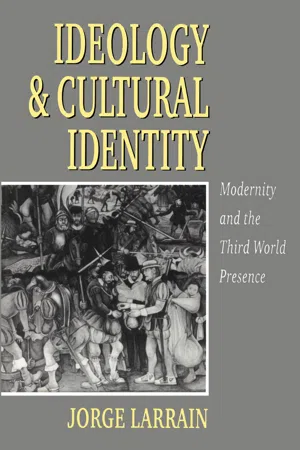
In this book Jorge Larrain discusses three of the most important concepts in the social sciences: ideology, reason and cultural identity.
Information
1
Ideology, Reason and the Construction of the Other
Introduction
The recent emergence of postmodernism has put at the centre of contemporary philosophical discussions the value of modernity and the problem of instrumental reason. However, it would be a mistake to believe that it is only with postmodernism that a thorough critique of the Enlightenment and its absolute trust in instrumental reason has been developed. From the very beginning, the belief in science and reason has been accompanied by critical theories, sometimes called historicist,1 which have emphasized the values of cultural relativism and have criticized the many problems created by the blind use of instrumental reason. While the typical theories influenced by the Enlightenment are universal theories of development which emphasize the identity of goals and the similarity of means in the course of history, the theories critical of modernity emphasize cultural differences and historical discontinuities.2 Although both types of theories have explicitly or implicitly developed their own critical conceptions of ideology, they do it in different ways. Theories that consciously want to develop the principles of modernity tend to criticize all obstacles – social, economic and philosophical – which stand in the way of reason, science and progress. Theories that regard modernity with suspicion tend to criticize reason and science themselves as ideological.
It is possible to argue as well that these two types of theories have a different approach to the cultural ‘other’. While universalistic total theories have difficulties in understanding otherness and difference and see history as a series of stages through which everybody has to go, historicist theories have difficulties in understanding common problems and the forms of equality which stem from a shared humanity. To them, history is not a universal but a segmented process whose understanding requires empathy with the different cultural essence which each nation develops. Universalistic theories look at the ‘other’ from the perspective of the European rational subject; they tend to apply a general pattern which postulates its own absolute truth, thus reducing all cultural differences to its own unity. Historicist theories look at the ‘other’ from the perspective of its unique and specific cultural set-up, thus emphasizing difference and discontinuity. There are dangers implicit in both positions. While the emphasis on absolute truth and historical continuity may lead to reductionism and neglect of the other’s specificity, the emphasis on difference and discontinuity may lead to the construction of the other as inferior. Two forms of racism may be the result of these extremes: whereas universalistic theories may not accept the other because they cannot recognize and accept its differences, historicist theories may dismiss the other because it is constructed as a different, inferior being.
These two types of theories have, tendentially, different conceptions of history and cultural identity. Universalistic theories tend to conceive of history as universal, unilineal, teleological progress, whereas the historicist approach conceives of history as a goalless, discontinuous and segmented process which has no universal direction. Paradoxically, the emphasis on historical specificity leads historicist theories to conceive of cultural identity ahistorically, as an essence, as an immutable spirit which marks an unbridgeable difference between peoples and nations. The emphasis on history as unilineal progress, on the contrary, may disregard historical specificities, but usually accepts a notion of cultural identity as a process of construction and reconstruction which cannot be reduced to an essence.
Some good examples of what I have called the typical universalistic theories of modernity are classical political economy, Marxism, Weberian modernization theory and neo-liberalism. They constitute important totalizing theories of development which possess an underlying theory of history and propose a universal road to progress to all countries. Although some of them go back to the eighteenth or nineteenth century, they have been very influential world-wide until today. In spite of their many differences, some of their essential underlying philosophical assumptions are very similar. These theories take different angles to see and approach the big project of modernity which had its roots in the European Enlightenment. They all start from a firm belief in instrumental reason and in science, in the idea that we can understand reality and transform it, thus improving our lives. Reason for them is no longer autonomous, beyond the power of human beings; it is an instrument of control and domination of nature, an auxiliary means of production, a way of manipulating means to achieve our ends. Common to these theories as well is the assumption that they can diagnose and analyse undesirable social situations and do something about them. Hence the importance of ideology critique for all of them. They believe that it is possible to establish by means of rational argument that certain prevailing ideas are distorted or wrong.
Hence, all traditional theories of development typical of modernity adhere to a particular notion of reason and conceive of history in terms of the deployment and progressive success of certain forms of agency which specifically express the progress of reason. From the vantage point of such conceptions of historical reason it is possible to ascertain erroneous forms of action and distorted ideas which represent obstacles to the progress of reason. Thus specific forms of ideology critique are developed. Theories of development entail theories of historical reason and theories of ideology.
For example, classical political economy argued in favour of private property, free trade and the establishment of market forces in all the domains of the economy. The entrepreneur became the main agent of progress as the producer of wealth and development. Historical reason was deployed in the free and continuous advance of productive forces and material wealth achieved by market forces. Hence the remnants of feudalism became the main object of ideological critique. Feudalism encroached upon production, and did not allow free trade and free labour. It had, then, to be dismantled so that reason and science could be applied to the productive process. Marxism in its turn makes a case for the socialization of the means of production and considers the proletariat, the direct producer, as the agent of historical reason which will be fully realized in classless society. From this position Marx develops a concept of ideology with which he criticizes the dominant political ideas of capitalism for concealing forms of inequality and exploitation. However, in proposing socialism as a road to the further development of productive forces, Marxism reaffirms a process of change and instrumental rationalization, but in a more radical manner and by the utilization of different means.
Modernization theory, drawing on the ideas of Max Weber, sees society in transition to modernity, in a process of increasing rationalization, a process whereby the traditional absolute forms of rationality typical of aristocratic and religious ideas must be criticized and set aside. Absolute reason fixed legitimate ends and means without regard to their productive usefulness, thus hindering progress and change. So it had to be replaced by new forms of instrumental rationality which maximized control, adaptation and productivity. However, an important difference between Weber’s theory and the post-war modernization theories must be noted. Whereas the latter see in the process of rationalization and secularization not only a necessity but also the fulfilment of human hopes for a better life, the former is aware of the grave risk that human beings will be increasingly dominated by the ‘iron cage’ of bureaucratized structures and reified relationships. Still, both see the process as ineluctable. Neo-liberalism, in its turn, constitutes a recent revival of Adam Smith’s ideas which consider free market and free trade as the panaceas which bring about the wealth of nations. The main historical difference from classical political economy is that the ideological critique has shifted from feudalism to Marxism and socialist ideas of the interventionist state. The problem is no longer seen as mercantilism but the more recent Keynesian policies which, according to neo-liberalism, lead to protectionism, excessive state expenditure on welfare, and the excessive power of trade unions, all of which result in poor economic growth.
Ideology and Reason
The concept of ideology was born in the context of the early bourgeois struggles against feudalism and the traditional aristocratic society. These struggles were very much the backcloth of the eighteenth-century Enlightenment, which is, more precisely, the cultural and philosophical environment within which the concept of ideology was generated for the first time. This historical context helps us understand why the concept of ideology emerged, first, as a science of ideas which entailed a deep trust in reason and, second, as a critical weapon to be used in the struggle against the old regime. Both aspects were inextricably linked. It was precisely the belief that truth could be rationally and scientifically achieved, and that armed with it society could be rationally reconstructed, that provided the Enlightenment with the confidence to criticize irrational, metaphysical and religious ideas. Not only were these forms of knowledge deemed to be distorted and superstitious but by spreading ignorance and error among the masses they worked in the interest of, and buttressed, aristocratic power. As the unhappiness of humankind was believed to be related to ignorance and prejudice, rational and lay education was thought to be the liberating solution. Ideology as a science thus entailed a renewed optimism and confidence in progress, reason and education; it believed in the emancipation of humankind.
The belief in reason, especially the belief in instrumental reason, is closely tied up with a critical concept of ideology. Everything that appears traditional or backward, everything that does not lead to progress, is the opposite of reason, is ideology. Ideology is a notion that is used to defend reason, to criticize all those ideas which are not progressive, which do not help control nature to the benefit of human beings. Instrumental reason is anthropocentric and subjective. The human being is the centre, the measure of all things. Instrumental reason is the tool that allows us to control and dominate, the tool that introduces calculability, cost and benefit. Instrumental reason therefore tends to reduce that which is good for humankind to that which increases productivity. Reason becomes an auxiliary means of production, and ideology becomes its critical weapon.
The spirit of modernity was imbued with these ideas: progress was material progress; it was growth in the production of material goods. In so far as metaphysics, religion and mythology did not help to control nature, to increase production, they had to be attacked as ideological forms. So there is a close relation between the belief in instrumental reason and the critical concept of ideology as the opposite of science or reason. In this sense there is a common thread from the French Enlightenment philosophers of the eighteenth century to the neo-liberal thinkers of today: they all wage battle against ideology as the antithesis of reason. The close historical relationship between reason and ideology makes an implicit reference to agency, that is to say, there are agents of reason and ideology. The former are for progress, the latter oppose it. At the beginning of bourgeois struggles they were synthesized in the bourgeoisie versus the feudal lords but could also be symbolized in the scientist-educator versus the priest.
With the development of bourgeois society and the expansion of capitalism, serious problems, irrationalities and contradictions inherent in the system came to the fore. Two theoretical possibilities emerged to confront them. On the one hand, by taking as a model the bourgeois critique of metaphysics and religion, Marx developed his concept of ideology in order to unmask the new forms of domination and exploitation. Ideology was no longer a science but a kind of distorted consciousness which masked the contradictions of society, thus contributing to the reproduction of the system. Marx strongly believed in reason, but for him the new proletarian class rather than the bourgeoisie was to be its bearer in order to liberate humankind. The agent was changed but the belief in emancipation was kept. Thus Marx accomplished the first important transposition in the meaning of ideology, from a science to a specific kind of distortion, but maintained the belief in reason and emancipation and the need to criticize those ideas which, by concealing the real problems of society, put obstacles in the way of the emancipatory forces.
Marx and Ideology
Marx’s early critique of religion first outlines such a mechanism: religion compensates in the mind for a deficient social reality; it reconstitutes in the imagination a coherent but distorted solution which goes beyond the real world in an attempt to resolve the contradictions and sufferings of the real world. As he put it, ‘religious suffering is at one and the same time the expression of real suffering and a protest against real suffering. Religion is the sigh of the oppressed creature.’3 Religion appears as an inversion because God, being a creature of the human beings’ mind, becomes the creator, and the human beings, who create the idea of God, become the creatures. But this inversion in the mind responds to and derives from a real inversion: ‘this state and this society produces religion, which is an inverted consciousness of the world, because they are an inverted world.’4
When Marx criticizes the German philosophers and left Hegelians, the same mechanism of inversion is present. The German ideologists believed that the true problems of humankind were mistaken and religious ideas which they could destroy by criticism. They forget, Marx and Engels aver, that ‘to these phrases they themselves are only opposing other phrases, and they are in no way combating the real existing world.’5 Their ideological inversion consists in their starting from consciousness rather than material reality; instead of looking at German reality ‘they descended from heavens to earth.’ Again, this mental inversion responds to a real inversion in reality: ‘If the conscious expression of the real relations of these individuals is illusory, if in their imagination they turn reality upside-down, then this in its turn is the result of their limited material mode of activity and their limited social relations arising from it.’6
Similarly, when analysing the capitalist mode of production, Marx distinguishes the sphere of appearances (the market) from the sphere of inner relations (production), and argues that there is a basic inversion at the level of production, namely, the fact that past labour dominates living labour (the subject becomes an object and vice versa), and that this inversion ‘necessarily produces certain correspondingly inverted conceptions, a transposed consciousness which is further developed by the metamorphoses and modifications of the actual circulation process’.7
These examples, taken from Marx’s analyses at different points in his intellectual evolution, show a consistent pattern in spite of their different nature. In all of them there is a reference to an ‘inverted consciousness of the world’ which corresponds to an ‘inverted world’. This inverted world is practically produced by a ‘limited material mode of activity’ as a contradictory world and is simultaneously projected into distorted forms of consciousness which conceal and misrepresent that contradictory reality. The role of ideology is to help reproduce that contradictory world in the interest of the ruling class. But ideology is not the result of a conspiracy of the ruling class to deceive the dominated classes, nor is it an arbitrary invention of consciousness. It is rather a spontaneous or elaborated discursive attempt to deal with forms of oppression and contradictions which is unable to ascertain the true origin of these problems and therefore results in the masking and reproduction of those very contradictions and forms of oppression.8
The contradictions Marx refers to in his treatment of ideology within capitalism are all derived from or express an aspect of the principal contradiction of capitalism, namely, the contradiction which is constitutive of the very essence of the capitalist mode of production, the contradiction between capital and labour. These two poles relate in a contradictory way because they presuppose and negate each other. As Marx puts it, ‘capital presupposes wage labour; wage labour presupposes capital. They reciprocally condition the existence of each other; they reciprocally bring forth each other.’9 But this mutual conditioning engenders mutual opposition because ‘the working individual alienates himself; relates to the conditions brought out of him by his labour as those not of his own but of an alien wealth and of his own poverty.’10 Live labour engenders capital (dead labour), but the latter controls the former; capital reproduces itself by reproducing its opposite, wage labour. It is this contradictory process of continuous reproduction whereby capital reproduces itself by reproducing its opposite that explains the origin and function of ideology. The process, in so far as it is contradictory and alienates the worker, needs to be concealed in order to be able to continue to reproduce itself.
The way in which ideology is produced as part of the process of reproduction of the capitalist main contradiction can be ascertained by focusing on the way in which the two poles, capital and labour, relate to each other. Although the production and appropriation of surplus value occur at the level of production, capital and labour first come into contact through the market. ...
Table of contents
- Cover Page
- Title Page
- Copyright
- Content
- Preface and Acknowledgements
- Introduction
- 1 Ideology, Reason and the Construction of the Other
- 2 Ideology and the Assault on Reason
- 3 Structuralism and the Dissolution of Althusserianism
- 4 Poststructuralism and Postmodernism
- 5 Habermas and the New Concept of Reason
- 6 Cultural Identity, Globalization and History
- Notes
- Index
Trusted by 375,005 students
Access to over 1.5 million titles for a fair monthly price.
Study more efficiently using our study tools.
Frequently asked questions
Yes, you can cancel anytime from the Subscription tab in your account settings on the Perlego website. Your subscription will stay active until the end of your current billing period. Learn how to cancel your subscription
No, books cannot be downloaded as external files, such as PDFs, for use outside of Perlego. However, you can download books within the Perlego app for offline reading on mobile or tablet. Learn how to download books offline
Perlego offers two plans: Essential and Complete
- Essential is ideal for learners and professionals who enjoy exploring a wide range of subjects. Access the Essential Library with 800,000+ trusted titles and best-sellers across business, personal growth, and the humanities. Includes unlimited reading time and Standard Read Aloud voice.
- Complete: Perfect for advanced learners and researchers needing full, unrestricted access. Unlock 1.5M+ books across hundreds of subjects, including academic and specialized titles. The Complete Plan also includes advanced features like Premium Read Aloud and Research Assistant.
We are an online textbook subscription service, where you can get access to an entire online library for less than the price of a single book per month. With over 1.5 million books across 990+ topics, we’ve got you covered! Learn about our mission
Look out for the read-aloud symbol on your next book to see if you can listen to it. The read-aloud tool reads text aloud for you, highlighting the text as it is being read. You can pause it, speed it up and slow it down. Learn more about Read Aloud
Yes! You can use the Perlego app on both iOS and Android devices to read anytime, anywhere — even offline. Perfect for commutes or when you’re on the go.
Please note we cannot support devices running on iOS 13 and Android 7 or earlier. Learn more about using the app
Please note we cannot support devices running on iOS 13 and Android 7 or earlier. Learn more about using the app
Yes, you can access Ideology and Cultural Identity by Jorge Larrain in PDF and/or ePUB format, as well as other popular books in Social Sciences & Sociology. We have over 1.5 million books available in our catalogue for you to explore.