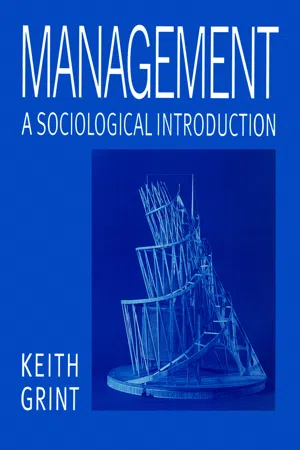
- English
- ePUB (mobile friendly)
- Available on iOS & Android
eBook - ePub
About this book
This is a lively introduction to management, covering an array of management orthodoxies and demonstrating, through contemporary sociological theory, that many of the old approaches are in need of reconstruction.
Information
1
Into the Heart of Darkness: A Short Theoretical Journey
Theory is when you know everything and nothing works;
Practice is when everything works and nobody knows why;
Here we combine Theory with Practice:
Nothing works and nobody knows why.(Anonymous)
Introduction
In Joseph Conrad’s Heart of Darkness, Marlow, the narrator, tells the story of his journey up the river Congo in search of the mysterious Kurtz, an idealized figure of the company who, as Marlow approaches, takes on the appearance of increasing irrationality. When Marlow eventually reaches this European icon of morality he discovers a world of evil far darker than Marlow could ever have imagined, and Marlow is himself pushed to examine his own nature, character and morality. The story is open to many different interpretations or readings but the one I wish to pursue here is that epitomized by the contemporary rendering of Heart of Darkness, removed to South East Asia at the time of the Vietnamese War, in the film Apocalypse Now. In this film the all-American hero, or avenging angel, Captain Willard, played by Martin Sheen, once more sets out to discover the whereabouts of an errant colleague, but this time the mysterious Kurtz is transformed into a renegade American colonel, once again called Kurtz, played by Marlon Brando. Colonel Kurtz is intent on turning himself into a warlord over a drug-infested corner of Cambodia. The heroic journey to eliminate the stain on America that the Colonel represents becomes increasingly harrowing as the avenging angel perceives the irrationality and destruction wrought by his comrades in pursuit of the communist enemy, and by the time he reaches the villain it is no longer clear to him who is responsible for the death and destruction; who is rational and who is not. In one scene, amidst the destruction of a Vietnamese village held by the communists (accompanied by the sound of Wagner’s ‘Ride of the Valkyries’ blasting from the helicopter gunship’s loudspeaker system), the colonel in command arranges for one of the troops to surf along a stretch of water at the point of a river that is still subject to enemy fire. ‘It’s pretty hairy in there sir … it’s Charlie’s [Communist] point’, shouts one of the worried troops involved. ‘Charlie don’t surf, comes the laconic reply from the colonel. As Willard remarks to himself, ‘I began to wonder what they had against Kurtz. It wasn’t just murder and insanity – there was enough of that to go round for everyone.’ In short, the journey is one of self-enlightenment through travelling into the heart of darkness to the place at which the traveller recognizes that Kurtz, the fallen idol, is as much a part of his own culture as Willard is. The journey can also be read as one intent on discovering the truth ‘out there’ but one which has become a journey of self-recognition, where to be insane is the norm and where what counts as ‘the truth’ and as normality lies in the external gaze of the assessor, not the internal renderings of rationality.
The analysis of management can be read through a similar frame – it has been scripted as a journey to acquire the secret of success, to drink from the ‘holy grail’ of managerial truth and to achieve the desired status of manager, or even better chief executive officer (CEO). Yet the journey through the maze of management texts leads in ever decreasing circles into the clear, cold knowledge that nobody really seems to be able to deliver the magic elixir. The budding manager could probably spend several years reading the management books at the airport and still be unsure as to the meaning or method of it all. In fact, one might want to consider such action as a clear sign of Kurtzian insanity in the knowledge that management fads and fashions seem to change with the seasons and that what counts as common sense one year will undoubtedly prove to be self-evident claptrap the following year.
At this point in the management journey it begins to dawn on our weary traveller, who has gone nowhere but read a lot, that the magic elixir is not something that can be drunk and possessed, to be redeployed at will on return to the office. Indeed, there may be a recognition that the journey was probably never going to lead to such a solution and our executive returns home to the office, despairing of a journey that has only persuaded him or her of something that many of us would prefer not to know: that our understanding of the world – and thus the secret of management success – is imposed from without, a socially created, regulated and legitimated practice, not one subject to the measurable objectivity of facts or of truth.
This book is intended as a guidebook to the heart of darkness which I take to be management. Management is a mysterious thing in so far as the more research that is undertaken the less we seem to be able to understand. In a version of ‘progressive ignorance’, borrowed from Socrates, the higher the level of immersion in the waters of management the muddier the river becomes, as contradictory reports suggest a world of inordinate complexity and change that is only (temporarily) stabilized in space and time by the words on a page or the speech in a room. If the world of management really is as contingent and confused as the contradictory literature that piles up on my floor suggests, then there are at least two things we can do about it: first we can resort to the resplendent and worthy motto that has served most of us well for many years: ‘Ignorance is bliss’. Under this strategy we smile smugly to ourselves about the inability of academic researchers to deliver the goods, that is to show managers how to manage better, and we manage in the way we always have done (and we don’t make international comparisons to avoid any discomfort). Second, an alternative, and again well-tried and tested, strategy is to rely on consultants as a better bet: ‘More expensive ignorance is better bliss.’ Here we spend a small fortune on self-professed ‘experts’ (after all, if we could assess their expertise we would not need them, would we?), and if things do not quite go to plan we change the experts for better ones (that is, more expensive ones).
In this book I want to look at management through a third approach, rooted not in expertise but in recognition of ignorance, that is our very limited ability to understand and control the world, and in recognition that the quest for bliss, perfect harmony and the solution to our problems is itself very problematic in the light of our limited knowledge: ‘In the world of the blind there are no one-eyed monarchs’ (or ‘Scepticism rules OK’) might be an appropriate motto here.
The rest of this chapter is a brief theoretical journey through some contemporary theories of management and a sketch of what is to follow in the main body of the book. It is not a review of all, or even most, past or present sociological theories of management or organizations (see Burrell and Morgan, 1979; Morgan, 1986; Hassard and Pym, 1990; Reed and Hughes, 1992; Hassard and Parker, 1993; Hassard, 1993, for this). Rather, it is an attempt to situate some of the more radical methodological and epistemological developments in social theory in a managerial context.
This book does not pretend to be an introduction to the sociology of management, then, but a sociological introduction to management. The difference is that the former would require yet another grand run through the history and philosophy of many sociological traditions, whereas the latter is more concerned to outline and deploy one particular sociological approach to the substantive area considered as management. In short, the book concentrates on management rather than sociology. Sociology is my disciplinary background and provides the theoretical and methodological approach but I do not attempt to push the boundaries of sociological theory beyond their already wide compass.
Equally important, the book is not a sociological introduction to all aspects of management, for which a CD-ROM rather than a book might be more appropriate. Instead of providing a universally thin sociological veneer over management in general, then, this book provides an array of sociologically inspired enquiries of diverse substantive fields and at different levels of analysis. In keeping with the journey into the heart of darkness, the text sets out by providing a historical framework from which to assess the chosen subject, and proceeds to delve deeper and deeper into the managerial world. Thus, at the end of the historical scene setting, it proceeds by considering who the contemporary subjects actually are, what they do, and why they do what they do. It then steps continuously deeper, in a theoretical sense, by considering an array of substantive areas, first on appraisals and managing radical change like reengineering, two currently popular and practical dilemmas for management; and subsequently on leadership and culture, two topics with rather longer histories and more complex theoretical foundations. The penultimate two chapters, on gender and technology and on fatalism and freedom, take the journey further into the philosophical mist so that the journey itself ends not in the bright light of what we take to be reality but up against a raft of paradoxes that are reflected upon in the final chapter. In sum, the metaphorical journey ends, just as Conrad’s did, back where we began, not necessarily finding any elixir but hopefully understanding why the journey went the way it did and what this might tell us about management and the role of theory.
Theory in management studies, perhaps more than almost any other academic context, arrives at the management student’s door laden with moral and political baggage: theory, according to some anti-theoretical accounts, is apparently irrelevant to the ‘real world’ of management where decisions are taken on the basis of facts or rationality or whatever happens to be the anti-theoretician’s particular animus. As I shall argue in the next chapter, the empiricist and positivist fascination with ‘real facts’ as opposed to ‘vacuous theory’ is itself particularly virulent in Britain, it has been so for centuries, and it is not restricted to the world of management. This often becomes manifest in contrasts that are held to exist between the ‘real’ world and whatever is being deprecated, usually the ‘unreal’ world of academia. The criteria for constructing the boundary of reality have always escaped me. At the same time, debates within the world constructed by management theorists are often just as acrimonious as those that occur between management theorists and ‘practitioners’. Perhaps the latter is an exaggeration since, by and large, practitioners of management very often do not engage in debate with theoreticians – they just ignore each other. In practice the whole circus appears vaguely ludicrous: those who argue that theory is irrelevant to the real world adopt a theoretical position in their anti-theoretical ardour which assumes that (theoretically) facts stand for themselves; that is, that the world of reality is self-evident and open to a non-theoretical investigative approach which will reveal the world in its transparently obvious truth. This, presumably, is why everyone agrees about everything – because everything is so blatantly obvious. On the other hand, if there are occasions where we disagree about the meaning of something, about whether something is true, about whether one thing caused another to happen, about the meaning of life – to name just a few problems – then perhaps we should consider what it is that the theories imply.
This chapter does not pretend to be neutral or disinterested but neither does it pretend to have discovered the holy grail of theoretical truth. This modesty is only partly motivated by theory itself, in that I will argue that a critical element of management lies in the way management is constructed through the accounts of various agents involved; hence what management is ‘really’ like is a function of the way we construct management in the first place. The other element of modesty derives from a recognition that if it is the case that we do not so much discover as construct management through our accounts then we can never be absolutely certain that we are right. Thus the relativist’s dilemma – that everything is relative except this – cannot be transcended by dint of linguistic contortion (at least I don’t know how to do it – though there may be a way). What I am concerned to do here, therefore, is to explain the consequences of certain theoretical positions and consider the heuristic limits of the constructivist approach. In doing so I hope to avoid the charge of labyrinthine linguistic complexity that so often allows the debate to founder on the reef of confusion. Naturally, my simplified version of the debate between modernism and postmodernism will, in all probability, not meet with universal approval – but that is inevitable in a world that requires interpretative effort, and anyway, if everyone agreed with my theoretical approach (which I imagine to be more akin to a wobbly jelly than a neat path), the project might seem rather foolish.
In the world of management the modernist–postmodernist debate hinges on two rather different substantive areas. On the one hand the debate is concerned with the most appropriate way to describe the current state of the world: have we moved beyond the controlled world epitomized by the machinations of the Fordist assembly line and Taylorist time-and-motion experts, to a postmodern world where flexibility and change are endemic? On the other hand, the debate surrounds the way we understand the world. Can we rely on the rational, scientific and measurable methods of the modernist scientists and positivists, or should we abandon certainty and spend more effort in understanding how particular accounts are constructed in such a way that they appear to be legitimate, to generate a transparent account of the world, while all the time masking the opacity that postmodernists claim is an inevitable result of our necessary reliance upon language?
In the (modernist) descriptive beginning was industrial capitalism, a socio-economic system that rested upon the primacy of production where the real world and the fantasy world were kept separate. According to Baudrillard’s postmodern account, the contemporary world is no longer dominated by production, as consumption has displaced it in economic significance and in terms of ideological influence to the extent that productively based social classes are displaced by identities constructed through consumption. Furthermore, the division between reality and fantasy are melded into one. Perhaps both these aspects can be captured in the theme parks that proliferate across the world. These palaces are neither fantasy nor real but both and neither simultaneously, and the patrons are distinguished by their spending patterns, not by the socio-economic category fixed by professional sociologists. The patrons are what they consume, not what they produce.
In the (pre-modernist) epistemological beginning was God, and God explained everything that there was to be explained and also explained all that could not be explained; a very effective explanatory system, one might think. However, this hermetically self-sealing land of explicable and acceptable ignorance took a radical turn for the better and worse when the Enlightenment thinkers decreed that the inexplicable was no longer acceptable, particularly when Kant took his own motto, sapere aude (dare to know), to its logical conclusion and located the authority to explain all within human rationality, as opposed to relying upon the external authority of God. Reason not religion was then the torch to light up the unknown. I’m tempted to say, ‘The rest is history’, but I won’t; too late.
Actually the rest, according to Cooper and Burrell (1988), is two histories. One was concerned with employing reason to ever more complicated systems of modern organization, and we can see the results across various worlds, from Lenin’s application of Taylorism to modernize the Soviet Union, through the growth of huge bureaucracies across the world (as predicted by Weber), to the rise of theoretical explanations of human behaviour rooted in rational action – economics and rational decision theory being two primary contenders. The other, and much less influential, history sought to enlighten humanity rather than control it, or explain how it operated in predictable ways. This was the tradition initiated by Kant himself, carried on – or carried off – by Karl Marx, and reconstructed anew today by the likes of Habermas (Held, 1980).
The ‘end of history’, as Fukuyama (1992) labels the defeat of the alternatives to capitalist democracy, is paradoxically another example of the ‘grand narratives’ that litter all modernist accounts of the world, according to Lyotard (1984). Modernism, accordingly, rests upon progressive notions of improvement through the application of science and rationality to the extent that the best of all possible worlds is, ultimately, achievable. Precisely what this world looks like is, of course, subject to considerable dispute but the whiggish approach to historical explanation remains at the heart of modernist enterprises. That millions of people have suffered or died at the hands of many modernist ‘utopians’ (see chapter 5) is often taken by postmodernists as a clear indication that the entire approach is premised upon morally ambiguous foundations (see Grint and Woolgar, 1995a). Since Nazi Germany, until then regarded by many as the most ‘cultured’ and scientifically advanced nation in the world, decided to murder 6 million Jews and many millions more Soviet citizens, on the grounds that they were scientifically proven to be sub-human, one is tempted to agree that the links between scientific, cultural and moral progress are few and that all such meta-narratives are suspect. The modernist counter-attack is to suggest that the Allies’ defeat of Nazi Germany was itself only made possible because of the horror with which this same modern and humane world reacted to the barbaric Nazi atavism.
However, much of the current epistemological debate between modernist and postmodernist approaches – in so far as there is a debate rather than an agreement not to listen – centres less on politics than on the role played by language (see Cooper and Burrell, 1988; Hassard, 1994; N.J. Fox, 1993; Clegg, 1990, for useful discussions of the debate). For Lyotard (1984) the different discourses locked into the competing meta-narratives suggest that the legitimacy of any one discourse is restricted to a localized point in space and time – in effect what counts as true depends upon where and when you are looking for it, and which version of the ‘language game’ is in operation.
From Derrida (1976, 1978) (and originally from Saussure’s (1974) semiotic theory), postmodernist approaches adopt the term différance to suggest that language does not reflect the world but constitutes it. It constitutes it with regard not to the essence of the thing so constituted but to the difference between the thing and other things. To take an appropriate example, the word ‘management’ gains its meaning not by reflecting the essence of the group of people who manage but in relation to the difference between this group and the group that is managed by them – the ‘managed’; one cannot make sense of the word ‘manager’ without simultaneously understanding the word ‘managed’ or ‘non-manager’ or ‘employee’. It is, then, according to Derrida, the differences not the essences that we should concentrate on.
However, différance also implies that the meaning of any word is itself subject to different interpretations depending on the context, and so the move from essence to difference does not provide the solution to the problem of meaning. For instance, ‘management’ can mean a group of high-status individuals or a group of exploiters or a task or the butt of numerous jokes or the legitimation for one’s rapid and ungracious exit from a nightclub.
Derrida also argues that logocentrism, the assumption that a transparent picture of the world can be secured through human thought, is problematic and that the question is not whether such a picture is true or not but how the claim to truth is constituted in and through discourse. We might, for instance, consider the way that claims to the truth in academic writings are legitimized as much through appeals to other authorities (Duck, D. (1982) and Flintstone, F. (2999 BC)) as through claims whose validity can be assessed by the reader (see if this works at home). This goes not just for qualitative studies (Atkinson, 1990) but for quantitative studies too (Woolgar, 1988a). Here, unless the reader can be bothered to read Atkinson and Woolgar (both good books actually), and then read the authorities that they cite in their own support, ad infinitum, you will have to take it on trust that these two works provide persuasive accounts of the alternative cases.
The critical point here is that language does not reflect the world but constitutes it. This need not mean that the world does not exist except in and through our constitution of it – as solipsism implies – but it does imply that whatever does exist we can only know by way of our constituting it through discourse. Thus, to misquote Levi-Strauss, the world cannot be known in the ‘raw’ – that is, in an untainted form – but only in the ‘cooked’, in a form mediated by language and human interpretation. Thus postmodernists pursue the ‘deconstruction’ (Derrida, 1978) of claims to legitimacy to demonstrate the constructed, as opposed to the non-constructed (true, natural, objective), nature of the clai...
Table of contents
- Cover Page
- Title Page
- Copyright
- Dedication
- Contents
- Acknowledgements
- 1 Into the Heart of Darkness: A Short Theoretical Journey
- 2 The Black Ships: The Historical Development of British Management
- 3 Mimetic Pyrophobes: What are Managers, What do Managers Do, and Why do they Do What they Do?
- 4 From Silent Monitors: The Long and Relatively Unhappy Life of Management Appraisals
- 5 Reengineering Utopia: Managing Radical Change
- 6 The Alchemy of Leadership
- 7 The Culture of Management and the Management of Culture
- 8 Managing Gender Inequality through Technology
- 9 Fatalism, Freewill and Control: An Index of Possibilities
- 10 Reflections
- Bibliography
- Index
Trusted by 375,005 students
Access to over 1.5 million titles for a fair monthly price.
Study more efficiently using our study tools.
Frequently asked questions
Yes, you can cancel anytime from the Subscription tab in your account settings on the Perlego website. Your subscription will stay active until the end of your current billing period. Learn how to cancel your subscription
No, books cannot be downloaded as external files, such as PDFs, for use outside of Perlego. However, you can download books within the Perlego app for offline reading on mobile or tablet. Learn how to download books offline
Perlego offers two plans: Essential and Complete
- Essential is ideal for learners and professionals who enjoy exploring a wide range of subjects. Access the Essential Library with 800,000+ trusted titles and best-sellers across business, personal growth, and the humanities. Includes unlimited reading time and Standard Read Aloud voice.
- Complete: Perfect for advanced learners and researchers needing full, unrestricted access. Unlock 1.5M+ books across hundreds of subjects, including academic and specialized titles. The Complete Plan also includes advanced features like Premium Read Aloud and Research Assistant.
We are an online textbook subscription service, where you can get access to an entire online library for less than the price of a single book per month. With over 1.5 million books across 990+ topics, we’ve got you covered! Learn about our mission
Look out for the read-aloud symbol on your next book to see if you can listen to it. The read-aloud tool reads text aloud for you, highlighting the text as it is being read. You can pause it, speed it up and slow it down. Learn more about Read Aloud
Yes! You can use the Perlego app on both iOS and Android devices to read anytime, anywhere — even offline. Perfect for commutes or when you’re on the go.
Please note we cannot support devices running on iOS 13 and Android 7 or earlier. Learn more about using the app
Please note we cannot support devices running on iOS 13 and Android 7 or earlier. Learn more about using the app
Yes, you can access Management by Keith Grint in PDF and/or ePUB format, as well as other popular books in Social Sciences & Urban Sociology. We have over 1.5 million books available in our catalogue for you to explore.