eBook - ePub
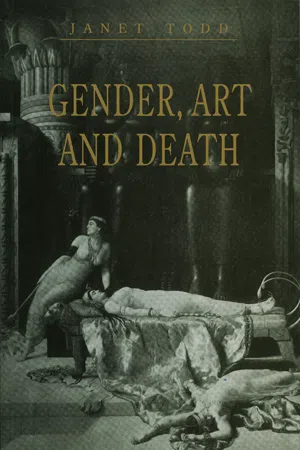
Gender, Art and Death
About this book
In this book, Janet Todd, one of the leading authorities on seventeenth- and eighteenth century women writers, discusses gender issues from the Restoration to Romanticism investigating women authors and the fascination with culturally privileged art and with heroic death.
Information
1 Aphra Behn: the ‘lewd Widow’ and her ‘Masculine Part’
Public female writers of the Restoration were obliged to excite and interest an audience with their images. In order to write a woman had to gender the artistic subject and engender art as more ‘feminine’ wiles than ‘masculine’ skill and wit. The association of sex and text for a woman problematized art as a form of authority and as a means of creating a culturally privileged artistic self.
Mediated and facilitated by both male and female expectations, the images of women writers ranged from the elaborate and orchestrated secrecy of the poet and playwright Katherine Philips, ‘the matchless Orinda’, to the display of ‘Female Sweetness and a Manly Grace’ of the ‘ingenious Aphra Behn’.1 But the most current public image for the female author was created by men: that of whore or slattern. This image came primarily from seventeenth-century satirists, including Robert Gould, the probable composer of the phrase ‘lewd Widow’ for a character in a play by Aphra Behn; he insisted on pulling the playwright down to the level of the actress and the actress to the prone position of the whore. The image has interestingly reappeared more eulogistically in late twentieth-century New Historical feminist criticism.
I
In June 1669 Dryden put on Tyrannic Love, a tragedy with parts in it for every celebrity of the theatre, including Nell Gwyn, Pepys’s ‘bold merry slut’. At the end of the play she enacted her suicide to the copious tears of the audience. After this fatal fall she was picked up and carried off on a bier. As the bier arrived at the wings, however, she suddenly leapt off it, crying:
Hold, are you mad? you damn’d confounded Dog,
I am to rise, to speak the Epilogue.
After this resurrection she walked to the front of the stage, where she announced, ‘I’le come dance about your Beds at nights.’ Here she alluded to her public reputation as a notorious whore, which the coterie playhouse audience knew well; the reputation contrasted with her role in the play as the virtuous Valeria. Nell Gwyn was usually associated with comedy and the audience was aware of this when she went on to speak these lines:
… I walk because I dye
Out of my Calling in a Tragedy.
O Poet, damn’d dull Poet, who could prove
So senseless! to make Nelly dye for Love;
Nay, what’s yet worse, to kill me in the prime
Of Easter-Term, in Tart and Cheese-cake time! …2
In Aphra Behn’s The City Heiress, or Sir Timothy Treat-all (1682) the actress Charlotte Butler, much satirized for lewdness and greed, acted the role of a virginal heroine who was given her own name, Chariot; like Nell Gwyn’s, Butler’s epilogue draws attention to the woman behind the part and the incongruity of her dramatic role and personal reputation. In both sets of concluding lines, then, there is almost no input from the acted character and much from the glamorous personality acted offstage. As Pepys revealingly remarked of another work, Shirley’s Hyde Park, ‘[It] is but a very moderate play; only, an excellent Epilogue spoke by Becke Marshall.’3
In the epilogues spoken by actresses the tone of tragedy or comedy might be broken, the poet mocked – even if self-mocked for the speakers had not usually written the words – the theatrical role declared and the sensual character of the woman acting offstage suggested. Epilogues thus became a winking at the audience, excluding the playwright from an audience–actor compact. At these moments the actress was refusing to be content with the playwright’s play to keep disbelief suspended.
Beyond epilogues, both actresses and playwrights kept the line between stage and street blurred, though they used different means to do so. In their texts playwrights might describe the actual physical attributes of the actress they knew would play the role, while actresses often provided parts of their theatrical costumes themselves – sometimes these were known to have been received from admirers and keepers. Men could and did go to the tiring-room to watch actresses dressing, though the King, who had other opportunities of voyeurism, tried to stop the practice for his subjects. In his diatribe against the theatre, The Play-House. A Satyr (1689), Robert Gould imagines entry into the tiring-room where the actress who has just inflamed desire by denial – that is by acting on stage rather than in bed – inflames the amorous watcher still further by getting ‘wantonly’ into her shift. For Gould the actress is the whore and the stage her place of pimping. This simultaneous controlling of the sexuality of the actress’s body and the advertising of her physical wares, this self-consciousness of display, meant that, as far as the actress was concerned, a sort of theatrical pornography was of the madam as well as of the whore.
The writer of the first prologue to a play after the Restoration known to include a professional actress on the public stage assumed that men would titter and have some difficulty separating the woman not only from the role she played but also from the basic public-professional role for women: that of prostitute. When the King had broken with the prewar public stage by allowing women habitually to replace the earlier boys, he had followed his act with a royal warrant of 1662 which insisted that women play female roles, thus suggesting the ambiguously sexual titillation that moralists had earlier deplored in the male playing of women’s parts. He also drew attention to the lewd possibilities of the new mixed companies when he caused his warrant to demand that female roles be ‘harmless delights’ avoiding the ‘prophane, obscene and scurrilous’ – a comic demand in the light of Charles’s future patronage of the theatres and the use of its ladies for royal service. The assumption that actresses were working whores is caught some years later by the satirist Tom Brown, when he declared
‘Tis as hard a matter for a pretty Woman to keep herself honest in a Theatre, as ‘tis for an Apothecary to keep his Treacle from the Flies in Hot Weather; for every Libertine in the Audience will be buzzing about her Honey-Pot.
The imagery is characteristic of this sort of comment.4
The initial result of woman’s arrival was, then, an elaborate resexualizing of the feminine body and its objectification on- and offstage, as well as a fictionalizing of the self presumed to inhabit that body. Much play was made of parts and acts. Clearly the audience was aware of the actress’s public personal life and had come to watch a play, an actress and a social celebrity; it had thus come prepared to take some enjoyment from outside the fictional text of the play. In such circumstances the personality of the actor could only intermittently be submerged in the part. It becomes fitting then that in epilogues such as those spoken by Nell Gwyn and Charlotte Butler the actress should spoil one type of pleasure – of representation – to create another – of presentation of her ‘self. When later Jeremy Collier came to attack the wicked Restoration stage, it was the blurring of real and pretended in the use of women in epilogues that he found most disquieting:
… the Prologues and Epilogues are sometimes Scandalous to the last Degree … Now here properly speaking, the Actors quit the Stage, and remove from Fiction into Life. Here they converse with the Boxes, and Pit, and address directly to the Audience…. Upon such Occasion one would imagine if ever, the Ladies should be used with Respect, and the Measures of Decency observ’d. But here we have Lewdness without Shame or Example: Here the Poet exceeds himself. Here are such strains as would turn the Stomach of an ordinardy [sic] Debauchee, and be almost nauseous in the Stews. And to make it the more agreeable, Women are commonly pick’d out for this service.5
If the actress was often assumed to be the prostitute, analogy could be made between the masked actress on stage and the masked woman off, whether whore plying her trade in the galleries and pit or lady in her box – though social lines were not as drawn as this implies.6 Occasionally a subtle connection may be made, one which may even include the playwright. In Aphra Behn’s first performed play, The Forc’d Marriage (staged in 1670), the actor speaking the prologue creates the playwright or ‘Poetess’ as a kind of actress and, pointing to offstage spectator-whores and masked ladies, suggests both as spies or secret agents for the female playwright (and inevitably too for the actress). So a sense of slightly threatening feminine collectivity is created: ‘The Poetess too, they say, has Spies abroad.’ But the actress who follows the actor to conclude the prologue denies this collectivity and the stratagems it implies; she firmly separates the actress from the whore, the ‘Vizard’ in the audience, and she reduces women from agents and manipulators to sexualized bodies with amorous power but no threat since these bodies exist only ‘to pleasure you’.
Usually, however, the on- and offstage analogy is entirely abusive. Both male and female playwrights accused the audience of imitating the supposed lewd conduct of the actresses, but hypocritically denying it, then blaming the playwright for showing them a mirror of themselves. In fact the verbal bawdry denigrated on the stage in the illuminated theatre, ostensibly by women in the audience, served together with seductive ‘modesty’ as foreplay to activity in the darkened inns of Paddington – or so playwrights like Behn and Wycherley charged.7 In The Play-House. A Satyr, after a lewd description of the audience as diseased and drunken punks and their customers as voyeurs of the ‘proud Mimicks’ on the stage, Gould imagines life and theatre coalescing in ‘a Play-House Punk in Drink’:
Inspir’d by Lust’s Enthusiastick rage,
She’d prostitute her self ev’n on the Stage,
Strip naked, and, without a thought of shame,
Do things Hell’s blackest Fiend wou’d blush to name.8
Insistently Gould brings the playhouse and the world offstage together, so that the lewd horror allowed in the theatre becomes possible in the larger world of society and the court: “tis the Stage/ That makes these Insects gain upon the Age.’9 In imagination the final copulation, which in the end makes the lewdness on the stage frustrating and unsatisfying and to which both playwrights and actresses playfully allude, is hideously performed by the punk in public profanation of a private act. Life corrupts art and art corrupts life.
In ‘act’, whether scandalous or not, it is clear that the actor/actress had the upper hand in the playhouse and that often the playwright was demoted to the level of the butt in the audience. It seemed evident to Gould, therefore, that there should be some bad feeling between playwright and actor, and he charged that the actor kept the playwright poor although the playwright had in fact made the actor rich. He concluded that power had especially shifted towards the actor when the two theatrical companies united in 1682. Characteristically he makes his point by taking his now impotent playwright ‘behind the Scenes’ into the actors’ and actresses’ private room to revolt him into judging them ‘by the Lump’ as ‘idle, pimping, spunging Slaves’.10 When the playwright was female, the comic antagonism of playwright and audience, caught in the epilogue convention of betraying the playwright and in the economic antagonism suggested by Gould, inevitably became part of the sexual antagonism of men and women, in which some of ‘the sex’ took the treacherous part.
There are elements in Aphra Behn’s plays that suggest the female playwright – the placing of an opening exposition in the mouths of women or the frequent reversed scene of the female gaze on the male body. There are also signs of her admiration of particular actresses both as actresses and as seductive and mirroring forms with whom her own stance of feminine adoration, especially of the royal brothers, James and Charles, inevitably link her. She is one of the few writers to dedicate a work to Nell Gwyn, while Elizabeth Barry, the most famous actress of the day, once mistress and acting pupil of the libertine courtier Earl of Rochester, took part in a large number of Behn’s plays and is praised by her in the poem ‘Our Cabal’. Nonetheless, since the actress is made so often to obliterate the author and the image of the actress as whore is so potent, it seems likely that a female playwright such as Behn would wish for some means of retaliation in the seemingly unequal struggle, as well as having some need of it if she aimed to avoid reduction from ‘poetess’ to ‘punk’. If the actress can disturb representation, so, after all, can the playwright, who can at one time underline, at another undermine, the acting body’s inability or readiness to become a vehicle of representation.
Much in Behn’s plays concerns theatre, much serving as a kind of meta-criticism and commenting on theatrical business and performance. Occasionally Behn goes further, referring to particular acting moments and dramatizing the actress as actress or as contingent woman. In these cases the actress is presented as immanent and acting in the present, having no claim to the status that lasting and privileged art might convey. In The Rover, the verbal and physical wit of the young girl certainly triumphs – though the audience does not stop to wonder at a triumph that means giving her virginal self and her considerable dowry to a much prostituted and penniless man; in other plays, however, the woman might get her man while showing little wit and skill. Sympathetic men such as the Rover himself are also presented with wit, but the sexual difference assures that no man is presented in a play as desirable without wit where a woman played by a pretty actress can be so. In such presentations women are reduced to the power of the sexual body; the reduction can be imaged in the bad acting that, in the theatre, conventionally denotes lack of wit and useful self-knowledge.
In her overtly political play the farcial The Roundheads (1682), Behn presents a Roundhead wife, Lady Lambert, smitten by one of the sexy cavaliers. She believes that she has enormous social status appreciated by all: ‘I thought I’d been so elevated above the common Crowd, it had been visible to all Eyes who I was.’ The man, however, like some of the audience of a sexually alluring actress, sees simply a sexualized body, in this case of an upstart wife. ‘A thing just like a Woman’, he calls her, and comment is made on her ‘ill acted Greatness’.11 Lady Lambert’s notion of the royalty to which she aspires is entirely theatrical; she frequently talks a species of blank verse and gives vent to Shakespearean sentiments on Royalty. She draws attention to acting all the time, either through her assumption of social status, to which she has no right by birth and breeding, or through her pretence of religious piety, of which she has none. That she decides to ‘act’ publicly suggests already a licentiousness in the sexualized schemes of the theatre and prostitution into which she has entered; that she cannot act credibly and is yet lusted after suggests the real attraction of the lady onstage.
In what is possibly Behn’s last play, The Widow Ranter, the chaotic state of the mismanaged colony of Virginia where the play is set is symbolized partly in the American women who, like Lady Lambert, put on airs and dress to which they have no social claim. Mrs Flirt declares herself the daughter of a royalist gentleman, when the others know her father to have been a pu...
Table of contents
- Cover Page
- Title Page
- Copyright
- Contents
- Acknowledgments
- Introduction: memory and women’s studies
- 1. Aphra Behn: the ‘lewd Widow’ and her ‘Masculine Part’
- 2. Spectacular deaths: history and story in Aphra Behn’s Love Letters, Oroonoko and The Widow Ranter
- 3. Pamela: or the bliss of servitude
- 4. Marketing the self: Mary Carleton, Miss F and Susannah Gunning
- 5. ‘A martyr to her exigencies’: Mary Ann Radcliffe
- 6. Mary Wollstonecraft and the rights of death
- 7. Thoughts on the death of Fanny Wollstonecraft
- 8. Jane Austen, politics and sensibility
- 9. Who’s afraid of Jane Austen?
- Index
Trusted by 375,005 students
Access to over 1.5 million titles for a fair monthly price.
Study more efficiently using our study tools.
Frequently asked questions
Yes, you can cancel anytime from the Subscription tab in your account settings on the Perlego website. Your subscription will stay active until the end of your current billing period. Learn how to cancel your subscription
No, books cannot be downloaded as external files, such as PDFs, for use outside of Perlego. However, you can download books within the Perlego app for offline reading on mobile or tablet. Learn how to download books offline
Perlego offers two plans: Essential and Complete
- Essential is ideal for learners and professionals who enjoy exploring a wide range of subjects. Access the Essential Library with 800,000+ trusted titles and best-sellers across business, personal growth, and the humanities. Includes unlimited reading time and Standard Read Aloud voice.
- Complete: Perfect for advanced learners and researchers needing full, unrestricted access. Unlock 1.5M+ books across hundreds of subjects, including academic and specialized titles. The Complete Plan also includes advanced features like Premium Read Aloud and Research Assistant.
We are an online textbook subscription service, where you can get access to an entire online library for less than the price of a single book per month. With over 1.5 million books across 990+ topics, we’ve got you covered! Learn about our mission
Look out for the read-aloud symbol on your next book to see if you can listen to it. The read-aloud tool reads text aloud for you, highlighting the text as it is being read. You can pause it, speed it up and slow it down. Learn more about Read Aloud
Yes! You can use the Perlego app on both iOS and Android devices to read anytime, anywhere — even offline. Perfect for commutes or when you’re on the go.
Please note we cannot support devices running on iOS 13 and Android 7 or earlier. Learn more about using the app
Please note we cannot support devices running on iOS 13 and Android 7 or earlier. Learn more about using the app
Yes, you can access Gender, Art and Death by Janet Todd in PDF and/or ePUB format, as well as other popular books in Literature & Feminist Literary Criticism. We have over 1.5 million books available in our catalogue for you to explore.