Until the late 1980s, there were very few democratically elected governments in the developing world. These areas were characterized by a range of authoritarian regimes from military administrations to one-party dictatorships. Over the past decade, however, the situation has altered significantly and an increasing number of developing countries have made the transition to democracy. For some, this process of building and consolidating democracy has been relatively easy, while for others, it has proved more complex and harder to sustain.
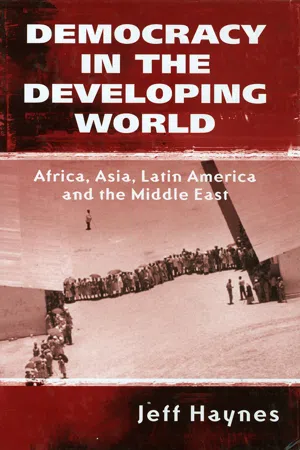
In this important new textbook, Jeff Haynes seeks to explain why these differences occur. Adopting a broadly comparative approach, he begins by examining the theories and practice of democratic transition and consolidation in the new democracies of Africa, Asia, Latin America and the Middle East. Haynes argues persuasively that a country's ability to consolidate democracy depends not only on the interaction of structural and agency factors, but also on a variety of specific domestic and international concerns which may help or hinder democratic progress. Using a wide range of case studies to illustrate his argument, Haynes provides an accessible and comprehensive analysis of the processes and problems of democratic consolidation in developing nations.
This is an important textbook that will be invaluable to students in a variety of areas from politics and comparative politics to development studies and history.
Trusted by 375,005 students
Access to over 1.5 million titles for a fair monthly price.
Until recently there were very few democratically elected governments in Latin America, Asia or Africa. Instead, political terrains were filled with various kinds of unelected regimes, including military, one-party or no-party systems and personalist dictatorships. The ‘third wave of democracy’ is said to have started in Southern Europe in the mid-1970s, before spreading to Latin America, Eastern Europe, Asia and Africa (Huntington 1991). Eventually the result was that, whereas in the early 1970s only a quarter of countries had democratically elected governments, two decades later more than 50 per cent had them. By the end of the 1990s, about 75 per cent of governments around the world had come to power via the ballot box. Such was the shift to elected governments during this time that a new area of concern in political science was born: ‘transitology’, that is, the study of democratization, ‘the process of becoming democratic’ (Bealey 1999: 100). As time went on, studies of democratic transition were augmented by investigations of the difficulties of consolidating democracy, known as ‘consolidology’.
By the 1990s, all 23 Latin American countries, with the exception of Cuba, had elected governments, as did several formerly authoritarian countries in Asia – including Bangladesh, Nepal, the Philippines, Taiwan, South Korea and Mongolia. Africa showed a similar picture, with over 20 democratically elected governments. The only region that seemed apart from the democratic trend was the Middle East. With the exception of Turkey and the partial exceptions of Jordan, Morocco, and Kuwait, authoritarian – that is, democratically unaccountable – regimes remained the norm.
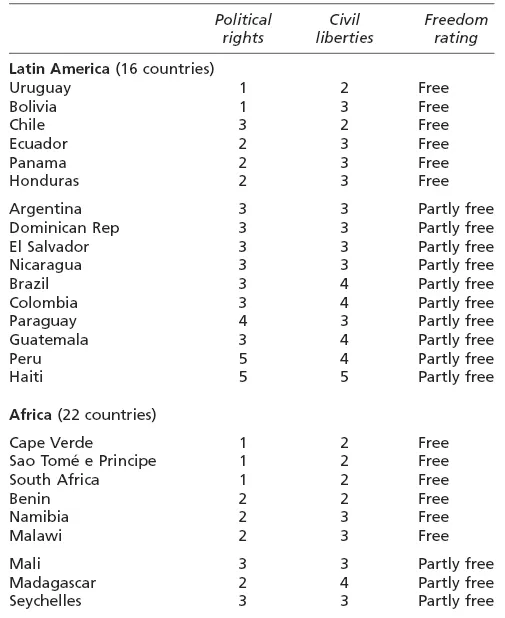
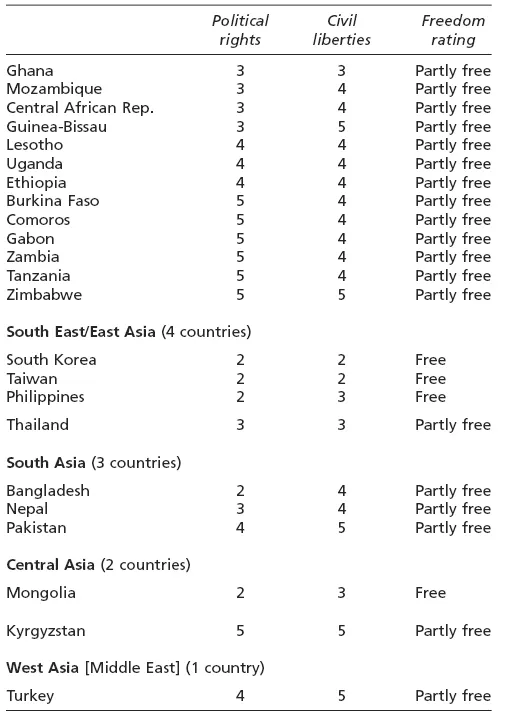
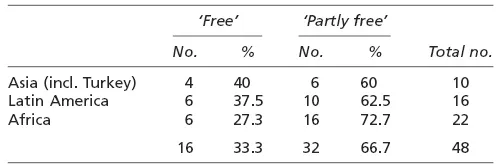
By 1999, as table 1.1 indicates, there were 48 new democracies in Latin America, Asia (counting in Turkey) and Africa: 16 in Latin America, 10 in Asia and 22 in Africa. Of the 10 in Asia, 4 (40 per cent) – Mongolia, South Korea, Taiwan and the Philippines – were classified as ‘free’ by Freedom House (see below); the other 6 (60 per cent) – Bangladesh, Kyrgyzstan, Nepal, Pakistan, Thailand and Turkey – were judged ‘partly free’. Of the 16 in Latin America, Freedom House perceived 6 (37.5 per cent) as ‘free’, while the remaining 10 (62.5 per cent) were ‘partly free’. Africa had 6 (27.3 per cent) new democracies rated ‘free’ and 16 (72.7 per cent) ‘partly free’.
Table 1.1 New democracies in Latin America, Africa and Asia, 1999: ratings by Freedom House
The Freedom House scale runs from 1 = most free, to 7 = least free; see the appendix to this book for Freedom House criteria and methodology. All data from ‘Annual survey of Freedom country scores, 1972–3 to 1998–9’, http://www.freedomhouse.org/survey99/method/
As table 1.2 shows, there was relatively little difference in the percentages of ‘free’ states – that is, where democracy might be said to be consolidated – among the new democracies in the three regions. In other words, democracy appeared to be consolidated, with democratic institutions developed to a considerable degree, in about one-third of the new democracies. Why was the average consolidation rate as it was? Was it simply that insufficient time had elapsed since the initial democratic transitions? A comparison can be made with three Southern European third wave democracies: Greece, Portugal and Spain. All are said to have completed democratic transitions – and to have been well on the way to democratic consolidation – within a decade following the collapse of authoritarian governments in the mid-1970s. But such a fast rate of democratic progress is historically most unusual. Even under broadly favourable conditions, it normally takes much time and effort to develop democracy and democratic institutions to the point of consolidation. For example, democratic consolidation in Britain and the United States gradually evolved over a long period of time – decades or longer. Consequently, judged in such a historical context, ‘only’ limited signs of democratic consolidation a few years after authoritarian rule ends do not necessarily signify that democratic progress is not being made. On the other hand, while democratic consolidation may well be a lengthy process, it is possible to identify whether it is happening by various indicators, including the amount of political rights and civil liberties judged to be present in a country. This is the method chosen by the American organization, Freedom House, which publishes an annual survey of democratic progress covering all countries (see p. 11 and the appendix below for the Freedom House criteria and methodology).
Table 1.2 ‘Free’ and ‘partly free’ new democracies, 1999
Source: Freedom House.
Whereas there was much euphoria in the late 1980s and early 1990s that the world was witnessing an epochal shift to democracy, captured in the term ‘new world order’, by the end of the latter decade many observers were much less certain. After a decade of swift democratization, commentators’ opinions varied about the chances of widespread democratic consolidation. A few saw evidence of continuing democratic progress around the world, believing that, while consolidating democracy would be a long, arduous and highly problematic task, there was clear evidence of gradual democratic consolidation in many new democracies (Karatnycky 1999). Others saw something different: a widespread ‘hollowing out’, that is a diminishing, of democracy in many countries that had recently undergone democratic transitions. While multiparty competition was common, with, in some cases, a large degree of uncertainty over electoral outcomes, few new democracies showed much evidence of democracy becoming entrenched and embedded in ways commensurate with democratic consolidation. In fact, Diamond (1999) asserted, there was strong empirical evidence, not just of a failure of democracy to progress, but of something more serious: a ‘reverse wave’ away from democracy and back to authoritarianism.
1.2 The third wave of democracy and its ramifications
Contrasting assessments of widespread democratic consolidation are the starting point for this book. It is not principally about democratization and democratic transitions, although, because the nature of a transition is often thought to influence the chances of democratic consolidation, we focus on the issue in chapter 2. However, the main concern of the book is democratic consolidation – its problems and processes – in the new democracies of Latin America, Asia, Africa and the Middle East, an issue we turn to in chapter 3. It is worth noting in this context that the concept of ‘third wave of democracy’, originally coined by Samuel Huntington (1991), is actually rather meaningless. This is because it is used to group together all recognizably democratic systems outside Western Europe and the United States. The problem is that there are very few common features between the political systems of countries as politically, socially and economically different as those of Latin America, Asia and Africa. In addition, some third wave democracies, such as Chile, have a long history of democracy and recent, relatively short, periods of authoritarian rule; others, such as Jordan or South Korea, have no tradition of democracy. This is not irrelevant because a tradition of democracy is thought likely to make a significant difference to attempts to consolidate democracy, for example by affecting the level of party institutionalization, seen as an important contributory factor in democratic consolidation. The point is that some countries will build and consolidate democracy relatively easily, and others will not; and that countries that manage to consolidate democracy tend to have certain identifiable characteristics and features.
Chapter 3 is devoted to an examination of the theory and practice of democratic consolidation, and addresses the following issues:
1 What is democratic consolidation?
2 Why does it occur in some countries and not others?
My main hypothesis is that democratic consolidation is linked to:
1 the nature of the structural conditions that democratically elected regimes inherit;
2 agent-led innovations that can encourage or discourage democratic progress.
The interaction of these two sets of concerns is known as structured contingency.
The literature on democratization and democratic consolidation is clear about when to expect structural continuities or agent-led innovations. Many analysts favour contingent explanations for democratic transitions, that is, political outcomes seem primarily to be the result of the interplay and interactions between leading political actors. On the other hand, when attention turns to seeking to explain democratic consolidation, structural explanations are usually deemed of greater relevance to outcomes. This is because a contingent approach – one that focuses on what political actors do – cannot tell the whole story. To augment its insights, it is also necessary to be concerned with patterns of institutional regularity which significantly inform progress towards democratic consolidation. However, there is a complicating factor: while the insight that both structure and agency are of importance to democratic consolidation may be analytically useful, we cannot know at the outset how much weight to attach to each. Under what conditions will structure shape action? Under what conditions will the opposite be true? It seems likely that the relative importance of structure and contingency will differ from country to country and reflect the importance of various factors, both domestic and, given the importance attached to globalization, external. It may well be that some circumstances lead to political contin-uity, while others favour significant political innovations.
Using the explanatory insights offered by a structured contingency approach, in chapters 4–8 I focus on democracy and democratic consolidation – or their lack – in Latin America, East and South East Asia, South Asia, Africa, and the Middle East. Each chapter contains two case studies. The main criteria for selection are that countries should have interesting political histories, that they have made recent attempts to consolidate democracy, and that they illustrate the role of structured contingency in democratic outcomes.
Inevitably I will be making comparisons – and generalizations – between a number of diverse countries in different parts of the world. An obvious problem with this approach is that because these regions and countries vary – for example, they have different historical experiences, cultures and social, political and economic structures – then, it might be argued, comparisons between them would offer little in the way of general analytical guidance. To complicate matters further, there were ‘unexpected’ democratic outcomes within regions, for example the sudden emergence of democracy in the 1990s in economically impoverished, multiethnic African countries, such as Benin, Malawi and Mali. Consequently, attempting a comparative examination of democratization and democratic consolidation could throw up at least as many questions as answers. However, there is a growing body of literature on democratic consolidation, and this will help in attempting to pull things together when seeking to identify and account for both universal and particularistic factors of regions’ and countries’ democratic experiences. In sum, aware of the potential pitfalls of overgeneralization, I am nevertheless convinced that it is possible to arrive at a reasonably well-informed judgement regarding what factors are most important in explaining why democratic consolidation has occurred in some countries and not in others.
Before discussing the issue fully in chapter 2, it will be useful to note here what are said to be the main signs to explain democratic consolidation or its lack. The literature on democratic consolidation highlights how important it is that certain conditions and factors are present, including ‘broadly consensual, political attitudes, social structures and political institutions’ (Pinkney 1993: 159). Other important factors are said to include a certain, relatively high, level of national prosperity; a robust, relatively unfragmented civil society; and an institutionalized, relatively unfragmented party system. International encouragement can only help, although it is rarely, if ever, pivotal for democratic consolidation. Certain factors, the converse of the above, are said to make democratic consolidation most unlikely: enduring economic crisis; lack of societal toleration among ethnically and/or religiously divided groups; a weak civil society; a highly fragmented party system; no or unsustained external encouragement.
1.3 Forms of authoritarian rule
While it is important to identify what democracy is, defining it is a very tricky task. Consequently, I shall start by discussing what it is not. I will do this by identifying four generic types of authoritarian regimes found either historically or currently in the regions examined in this book. Although by 2000 around 75 per cent of governments were elected, this obviously implies that around a quarter – about 50 regimes – were not. Four generic kinds of authoritarian regimes can be identified:
1 communist governments;
2 non-communist single-party regimes;
3 ‘personalist’ governments, including autocratic monarchies;
4 military administrations.
Communist governments
After the demise of socialist regimes in Eastern Europe a decade ago, five communist governments remained worldwide, those of China, Cuba, Laos, North Korea and Vietnam, collectively home to nearly 1.5 billion people. The theoretical justification for communist single-party rule was that only the party had the capacity to organize the defence of the revolution against counterrevolutionary forces, plan and oversee expansion of the forces of production, and supervise the reconstruction of society. Consequently, the party, via the state, was to be the vehicle for building the framework for communism. Following the collapse of Eastern Europe’s communist regimes, the remaining communist governments, to some degree affected by the global pro-democracy Zeitgeist, felt obliged to change tactics and, in some cases, alter national goals. For example, the communist government of China allowed capitalism to grow to previously unexpected heights, to the extent that it is difficult to believe now that it still envisages the development of a classless society. The governments of Vietnam and Cuba also allowed more capitalism than before, while both Laos and North Korea urgently sought increased international aid to shore up their crumbling economies. In sum, affected by the global trend towards free markets and, to a lesser degree, democracy, after the fall of the Soviet bloc the remaining communist regimes attempted to reform econom...
Table of contents
Cover
Title page
Copyright page
1 The Third Wave of Democracy
2 Democratic Transitions and Structured Contingency
3 Explaining Democratic Consolidation
4 Latin America
5 East and South East Asia
6 South Asia
7 Africa
8 The Middle East
9 Conclusions
Appendix: The Freedom House Survey and Organization
Bibliography
Index
Frequently asked questions
Yes, you can cancel anytime from the Subscription tab in your account settings on the Perlego website. Your subscription will stay active until the end of your current billing period. Learn how to cancel your subscription
No, books cannot be downloaded as external files, such as PDFs, for use outside of Perlego. However, you can download books within the Perlego app for offline reading on mobile or tablet. Learn how to download books offline
Perlego offers two plans: Essential and Complete
Essential is ideal for learners and professionals who enjoy exploring a wide range of subjects. Access the Essential Library with 800,000+ trusted titles and best-sellers across business, personal growth, and the humanities. Includes unlimited reading time and Standard Read Aloud voice.
Complete: Perfect for advanced learners and researchers needing full, unrestricted access. Unlock 1.5M+ books across hundreds of subjects, including academic and specialized titles. The Complete Plan also includes advanced features like Premium Read Aloud and Research Assistant.
Both plans are available with monthly, semester, or annual billing cycles.
We are an online textbook subscription service, where you can get access to an entire online library for less than the price of a single book per month. With over 1.5 million books across 990+ topics, we’ve got you covered! Learn about our mission
Look out for the read-aloud symbol on your next book to see if you can listen to it. The read-aloud tool reads text aloud for you, highlighting the text as it is being read. You can pause it, speed it up and slow it down. Learn more about Read Aloud
Yes! You can use the Perlego app on both iOS and Android devices to read anytime, anywhere — even offline. Perfect for commutes or when you’re on the go. Please note we cannot support devices running on iOS 13 and Android 7 or earlier. Learn more about using the app
Yes, you can access Democracy in the Developing World by Jeffrey Haynes in PDF and/or ePUB format, as well as other popular books in Politics & International Relations & Politics. We have over 1.5 million books available in our catalogue for you to explore.