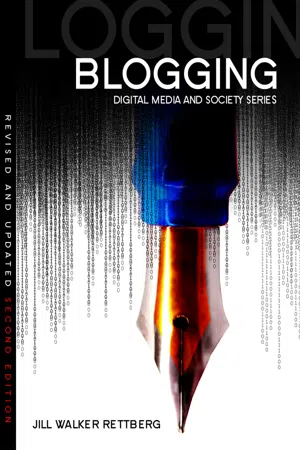
Thoroughly revised and updated, this new edition of Blogging provides an accessible study of a now everyday phenomenon and places it in a historical, theoretical and contemporary context. The second edition takes into account the most recent research and developments and provides current analyses of new tools for microblogging and visual blogging.
Jill Walker Rettberg discusses the ways blogs are integrated into today's mainstream social media ecology, where comments and links from Twitter and Facebook may be more important than the network between blogs that was significant five years ago, and questions the shift towards increased commercialization and corporate control of blogs. The new edition also analyses how smart phones with cameras and social media have led a shift towards more visual emphasis in blogs, with photographs and graphics increasingly foregrounded.
Authored by a scholar-blogger, this engaging book is packed with examples that show how blogging and related genres are changing media and communication. It gives definitions and explains how blogs work, shows how blogs relate to the historical development of publishing and communication and looks at the ways blogs structure social networks.
eBook - ePub
Blogging
About this book
Information
CHAPTER ONE
What is a Blog?
To really understand blogs, you need to read them over time. Following a blog is like getting to know someone, or like watching a television series. Because blogging is a cumulative process, most posts presuppose some knowledge of the history of the blog, and they fit into a larger story. There’s a very different sense of rhythm and continuity when you follow a blog, or a group of blogs, over time, compared to simply reading a single post that you’ve found through a search engine or by following a link from another website. A blog consists of more than words and images. It cannot be read simply for its writing, but is the sum of writing, layout, connections and links and the pace of publication.
You probably already have some idea of what a blog is, but, if you’re like most of us, your concept of “blog” may be skewed by the kinds of blogs that you have read or that you have read about in the media. This chapter will provide you with a definition of what a blog is, but, more importantly, I hope to give you a broad sense of what blogs can be.
In the first edition of this book, I included a section on how to set up your own blog. Five years later, I am still quite sure that you will understand blogs better if you try setting up your own blog, but I think it’s easier to learn to do that from the internet than from a book. Go to one of the common blogging engines like Blogger.com or Wordpress.com, and follow their instructions. It’s free and it’s really very easy – you just click a few buttons, select a template to determine what your blog should look like and you’ll be ready to publish your first post. I prefer the more open systems like Wordpress, which you can even install on your own server if you want total ownership, but a lot of people enjoy blogging on more limited services like Tumblr and Pinterest. Even Facebook is a kind of blogging. So as you read, please don’t be afraid to dive in and try things for yourself.
This chapter starts off with a history of blogging to give us a sense of our surroundings. Next, I’ve chosen three kinds of blogs for us to look at and analyse: a personal, diary-style blog; a filter-style blog that combines expertise with a personal twist; and two topic-driven blogs: a political blog and a craft blog. After examining these blogs, I’ll discuss some definitions of blogs and consider how well they suit our examples.
A brief history of weblogs
Weblogs are unequivocally a product of the Web, and their history can be said to have begun at the same time as the Web was born. The World Wide Web was invented by Tim Berners-Lee and first implemented at the end of 1990, when Berners-Lee finished building the tools necessary to publish and view the first website: a web server on which to host the website, a web browser with which to view it, and the site itself. At the time, Berners-Lee was a scientist at CERN, the well-known particle physics lab in Switzerland, and his project was not seen as particularly important. The internet had already existed for two decades and was used by scientists, programmers and people interested in new forms of communication. Before the Web, the internet ran a number of protocols, such as email, UseNet (discussion groups), IRC (a chat system) and Gopher (a way of browsing files on remote servers). Many people simply saw the World Wide Web as yet another protocol. Berners-Lee’s prototype web browser was entirely text based, so web pages couldn’t include images or other media as they do today, and web browsers were not available on most computer platforms. It wasn’t until 1993 that the Web opened up to the general public with the release of Mosaic, the first widely available graphical web browser, and also the first web browser to allow embedded images. Previous browsers had displayed images in separate windows, not in the same window as the text.
Most early websites were imagined as finished products rather than the constantly updated blogs and social media we are familiar with today. In retrospect, personal home pages can be seen as a precursor to blogs, but they were envisioned as complete presentations of the user’s interests, not as something that would change daily. Websites were, however, often published before their creators imagined them to be complete. ‘Under construction’ signs were a common sight on websites in the 1990s, often accompanied by an icon depicting a worker with a shovel, as on road signs, showing the tension between the desire for completion that we had inherited from print and the constant flux of the Web.
By 1994, some pioneers had started online diaries. One of the first diarists was Justin Hall, who still blogs today. If you look at the early pages on his website, Justin’s Links, you’ll see that his site then was very different from today’s blogs, and provides a wonderful example of the shift from building ever-expanding, densely hypertextual websites to developing blogs that are not intended to ever be completed. Hall used the section of his site called Vita to tell the story of his life (links.net/ vita). Some pages show links organized chronologically from his childhood to the present; others are organized thematically by family, by places he grew up and has travelled to, by school, and by people who’ve meant a lot to him. Once you click a link, you find yourself in a labyrinth of interlinked stories that keep leading you through parts of Hall’s life, frequently circling back to certain key topics, such as his father’s suicide when he was eight, or his fascination with the Web. In 1996, Hall began publishing diary entries (in a section of the site called Daze), but each entry still had the same rambling style as his autobiography. Hall didn’t start using blogging software until 2003. Up until then, he hand-coded each entry.
When Justin Hall began publishing regular diary entries in 1996, his site matched today’s understanding of what a blog might be. However, at the time, the word ‘weblog’ didn’t exist – or rather, the word existed but was used for a different purpose. The term ‘Web log’ was used in the early 1990s to refer to the log of visitors that a person who administers a Web server can see. A Web log showed the number of total hits a site had received, how many unique users had visited, how much data had been transferred and other information about the traffic to the site.
In December 1997, Jorn Barger proposed the term should be used differently (Blood 2000). Barger’s site, Robot Wisdom, was (and still is) a frequently updated list of links to other websites Barger has visited and wants to recommend, and Barger used the word ‘weblog’ as part of the title of his site, Robot Wisdom: A Weblog by Jorn Barger. This, it seems, was the first usage of the word ‘weblog’ in this sense. Robot Wisdom was a very bare list of links, with little or no commentary on each link. This style is similar to that of the more widely read Scripting News in the early years. Scripting News is the weblog of Dave Winer and was launched in April 1997, several months before Robot Wisdom, and also consisted of links to websites the blogger had seen with very minimal commentary. Here are the first few lines of Winer’s very first post, with the links underlined:
Tuesday, April 01, 1997
Linkbot, Big Brother.
Barry Frankel says Web Ads are Intrusive and Wesley Felter replies.
Check this out. Amazing!
MacWEEK: Goodbye AppleLink. (A tear comes to my eye …)
Winer is still a prolific blogger, often writing several posts a day. The most obvious difference is that each post is longer, giving more context and presenting Winer’s opinions on the topic at hand. He will also often include links to more different sources. Today, Winer uses links to build an argument, pulling ideas together from different websites and weaving links into miniature essays. Winer’s 1997 posts are much closer to Robot Wisdom’s simple list of links, logging the websites visited in much the same manner as the history menu on your web browser.
Early bloggers hand-coded their sites, meaning that they had to create their blogs from scratch and edit raw HTML code or use a visual HTML editor like Dreamweaver each time they updated the blog. In late 1998 and throughout 1999, several free tools appeared that allowed bloggers to easily publish and update blogs and online diaries using templates and Web-based forms where posts could simply be typed straight in. Open Diary launched in October 1998, offering online diarists free hosting and an easy publishing solution. By January 1999, they hosted 2,500 diaries, all of them anonymous. In fact, Open Diary required that users be anonymous:
The Open Diary is a totally anonymous diary community. We don’t want to know who you are, and we don’t want your readers to know who you are. Therefore, please do not include any information in your diary that would identify you. Such information includes full names, street addresses, phone numbers, and e-mail addresses that include your name in them (like [email protected]).
We do not allow any such information on this site, and if you enter it, it will be deleted. […] Remember, there is a potential audience of 100 million people on the Internet who could read your diary, we would prefer (and we think you would also) if they didn’t know who you are. (opendiary. com, ‘The Rules’, accessed at thearchive.org’s archive for 25 January 1999)
Early weblogs differed from many online diaries in that they were generally written by people who used their full name, and, of course, in that they primarily consisted of comments on other websites and not of diary-like discussions of the writer’s own life.
1999 also saw the launch of Pitas, the first free weblogging tool, followed by the release of Blogger in August of the same year. In her early essay on weblogs, Rebecca Blood argued that the actual posting interface of Blogger may have influenced the way weblogs developed in this period from being sparse lists of links, like Barger and Winer’s early posts, to being more essayistic, including thoughts on issues not directly related to a specific website and links to other blogs that led to conversations between blogs (Blood 2000). When you posted to your Blogger blog in 1999, the interface provided a small box for you to type the post’s title, and a larger box for you to type whatever you like. Other blogging systems, like that at the still popular community blog Metafilter, had and still have a more rigid system. At Metafilter, you fill out several boxes, each clearly labelled with instructions to the writer:
• Post Title. Keep it short and descriptive.
• Link URL. Web address of the site you’re posting about.
• Link Text. These will be the first words of your post, and will be a clickable link to the web address you entered above.
• Description. The body of your post. Feel free to add links within your description, keep it one paragraph long if possible, line breaks will be stripped.
Recently, two extra boxes were added: an extended description and a box for tags. The original interface leads to a very specific form of post that is quite similar to the early style of Winer and Barger. For instance, in August 2007, one could read posts such as the following:
The Icelandic coastline. A gallery of photos of the rugged, cold, and beautiful coast of Iceland.
posted by Gamblor at 5:40 AM – 18 comments
Time lapse animations of planets and satellites. See what an amateur digital astrophotographer could do a decade ago. This is what the animated gif was designed to do.
posted by dkg at 6:43 AM – 20 comments
Statetris is Tetris with European countries or American states as blocks.
posted by goodnewsfortheinsane at 8:53 PM – 27 comments
As you can see, the posts match the constraints set up by the four boxes of Metafilter’s posting interface. There are exceptions, as it is possible to compose a post without using the initial link, but Metafilter is heavily dominated by brief, sparse posts linking to one or more interesting or unusual websites. The comments, however, can develop into lengthy debates, often involving scores, sometimes hundreds, of participants.
By the year 2000, Rebecca Blood wrote that the transition from the sparse lists of links, or filter-style weblogs, as she calls them, to the more essayistic form of blogging had largely taken place. She credits the free-form interface of blogging sites like Blogger with this shift:
It is this free-form interface combined with absolute ease of use which has, in my opinion, done more to impel the shift from the filter-style weblog to journal-style blog than any other factor. And there has been a shift. Searching for a filter-style weblog by clicking through the thousands of weblogs listed at weblogs.com, the EatonWeb Portal, or Blogger Directory can be a Sisyphean task. (Blood 2000)
But not all early weblogs were sparse, minimal lists of links. An early blogger who wrote considerably more essayistic posts than Jorn Barger and Dave Winer was Peter Merholz, who was the first person to shorten the term ‘weblog’ to ‘blog’. Merholz simply noted this in the sidebar to his blog in 1999: ‘I’ve decided to pronounce the word “weblog” as wee’-blog. Or “blog” for short’ (Blood 2000). Merholz’s posts to his blog PeterMe have consistently been more essayistic than sparse, often discussing issues of usability and interface design, the field within which he works. Merholz still blogs today and has maintained this essayistic style.
Looking back, blogs like Metafilter, Scripting News and Robot Wisdom are very reminiscent of Twitter messages today, and perhaps also of Facebook status messages. On Twitter, users are limited to 140 characters in each of their posts, requiring extreme brevity and often somewhat contorted language to get a message across. Like Metafilter, Twitter and Facebook provide small boxes to write in and provide the user with prompts that guide what the boxes should be filled with. Facebook initially asked ‘What are you doing right now?’, later changing this to ‘What’s on your mind?’ Twitter used to ask ‘What are you doing?’ but now simply explains ‘Compose new tweet’, although if you press the icon that brings up a new window to write a tweet, you are given the prompt ‘What’s happening?’ Presumably, we have already learnt how to use Twitter, and no longer need such explicit prompts.
Another factor in the shift Blood identifies from a brief to an essayistic style of blogging is likely the merging of two previously fairly distinct genres. Early web diaries such as that of Justin Hall have little in common with the early weblogs of Jorn Barger or Dave Winer, or with the Metafilter of today. Carolyn Burke, who started her online diary in January 1995, wrote at the Online Diary History Project, ‘I wanted everyone in the world to expose their inner lives to everyone else. Complete open honest people. What a great and ideal world would result’ (Burke, n.d.). The early years of the web were characterized by utopianism and optimism: finally, everybody would be able to communicate freely. Blogger’s slogan in 2000, ‘Push-button publishing for the people’, takes another tack on the matter– not shared intimacy, as with personal diaries online, but opening up publishing to regular people.
Once free, easy-to-use blogging systems like Blogger.com and others were established, blogging took off. By 2002, the Oxford English Dictionary was asking Peter Merholz for a print source for the word ‘blog’ so they could include it in their dictionary (peterme.com, 14 June 2002).
The blog search engine Technorati.com launched in 2002. The number of blogs it tracked grew rapidly, from a little over 100,000 in late 2003 to three million by July 2004. At this point, the total number of blogs was doubling every few months. Blog search engines like Technorati made the connections and conversations between blogs much more easily accessible to outsiders, and provided vast amounts of data about the blogosphere, as people had begun to call the global networks of blogs and the conversations taking place in them. Technorati began to release quarterly reports on ‘The State of the Blogosphere’, which were much cited and discussed and gave some of the largest-scale pictures of what blogs across the world were like. Technorati still exists today, but after indexing well over 100 million blogs in 2008 they have cut back to only one million blogs today, and have stopped indexing blogs in languages o...
Table of contents
- Cover
- Half Title
- Title Page
- Copyright
- Contents
- Acknowledgements
- Introduction
- 1 What is a Blog?
- 2 From Bards to Blogs
- 3 Blogs, Communities and Networks
- 4 Citizen Journalists?
- 5 Blogs as Narratives
- 6 Blogging Brands
- 7 The Future of Blogging
- References
- Blogs Mentioned
- Index
Trusted by 375,005 students
Access to over 1.5 million titles for a fair monthly price.
Study more efficiently using our study tools.
Frequently asked questions
Yes, you can cancel anytime from the Subscription tab in your account settings on the Perlego website. Your subscription will stay active until the end of your current billing period. Learn how to cancel your subscription
No, books cannot be downloaded as external files, such as PDFs, for use outside of Perlego. However, you can download books within the Perlego app for offline reading on mobile or tablet. Learn how to download books offline
Perlego offers two plans: Essential and Complete
- Essential is ideal for learners and professionals who enjoy exploring a wide range of subjects. Access the Essential Library with 800,000+ trusted titles and best-sellers across business, personal growth, and the humanities. Includes unlimited reading time and Standard Read Aloud voice.
- Complete: Perfect for advanced learners and researchers needing full, unrestricted access. Unlock 1.5M+ books across hundreds of subjects, including academic and specialized titles. The Complete Plan also includes advanced features like Premium Read Aloud and Research Assistant.
We are an online textbook subscription service, where you can get access to an entire online library for less than the price of a single book per month. With over 1.5 million books across 990+ topics, we’ve got you covered! Learn about our mission
Look out for the read-aloud symbol on your next book to see if you can listen to it. The read-aloud tool reads text aloud for you, highlighting the text as it is being read. You can pause it, speed it up and slow it down. Learn more about Read Aloud
Yes! You can use the Perlego app on both iOS and Android devices to read anytime, anywhere — even offline. Perfect for commutes or when you’re on the go.
Please note we cannot support devices running on iOS 13 and Android 7 or earlier. Learn more about using the app
Please note we cannot support devices running on iOS 13 and Android 7 or earlier. Learn more about using the app
Yes, you can access Blogging by Jill Walker Rettberg in PDF and/or ePUB format, as well as other popular books in Languages & Linguistics & Journalism. We have over 1.5 million books available in our catalogue for you to explore.