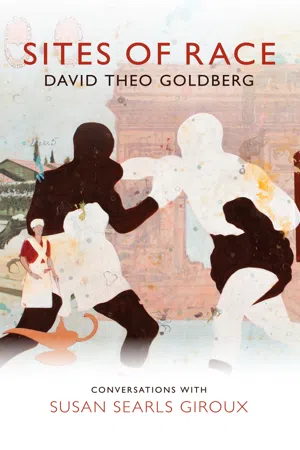
Critical social theorist and philosopher David Theo Goldberg is one of the defining figures in critical race theory. His work, unsurpassed in its analytical rigor and political urgency, has helped transform the way we think about race and racism across the humanities and social sciences, in critical, social and political theory and across geopolitical regions.
In this timely collection of incisive and lively conversations with Susan Searls Giroux, Goldberg reflects upon his studies of race and racism, exploring the key elements in his thought and their contribution to current debates. Sites of Race is a comprehensive overview of Goldberg's central ideas and concepts, including the idea of the Racial State, his emphasis on militarism as a culture, and his treatment of the "theology of race". Elegantly navigating between the theoretical and the concrete, he brings fresh insight to bear on significant recent events such as the War on Terror, Katrina, the killing of Trayvon Martin and Arizona's controversial immigration laws, in the process enriching and elaborating upon his vast body of work to date.
Sites of Race offers fresh avenues into Goldberg's work for those already familiar with it, and provides an ideal entry point for students new to the field of critical race theory.
- English
- ePUB (mobile friendly)
- Available on iOS & Android
eBook - ePub
Sites of Race
1
Race to modernity
Susan Searls Giroux: You grew up in apartheid South Africa, where you engaged, as you have put it, in “years of struggle against apartheid on picket lines and around parliament, through the mists of tear gas and protest slogans and closing down the college campus,” then moving to the US to attend graduate school in New York City and finding there “Reagan's brand of ‘new racism’ reeled all about too. There it lay, not quite invisibly,” you write, “in the conditions producing both homelessness and homeboys, dramatically differentiated employment rates across race and hypersegregation” [Goldberg 2002b: 422–3]. It is against this backdrop that you map the personal and political contexts that informed your transition from youthful activism to write on the “philosophical foundations of racism,” which, radically revised, became the basis for Racist Culture [1993]. You produced, in short, a comprehensive philosophical archeology of racial conceptualization where none had existed before, as part of your efforts to “throw down a gauntlet to the discipline of philosophy, to challenge its parochialism, its self-possessed denial, its blindness to its own traumatic implication in the history of racist reproductions, its sweeping of its own stench behind that veil of ignorance” [Goldberg 2002b: 423]. Can you talk about why you chose to intervene in what you saw unfolding all around you in Cape Town and then New York in the form of a deeply historical and philosophical treatise on racism, especially as we seem to find ourselves at a time when there is a great deal of suspicion and cynicism about the significance of “academic” interventions in the worldly space of politics? Your own formation as an intellectual seems to suggest a need to rethink common-sense distinctions between theory and practice, the so-called “ivory tower” and the space of “realpolitik.”
David Theo Goldberg: Let me start with the autobiographical and thread back into the conceptual question. I grew up in a middle-to-increasingly-upper-middle-class home, a fairly liberal South African family. Extended members of the family were engaged in politics from the center to the left, the older members being more centrist in nominally opposing apartheid under a liberally driven sense of what living in South Africa might be as a nonracial society and voted and acted accordingly; the younger members of the family engaged in antiracist activity of various kinds, mainly campus politics, which to some degree took on life-and-death circumstances. A cousin, closest to me growing up, identified himself as a mixed-race person living with and interacting with other mixed-race people in Cape Town, and continues to live out his life forty years later in a quite provocative way, refusing to give in to certain aspects of racial politics in South Africa, much to the chagrin of the rest of the family. So we have this not quite entire gamut, because the entire gamut would include proto-nationalists and the like, who were absent, sometimes refused. Another cousin wanted to marry the daughter of a notable apartheid government cabinet minister, and both families intervened to prevent it, liberalism and racial nationalism, Jewishness and Calvinism running headlong into each other. At the same time, as with almost every family like this in South Africa, there were members of the household – I hesitate for all the obvious political reasons to say quite full members – who as domestic labor lived with us and were very much part of an extended family, socially intimate. As I grew into teenage years, living social life on a beach, I would go off into townships with friends of my age and begin to engage with black people. Older men invited us into their homes in the townships, to engage in illicit transactions. I realize retrospectively that there was more than the illicit activity holding us together; there was a – I'll call it – humaneness, treading on the ground of humanism Paul Gilroy continues to push provocatively and productively, that drew us in, drew us together. There were common exchanges around politics, sports, discussions about sexuality. There were conversations about social life, about political issues of the day. It's those things that one realized flew very dramatically and very immediately in the face of apartheid. We were transgressing apartheid as we were doing this, but it also prompted very deep questions about the forms of race denial and human denial with which we were confronted on the most immediate basis.
Everything in South Africa then, and to some, though lesser, degree now, had a racial dimension to it, so that the forms of repression, which were so deep around race, could only inevitably pervade every other aspect of social-political life, in both trivial and nontrivial ways. From discipline at school to everyday policing in the street, the forms of invasiveness were at every level of existence, concerning not just the more obvious traditional senses of political activity. And as a thinking teenager I began to question those forms of repression and to realize that they marked and ordered every aspect of our everyday being.
I grew up in a house on a hill looking out to Robben Island across Table Bay. It was literally the first view of my morning, every morning of my teenage and into university life. And so I was faced daily by the question of racially founded privilege and the costs at which it was purchased. This wasn't just about Mandela, although he symbolized something to us even in the mid- to late 1960s and early 1970s. It was a matter of the symbolism of a future South Africa that would not be beholden to these pervasive forms of repression. That became evident every day I woke up. It was a formative part of waking experience. I can't say everybody had this experience, or faced this question explicitly. I just happened to live on a hill overlooking Robben Island. But every time there was a piece of news about somebody dying on Robben Island or in other spaces of incarceration, about Steve Biko being beaten to death by the police in 1977 or forms of political repression like those in 1976 or earlier in the 1972 trade union strikes, and so on, these issues became more palpable, and one couldn't help but take a stand. Even if you refused to take an explicit stand on these things, it was a stand, right? So the more conscious one became, the more inevitably present to one these questions were.
For black people in the townships it was more immediate and more direct, especially post-1976: black urban space was being made ungovernable. The privilege for those of us at almost completely white universities itself came into question. Black and mixed-race students would only be admitted to designated white and privileged universities if they could show that their desired course of study was not available at designated black colleges. So black students would design seemingly anomalous curricula, like pre-medicine and archeology (perhaps interdisciplinarily they were way ahead of the curve!).
In the early 1970s in South Africa, debates in the social sciences and the humanities, in which I was training, were very largely around the class/race question in the wake of Althusser. There were heated debates around interpellation, around repressive and ideological state apparatuses. We were reading Fanon seriously, not so much Black Skin White Masks [1956], which became a text du jour of the northern hemisphere academy in the late 1970s and early 1980s. We took inspiration from what we read as revolutionary texts, Wretched of the Earth [1963], A Dying Colonialism [1965], and Toward the African Revolution [1969]. These texts spoke to us about the possibility of Zimbabwe and Mozambique being free societies (painful to think of the former in these terms today), of throwing off colonial repression. So when I left South Africa in 1977 and arrived in New York in 1978, it was that set of experiences I brought with me.
Going into a graduate program in philosophy that was consumed with the questions of philosophy of language, the philosophy of science, epistemology, very traditional philosophical questions, I began looking around for other inspirations. Edward Said had just published Beginnings [1978] and was about to publish Orientalism [1979]. I sat in a class of his on Gramsci, Althusser, and Foucault at Columbia. I was searching around in the corpus of philosophy, in that form of philosophy to which I was being subjected as a graduate student, in order to come to terms with a project that would speak to me, and that I could speak to from my own experience. That struggle over race and class had stayed with me, those South African debates. They were still very reductionistic; they were concerned with Althusser, to use Foucault's term, as the counterhistory within the Marxist corpus, which is why it was seized on within the context of South Africa in the 1970s. It offered a counter to the reductionism of a Harold Wolpe, to some extent Martin Legassick and Stanley Trapido or Ben Magubane, of racism as an epiphenomenal ideological formation, the force of which was always driven by class and the form of class would define the form of racial arrangement being expressed. This always struck me as a weak response regarding the force of race. Race seemed so obviously a much thicker, less epiphenomenal and dependent form of engagement, of social being and arrangement, of politics than class reductively was able to account for. Those seeking to reduce race to shadow effects of class struck me as necessarily paying no attention to the complexities of the racial.
SSG: It functions as an evasion, actually …
DTG: … an evasion, yes. The material conditions were not unimportant, of course. They set the limits of possibility. But they certainly didn't define or comprehend the self-determinations around questions of race. When I was confronted with figuring out a dissertation project, there was very little, no philosophical dissertations about race. There was a bit of analytic philosophy around race and morality that addressed race, from the liberal point of view, as an irrelevant category. So I began a kind of archeology trying to trace the philosophical and intellectual considerations out of which this commitment to race as a morally irrelevant category emerged from the likes of Hobbes onwards. And this archeology became, predictably, much influenced by Foucault. It became a genealogy of modernity. So you can begin to see in what became Racist Culture the emergence and elaboration of forms of racially shaped liberalism as a centerpiece of philosophical modernity.
An anecdote bears out the force and pervasiveness, even the hegemony, of this philosophical disposition regarding race in the English-speaking academy of the time. Gerry Cohen, an analytic Marxist who in the early 1980s was writing very effectively about “world-ownership,” about property, subjectivity, and power [see Cohen 1986], came to give a talk for my graduate program. At the reception he asked me, “So what are you working on?” And I said, “The philosophical foundations of racism.” He clearly balked, was taken aback, and blurted out, not unsympathetically, “You mean racism has philosophical foundations?” And it was that, not just ignorance, but blindness, the veil of ignorance, you might say, to push the point, which I took as an expression of a much broader, wider, deeper set of evasions, as you called them …
SSG: Right, a refusal to know.
DTG: An absolute refusal in which these questions were not even on the map and an excavation of the philosophical history that produced them was just starting up. This was pre-Skip Gates's “Race,” Writing and Difference [Gates and Appiah 1992], pre-Racial Formations [Omi and Howard 1986], it was just at the time that Stuart Hall was writing “Race, Articulation and Societies Structured in Dominance” [1980]; Policing the Crisis [Hall et al. 1978] was not being widely read yet, even though it had been written three to four years earlier. Said's Orientalism was just taking hold of imaginations, of imaginative geographies, so it gives you a sense of how deep the silences ran. There was an emerging tension between a view that race and racism couldn't possibly have any philosophical or more broadly intellectual underpinnings and the counterhistory concerned to uncover exactly the intellectual underpinnings race and racism had been afforded throughout modernity. I wasn't alone. I quickly found a group of young African-American philosophers who became very influential in my socialization into a set of philosophical debates. With them a society formed, founded by Al Prettyman in his living room on Broadway, into which circle I was welcomed, the New York Society for Black Philosophy, which included Cornel West, Howard McGary, Tommy Lott, Bill Lawson, Lucius Outlaw; it was through the Society I met Angela Davis. It became very instrumental in opening up the American Philosophy Association to engaging these questions. If you attend an APA meeting today you will see all kinds of panels addressing issues of race that would not have been possible without this moment in the early 1980s.
SSG: One of the primary theoretical concerns in The Racial State [Goldberg 2002a] has been to differentiate historically between the shifting logics and practices – moral and legal, economic and political – within specific racially configured states. Principally you discuss the movement from what you call “racial naturalism” to “racial historicism,” and the corollary transition in forms of racial rule from brute force to the rule of law. You describe the current moment in terms of a new regime of racially conceived truth – what you call states of racelessness.
Your most recent work, however, seems to indicate a return to brute force and violence in the interests of racial rule. I'm thinking in particular of your discussion of racial americanization, the militarization of its domestic and foreign policy, but also your analysis of the state of Israel and the simultaneous elaboration of what you call racial palestinianization. As in the discussion of the US, you unveil a kind of Hobbesian scene around racial palestinianization concerning war becoming permanent, relationships of force, the suspension of rights, and so on. Your comments raise so many questions, but I'll focus on two primarily.
First, how is it that what you've called “naturalistic” logics and the use of violence seem to re-emerge and come to the fore in the context, particularly in the US, though I suspect at least nominal support globally, of a commitment to racelessness or race-transcendence? And, second, does this bespeak another order of brute force altogether – what you call, after Achille Mbembe [2003], “necropolitics”?
DTG: Racial naturalism is the name I give to the set of claims that those considered not European or white, or not of European or to some significant degree white descent, are inherently inferior – naturally so – to those who are. Racial historicism, by contrast, is the set of claims that those not European or white, or not of European descent, are historically immature by comparison, and that the more mature have an obligation to school the less mature until they are capable of making good judgments for themselves, can thus rule themselves well (the civilizing mission). As I indicate in The Racial State, these two views don't preclude each other; they become more or less dominant in relation to historical circumstances. You can find both views held by the same person to different ends and purposes, or at different times; or held in the same state at different moments. They come and go; while one might be dominant, even to a degree hegemonic, that does not preclude the taking up of the logic of the other to certain purposes and under certain conditions. Sepulveda in mid-sixteenth-century Spain represents naturalism; Las Casas represents racial historicism in his resistance to enslaving the Indios of the Americas. But Las Casas himself owned African slaves, blind to the contradiction precisely by his racial naturalism with respect to Africans. Naturalism dominates European racial consciousness from the fifteenth well into the nineteenth century, underpinning modern slavery; historicism serves as naturalism's resistance, the understanding of the racial in the name of which abolition is largely driven, and becomes dominant in the wake of emancipation. World War II, arguably, is the ultimate contestation between these warring racial conceptions.
Now 9/11 seems to have opened up a space in which naturalism gets re-invoked. Muslims have been re-naturalized, so to speak. The language in the 2012 US presidential campaign about a large percentage of the population being “moochers and takers” (47 percent in Romney's account, 30 percent in Paul Ryan's) naturalizes a set of cultural claims, reinserting among conservatives naturalist commitment insinuatingly into their traditional “poverty of culture” concerns. In invading Iraq, you can see historicist assertions at work: the US will help to acculturate Iraqis into acquiring democratic values and institutional structures and practices. It is not that they are inherently incapable of them; quite the contrary. They have just not had the opportunity historically to nurture them, which America will now educate them into doing, cultivate in them, in short, civilize them. Here (and in Afghanistan too), one finds in the dominant American position the interlacing of a historicist with a naturalist conception: alongside the insistence on acculturating democratic disposition can be found the insistence of murderous tendencies, the resort to violence seen as “their natural way” of settling differences. Among many Israelis you find a similar bifurcation regarding Palestinians. This trajectory of racial conception arcs from the Inquisition at modern Europe's founding to Europe's latter-day self-fortressing to hold at bay perceived pollutants of “real” Euro-identity.
SSG: And you've also said that racelessness insistent on historical amnesia leaves no other analytical alternative to this kind of biologized naturalism.
DTG: Underlying these differentiated claims is a deeper, longstanding concern, namely, the management of heterogeneities in any society. Such management assumes two dominant forms: first, acknowledging mixture and “diversity” but insisting that all social subjects be bound by the prevailing social and cultural values of those dominant in the society (I call this the insistence on “Euro-mimesis”); and, second, the recourse to violence where management through mixture fails, where subjugated subjects more or less self-consciously refuse Euro-mimetic imposition. Violence is usually rationalized in terms of naturalizing forms of representation. So the notion of a permanent war opens up a space for imposing violent technologies of management directly, viscerally, on people. The longer the violence lingers and is met with resistant counter-violence, the likelier it is that historicizing rationalizations will dissipate, even disappear, and the boldness of the violence will ramp up. One can probably trace this waxing and waning in specific cases, like Iraq or the Palestinian Territories, in the war on terror, in the pacification program, more recently in US media characterization of Egyptians “not having democracy in their political DNA,” and in the rationalization of “black on blac...
Table of contents
- Cover
- Dedication
- Title page
- Copyright page
- Acknowledgments
- Introduction
- 1: Race to modernity
- 2: Global racialities
- 3: Modernity's civic religion
- 4: Racial states
- 5: Fearing Foucault
- 6: The raciologics of militarizing society
- 7: Migrating racisms
- 8: Civic lessons
- 9: Racial (ir)relevance
- 10: Reiteracing Obama
- References
- Index
Trusted by 375,005 students
Access to over 1.5 million titles for a fair monthly price.
Study more efficiently using our study tools.
Frequently asked questions
Yes, you can cancel anytime from the Subscription tab in your account settings on the Perlego website. Your subscription will stay active until the end of your current billing period. Learn how to cancel your subscription
No, books cannot be downloaded as external files, such as PDFs, for use outside of Perlego. However, you can download books within the Perlego app for offline reading on mobile or tablet. Learn how to download books offline
Perlego offers two plans: Essential and Complete
- Essential is ideal for learners and professionals who enjoy exploring a wide range of subjects. Access the Essential Library with 800,000+ trusted titles and best-sellers across business, personal growth, and the humanities. Includes unlimited reading time and Standard Read Aloud voice.
- Complete: Perfect for advanced learners and researchers needing full, unrestricted access. Unlock 1.5M+ books across hundreds of subjects, including academic and specialized titles. The Complete Plan also includes advanced features like Premium Read Aloud and Research Assistant.
We are an online textbook subscription service, where you can get access to an entire online library for less than the price of a single book per month. With over 1.5 million books across 990+ topics, we’ve got you covered! Learn about our mission
Look out for the read-aloud symbol on your next book to see if you can listen to it. The read-aloud tool reads text aloud for you, highlighting the text as it is being read. You can pause it, speed it up and slow it down. Learn more about Read Aloud
Yes! You can use the Perlego app on both iOS and Android devices to read anytime, anywhere — even offline. Perfect for commutes or when you’re on the go.
Please note we cannot support devices running on iOS 13 and Android 7 or earlier. Learn more about using the app
Please note we cannot support devices running on iOS 13 and Android 7 or earlier. Learn more about using the app
Yes, you can access Sites of Race by David Theo Goldberg in PDF and/or ePUB format, as well as other popular books in Economics & Economic Theory. We have over 1.5 million books available in our catalogue for you to explore.