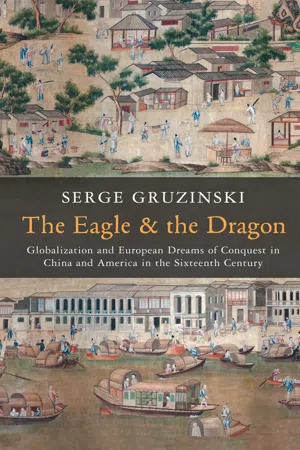
In this important new book the renowned historian Serge Gruzinski returns to two episodes in the sixteenth century which mark a decisive stage in global history and show how China and Mexico experienced the expansion of Europe.
In the early 1520s, Magellan set sail for Asia by the Western route, Cortes seized Mexico and some Portuguese based in Malacca dreamed of colonizing China. The Aztec Eagle was destroyed but the Chinese Dragon held strong and repelled the invaders - after first seizing their cannon. For the first time, people from three continents encountered one other, confronted one other and their lives became entangled. These events were of great interest to contemporaries and many people at the time grasped the magnitude of what was going on around them. The Iberians succeeded in America and failed in China. The New World became inseparable from the Europeans who were to conquer it, while the Celestial Empire became, for a long time to come, an unattainable goal.
Gruzinski explores this encounter between civilizations that were different from one another but that already fascinated contemporaries, and he shows that our world today bears the mark of this distant age. For it was in the sixteenth century that human history began to be played out on a global stage. It was then that connections between different parts of the world began to accelerate, not only between Europe and the Americas but also between Europe and China. This is what is revealed by a global history of the sixteenth century, conceived as another way of reading the Renaissance, less Eurocentric and more in tune with our age.
eBook - ePub
The Eagle and the Dragon
Globalization and European Dreams of Conquest in China and America in the Sixteenth Century
- English
- ePUB (mobile friendly)
- Available on iOS & Android
eBook - ePub
The Eagle and the Dragon
Globalization and European Dreams of Conquest in China and America in the Sixteenth Century
About this book
Information
1
Two Tranquil Worlds
What frightens me in Asia is the vision of our own future which it is already experiencing. In the America of the Indians, I cherish the reflection…of an era when the human species was in proportion to the world it occupied.
Claude Lévi-Strauss, Tristes tropiques
(trans. J. and D. Weightman, p. 150)
In 1520 Charles V, Francis I and Henry VIII were the three rising stars of Latin Christendom: regent of Castile since 1517, crowned king of Germany in 1520, Charles the Great had been born with the new century; Francis I had been king of France since 1515, Henry VIII king of England since 1509.1 Meanwhile, in Portugal the ageing Manuel the Fortunate was still vigorous enough to marry the sister of the Tudor king. Faced with their French and English rivals, Charles the Great and Manuel of Portugal nurtured oceanic ambitions which would project their kingdoms towards other worlds. In November 1519 a Spanish adventurer called Hernán Cortés, at the head of a small troop of foot soldiers and cavalrymen, made his entry into Mexico. In May 1520 a Portuguese ambassador, with even fewer men, entered Nanking. It was here that the ambassador Tomé Pires was received by the emperor of China, Zhengde. Korean sources reveal the presence of some Portuguese in the imperial entourage, where they would have enjoyed the services of a guide and interpreter, the Muslim merchant Khôjja Asan.2 In Mexico, and at this same period, Cortés met Moctezuma, leader of the Triple Alliance, or, if preferred, the ‘Emperor of the Aztecs’.
The Two Emperors
Let us look first at Zhengde. It was in Peking, in June 1505, that Zhu Houzhao succeeded his father, the Emperor Hongzhi, under the imperial name of Zhengde. The tenth Ming emperor had acceded to the throne at the age of fourteen and he died in 1521.3 His reign was much criticized by the chroniclers. According to them, Zhengde neglected affairs of state in favour of a life of pleasure. He liked to travel outside the Forbidden City, leaving his predatory eunuchs to amass fortunes.
In reality Zhengde was also a warrior who tried to escape the tutelage of the senior civil servants in order to revive the tradition of openness, even cosmopolitanism, of the preceding Mongol dynasty, the Yuan. He spent most of his time away from the imperial palace and he liked to surround himself with Tibetan monks, Muslim clerics, artists from central Asia, and Jurchen and Mongol bodyguards; when, that is, he was not meeting foreign ambassadors who had travelled to Peking. He even prohibited the slaughter of pigs so as to improve relations with the Muslim powers of central Asia. In 1518 and 1519 he personally led military campaigns in the north against the Mongols and in the south in Jiangxi. In 1521 he decided to crush a rebellious prince and had him executed in Tongzhou. This did nothing to improve his image; or that at least is the impression left by the official chronicles and gazetteers that appeared after his death, all of which present his reign as a time of disorder and decay (moshi). An exodus of peasants to the mines and the towns, the rise of parvenus, the abandonment of traditions, ‘local customs’ made to undergo ‘a sea change’,4 harsh exactions by officials, unease and unrest among the people, the growth of illegal trade with the Japanese – the verdict of the official histories is hardly complimentary. Added to which were natural catastrophes, a flood and a famine in 1511, which they were quick to blame on the crisis then afflicting society. But not the whole of society; it was also an age when new fortunes were too many to count, when production everywhere increased and when international trade was more prosperous than ever before.5
In 1520 the ruler of China, in a drunken stupor, fell from the imperial boat into the waters of the Grand Canal, the principal artery connecting the north and south of the country. The fever or pneumonia he caught as a result of this enforced immersion killed him the following year, on 20 April, aged only thirty. It was icy water that had led to his death, and as this was the element of the dragon, some chroniclers believed that dragons had been responsible for his untimely end.6 Only a few months earlier, mysterious creatures had disturbed the calm of the streets of Peking, attacking passers-by and wounding them with their claws. They were called ‘Dark Afflictions’.7 The Minister of War restored order and the rumours died down. Zhengde, who had always been curious about strange phenomena, had met the Portuguese embassy not long before his death. To his contemporaries and their successors, however, this episode counted for little. It did not earn him the posthumous and tragic fame that would be attached to the person of the tlatoani of Mexico-Tenochtitlan, Moctezuma Xoyocotzin. A film of 1959, The Kingdom and the Beauty, made at the height of the Communist era, was not enough to immortalize the adventures of a sovereign who had disguised himself as a man of the people the better to indulge his pleasures.
We know a great deal, but at the same time very little, about Moctezuma Xoyocotzin. The Aztec world is even less familiar to us than the Chinese world and it has acquired an enduring tragic aura. Indians, Spanish and mestizos have all left biased and contradictory pictures of Moctezuma Xoyocotzin: either reasons had to be found for the collapse of the indigenous kingdoms, or the prowess of the Spanish conquest had to be glorified.8 Grandson and successor of Ahuitzotl (1486–1502), Moctezuma was born around 1467. He was a mature and experienced ruler in his fifties at the time of the arrival of Hernán Cortés. The ninth tlatoani, he reigned from 1502 to 1520 over the Mexicas of Mexico-Tenochtitlan; he also dominated Texcoco and Tlacopan, his partners in the Triple Alliance – the ‘three heads’. Western tradition has made him emperor of the Aztecs.
The chroniclers invest him with warlike virtues he had apparently demonstrated at the beginning of his reign, but he seems to have made little use of them against the conquistadors. He strengthened his control over the noble elites and reorganized the upper echelons of the administration, dismissing some of those who had served under his predecessor; he altered the calendar – the full significance of this will emerge later; and he led numerous campaigns against the enemies of the Triple Alliance, but with only modest success. The defeat he suffered at the hands of Tlaxcala (1515) shows that it was not necessary to be Spanish or to have horses and firearms to get the better of him. Like his Chinese fellow ruler the Emperor Zhengde, he kept a menagerie full of exotic animals. He resembled him, too, in his liking for women; the chronicler Díaz del Castillo confirms that he was ‘free of sodomy’, a matter on which the Spanish needed constant reassurance. Moctezuma met his death at the hands either of the Indians or of the Spanish. According to the histories written after his death, his reign was punctuated by evil omens, which the ‘priests of the idols’ were unable to decipher and which were later associated with the Spanish conquest. His wretched death has inspired films and operas.9 Unlike the Emperor Zhengde, he has an imperishable place in Western history and in the European imaginaire.
These two emperors had nothing in common except the fact of being caught up in the same history. In November 1519 Moctezuma encountered the Spanish in Mexico; a few months later Zhengde met the Portuguese in Nanking. I will return to this coincidence, but after a brief introduction to what China and Mexico represented at the dawn of the sixteenth century.
The China of Zhengde and the Mexico of Moctezuma
In 1511 the Portuguese took Malacca and the Spanish seized Cuba. The Iberian fleets were then only a short distance from, as it were, two huge icebergs, whose visible tips they were preparing to explore. For a few years yet, Mexico and China would escape the expansionist fever then consuming the Iberian Crowns and their subjects.
The two countries had little in common, other than being next on the list of Hispano-Portuguese discoveries…or conquests; and other than the strange – to European eyes – fact of having experienced millennia of history which had unfolded quite apart from the Euro-Mediterranean world. China and Mexico had followed trajectories alien both to Judeo-Christian monotheism and to the political, juridical and philosophical heritage of Greece and Rome, though without ever having been exclusively inward-looking. It is true that, while the Amerindian societies had developed without any sort of relationship with the outside world, contacts had long existed between the Chinese world and the Mediterranean (by way of the famous Silk Road). We should not forget that China had always been in communication with a part of Eurasia, if only by welcoming Indian Buddhism, allowing centuries of Islamic penetration or sharing immune resistances; these last, when the crisis struck, were cruelly absent in the case of the Amerindian populations.
What were China and Mexico like in the second decade of the sixteenth century? China was an empire (although some prefer to talk of ‘the Chinese world’),10 whereas ancient Mexico was far from a politically unified whole. Archaeologists prefer the much broader concept of Mesoamerica, given that ‘Mexico’ evokes a national reality that emerged in the nineteenth century and is wholly anachronistic for the period under discussion here. In any case, it is not my intention here to compare China and Mexico. I aim rather to provide a brief sketch of each on the eve of the Iberian arrivals, with the emphasis on the crucial features which help to explain the way they each reacted to European intervention, particularly in the areas that are pivotal whenever there is a clash of civilizations: the ability to move rapidly on land and sea, the art of collecting and circulating information, familiarity with operating at a continental and intercontinental level, the capability to mobilize material, human and military resources at short notice and unexpectedly, a propensity to think on a world scale. These strengths – part technical, part psychological and intellectual – would all play a part in Iberian expansion: without capital, ships, horses, firearms and writing, no far-flung expansion was conceivable, with all it involved in the spheres of the movement of men and material, logistical support, fact-finding and spying campaigns, methods of extracting and transporting wealth and, what is too often forgotten, the creation of a world consciousness.
A brief appraisal is inevitably unsatisfactory, and even more so in the case of Mesoamerica because, in our communal memory, China and ancient Mexico do not loom equally large. The sudden influx of Spaniards into their new conquest inspired...
Table of contents
- Cover
- Dedication
- Title page
- Copyright page
- Acknowledgements
- Foreword
- Introduction
- 1: Two Tranquil Worlds
- 2: Openness to the World
- 3: Because the World is Round
- 4: A Leap into the Unknown?
- 5: Books and Letters from the Other End of the World
- 6: Embassy or Conquest?
- 7: The Clash of Civilizations
- 8: Naming the Others
- 9: A Story of Cannon
- 10: Opacity or Transparency?
- 11: The Greatest Cities in the World
- 12: The Time of the Crime
- 13: The Place of the Whites
- 14: To Everyone Their Own Post-War
- 15: The Secrets of the South Sea
- 16: China on the Horizon
- 17: When China Awakes
- Conclusion: Towards a Global History of the Renaissance
- Bibliography
- Index
- End User License Agreement
Trusted by 375,005 students
Access to over 1.5 million titles for a fair monthly price.
Study more efficiently using our study tools.
Frequently asked questions
Yes, you can cancel anytime from the Subscription tab in your account settings on the Perlego website. Your subscription will stay active until the end of your current billing period. Learn how to cancel your subscription
No, books cannot be downloaded as external files, such as PDFs, for use outside of Perlego. However, you can download books within the Perlego app for offline reading on mobile or tablet. Learn how to download books offline
Perlego offers two plans: Essential and Complete
- Essential is ideal for learners and professionals who enjoy exploring a wide range of subjects. Access the Essential Library with 800,000+ trusted titles and best-sellers across business, personal growth, and the humanities. Includes unlimited reading time and Standard Read Aloud voice.
- Complete: Perfect for advanced learners and researchers needing full, unrestricted access. Unlock 1.5M+ books across hundreds of subjects, including academic and specialized titles. The Complete Plan also includes advanced features like Premium Read Aloud and Research Assistant.
We are an online textbook subscription service, where you can get access to an entire online library for less than the price of a single book per month. With over 1.5 million books across 990+ topics, we’ve got you covered! Learn about our mission
Look out for the read-aloud symbol on your next book to see if you can listen to it. The read-aloud tool reads text aloud for you, highlighting the text as it is being read. You can pause it, speed it up and slow it down. Learn more about Read Aloud
Yes! You can use the Perlego app on both iOS and Android devices to read anytime, anywhere — even offline. Perfect for commutes or when you’re on the go.
Please note we cannot support devices running on iOS 13 and Android 7 or earlier. Learn more about using the app
Please note we cannot support devices running on iOS 13 and Android 7 or earlier. Learn more about using the app
Yes, you can access The Eagle and the Dragon by Serge Gruzinski in PDF and/or ePUB format, as well as other popular books in Historia & Historia moderna temprana. We have over 1.5 million books available in our catalogue for you to explore.