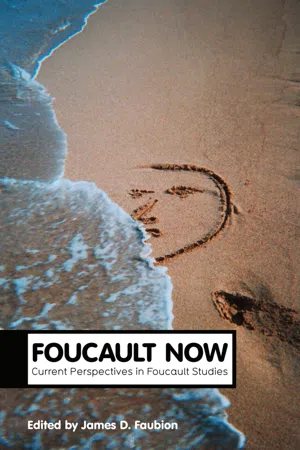
Michel Foucault is recognized as one of the twentieth century's most influential thinkers, however the authors in this volume contend that more use can be made of Foucault than has yet been done and that some of the uses to which Foucault has so far been put run the risk of and occasionally simply amount to misuse.
This interdisciplinary volume brings together a group of esteemed scholars, recognized for their command of and insights into Foucault's oeuvre. They demonstrate the many respects in which Foucault's project of an ontology of the present remains vital and continues to yield compelling insights and show that an ontology of the present is restricted to no particular terrain, but instead ranges widely and on paths that frequently intersect.
The essays in this much-needed new collection address the key components of Foucault's thought, ranging from his approach to power, biopolitics and parrhesia to analysis of key texts such as Folie et Déraison and Histoire de la sexualité.
This collection will spark debate amongst students and scholars alike and demonstrates that that every further encounter with Foucault's corpus is more likely than not to demand a revisiting of interpretations already formulated, conclusions already drawn, uses already devised.
Contributors include Didier Eribon, Eric Fassin, John Forrester, Ian Hacking, Lynne Huffer, Colin Koopman, James Laidlaw, Laurence McFalls, Mariella Pandolfi, Paul Rabinow and Cary Wolfe.
eBook - ePub
Foucault Now
About this book
Information
Part I
Object Lessons
1
The Undefined Work of Freedom: Foucault’s Genealogy and the Anthropology of Ethics
James Laidlaw
It is necessary to free oneself from the sanctification of the social domain as the sole instance of reality and to cease to consider as no more than wind the thing that is essential in human life and in human relations, namely thought.
– Michel Foucault (DE4, 180 [PPC, 155]; cited in Veyne 2010, 97)
Until a little over a decade ago, Michel Foucault’s writings were most conspicuously influential among anthropologists in attempts to understand the dynamics of domination and resistance under colonial and post-colonial states and political dimensions of modern knowledge practices. Guided by these interests, anthropologists mostly referred to Foucault’s early and mid-period writings (especially OT and DP ). More recently, a growing anthropological interest in morality and ethical life has involved more attention being paid to his later “genealogy of ethics.” While it would be wrong to say any distinct schools have emerged in the anthropology of ethics, the literature does divide roughly into those who claim morality as a hitherto understudied domain of life, identifying culturally variable “different moralities” as objects of study for a new sub-discipline (e.g., Howell 1997; Barker 2007; Zigon 2008; Heintz 2009; Sykes 2009), and those who go further to argue that ethics is a pervasive aspect of human life that social theory as currently constituted is largely ill-equipped to comprehend (e.g., Mahmood 2005; Evens 2008; Laidlaw 2010; Lambek 2010; Faubion 2011).
The sociologist Zygmunt Bauman (1988, 5) had more of a point than most would wish to acknowledge when he described sociology in particular, and social theory in general, as the “science of unfreedom.” Though few of us like or dwell on the fact, social explanation, as it is standardly understood, can be any good only insofar as we can discount the ethical dimension of people’s conduct. Invoking “the social” – or “ideological state apparatuses,” “the global system,” “neo-liberalism,” “colonialist discourse,” or whatever – can be supposed to explain why people do one thing rather than another only insofar as their experience of freedom of decision is deemed illusory. This is why social scientists have so rarely felt the need actually to deploy any concept of freedom in their analyses. Bauman himself, commissioned to write on freedom as a “concept in the social sciences,” explicitly rejects this possibility, as he does various points of view from which freedom might be thought to be an important aspect of the human condition, in favor of the view that what is of sociological significance, and a proper object of sociological attention, is the peculiarly modern and parochially Western ideology that values freedom so highly (1988, 28–9). The anthropology of ethics has at least already achieved enough to “provincialize” that assumption. But the conceptual challenge remains.
John Stuart Mill famously observed that political economy is premised on an abstraction from the complex reality of human motivation and action. It treats of human action, he wrote, only insofar as people act in the pursuit of wealth and “makes entire abstraction of every other passion or motive” (1864, 137). Equipped only with the concepts and standards of explanatory adequacy of “the science of unfreedom,” anthropology will remain in a position still more dismal than Mill’s economics: able to treat of human conduct only by abstracting from its ethical dimension. It is not then an oversight that anthropology, as many have remarked, has largely and in spite of itself neglected the study of morality. With only these conceptual resources, ethics must remain necessarily outside our purview, and an anthropology of ethics must be a contradiction in terms.
Is it necessary to remind ourselves that the remarkably tenacious hope that a “dialectic of structure and agency” that would suffice to make this problem go away (as in Bourdieu 1977, Giddens 1979, and Ortner 2006) remains stubbornly unfulfilled? This way of conceiving the problem accepts from the outset that social explanation must be at the expense of a recognition of agency, since the latter is conceptualized as being in a zero-sum relation with the efficacy of “larger structures.” This, I suspect, is why authors writing in this vein have mostly not dared to describe that which they wish to “recuperate” for what they sometimes call “the acting subject” by the name of freedom. In the absence of the promised synthesis, the best we get is a to-ing and fro-ing recognition of the “force” first of one and then of the other end of the polarity.
The reason an anthropology of ethics is more than merely a new sub-discipline, then, is that for it to succeed requires the development of a notion of explanatory adequacy – of what an effective “social explanation” might be – that does not redescribe the conduct of responsible agents as the effects of causal “forces.” This, obviously, requires making “freedom” a part of our conceptual vocabulary: not just an object of ideology critique but a concept we think about and also think with. In what follows, I shall try to show that Foucault’s later writings provide an ethnographically usable conception of freedom, which the very idea of an anthropological engagement with ethical life requires.
The single most far-reaching – but still largely unappreciated – conceptual innovation in Foucault’s later works is his rethinking of the concepts of power and freedom, such that they are not defined negatively in relation to each other, and in which the latter emerges as both a ubiquitous social and historical fact and a central term in the analysis of how subjects have historically been constituted.
The radicalism of the late Foucault in relation to some dominant assumptions of “social theory” is still so little understood that he is routinely invoked, both by admirers and detractors, as if it were logically unproblematic simply to bolt his concepts onto analysis framed largely in loosely Marxist (or, equally implausibly, psychoanalytic) terms. So anthropological journals overflow with assertions about the role of “neo-liberal governmentality” or “the apparatus of disciplinary power” in the functioning of “late capitalism.” This is so common that its sheer oddness goes unremarked. It is true that there is almost nothing about which Foucault is unambiguously consistent in all his writings. But antipathy to Marxism (as to psychoanalysis) comes pretty close. We all ought to know the name of the brilliant exegete who achieved a comprehensive synthesis between these apparently antithetical intellectual projects, and to whom so many anthropologists and others routinely refer to justify mingling of their terminologies. But no such figure exists, and that synthesis has never been realized.
It is true that DP can plausibly be read, in Marxist terms, as attributing the changes it describes to their functionality for a developing capitalist economy. But HS1 (published just one year later) explicitly rejects any such argument, and overturns the then-accepted radical consensus, which Foucault labels “the repressive hypothesis,” that the demands of the capitalist economy for a pliant workforce had fuelled increasingly severe sexual repression. Foucault countered (1) that the period had seen no such thing, but an increasingly imperative “incitement” to discourse about sexual matters; (2) that the resulting “discursive explosion” saw the constitution of “sexuality,” the idea of the subject’s defining essence being revealed in its desires; (3) that power had therefore come preponderantly to take not the negative form of repression but positive techniques for the elicitation of desires; and finally (4) that projects aiming at the “liberation” of desire therefore constituted not in any serious sense a challenge to the prevailing configurations of power, but instead their intensification.
This final point was a rejection of a perennial complement to sociological determinism: the ideal of “liberation” as a perfectly unconditioned state achieved by removal of all constraint. This ideal, which no doubt has theological roots, had recently enjoyed a polymorphous efflorescence in French intellectual life, including the diffusely contradictory fantasy of 1968, “it is forbidden to forbid” (Bourg 2007), and the projected insurrection by Deleuze and Guattari’s (1983) “desiring machines.” While Anti-Oedipus was an internal critique of psychoanalysis conducted within a historical-materialist framework, Foucault’s historicizing of desire broke the bounds of both Marxist and psychoanalytic thought. As Grace (2009: 53) concisely summarizes, the latter’s account of sexuality entailed “a new, non-Marxist ontology of contemporary society.” Foucault was later to remark that the importance of 1968 lay in the fact that the new concerns it threw up could not finally be addressed in a Marxist framework, although that is initially what the insurgents of the time sought to do (EW1, 115), so that its longer-term effect was the decline of Marxism, and a greater receptivity to his own work (EW1, 125; cf. also EW3, 268–70). In general, his genealogy of ethics constitutes the most profound repudiation of historical-materialist and determinist social theory, in favour of the irreducible importance of reflective ethical thought. Although he only put things in these terms towards the end of his life, Foucault attributed his coming to see the importance of this to his reading of Nietzsche in the early 1950s, and his consequent break with “the double tradition of phenomenology and Marxism” (EW1, 202).
The completion of the first volume of The History of Sexuality left Foucault with two compelling questions, which oriented his later writings and shaped the development of his genealogy of ethics. The first was how to complete his reconceptualization of power. He had called for the rejection of the negative “juridical” model of power as external constraint, in favor of recognition of the productivity of power as a constitutive aspect of all social relations. But if there never could be relations from which power would be absent, how then to conceptualize freedom? What is freedom, if not the absence of power? Freedom should be thought, Foucault was now suggesting, not to be in a zero-sum external relation to power, but as an aspect of the configuration of power relations. Aware that this was counter-intuitive, when viewed from within the assumptions he was asking us to abandon, Foucault revelled in the apparent paradox: “power relations are possible only insofar as the subjects are free … If there are relations of power throughout every social field, it is because there is freedom everywhere” (EW1, 292). This is why Foucault’s later interest in freedom was not, as some have supposed, a change in his interests. There could be no question of a move in focus from power to freedom, because he had come to see that the latter is not a separate subject matter. Equally, freedom was not to be imagined as a state – the circumstances that will prevail once we have conquered power – that could be secured by any social arrangements, institutions, or laws (EW3, 354–5). It will always be something exercised through the medium of relations of power. “This is why I emphasize practices of freedom over processes of liberation” (EW1, 283).
The second question bequeathed to Foucault’s genealogy of ethics by the analysis in HS1 was: what are the sources of the kind of subject to whom the repressive hypothesis seemed so intuitively persuasive, the “desiring subject”? How had we come to think that the essence of our being – that which we might imagine “liberating” – lay in our desires? “What had to happen in the history of the West for the question of truth to be posed in regard to sexual pleasure?” (PK, 209). The projected further volumes in the History of Sexuality series were therefore to describe “how it comes about that people are told that the secret of their truth lies in the region of their sex” (PK, 214). The exercise was genealogical, tracing back to find a place and time where the self was not given, in a truth discovered by examining one’s desires, but instead was produced by the subject through active self-constitution. To do this, Foucault developed a number of conceptual resources, including a formal analytic for the analysis of techniques of the self (HS2, 26–8; EW1, 263–6), but the most important for us here are his concept of subjectivation and his distinction between moral codes and ethics.
Foucault used the verb asujettir (subjectify) and the noun asujettissement (subjectivation) to refer to how subjects are formed in power relations, including how the self acts on and shapes itself, therefore not merely “subjection,” as many translations of Foucault have suggested, still less the outcome of mechanical processes of “interpellation” into structures, as in Althusser (1971) and those who, like him, speak of “subject positions” being occupied by a “subjectivity without a subject” (Badiou 2005, 66). Foucault made clear that he did not believe in “a universal form of subject that one could find everywhere” (FL, 452), nor therefore in any notion of the subject as sovereign or original, but his thought is equally incompatible with the universalism of Lacanian psychodynamics, or of the sort that Althusser wove into Marxist theorizing.
Processes of subjectivation, including what Foucault called “techniques of the self” and “practices of freedom,” which individuals may take up from the rules, styles, and conventions in their cultural milieu, do actually make something real, and the question of the role subjects play in their own constitution is an empirical historical one. The point of his genealogy of ethics was to show how subjects have been made, historically, in radically different ways. So “the subject” is something of which one might have a history, but not a general theory (HS1, 82; PK, 326).
The distinction, within any historically particular form of moral life, between moral codes and ethics, is central to Foucault’s genealogy. HS2 begins, in a classic Foucault move, with a revision of a commonly accepted narrative, this time the idea that the transition from the pagan world to Christianity was one from a “more relaxed” sexual ethic to greater strictness, caused by the introduction of Christian notions of sin. Moral concern and uneasiness about sexual acts long predated Christianity, as Foucault illustrates with four concerns expressed by authors throughout the period: fear that sexual emission might weaken the body; idealization of fidelity within marriage; perceptions of moral danger in same-sex relations; and the idea that heroic abstinence might give access to wisdom (HS2, 15–20). We should resist the reflex whereby uneasiness about sexual acts is “too readily attributed to Christianity (when it is not attributed to capitalism or ‘bourgeois morality’!)” (EW1, 90; also 179–80; 254). There is a profound change in ethics over this period, but the advent and spread of Christianity did not explain this, and it consisted not merely in greater “strictness” but in ethical concern taking a different form.
Foucault distinguishes between what he calls moral codes – rules and regulations enforced by institutions such as schools, temples, families and so on, and which individuals might variously obey or resist – and ethics, which consists of the ways individuals might take themselves as the object of reflective action, adopting voluntary practices to shape and transform themselves in various ways (HS2, 25–32; EW1, 253–80). Ethics, including these techniques of the self and projects of self-formation, are diagnostic of the moral domain. Among all the various institutionally sanctioned laws, rules, interdictions, or values, it is those that are associated with modes of self-formation that we might sensibly regard as “moral” (HS2, 28). But although thus intimately related, moral codes and ethics must be distinguished analytically, because they may change independently. Generally, moral codes themselves are more similar across societies and historical periods than are the forms taken by ethical practice, and some societies have more elaborate ethical cultures than others (HS2, 30). The transition from pagan to Christian moralities can only be understood as part of the long transformation from what Foucault called an “aesthetics of existence” to a “hermeneutics of desire,” and in that process moral codes changed very little: the profound change was in forms of ethical practice (HS2, 30–2; 250; EW1, 180; 195–6; 254; 270–1).
Foucault’s is by no means the only ethics-morality distinction in the current literature....
Table of contents
- Cover
- Half Title
- Title Page
- Copyright
- Contents
- Acknowledgements
- Contributors
- Abbreviations
- Introduction: The Use of Foucault
- Part I: Object Lessons
- Part II: Cases in Point
- References
- Index
Trusted by 375,005 students
Access to over 1.5 million titles for a fair monthly price.
Study more efficiently using our study tools.
Frequently asked questions
Yes, you can cancel anytime from the Subscription tab in your account settings on the Perlego website. Your subscription will stay active until the end of your current billing period. Learn how to cancel your subscription
No, books cannot be downloaded as external files, such as PDFs, for use outside of Perlego. However, you can download books within the Perlego app for offline reading on mobile or tablet. Learn how to download books offline
Perlego offers two plans: Essential and Complete
- Essential is ideal for learners and professionals who enjoy exploring a wide range of subjects. Access the Essential Library with 800,000+ trusted titles and best-sellers across business, personal growth, and the humanities. Includes unlimited reading time and Standard Read Aloud voice.
- Complete: Perfect for advanced learners and researchers needing full, unrestricted access. Unlock 1.5M+ books across hundreds of subjects, including academic and specialized titles. The Complete Plan also includes advanced features like Premium Read Aloud and Research Assistant.
We are an online textbook subscription service, where you can get access to an entire online library for less than the price of a single book per month. With over 1.5 million books across 990+ topics, we’ve got you covered! Learn about our mission
Look out for the read-aloud symbol on your next book to see if you can listen to it. The read-aloud tool reads text aloud for you, highlighting the text as it is being read. You can pause it, speed it up and slow it down. Learn more about Read Aloud
Yes! You can use the Perlego app on both iOS and Android devices to read anytime, anywhere — even offline. Perfect for commutes or when you’re on the go.
Please note we cannot support devices running on iOS 13 and Android 7 or earlier. Learn more about using the app
Please note we cannot support devices running on iOS 13 and Android 7 or earlier. Learn more about using the app
Yes, you can access Foucault Now by James Faubion in PDF and/or ePUB format, as well as other popular books in Social Sciences & Media Studies. We have over 1.5 million books available in our catalogue for you to explore.