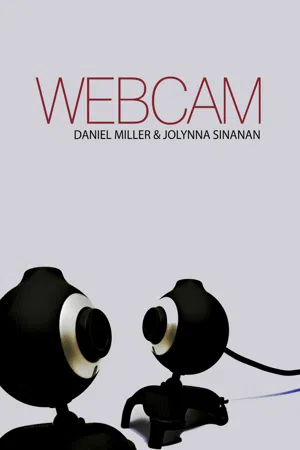
Based on research in London and Trinidad, this book shows how 'always-on' webcam is becoming an entirely different phenomenon from the initial use of webcam as a videophone. Webcam is examined within the framework of 'polymedia' - that is, the new environments created by the simultaneous presence of a multiplicity of communication technologies - and used to exemplify a theory of attainment that accepts media technologies as aspects of, rather than detracting from, our basic humanity.
- English
- ePUB (mobile friendly)
- Available on iOS & Android
eBook - ePub
Webcam
About this book
The use of webcam, especially through Skype, has recently become established as one more standard media technology, but so far there has been no attempt to assess its fundamental nature and consequences. Yet webcam has profound implications for many facets of human life, from self-consciousness and intimacy to the sustaining of long-distance relationships and the place of the visual within social communications.
Information
1
Conclusion: A Theory of Attainment
Skype and webcam
The grounds for choosing the topic of webcam in personal communications were really quite simple. It was evident from research on other new communication technologies that webcam was coming to play a significant role. Yet, we knew of no anthropological studies dedicated to ascertaining its consequences. By 2011, Skype was reaching a critical point. Not ubiquitous, at least compared to mobile phones, but because of large-scale initiatives such as ‘One laptop per child’ with their integrated webcams, access was spreading to include lower income populations (Rosenberg, 2012). In Trinidad today, most people have transnational friends or family, which seemed to be the most common initial incentive for using Skype. Our research suggested that for some relationships, webcam had become a critical intervention. We also felt confident that webcam was now sufficiently embedded as an accepted part of people's everyday lives here to become the subject of ethnography as a study of the mundane.
Although we undertook the study from a hunch that the impact of webcam might now be profound, we didn't start with any particular ideas or hypotheses. We are not that kind of natural scientist. We began, instead, from what we hope is the modesty of anthropology that says the expertise lies not with the academic, but with the peoples they study. It is their creativity and inventiveness, their interpretations and accommodations, their insights and frustrations that we must share; and from them build a picture, a generalized image of what seems to be happening in their world. Only then do we ask why this matters for anthropologists and indeed for everyone.
The title of this book, Webcam, is problematic for various reasons, but we would argue it is simply better than the alternatives. Many of our informants, especially in the UK, avoid the term altogether, because a critical moment in the spread of webcam came with its usage for pornography as by ‘camgirls’ (Senft, 2008). Another influential initial usage was setting up a webcam to observe a site such as a street or events such as a rare bird nesting. Apart from within the last chapter, we do not cover such uses of webcam. You should assume a silent sub-title Webcam – but in most chapters only as used within personal communications. These communications may be dyadic or between groups as, for example, when two families greet each other at Christmas. So our interest is closer to that of Baym (2010) and Broadbent (2012) but very different from Senft (2008). To avoid these earlier connotations of the term, many people prefer to refer instead to proprietary platforms such as Skype and FaceTime, and terms such as Skyping or ‘do you want to Skype?’ are universally used and recognized. But there are various such platforms, so that we could not use any one of these for our title. By now, many other informants are comfortable with the term webcam and will themselves extend this to create the verbs ‘webcamming’ or ‘to webcam’, for example, often interchangeably with Skyping (which is in any case confusing since half of Skype calls are made without webcam). Given the rise of FaceTime and webcam within smartphones, the term webcam may grow at the expense of Skype. So we concluded that Webcam was the imperfect, but best available title for this volume. In the final chapter, we will move beyond personal communication to issues of surveillance and the use of webcams in commerce more generally.
Whatever our title, we still need to acknowledge the sheer dominance of Skype in the use of webcam for personal communication up till now. Skype, the product of two Estonian developers, was released in 2003. Incredibly, by 2005, it was bought by eBay for US$2.6 billion and subsequently by Microsoft in 2011 for US$8.5 billion. Still more than a third of its development team are based in Estonia. Currently, it is being incorporated into Microsoft with the migration of Windows Messenger into Skype. According to Skype's Chief Technology Strategist, by the end of 2012 Skype accounted for around 25 per cent of all international calls of any kind (Rosenberg, 2012). Around half of these Skype calls employed video. The average call was around half an hour and there are around 40 million users online at peak times. Skype has been downloaded approximately 200 million times on iPhone and Android phones. According to Skype Numerology (Mercier, 2012), the number of monthly paying Skype users is a mere 8.1 million, leaving revenues remaining sparse at an estimated US$400 million per annum. Skype is, however, likely to enhance future products and add to the Microsoft range in various ways.
This is not, however, a study of either Skype or webcam merely as a technology or commercial product. It is an anthropological study of its role in relationships. Consider the following quotation from our pilot study: ‘You know what men are like, they are so impatient with technology. They get so easily frustrated and angry. And to be honest, webcam in those days was pretty crap, kept cutting off, out of focus, just starting a conversation and it goes wrong.’ This is hardly a unique complaint; in many of our conversations, we included some discussion about people's first experiences with webcam and these were fairly mixed. On reflection, we are rather glad that we waited until 2011 in order to carry out our research. We have the feeling that the whole thing is a rather more pleasant engagement by now. So why start with this vignette? It makes the point that people have relationships with people and they have relationships with technology, and, mostly, we can't really disentangle the two. This affair ended soon after. Did their frustration with the technology cause, add merely a soupçon, or was it irrelevant to that break up? In thereby conforming to her general stereotypes of what men are like, did this experience increase his masculine attraction as a proper man, or demonstrate that he was exactly the kind of man who was really not for her? Are such stereotypes best regarded as general, regional or individual?
If there is a dominant topic within anthropology it is, and probably should be, the study of relationships. Anthropologists recognize that there are no unmediated, pure relationships. All the ways in which relationships exist, including communication, are cultural activities. The peoples whom anthropologists encounter in Melanesia or Amazonia prove just as fraught as the anthropologists themselves with anxiety and regrets about what they have just said, which for them might include its conformity with religious scruples, politeness with respect to that particular relationship and all those myriad filters that make certain that so much must remain unsaid and that communication is replete with constraint and misunderstanding. Even in our digitally founded world, the technological can often be the least significant aspect of mediation. So before we can approach our topic of webcam, we need to establish how we understand this concatenation of the human, culture and technology.
This is one of the reasons why this book has a slightly unusual structure. We will start with our conclusions. The next section is called ‘A Theory of Attainment’. The intention is firstly to take responsibility for these issues regarding how we contend with this inevitable mix of technical and cultural properties. The remaining chapters consist largely of reportage from interviews and ethnography, followed by analysis, leading to these conclusions. But we felt it was important to be able to judge those conclusions against these more substantive materials, which means being clear as to the claims we intend to make. Finally, we wanted to establish the academic grounds for asking readers to then submit themselves to so much detailed discussion of material mostly derived from a small town in Trinidad, which otherwise is unlikely to be of much concern. For all these reasons, this chapter starts with our conclusions.
A theory of attainment
Most persons are surprised, and many distressed, to learn that essentially the same objections commonly urged today against computers were urged by Plato in the Phaedrus (274–7) and in the Seventh Letter against writing. Writing, Plato has Socrates say in the Phaedrus, is inhuman, pretending to establish outside the mind what in reality can be only in the mind. It is a thing, a manufactured product. The same of course is said of computers. Secondly, Plato's Socrates urges, writing destroys memory. Those who use writing will become forgetful, relying on an external resource for what they lack in internal resources. Writing weakens the mind. (Ong 1982: 78)
The conclusions of this book are in several respects the exact opposite of what may be found in most popular writing regarding the impact and consequences of new communication media. The problem is that there is a natural tendency to take the world we live in at any particular moment as the bedrock of our authenticity, a world that has come to appear natural, or at least natural in comparison to the changes that are about to occur to us. The quotation from Ong reveals that for Plato's Socrates, the invention of writing meant that we could no longer be fully human; the essential qualities of our mind, our creativity, our memory and, above all, our authenticity were forever lost. Ong notes that in the fifteenth century, very similar arguments were made about the invention of printing, which would downgrade the wisdom of persons in favour of the products of the machine. Today, the ability to write has become so ubiquitous that we have almost forgotten that it is a technology and when anthropologists tell us about societies without writing, we are more tempted to consider that it is they, rather than us, who lack an essential quality of being fully human. To be illiterate is now regarded as pitiful, rather than the superior version of humanity presumed by Plato.
Any new media is first experienced as an additional and problematic mediation to our lives. We can't help but contrast it with some imagined conversation between two people standing in a field as representing the original, unmediated and natural form of communication. A technology, by contrast, is always regarded as something artificial that imposes itself between the conversationalists and mediates that conversation. An example of this kind of discourse is the recent book by Turkle, Alone Together (2011). The book is, in essence, a lament for a passing world of real relationships based on true social life that are most fully established by face-to-face communication – a world that is lost by the more superficial and mediated world of digital communication. Her inclusion of advances in robotics reinforces the idea that recent technological advances are leading to a loss of something essential about humanity. The problem we have with such books lies in thinking that a relationship to a robot represents a downgrading of our humanity because it substitutes for a real relationship. Amongst the many things this ignores is history. Not many Christians would have a problem seeing Jesus as a friend, nor would they regard a nun who takes vows of separation as a pathology. English people sometimes seem to prefer the friendship of pets to people. Material culture is an anthropological study of relationships to material things, such as our house, that may be amongst our key relationships. There has never been a time when people reduced their relationships merely to other people. While in some ways unprecedented, in other respects, digital technologies still have a very long way to go before they reach the degree of extraordinary found in the relationships presumed by religious cosmologies, created (or recognized as utterly real, depending upon one's personal religiosity) by humanity.
It is not easy to refute writings such as Turkle, which tend to be hugely popular, because they resonate with a lament for past authenticity, which is a leitmotif of the modern world, as it was often in ancient worlds (consider the Roman satirist Juvenal). Perhaps the worst terms found in the discussion of new digital technologies are words such as ‘real’ and ‘true’ when used to describe the prior status quo. These resonate with popular assumptions which are almost universally held, and constantly reinforced in journalism. New technologies are making humanity itself more artificial and thereby less intrinsically human. The discourses that prevail, both popular and academic, are essentially conservative discourses.
In stark contrast to such arguments is the reiteration of a tenet of anthropological theory that is found in the recent introduction to the book Digital Anthropology, written by Miller and Horst (2012: 12). With respect to these arguments, they suggest that
This is entirely antithetical to what anthropological theory actually stands for. In the discipline of anthropology all people are equally cultural, that is the products of objectification. Australian indigenous tribes may not have much material culture, but instead they use their own landscape to create extraordinary and complex cosmologies that then become the order of society and the structures guiding social engagement (e.g., Munn, 1973; Myers, 1986). In anthropology, there is no such thing as pure human immediacy; interacting face-to-face is just as culturally inflected as digitally mediated communication but, as Goffman (1959, 1975) pointed out again and again, we fail to see the framed nature of face-to-face interaction because these frames work so effectively.
The discussion concludes with a principle. ‘Digital anthropology will be insightful to the degree it reveals the mediated and framed nature of the nondigital world. Digital anthropology fails to the degree it makes the nondigital world appear in retrospect as unmediated and unframed. We are not more mediated simply because we are not more cultural than we were before’ (Miller and Horst, 2012: 13).
In other words, anthropology as a discipline rejects the idea that two people standing in a field, or two Australian indigenous individuals conversing in the desert, are in any way closer to some natural foundation for conversation than two people discussing their relationship through Facebook. Even in the desert, these indigenous individuals converse in a world highly structured by the appropriate and customary forms of address for the kinship categories they occupy. They spoke as a mother's brother should to a sister's son, and may well have assumed that their conversations were being influenced by spirits and ancestors. We do not see their ancestors, just as we don't see the infrastructure behind Facebook, but the possibility that the unseen may determine what we can and should say are equally strong.
Goffman (1959) did more than anyone to refute the illusion of communication as natural and unmediated. He revealed the myriad ways in which our everyday appearance and everyday encounters are the products of artifice. We literally compose ourselves before entering the door. This ‘we’ was not people within digital worlds but the folk in rural areas such as the Shetland Islands. The very people we laud as models of authenticity, artisanal craftspeople in weaving wool, were actually found to be crafting themselves more or less continuously. Self-presentation was discovered to be the art of everyday life.
But the very fact that Goffman's work came across as a revelation is testimony to the degree to which we do not easily view either our own or others' worlds in this manner. Goffman does not often impute intentionality to this activity; we can't help but act in this way. Indeed, it is this lack of consciousness that has allowed us to conceive of personal communication as natural and unmediated. Goffman also showed how frames that cue us into what kind of behaviour is expected of that particular context help us remain unselfconscious about the way we behave differently in these different contexts. We naturally (that is highly artificially) act differentially when we are within a theatre or while on holiday (Goffman, 1975). Much of Miller's previous work on material culture (2009a, 2009b), reinforced by the huge contribution of the anthropologist Bourdieu (1984), has been an examination of how objects such as clothing or housing act as frames in Goffman's sense, telling us how to behave without us realizing that this is the effect they are having upon us. One of the arguments of the next chapter is that the experience of having a webcam is analogous to the experience of having to read the work of Goffman. Both lead to an increasing consciousness and self-consciousness about the frames of human interaction. We are not more or less framed, but when we are looking at a rectangular computer screen right in front of us, we may certainly be more aware of the degree to which personal communication works within frames.
Both digital technologies and academic work such as Digital Anthropology help give us an appreciation of Goffman's insight that communication always was framed. An example of this could be van Dijck's (2007) book Mediated Memories in the Digital Age. This examines the impact of a whole slew of new media on memory. Certainly, there are marked changes. Photography seems to be turning into a more transient phenomenon for immediate circulation on social networking sites. These and blogs help to synchronize experience amongst a social group. Music may change in its relationship to nostalgia. Far from acting largely as an instrument of dematerialization, digital forms add considerably to this external capacity to store memory outside of the self in multi-modal, more collective forms. Memory has become even more about looking things up on search engines, rather than some pure act of introspection. Indeed, when considering the totality of new digital forms, this feeds a kind of collective fantasy of the digital memory machine that one day will be able to encapsulate the entirety of our externalized memory genres.
Certainly, there is a clear development in the facilitation of memory as lodged in forms outside of the mind – we all have a bigger external hard drive – the process that was lamented by Plato, though without that particular analogy. But the key point made by this book is that all these developments are actually useful in helping to confirm that memory was never the highly individualized cognitive function that existed primarily within an individual's brain. Following Bergson (2007 [1912]), Halbwachs (1992) and others, van Dijck (2007) argues that memory is far more collective and normative than we have acknowledged. It is socially incumbent upon us to video our babies' first attempts to walk. The way Facebook and other media then create a more collective sense of memory is in some measure returning us to this more socialized and less individualized memory of most of human history. Once again, the digital isn't taking memory into post-human realms, but is helping refine our comprehension of the prior mediations within human memory. Goody's (1987) research on the invention of both literacy and writing leads to similar observations about the way these impacted upon our capacity for recall, the recapitulation of stories and the nature of our sociality. But as an anthropologist, Goody also stressed the importance of understanding these changes at the level of cultural norms rather than the psychology of individual competence. Goody's writing is particularly pertinent because a problem with this refutation of conservatism is that it could be read as an opposition to the very concept of change itself. If we cannot become more mediated, then does that mean the impact of these new technologies is inevitably insignificant? Goody (1977, 1987) is quite forthright in acknowledging that the changes brought about by technologies such as writing and printing are fundamental, indeed, foundational to the emerging domination of various forms of reason. Ong (1982: 81) agrees: ‘Like other artificial creations and indeed more than any other, it is utterly invaluable and indeed essential for the realization of fuller, interior, human potentials. Technologies are not mere exterior aids but also interior transformations of consciousness.’ As Goody (1977) suggests, it would be absurd to dismiss the rise of science, for example, as other than fundamental in terms of human capacity and this is clearly a cultural and indeed global phenomenon, not reducible to the comparison of one individual's mind to another, which is why psychology is likely to be of little help here. Anthropology can retain cultural sensitivity while still appreciating that we simply must contend with long-term change. We have developed our theory of attainment precisely in order to deal with this quandary. How can we both acknowledge that technological developments may fundamentally change humanity while at the same time reject the idea that they are making us more or less human?
It is vital to the future of the discipline of anthropology, then, that we find a language that casts the savage mind as neither more primitive nor more authentic than the literate or, what Goody (1977) calls, the domesticated mind. Because, at the other end of the spectrum are those who would argue that it is only through digital technologies that we have finally become properly human. These arguments tend to start from a more psychological or philosophical liberalism, where humanity is the individual person who has now been extended into something else thanks to new technology. The highly influential media theorist Marshall McLuhan called one of his books Understanding Media: The Extensions of Man (1964). One of his arguments was: ‘Rapidly...
Table of contents
- Cover
- Title page
- Copyright page
- Acknowledgements
- 1: Conclusion: A Theory of Attainment
- 2: Self-Consciousness
- 3: Intimacy
- 4: The Sense of Place
- 5: Maintaining Relationships
- 6: Polymedia
- 7: Visibility
- References
- Index
Trusted by 375,005 students
Access to over 1.5 million titles for a fair monthly price.
Study more efficiently using our study tools.
Frequently asked questions
Yes, you can cancel anytime from the Subscription tab in your account settings on the Perlego website. Your subscription will stay active until the end of your current billing period. Learn how to cancel your subscription
No, books cannot be downloaded as external files, such as PDFs, for use outside of Perlego. However, you can download books within the Perlego app for offline reading on mobile or tablet. Learn how to download books offline
Perlego offers two plans: Essential and Complete
- Essential is ideal for learners and professionals who enjoy exploring a wide range of subjects. Access the Essential Library with 800,000+ trusted titles and best-sellers across business, personal growth, and the humanities. Includes unlimited reading time and Standard Read Aloud voice.
- Complete: Perfect for advanced learners and researchers needing full, unrestricted access. Unlock 1.5M+ books across hundreds of subjects, including academic and specialized titles. The Complete Plan also includes advanced features like Premium Read Aloud and Research Assistant.
We are an online textbook subscription service, where you can get access to an entire online library for less than the price of a single book per month. With over 1.5 million books across 990+ topics, we’ve got you covered! Learn about our mission
Look out for the read-aloud symbol on your next book to see if you can listen to it. The read-aloud tool reads text aloud for you, highlighting the text as it is being read. You can pause it, speed it up and slow it down. Learn more about Read Aloud
Yes! You can use the Perlego app on both iOS and Android devices to read anytime, anywhere — even offline. Perfect for commutes or when you’re on the go.
Please note we cannot support devices running on iOS 13 and Android 7 or earlier. Learn more about using the app
Please note we cannot support devices running on iOS 13 and Android 7 or earlier. Learn more about using the app
Yes, you can access Webcam by Daniel Miller,Jolynna Sinanan in PDF and/or ePUB format, as well as other popular books in Social Sciences & Media Studies. We have over 1.5 million books available in our catalogue for you to explore.