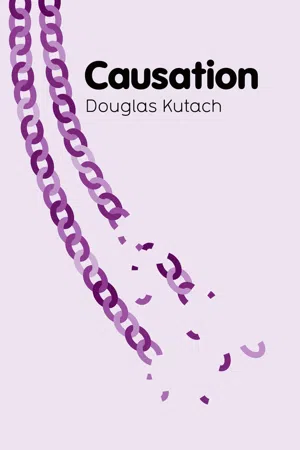
In most academic and non-academic circles throughout history, the world and its operation have been viewed in terms of cause and effect. The principles of causation have been applied, fruitfully, across the sciences, law, medicine, and in everyday life, despite the lack of any agreed-upon framework for understanding what causation ultimately amounts to.
In this engaging and accessible introduction to the topic, Douglas Kutach explains and analyses the most prominent theories and examples in the philosophy of causation. The book is organized so as to respect the various cross-cutting and interdisciplinary concerns about causation, such as the reducibility of causation, its application to scientific modeling, its connection to influence and laws of nature, and its role in causal explanation. Kutach begins by presenting the four recurring distinctions in the literature on causation, proceeding through an exploration of various accounts of causation including determination, difference making and probability-raising. He concludes by carefully considering their application to the mind-body problem.
Causation provides a straightforward and compact survey of contemporary approaches to causation and serves as a friendly and clear guide for anyone interested in exploring the complex jungle of ideas that surround this fundamental philosophical topic.
eBook - ePub
Causation
About this book
Information
1
Introduction: All Things Causal
At the beginning of every course I teach on causation, I like to mention three reasons for studying causation. First, it is the most important relation in the universe. As the great philosopher once said, “It surrounds us and penetrates us. It binds the galaxy together.” Second, virtually every other topic you can study depends on causation: science, history, music, business, law, medicine, and most important of all, bicycle repair.
My third reason is difficult for me to communicate without injecting some philosophical jargon, so I will leave you hanging for a while. In the meantime, you should think about reasons for yourself. Before, during, and after reading every chapter, ask yourself, “Why is causation worth studying? What is there to learn from philosophers musing about cause and effect? Is there any conclusion that could transform my conception of reality?” I can intimate to you that by spending a bit of time mulling over such questions, I have struck upon an idea that has altered my opinion about virtually everything I care about and everything I do. I hope that by introducing you to some tools for investigating causation, you will be encouraged to revolutionize your own conception of reality. If you succeed, please track me down and let me know. I would love to hear about it. We humans don't keep in touch enough.
It's going to take a modicum of effort for us to sort out what causation is and how to define it. We all have some basic ability to apply terms like ‘cause’ and ‘effect’, so we can start out by assuming that ‘causation’ is just another name for the relation between cause and effect, whatever that turns out to be. We will see soon enough that it is problematic to decipher expressions like ‘it causes’ and ‘it is a cause of’, but on the bright side, that is a sign that it's an ideal topic for drawing the sorts of distinctions that are the hallmark of good philosophy.
Before digging into details, you should be aware of the scope of a philosophical investigation of causation. Philosophy, it has been said, is in the business of understanding “how things in the broadest possible sense of the term hang together in the broadest possible sense of the term.”1 My goal is to help you to learn how philosophers have tried to understand causation insofar as it applies generally to all things. That means the focus of discussion is not on how we humans acquire our causal concepts, nor on how scientists discover causes, nor on how various historical figures have thought about causation. Instead, the goal is for you to acquaint yourself with a map of the contemporary conceptual landscape. We will be trying to answer questions like, “Which ways of thinking about causation are fruitful?” “What obstacles have been overcome in understanding causation?” and “What are the outstanding deficiencies in our current theories of causation?”
In this first chapter, I will avoid introducing any theories. Instead, I will highlight four distinctions that I have personally found to be insightful and helpful for organizing all of the information to come.
- singular vs. general causation
- linear vs. non-linear interaction
- productive vs. difference-making causation
- influence-based vs. pattern-based causation
I will now proceed through a discussion of each distinction.
Singular vs. General Causation
A singular event is a particular occurrence in the history of the universe. It can be identified in terms of its location in time and space, and it can be described in terms of the properties and relations it instantiates. When discussing singular causation, we typically designate one singular event as the effect. We then consider all the singular events that count as partial causes of that one effect. Philosophers use the term ‘cause’ for what is more accurately described as a partial cause. Singular causation is the relation that holds between any single effect and each one of its singular (partial) causes. We often express claims of singular causation in the past tense: “c was one of the causes of e,” or “c caused e,” because singular causation is usually evaluated in retrospect.
A general event is a type of event. By their nature, event types can be instantiated in multiple locations in space and time, and they can be described in terms of whatever properties and relations constitute that sort of event. We often express claims of general causation in the present tense: “C causes E,” or “Cs cause Es.” General causation is the relation that holds between an event type E and any event type C that tends to cause (or bring about) E.
(I like to use lowercase letters for singular causes and uppercase letters for general causes.)
To acquire an intuitive feel for the difference between singular causation and general causation, consider the encouraging tale of Hobo, the scruffy hound. Hobo was generously helping to reduce food waste around dumpsters in Moore, Oklahoma, when she was suddenly cornered by the resident dogcatcher. I happen to know this guy personally, and trust me, you do not want him to catch you whether you are a dog or not. Fortunately, Moore is situated in a tornado corridor, and at the very moment when Hobo had abandoned all hope of escape, a tornado touched down and hoisted Hobo high into the air, carrying her over to nearby Kitchen Lake, where she splashed down and swam to shore uninjured. Having learned a valuable lesson, Hobo migrated eastward, last anyone has heard.
In the particular fragment of history described by this very true story, Hobo was rescued by the tornado. The tornado was a major cause of Hobo's survival because dogs snared by the dogcatcher tend not to last long. More formally, we stipulate that the event of interest to us (playing the role of effect) is the dog's survival for several more years. Examining what happened in the fragment of history encompassing Hobo's narrow escape, we can rightly declare that the tornado's lifting of Hobo was one of the causes of her survival. In general, however, tornados do not cause dogs to survive for a long time; they pose a mortal danger. So, the tornado was a singular cause of survival even though tornados are not a general cause of survival.
Let's now engage in some philosophy by examining the distinction.
1. Note that in the definitions I offered for singular and general causation (marked in boldface), I used the term ‘cause’ on both sides. Therefore, I have not defined causation in terms of something non-causal. In philosophical jargon, I have not provided a reductive definition of causation. So far, I have merely attempted to distinguish the conceptual role of singular and general causes enough to convey what makes them different from each other, not to specify what each is in full detail.
2. Ordinary language carries connotations that some partial causes are more noteworthy than others, and much of the phrasing used for expressing claims of causation can obscure what is at stake in disputes over causation.
- One can distinguish between background and foreground causes: The last straw you placed on the camel caused its back injury. We think of the presence of the last straw as being especially prominent and thus figuratively in the foreground even though the last straw was no heavier than each of the previous thousands of straws, which we think of as in the background.
- One can distinguish proximal (or proximate) causes from distal causes. The proximal causes are nearby in space and time and the distal causes are far away in space or time. For example, we say “Julius Caesar's death was caused by assassins,” not that his death was caused by his own birth. Yet, upon reflection, it becomes evident that Caesar's birth set off a causal chain that led inexorably to his demise.
- One can distinguish enabling causes from activating causes. We say that what caused the blaze was the cow's having kicked over the lamp. We do not say that the presence of the many wooden buildings tightly packed together caused the fire. A more perspicuous description would indicate that the density of wooden structures caused the blaze to engulf most of the city by enabling the fire to spread and that the toppled lamp was an activating or triggering cause.
In all three examples, we have a tendency to deny the status of cause to the background, distal, and enabling causes, even though when we examine our reasons for doing so, we find that objectively they have the same status as events we are happy to designate as causes. In such cases, the features that distinguish them from genuine causes appear to be merely pragmatic. The partial causes we identify as non-causes might be less important to us, or they might be less amenable to our manipulations, or they might be so pervasive that it would be misleading to draw attention to them.
When philosophers discuss causation, they usually seek (or at least claim to seek) an egalitarian2 conception of causation that strives to count the background and distal and enabling causes as bona fide causes. They bracket the goal of evaluating which causes are more important and the task of ascertaining whether one of the causes deserves to be designated as the cause.
The subtleties of language and the general culture, however, allow these observations to be easily overlooked. For example, an expression of the form ‘a cause of e’ might be construed as more or less equivalent to ‘one of the causes of e’, but it might also be understood as ‘something that caused e’. If these two renderings of ‘a cause’ sound like they say the same thing, imagine a scenario where someone buys a winning lottery ticket. Is Jennifer's purchase of a lottery ticket a cause of her receiving money from the lottery agency? The purchase in this case was certainly one of the causes because she had to play to win, but the purchase was not something that caused her to win because it gave her only a one in a million chance. If we identify e's singular causes by answering, “Which events caused e?” we might arrive at different events than by answering, “Which events were among the causes of e?” The first question is usually answered by citing the events that were the most important contributing causes to e at the time they occurred. The second question is usually answered by citing events that somehow played a positive role in the overall development toward the occurrence of e. Philosophers are almost always concerned with the egalitarian conception of cause that corresponds to the second question.
3. Our linguistic idioms can also mislead us about causation to the extent that we do not separate out logical or definitional connections among events. For example, if someone answers the question, “How did Julius Caesar die?” by noting that he was assassinated, that conveys relevant information about the events that caused his death. However, it is somewhat misleading to say, “The assassination of Caesar was a cause of Caesar's death,” because assassination implies by definition a corresponding death. The definitional link is not a constituent of the causal connections among the conspirators and Caesar, and we need to ignore it when ascertaining causes.
Such definitional linkages are not rare because the term ‘cause’ is itself loaded. When we describe an event c as ‘one of the causes of e’, that presupposes that e occurred. Nothing can be a cause of an event that does not occur. So, when investigating what aspect of the cause makes its effect occur, we need to ignore the fact that its being one of the causes ensures the occurrence of its effect by definition. We do this simply by not treating “is a cause of e” as if it describes a property of c that can play a role in causation.
4. An alternative way to express the distinction between singular and general causes is to say that particular instances of causation are cases of token causation and that causal generalities concern type causation. The difference between types and tokens is meant to be widely applicable, not just to events. For example, the typographic character that comes first in alphabetic order is a type, which we sometimes call “the letter A” or just “A.” Here are five of its tokens:
A a A a a
When we say that the line of text contains only one letter, we are saying that there is only one letter-type instantiated. When we say that the line of text contains exactly five letters, we are saying that there are five tokens of this one letter-type.
Applying the type–token distinction to causation, we say that the generality that holds from smoking to lung cancer is type causation (or type-level causation) and that any particular instance of lung cancer that was caused by smoking is token causation.
Is there any reason to speak of singular vs. general causation rather than token vs. type causation? They are mostly the same distinction, but perhaps the following example highlights a nuance. We nowadays take for granted that unicorns have never existed,3 yet it seems reasonable to assert that if there had been any unicorns that walked in mud, they would have caused hoof-shaped impressions in the mud. One way to describe this possibility is to say that there is type causation between unicorns stepping in mud and the existence of hoof-marks. This type causation has no tokens because there never have been any real unicorns. On the one hand, it seems reasonable to speak of type-level causal relations among unicorn-events just because unicorns are a subtype of hoofed animal. Hoofed animals in general cause hoof-marks, and more specific hoofed species like unicorns will generally cause hoof-marks when present in muddy environments. On the other hand, when we speak of causal generalities we tend to have in mind cases where there is a repeatedly instantiated pattern of singular causation. Many individual horses have walked in mud and thereby caused hoof-marks, but no instance of a unicorn having caused a hoof-mark exists. So, perhaps we could let the term “general causation” refer to type causation that has corresponding tokens in the actual world, and make clear that “type causation” does not require that the causal regularity ever be realized.
Just to add some redundancy, philosophers have recently begun to adopt a distinction between actual causation and potential causation. As far as I can tell, ‘actual cause’ means the same thing as ‘token cause’ and the same thing as ‘singular cause’.4 Potential causation, I think, is meant to encompass causal relations that involve unicorns in addition to causal relations among existing entities.
5. Finally, most philosophical work on causation concentrates on singular causation, and there appears to be a prevailing opinion that if an adequate account of singular causes could ever be found, it would be relatively easy to construct a complementary account of general causation. The idea, perhaps, is that if we have a good rule telling us whether one chosen event is a cause of our given effect – using information about its surroundings, any operative laws, and perhaps other parameters – then that same rule will automatically identify the full collection of causes. One reason to suspect that the connection between singular and general causation is more subtle is that on the few occasions where rules for deriving general from singular causation have been spec...
Table of contents
- Cover
- Key Concepts in Philosophy
- Title page
- Copyright page
- 1: Introduction: All Things Causal
- 2: Causal Oomph
- 3: Process and Mechanism
- 4: Difference-Making
- 5: Determination
- 6: Probability-Raising
- 7: Manipulation and Intervention
- 8: Mental Causation
- Bibliography
- Index
Trusted by 375,005 students
Access to over 1.5 million titles for a fair monthly price.
Study more efficiently using our study tools.
Frequently asked questions
Yes, you can cancel anytime from the Subscription tab in your account settings on the Perlego website. Your subscription will stay active until the end of your current billing period. Learn how to cancel your subscription
No, books cannot be downloaded as external files, such as PDFs, for use outside of Perlego. However, you can download books within the Perlego app for offline reading on mobile or tablet. Learn how to download books offline
Perlego offers two plans: Essential and Complete
- Essential is ideal for learners and professionals who enjoy exploring a wide range of subjects. Access the Essential Library with 800,000+ trusted titles and best-sellers across business, personal growth, and the humanities. Includes unlimited reading time and Standard Read Aloud voice.
- Complete: Perfect for advanced learners and researchers needing full, unrestricted access. Unlock 1.5M+ books across hundreds of subjects, including academic and specialized titles. The Complete Plan also includes advanced features like Premium Read Aloud and Research Assistant.
We are an online textbook subscription service, where you can get access to an entire online library for less than the price of a single book per month. With over 1.5 million books across 990+ topics, we’ve got you covered! Learn about our mission
Look out for the read-aloud symbol on your next book to see if you can listen to it. The read-aloud tool reads text aloud for you, highlighting the text as it is being read. You can pause it, speed it up and slow it down. Learn more about Read Aloud
Yes! You can use the Perlego app on both iOS and Android devices to read anytime, anywhere — even offline. Perfect for commutes or when you’re on the go.
Please note we cannot support devices running on iOS 13 and Android 7 or earlier. Learn more about using the app
Please note we cannot support devices running on iOS 13 and Android 7 or earlier. Learn more about using the app
Yes, you can access Causation by Douglas Kutach in PDF and/or ePUB format, as well as other popular books in Philosophy & Philosophical Metaphysics. We have over 1.5 million books available in our catalogue for you to explore.