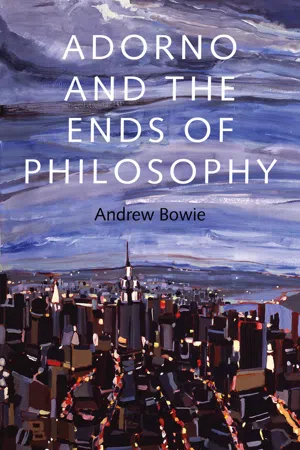
Theodor Adorno's reputation as a cultural critic has been well-established for some time, but his status as a philosopher remains unclear. In Adorno and the Ends of Philosophy Andrew Bowie seeks to establish what Adorno can contribute to philosophy today.
Adorno's published texts are notably difficult and have tended to hinder his reception by a broad philosophical audience. His main influence as a philosopher when he was alive was, though, often based on his very lucid public lectures. Drawing on these lectures, both published and unpublished, Bowie argues that important recent interpretations of Hegel, and related developments in pragmatism, echo key ideas in Adorno's thought. At the same time, Adorno's insistence that philosophy should make the Holocaust central to the assessment of modern rationality suggests ways in which these approaches should be complemented by his preparedness to confront some of the most disturbing aspects of modern history. What emerges is a remarkably clear and engaging re-interpretation of Adorno's thought, as well as an illuminating and original review of the state of contemporary philosophy.
Adorno and the Ends of Philosophy will be indispensable to students of Adorno's work at all levels. This compelling book is also set to ignite debate surrounding the reception of Adorno's philosophy and bring him into the mainstream of philosophical debate at a time when the divisions between analytical and European philosophy are increasingly breaking down.
- English
- ePUB (mobile friendly)
- Available on iOS & Android
eBook - ePub
Adorno and the Ends of Philosophy
About this book
Information
1
Negative Philosophy?
Philosophical contradiction
Adorno is well known for such claims as the one in Negative Dialectics, that philosophy ‘remained alive’ because ‘the moment of its realization’ was missed (Adorno 1997, 6, p. 15; see also Honneth 2008, pp. 93–111; O’Connor 2004). The difficulties involved in understanding the remark often lead to criticism of Adorno for his failure to offer substantial perspectives either for positive social and political change or for the concrete practice of philosophy. It seems as if there must be a clear notion of what ‘philosophy’ is, and that it had the potential to be ‘realized’, but if we ask what precisely this refers to we are pretty much left in the dark. Moreover, such an appraisal of philosophy seems unlikely to constitute more than the kind of over-generalized thinking that analytical philosophers despair of in European philosophy.
However, if one looks at some possible contexts of the remark, a more plausible story can emerge. The remark might be understood, for example, in relation to Marx’s thesis on Feuerbach, that philosophy should be realized by changing the world, rather than interpreting it, a realization that has been associated with the perversion of the idea of philosophy as praxis in the Soviet bloc. In the Lectures on Negative Dialectics, Adorno says: ‘[B]y the fact that the turning of philosophical theory into practice did not happen, philosophical theory also cannot any longer be seen as obsolete, antiquated, superfluous, as it was supposed to be in that Marxian conception’ (Adorno 2003, p. 69). Alternatively, the remark might also be seen in terms of the perceived failure of the Enlightenment goal of self-determination to render the world a more humane place, which Adorno particularly associates with the ways in which ‘instrumental’ means/ends reason helped make the Holocaust possible. The idea of the ‘realization of philosophy’ can also be made more specific by considering another of its connotations, namely the idea of the ‘end of philosophy’, an idea which, in one of its versions, actually plays a key role in aspects of the history of analytical philosophy.
If philosophy is seen as ‘metaphysics’, in the sense of an account of the timeless true world underlying the changing world of appearances, the idea of its end has in varying forms been a theme of philosophy since the Young Hegelians attacked Hegel for the way his rationalist philosophical system was able to serve as an ideological cover for an unjust social and political status quo. This theme, as we saw, emerged in a different form in the Vienna Circle’s politically admirable, but philosophically flawed, attempt to exclude all metaphysical claims from philosophy in order to counter irrationalist attacks on well-warranted science. The idea of the end of philosophy is now part of recent pragmatist attempts, such as those of Richard Rorty, to reorient analytical philosophy away from its obsession with epistemology, on the grounds that epistemological reflection increasingly blocks more important social, cultural, political, and existential concerns. Adorno makes much the same point, employing a core dialectical assumption of his thinking, namely that any way of thinking can turn into its opposite in changed circumstances:
Epistemology is indeed not only a means of enlightenment, but in certain circumstances virtually another means of withdrawing from enlightening reflection. There is nothing in the world, even something as apparently as objective as epistemology, which, should the occasion arise, could not take on a social significance, a function in society, which transforms it into the opposite of what it once originally knew itself as. (Adorno 2008, p. 104)
This brief sample of ways in which the issue of the ‘end of philosophy’ is manifested brings us closer to the way Adorno sees the concrete practice and nature of philosophy.
The question is how the philosophical issue relates to the social and political issues which are part of what brings a particular philosophical stance to the fore. What Adorno seeks in philosophy are ways of transcending the world as it presents itself to us in specific historical circumstances, where the pressure of those circumstances can blind people to more humane alternatives. Adorno’s combination of argument about the specifics of issues with a meta-perspective on how those issues became the focus of philosophical concern is central to what can be learned from him for the contemporary practice of philosophy. The contradictions this combination involves are not something which Adorno sees as susceptible to a definitive resolution. They are rather themselves an expression of what is inherent in attempts to resolve real contradictions generated by the modern world, which must be seen both in terms of their historical genesis and in terms of the legitimacy of the arguments and practices advanced to resolve them. The gap between these two aspects and the way they affect each other is as significant as either considered on its own terms: a division of the problem into genesis and validation is not the solution to what is at issue here.
A good way to get an initial sense of the alternative offered by Adorno is to look at a few aspects of his lectures ‘Introduction to Philosophy’ (‘Einleitung in die Philosophie’, unpublished, given in 1959–60), and some other introductory lectures, notably on Kant’s Critique of Pure Reason (1995, given in 1959). These are intended to show to students of philosophy how doing philosophy is possible in the face of the idea of the end of metaphysics. Adorno insists to his listeners that ‘what I would like to convey to you is not supposed to be a so-called negative philosophy, which is just as trivial as a positive one, but rather that you completely refuse to adopt this unfortunate manner of thinking’ (Adorno 1959–60, p. 4972). On the issue of whether what he proposes is ‘idealist’, ‘realist’, ‘materialist’, ‘spiritualist’, and so on, he suggests that ‘one should not get involved in these labels [Fichets], as I’d like to call it [sic], which in a sense compete with each other’ (ibid., p. 4790), such that one ends up talking in the manner: ‘I as x [i.e. idealist, materialist, etc.] must think in the following manner’ (ibid., p. 4791). This stance might seem to lead to an untenable refusal to fulfil the commitments entailed by whatever Adorno claims about philosophy, and so to relativism. However, this assessment would not do justice to his approach.
All but the most dogmatic thinkers can and do find some positions plausible which are incompatible with their current conceptions. The most apt response to this situation need not be either simply to work hard enough on one’s existing arguments in order to overcome other, incompatible conceptions, to adopt the other conception if one’s own arguments come to seem untenable, or to find a mediating position between the two. All these approaches presuppose both that the issue that generates the contradictory conceptions is identifiable as the same issue, and that some kind of end-point to the contradiction is the required goal. The problem is that, as the history of philosophy shows, issues often turn out not to be as unified as they first appeared, and such end-points never seem to be definitive. On formal logical grounds one cannot make a positive claim based on the idea that contradiction, rather than resolution, seems constitutive in the history of philosophy. However, the awareness of the inherence of contradiction in philosophy has played a vital, if too often neglected, role in modern philosophy. Hegel can be seen as attempting both to incorporate and to overcome this awareness, by only eliminating contradiction at the end of his system, but this is precisely what Adorno opposes in Hegel. So what exactly does Adorno propose?
Adorno’s idea is simply that what counts is the reality of the issue which generates the contradiction. ‘Reality’ here is meant in a sense that involves no substantial philosophical commitment, thus not in terms of a philosophical realism of the kind that arises from the desire to escape scepticism about the ‘external world’. Adorno is pointing to the need to take account of all the decisive factors involved in whatever is being investigated, a need which may very well never be fulfilled, because of the obstacles to inquiry encountered in relation to any important issue. In a more philosophically reflexive sense, what he means is an echo of the Heidegger of Being and Time. Heidegger maintains that the standard claim that mathematics is a stricter discipline than history only applies because the existential foundations of mathematics are so much narrower.1 Neither Heidegger nor Adorno seeks to question the truth of mathematical propositions, but the analytical narrowing involved in mathematics brings with it exclusions, which can be an obstacle, or worse, to understanding a key issue. Stephen Toulmin says in The Uses of Argument that ‘[p]hilosophers have often held that arguments in some fields of inquiry are intrinsically more open to rational assessment than those in others: questions of mathematics and questions about everyday matters of fact, for instance, have been considered to have a certain priority in logic over (say) matters of law, morals or aesthetics’, but, he asserts, ‘there is […] a complete parallelism between arguments in all these different fields, and no grounds are yet evident for according priority to mathematical and similar matters’ (Toulmin 2003a, p. 37). Claims to validity require grounds, and there is no essential difference in the way grounds of legitimacy are presented in the differing disciplines; if there were, it would be hard to see how those outside a discipline could ever enter it and contest or confirm its claims. However, since Hamann’s critique of Kant’s view of the synthetic a priori in the 1780s, the tension between, on the one hand, a view of the world in which the mathematically constituted natural sciences are the basis of reliable truth and, on the other, one in which natural languages are seen as the indication that one cannot reduce the world to what can be grasped on the basis of mathematically grounded explanation has been part of what would become the European/analytical divide.
Adorno deals with this tension as part of what he intends with the notion of ‘non-identity’, which relates to two different ideas. On the one hand, there is the Leibnizian idea that no entities are ever absolutely identical with each other, which is part of what led Kant to make identity a function of the categories of thought. The sense that identity is in some way a function of subjectivity will be vital in Adorno’s complex critical relationship to Kant. On the other hand, there is the Hegelian idea that, because the determinacy of things depends on their relations to other things, they can never be definitively subsumed into a timeless classificatory concept which expresses their essential identity. This idea gives rise to Hegel’s particular version of the ‘concept/notion’ (Begriff), as a dynamic structure of inferences that encompasses the changing status of things which results from their shifting relations to other things. Now such reflections can lead to a metaphysical concern with extrinsic and intrinsic properties, external and internal relations, and the like, which would land one in the midst of precisely the kind of thinking that Adorno seeks to get beyond. It is not that all such philosophical debates must be merely fruitless; they can concretely influence how an issue is responded to. The point is rather that one can be more interested in the debates for the reasons suggested by John Dewey in the following remark, than as topics which generate more and more conflicting arguments: ‘[T]he distinctive office, problems and subject-matter of philosophy grow out of stresses and strains in the community life in which a given form of philosophy arises, and […] accordingly, its specific problems vary with the changes in human life that are always going on and that at times constitute a crisis and a turning point in human history’ (quoted in Bernstein 2010, pp. 220–1). Given the dissonance between the aim of settling philosophical contradictions and the historical fact that they are not settled in the manner of the contradictions between Ptolemaic and Galilean cosmology, this should be at least an arguable approach.
The clashes between versions of atomism and holism, for example, which helped generate divisions between analytical and European philosophy, seem at present to be leading towards the widespread acceptance of versions of holism. Although many, like Jerry Fodor, will no doubt object, it is a measure of how holism has largely won out in many areas that other disciplines in the humanities and beyond see little future in atomist philosophical approaches. Seeing semantics in terms of how words represent things and regarding this as the decisive aspect of language, rather than seeing representation as only one part of what happens in language, offers too few productive avenues of inquiry for the understanding of human culture. What is interesting for an Adornian approach is why such a divide became constitutive for philosophical activity in so many places at the time it did. Toulmin (2003b) has suggested that the logicist, atomist approaches that developed in philosophy with Frege and Russell can be linked to trends in modernism which sought to arrive at a kind of intellectual purity that countered the ambiguity and complexity of the real social and historical world.2
Now there is no doubt that the results of such purity can be valuable: some of the focus on logic deriving from Frege has played a decisive role in the development of computing and other areas of application which have transformed and are transforming the modern world. The successes of applications of modern logic are, however, not a legitimation of an analytical focus as philosophy, especially not in its own terms of arriving at a theory of meaning which would provide answers to key epistemological and other questions. The same aspects of analytical approaches have also led to an image of language which excludes much of what is involved in human communication, from all the expressive and symbolic forms such as music, to ethical issues in interpretation, and so on (see Bowie 1997, 2007; Forster 2010; Johnson 2008). This image clearly impoverishes many crucial debates about human self-understanding, and leads to the kind of semantic approaches that attempted to suggest that cognitive science will answer the decisive questions about language which are now coming to be seen by many to have been a failure. Such approaches are precisely an example of what Adorno means when he says in the Introduction to Dialectics: ‘There is no construct [Gebilde] in the world, not the highest constructs of philosophy, not the highest of art, which could not, by holding onto them in an isolated manner, be misused to keep people away from other things, to deceive people about other matters’ (Adorno 2010, pp. 80–1). As Forster (2010) suggests, the contemporary moves in certain areas of analytical philosophy against the ‘linguistic turn’ (e.g. of Timothy Williamson and others) are not least a result of the image of language in much analytical philosophy being so impoverished.
In this perspective philosophy is necessarily involved in a continuous process of course-correction generated by the way in which focusing on certain issues turns out to lead to the neglect of what may be more important issues. Adorno says at one point: ‘The history of philosophy is not just a history of problems and solutions, but in part also a rhythm of remembering and forgetting’ (Adorno 1959–60, p. 4988). The idea of course-correction might sound rather banal and obvious, but the potential dangers of an atomist approach do not seem to have been the least bit obvious in key areas of modern thought, where the method of reducing what is at issue to objects of specific, often mathematical, analysis has regularly led to serious problems.
The basic danger of an atomist analytical focus is apparent in the way that brilliant mathematical economists came up with formulae which nearly destroyed the world economic system in 2008. One example, given by John Lanchester in his hugely entertaining and informed account of the crisis, has precisely the characteristics which Adorno sees as central to ‘dialectical thinking’, where a phenomenon turns out to be the opposite of what it is supposed to be once it is involved in complex links to real-world factors. ‘Credit Default Swaps’ were invented to spread risk by locating it in many parts of the financial system, so preventing one part of a system concentrating all the risks and taking everything down with it if it went wrong. The trouble was that the risk was spread in a way nobody could keep track of, so ‘this tool, the CDS, which had been invented as a way of making lending safer, turned out to magnify and spread risks throughout the global system’ (Lanchester 2010, p. 65), with catastrophic effects. The point is not just that any intellectual tool can, in the wrong circumstances, produce disaster, but that the reason for the disaster is that the tool is employed to the exclusion of what lies outside its frame of reference. The whole trend of much modern economic theory, in which mathematical models are built which eliminate consideration of what people are actually known to do in real contexts, has now, in the light of such effects, led to a crisis in the subject. Richard Bronk (2009) has convincingly argued that economists could do worse than read Romantic literature and philosophy in order to begin to understand how people really act.
Another manifestation of this tendency is the fondness in analytical philosophy for so-called ‘thought experiments’, such as the ‘Trolley Problem’ (do you switch the track for a runaway railway trolley about to kill five people to a track that would kill one person? What if stopping the trolley killing the five could be achieved by pushing a fat man off a bridge onto the line?). In real circumstances does anyone think they will base their behaviour on the principle they decide should be inferred from this piece of pure abstraction which masquerades as a concrete example to test utilitarian theories? The objection to such theorizing, which is based on people’s actual counterfactual reflections, in which they necessarily engage all the time in order to make narrative sense of what they do and should do, is the idea that what is being conducted is an ‘experiment’ that has isolated the core of the problem and so can proffer a theory to solve it in the manner of a chemical theory. Models of the kind used in ‘thought experiments’ may play a useful role in the physical sciences, but the kind of debate engendered in the human sciences by such models is more often an obstacle to insight than an illumination, because it fakes a conceptual clarity which the complexity of real circumstances precludes. History tells us we often don’t know what ultimately motivates people to do morally praiseworthy things, but it also tells us a lot about what makes them do appalling things, and that will be the point of departure for Adorno, rather than the search for a mythical philosophical criterion to defuse moral dilemmas.
It is, of course, important to remember that it is not just an atomistic analytical focus which can be the source of problems caused by that focus’s occlusion of decisive phenomena. A totalizing explanatory system can also result in systemic blindness. If philosophy seeks to eliminate contingency either by isolating problems to be analysed in highly specialized terms, or by offering totalizing systematic conceptual answers, it may in this sense echo the effects of innovations in modern capitalism which are initially seen as the new big answer to perennial problems. Adorno’s linking of philosophical systems, like Hegel’s, to the way modern capitalism integrates everything into itself as an exchangeable commodity was sometimes regarded until very recently as a regrettable neo-Marxist residue of his thought. Recent events have, though, made at least some aspects of such links seem all too prescient. However, in the light of these initial remarks, it should also be clear that philosophical thinking seems to be suspended between, on the one hand, the need to avoid a narrow focus which fails to see how connections of an issue to other issues change the very nature of that issue and, on the other, the need to avoid...
Table of contents
- Cover
- Half Title
- Title Page
- Copyright
- Contents
- Preface
- Acknowledgements
- Introduction: Contemporary Alternatives
- 1 Negative Philosophy?
- 2 Contradiction as Truth-Content: Adorno and Kant
- 3 Immediacy and Mediation: Hegelian and Adornian Dialectics
- 4 Nature
- 5 Freedom
- 6 Aesthetics and Philosophy
- Conclusion
- Notes
- References
- Index
Trusted by 375,005 students
Access to over 1.5 million titles for a fair monthly price.
Study more efficiently using our study tools.
Frequently asked questions
Yes, you can cancel anytime from the Subscription tab in your account settings on the Perlego website. Your subscription will stay active until the end of your current billing period. Learn how to cancel your subscription
No, books cannot be downloaded as external files, such as PDFs, for use outside of Perlego. However, you can download books within the Perlego app for offline reading on mobile or tablet. Learn how to download books offline
We are an online textbook subscription service, where you can get access to an entire online library for less than the price of a single book per month. With over 1.5 million books across 990+ topics, we’ve got you covered! Learn about our mission
Look out for the read-aloud symbol on your next book to see if you can listen to it. The read-aloud tool reads text aloud for you, highlighting the text as it is being read. You can pause it, speed it up and slow it down. Learn more about Read Aloud
Yes! You can use the Perlego app on both iOS and Android devices to read anytime, anywhere — even offline. Perfect for commutes or when you’re on the go.
Please note we cannot support devices running on iOS 13 and Android 7 or earlier. Learn more about using the app
Please note we cannot support devices running on iOS 13 and Android 7 or earlier. Learn more about using the app
Yes, you can access Adorno and the Ends of Philosophy by Andrew Bowie in PDF and/or ePUB format, as well as other popular books in Philosophy & Philosophy History & Theory. We have over 1.5 million books available in our catalogue for you to explore.