China's inexorable rise as a major world power is one of the defining features of the contemporary political landscape. But should we heed the warnings of a so-called 'China threat?' Is China set to become the next superpower? Or will its ambitions be tempered by economic and political realities both at home and abroad?
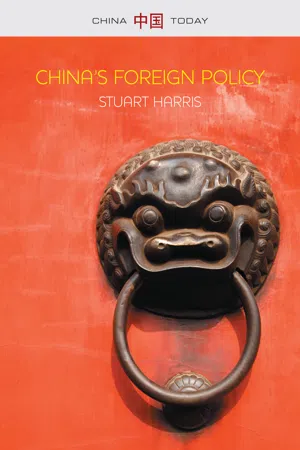
In this insightful and balanced analysis, noted China expert Stuart Harris explores China's present foreign policy and its motivations, focusing in particular on the extent to which China will co-operate with the West in years to come. He considers what factors, international or domestic, will influence the foreign policies being shaped in Beijing, including how far the Chinese regime will adhere to existing global norms and the evolving international system. In contemplating this uncertain future, Harris assesses the considerable challenges and vulnerabilities likely to impact on Chinese foreign policy, leading it to be cautious and hesitant or assertive and aggressive on the international stage. Concise and authoritative, this book will be essential reading for anyone seeking a clearer understanding of the international relations of one of the world's most important powers.
- English
- ePUB (mobile friendly)
- Available on iOS & Android
eBook - ePub
China's Foreign Policy
About this book
Information
1
Continuity and Change in China's Foreign Policies
China is no longer just an emerging power; it is already a regional great power with major global significance. Although not yet a superpower, it is still rising, even if with some potential fragility. For the more than 60 years since the establishment of the People's Republic of China (PRC) in 1949, its foreign policies have been of particular international interest. Over that period, those policies have reflected both ideology and pragmatism, and have undergone considerable change and development as China has developed and global circumstances have changed. China is now more active in the international arena and there is considerable interest in whether its future foreign policies will follow peaceful lines or will become aggressive and eventually seek to dominate.
Inevitably, much of the international discussion of China's foreign policy has focused on the concerns of the international community. Among security analysts and media commentators, the focus is on China's military modernization/expansion and the future of China–US relations; among policy officials and academics, the spotlight is on whether China will support or challenge the existing international system of rules, norms and institutions. In the early 2000s, there appeared a widely held view that China was demonstrating broad acceptance of the status quo, accommodating to, and integrating with, the existing international system, with no strongly articulated views about changing that system (Johnston 2003; Kang 2007). In recent years, however, there has been heightened media attention on an apparent increase in China's self-confidence and assertiveness, even to the point, it is argued, of arrogance in its international dealings.
Examples of this apparent assertiveness include its responses to US ‘spying’ on China's military developments when, in 2009, Chinese ships harassed an American surveillance ship, the Impeccable, in China's exclusive economic zone; and abrasive responses of some Chinese officials to statements by US officials about the South China Sea. In the economic field, examples include China's strong response to criticisms of China's trade surpluses and to pressures to revalue its currency; China's criticism of US mismanagement of its economy and weakening of the dollar, threatening China's large investment in dollar-denominated securities; and its strongly stated views in Group of Twenty (G20) meetings and particularly at the United Nations (UN) Climate Change Conference in Copenhagen in November 2009.
To what extent do these examples portray China as a confident, assertive power, demonstrating hubris and increased nationalism, unwilling to accept the international system as it is and wanting, as is often argued, to push its own ideas on norms and policies, indeed wanting to remake the global rules? How much substance is there, as well, in the argument that China sees a faltering and weakened US and a failing Western capitalist model, whereas now there is a successful Chinese model that enables it to challenge the American leadership of the global system? These are important questions with major implications for the future.
China's greater self-confidence and pride in its achievements no doubt contribute to what can be termed ‘assertiveness’. Whether this is arrogance is unclear. Is it, as Swaine (2011b) has observed, that China is less willing to accept US positions, notably US arms sales to Taiwan, political leaders' meetings with the Dalai Lama, US coastal surveillance of China, and Western lectures on human rights?
Despite the priority given to domestic issues, China's elites generally aspire for China to be accepted as a global great power. The implications of this for China and its foreign policies are part of our more general consideration of which domestic and international factors will influence the formulation of China's future foreign policies. For this purpose, we start by noting on the one hand the substantial changes in China's foreign policies since 1949 and, on the other, various continuities that have framed the context in which these changes have taken place and that have influenced China's policies from 1949 to the present. The purpose is to identify, as far as possible, continuities that may remain significant in China's future foreign policies.
In practice, even today, China's foreign policies are unlikely to be fully consistent over time, for several reasons. These include: the idea that past experiences probably still affect decision makers, although not uniformly; China's integration in the international system continues to make its foreign policy increasingly complex; because of globalization, few domestic interests are now unaffected by international developments, and those people representing those interests have risen to influential positions in the foreign policy decision-making process; and debate within China about foreign policy objectives and the methods to be employed has become more active and widespread, with public opinion playing an important role. In China, as elsewhere, moreover, foreign policy is contingent, often simply responsive to events and based on incomplete information.
Finally, the influence of strong leaders on foreign policies can often be decisive. Although China's top leaders today have less personal power, the judgements that they will make in the future, and the decisions that will emanate from this more diffuse decision-making process, with less powerful leaders, are fundamentally important to the international community. We cannot expect to know what the decisions of China's leaders will be in the coming decades: China's leaders today would themselves not know. The intellectual challenge, however, is that we inevitably project our vision of what China's future decisions will be in discussions of China's foreign policies, and we need to examine why we have a particular vision.
In this book, we look at what were understood to have been China's foreign policy objectives since 1949, and the methods that China has used to pursue those objectives. China's ability to pursue those objectives has been shaped by international and domestic developments. Major international developments that have impacted on foreign policies include the Cold War, already underway in 1949 when the PRC was established, the war on terror that began in the early 2000s, and the global financial crisis of 2007–8. Critical events include China's rapprochement with the US in the 1970s, and three major developments outside China's control – the international response to the 1989 Tiananmen Square tragedy, the fall of the Berlin Wall in the same year, and the dissolution of the Soviet Union and, effectively, the fall of international communism in 1991.
In this introductory chapter, we do two things. First, we look briefly at how history and culture have influenced and may influence China's approach to foreign policy. Second, we look at the main elements of the PRC's foreign policies under Mao Zedong and the first decade of Deng Xiaoping's leadership. We do this both to illustrate the major changes that took place over that 40-year period, and to provide a perspective from which to consider changes and continuities in China's foreign policies in the decades since. Subsequent chapters are concerned with China's current foreign policy starting with developments since the beginning of the 1990s.
The Role of History and Culture
This is a book about contemporary foreign policies, not about China's history or culture. We cannot, however, totally ignore the likely historical and cultural influences on the views of China's political leaders, on their perceptions of national interests, and on their foreign policies. Each state develops its own foreign relations culture, including not only strategic and military considerations, but also how peaceful intercourse with other states should be conducted (Stuart-Fox 2004: 119).
China's foreign policies since 1949 have reflected how China's leaders perceived world developments from within their worldviews that were themselves changing. Those worldviews reflected their beliefs and ideological conceptions of the way the world should work. The priorities given at any time to domestic needs versus its international objectives also influenced foreign policy judgements; this became clear over the past three decades with examples of China's reform programme and its related economic priorities and imperatives.
We can be confident that in some form, China's foreign policies will be a reflection of China's past and its culture, although there is considerable debate about what and how much influence each has had. If we examined US foreign policy without recognizing US self-perceptions of exceptionalism, we would fall short of a reasoned understanding of US foreign policy. Similarly, from discussions with Chinese scholars and officials over the years, it is clear that the Chinese people believe in China's exceptionalism, based on its different history and culture that is perhaps seen as superior to that of the West.
China's history, cultures and related traditions play important roles in its literature, public discourse, academic discussion and, indeed, in domestic political contestation; however, when looking at how these traditions have influenced foreign policy, problems emerge, as its history reflects many such traditions and many changes in cultures (Hunt 1996: 8). In the case of history, for example, these reflect the politically salient ‘humiliation’ in the second half of the nineteenth and the first half of the twentieth centuries, the patriarchal Middle Kingdom sinocentric worldview of much of the last millennium, the cosmopolitanism of much of the previous millennium, the cautionary lessons of the ‘warring states’ periods (whether in distant history or during the years of the Republic in the early twentieth century), and the quasi-imperialism that the Qing dynasty pursued to try to protect its core cultural areas from the potentially vulnerable peripheral areas such as Tibet, Xinjiang, Mongolia, Hong Kong and Taiwan. As Spence (2005) has noted, China's contemporary concerns about Tibet, Xinjiang and Taiwan stem from China's conquests in the seventeenth and eighteenth centuries and now constitute complex domestic grievances.
While today China's concerns for security have diminished in some respects – notably with the dissolution of the Soviet Union, the altered if still prickly relationship with the US, and the return of the territories of Hong Kong and Macau – it maintains its historic sensitivity to threats to its territorial integrity in its peripheral areas. Particular security concerns about its periphery and its unity have not diminished. Hong Kong and Macau have been reunited, but Taiwan has not. Periodic international developments, some seen as assisted by the West, particularly the US – such as ‘colour revolutions’, redolent in China's leaders' eyes, of the US's Cold War ‘peaceful evolution’ strategy,1 and the Arab Spring – and some not, such as Islamic militancy and Buddhist activism, are considered potential threats to that periphery, notably to Tibet, Xinjiang and, to a lesser extent, Inner Mongolia.
China sees the world in a different way than countries in the West, for various reasons, but most notably because of the Confucian belief in hierarchy. Moreover, while Western analyses commonly assume that the characteristics of the global system are best understood as anarchic, for China this is not necessarily the case. Van Ness (2002: 132–3) argues that for China, it is hegemonic rather than anarchic. China (and Japan), he argues, ‘perceive a hierarchical world environment, structured in terms of a combination of US military-strategic hegemony and a globalized economic interdependence. They devise strategies based on the perceived benefits/costs of participation in that system, as compared with opting out of it’.
For China's elites, global politics is concerned with the rise and fall of hegemonic powers. In this view, great powers rise to where they seek global domination and expansion, followed ultimately by the overextension of that great power and decline into passivity (Harding 1984; Shi 2012). This was reflected in China's recent close examination of the history of the various empires of the past, as China has sought to learn lessons as it rises to great power status. It is why China's leaders see that broader security in global terms, but also why they expect the US ultimately to decline, although with uncertainty about when.
Another dimension, however, comes from the different internal views about China's domestic relationship with the world. In the nineteenth century, views about how China should relate to the world were divided, in very broad terms, between a form of nativism (or nationalism) wanting autonomy, little global involvement and avoidance of contacts with foreigners who would contaminate China's culture and polity; and a cosmopolitanism or modernism that saw global involvement with importing technology, values and institutions as essential for China's development, which would provide means to counter imperialist depredations. Within Mao's PRC, nativism remained a favoured view among the more radical segments of the leadership, and Mao held both views at different times.
This division of views created tensions and sustained debates among the Chinese Communist Party leadership, as it had in China long before Mao, and as it does today.2 Under Hu Jintao, the domestic problems arising from China's rapid economic growth led to concerns with a ‘harmonious society’ drawing on Confucian thinking; it also led to divisions between those favouring continued acceptance of globalization, implied by the linked ‘harmonious world’ construct that Hu put forward in 2005 at the UN General Assembly, and those critical of globalization and its influence on society in China (Zheng and Tok 2007). This division accounts for some of the frequent shifts in China's foreign policies, as the influence of one or other interest groups varies.
A further perspective is a moral one in the sense of China's view of how the international order ought to operate over time. The PRC has sought different changes to the international order, being variously critical of capitalism, imperialism and, more recently and currently, hegemonism; it now seeks a harmonious world. Shih (1993: 201) argues that the changes to China's worldview are frequent, but that China is less interested in changing the world order than in establishing a position of moral superiority. In addition, while Mao saw a world of imperialist powers threatening China, he also viewed China's status as one of leadership, whether as a revolutionary state or in terms of the Third World. This reflected a carryover of Chinese history's concern with status and a conviction that China constitutes an exemplar.
While it is often convenient to talk about whether China is a ‘status quo’ power or not, that term lacks clarity. Johnston (2003) has argued that China wants the increased status and respect that acceptance as a great power and recognition of its increased material power will provide, including a bigger role in international institutions, but that it is difficult to see it as a status quo power, even if only ‘revisionist-lite’. At a broader level, its leadership has long held views as to how the international order ought to change, which is effectively a moral judgement. This is not surprising; the US is not a status quo power either, given its interests in the spread of democracy, human rights and market capitalism. As Van Ness has stated, the two states are the civilizing states (quoted in Shih 1993: 126).
As observed earlier, China aspires to be accepted as a global great power and to receive the status and respect that accompanies such recognition. On the other hand, to be acknowledged by others as having great power status is generally understood to mean that one should accept a responsibility to contribute to the preservation of the international order (Bull 1977: 199–222). A Maoist view would be that China had no responsibility, in the sense of obligation, to an international system that was run by two imperialist powers that had in the past humiliated China and continued to exclude it. Since gaining its permanent UN Security Council seat with the explicit special responsibilities of that position, and following Deng Xiaoping's economic reform and opening up programme that began in 1978, however, China has increasingly participated in the global system and benefited substantially from that participation. Moreover, since the 1990s, with its growing concern about its national image, China has increasingly argued that it acts responsibly in its international activities. Consequently, another aim of this study is to consider what constitutes ‘international responsibility’, and to what extent China is responsible in its foreign policies. This is not a simple matter as it is not always clear what is meant by ‘responsibility’, how it can be addressed and assessed, and what it implies for China (Chan 2001).
A related interest here is the extent to which history is relevant to China's future decisions on foreign policies and, if so, which particular history? Considerable attention is commonly given, both in discussions with Chinese officials and scholars and in Western analyses, to the influence of ‘victimhood’ which arose from the century of humiliation; it is also important in official Chinese rhetoric. Although this notion of victimhood is perhaps declining in importance among elites, it remains one amongst a number of influential factors. China's related sense of insecurity and vulnerability has led to a historically conditioned emphasis on sovereignty and the development of comprehensive strength which are now key elements of China's foreign policy.
Besides the ‘victimhood’ period, there are various experiences that one could draw upon to illustrate the present. There are many cultural traditions in China that provide other precedents for ‘after-the-event’ explanations of almost any conceivable line of foreign policy. Notably, there is a different imperial history which could ultimately become more important in shaping Chinese views – whether thought of in terms of the Middle Kingdom or, in a regional context, as the hierarchical tributary system. More recent elements of history have also imprinted memories. For example, not only was China subject to sustained hostility from both superpowers in the 1950s and 1960s, but both the US and the Soviet Union implicitly and explicitly threatened China with nuclear weapons in the same period.
A further continuity, which is a legacy of the ‘victimhood’ period of the nineteenth and early twentieth centuries, was the ‘traitor’ syndrome which stemmed from the need to blame someone for China's weakness in the nineteenth century. Whilst many Chinese officials negotiated from a weak position versus the foreigners' strengths, many others collaborated with the foreigners for practical or self-serving reasons, as happened under Japanese occupation. It remains a sensitive process to avoid blame for betraying national interests in dealing with international ...
Table of contents
- Cover
- China Today Series
- Title page
- Copyright page
- Dedication
- Map
- Chronology
- Preface
- Abbreviations
- 1: Continuity and Change in China's Foreign Policies
- 2: Foreign Policy Decision Making
- 3: China, the World and the International System
- 4: Insecurity and Vulnerability
- 5: Military Threats and Responses
- 6: Economic Foreign Policy
- 7: China, Its Neighbours and Beyond
- 8: Foreign Policy in Transition
- References
- Index
Trusted by 375,005 students
Access to over 1.5 million titles for a fair monthly price.
Study more efficiently using our study tools.
Frequently asked questions
Yes, you can cancel anytime from the Subscription tab in your account settings on the Perlego website. Your subscription will stay active until the end of your current billing period. Learn how to cancel your subscription
No, books cannot be downloaded as external files, such as PDFs, for use outside of Perlego. However, you can download books within the Perlego app for offline reading on mobile or tablet. Learn how to download books offline
Perlego offers two plans: Essential and Complete
- Essential is ideal for learners and professionals who enjoy exploring a wide range of subjects. Access the Essential Library with 800,000+ trusted titles and best-sellers across business, personal growth, and the humanities. Includes unlimited reading time and Standard Read Aloud voice.
- Complete: Perfect for advanced learners and researchers needing full, unrestricted access. Unlock 1.5M+ books across hundreds of subjects, including academic and specialized titles. The Complete Plan also includes advanced features like Premium Read Aloud and Research Assistant.
We are an online textbook subscription service, where you can get access to an entire online library for less than the price of a single book per month. With over 1.5 million books across 990+ topics, we’ve got you covered! Learn about our mission
Look out for the read-aloud symbol on your next book to see if you can listen to it. The read-aloud tool reads text aloud for you, highlighting the text as it is being read. You can pause it, speed it up and slow it down. Learn more about Read Aloud
Yes! You can use the Perlego app on both iOS and Android devices to read anytime, anywhere — even offline. Perfect for commutes or when you’re on the go.
Please note we cannot support devices running on iOS 13 and Android 7 or earlier. Learn more about using the app
Please note we cannot support devices running on iOS 13 and Android 7 or earlier. Learn more about using the app
Yes, you can access China's Foreign Policy by Stuart Harris in PDF and/or ePUB format, as well as other popular books in Politics & International Relations & Asian Politics. We have over 1.5 million books available in our catalogue for you to explore.