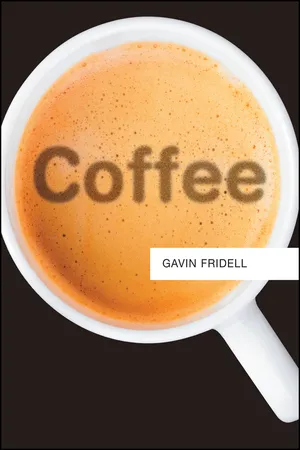
In a world of high finance, unprecedented technological change, and cyber billionaires, it is easy to forget that a major source of global wealth is, literally, right under our noses. Coffee is one of the most valuable Southern exports, generating billions of dollars in corporate profits each year, even while the majority of the world's 25 million coffee families live in relative poverty.
But who is responsible for such vast inequality? Many analysts point to the coffee market itself, its price volatility and corporate oligarchy, and seek to "correct" it through fair trade, organic and sustainable coffee, corporate social responsibility, and a number of market-driven projects. The result has been widespread acceptance that the "market" is both the cause of underdevelopment and its potential solution.
Against this consensus, Gavin Fridell provocatively argues that state action, both good and bad, has been and continues to be central to the everyday operations of the coffee industry, even in today's world of "free trade". Combining rich history with an incisive analysis of key factors shaping the coffee business, Fridell challenges the notion that injustice in the industry can be solved "one sip at a time" - as ethical trade promoters put it. Instead, he points to the centrality of coffee statecraft both for preserving the status quo and for initiating meaningful changes to the coffee industry in the future.
eBook - ePub
Coffee
About this book
Information
CHAPTER ONE
The global market and coffee statecraft
Following the global coffee market is a daunting task for any researcher, not least because of the dramatic ups and downs of coffee prices. When I began my graduate studies as a masters student in 1996, coffee prices were in the middle of a five-year recovery after a previous four-year collapse. The coffee composite indicator price, a commonly used estimate that combines different quality beans with different prices, dropped to extreme lows from 1990 to 1993, reaching as low as 54 cents per pound, only to recover starting in 1994, eventually reaching as high as $1.38 per pound. When I started my doctoral work in 1998, the mini-boom had already ended, with prices collapsing once again, this time to the lowest seen in 30 years and by some estimates the lowest prices in real value in over 100 years, taking into account historical rates of inflation. Prices dropped as low as 45 cents, causing a major global coffee crisis that left tens of thousands of farmers and rural workers confronting bankruptcy, migration, and hunger. Prices did not recover from the crisis years until 2007, when they crawled over $1 per pound and began to slowly increase. Then in 2011, as I began work on this book, prices boomed once again, reaching $1.95 per pound, the highest seen in decades, causing economic analysts to rush to celebrate the new “bull” market (see figure 1.1). As I wrapped up research for the book in the fall of 2013, prices had fallen, dropping to around $1, causing the International Coffee Organization (ICO) to raise concerns that “many producers may be selling at a price which is not remunerative compared to the cost of production.” Prices then soared upward once more at the start of 2014, due to an unanticipated drop in global coffee supply caused by one of the worst droughts in decades in Brazil, the world’s largest coffee producer. In the words of Wall Street Journal reporters, this reflected “how quickly global commodity markets can swing from concerns about oversupply to fears of a shortage.”1

Source: 1976 coffee Composite Indicator Price from the United Nations Conference on Trade and Development (UNCTAD) statistical database (http://unctadstat.unctad.org), accessed July 30, 2013.
Note: Year 2000 = 100.
Figure 1.1 The coffee rollercoaster (taking into account inflation), 1963–2012.
Charting the rollercoaster of global coffee prices, of course, is nothing compared to riding on it. Every dramatic drop and rise in the coffee rollercoaster brings with it immense social, economic, and political ramifications worldwide. More than just low prices, it is coffee’s extreme price volatility that has major impacts on coffee growing, exporting, and importing states; coffee companies and consumers; and, of course, above all else, millions of coffee farmers and rural workers – there are approximately 25 million coffee farmer families in the world, over 70 percent of whom are small farmers owning less than 10 hectares of land. During boom times, coffee has a reputation for providing good incomes among farmers in Latin America, Africa, and Asia, where most of the world’s coffee is grown due to the climatic needs of the tropical bean. Coffee is one of the most valuable commodities exported by the South, seconded only by oil and illegal drugs, and is capable of generating immense wealth.
During frequent bust times, however, the face of coffee changes, poverty and hunger intensify, general despair emerges, and bankruptcies and unwanted migrations in search of work are the outcomes for countless thousands. Coffee livelihoods can be extremely precarious and generate very poor social indicators, especially in those countries most dependent on coffee exports and most vulnerable to the chaos and uncertainty of the coffee rollercoaster. The small African country of Burundi, with a population over 8.5 million, is the most coffee dependent country in the world, relying on coffee exports for 54 percent of its total exports even while it only represents 0.2 percent of the world’s coffee exports. In 2011, Burundi had a life expectancy at birth of only 50 years and a GDP per capita of $247, and was one of the world’s lowest-ranked countries in the United Nations Human Development Index.2
Riding high above all of this are the transnational coffee roasters, retailers, traders, and supermarket chains, which rake in huge profits regardless of the ups and downs of the coffee rollercoaster. The global coffee chain is designed in such a way that, boom or bust, the lion’s share of wealth flows comfortably into the hands of corporate giants like Kraft Foods Group and Nestlé, the leaders in the global coffee industry and among the wealthiest companies in the world. During the darkest days of the global coffee crisis at the start of the new millennium, Oxfam International estimated that coffee farmers in Uganda received 14 US cents per kilo for green beans that were then transported, processed, and sold in supermarket chains in the UK as instant coffee for $26.40 per kilo – a price inflation of over 7,000 percent.3 Needless to say, with a global value chain arranged as unevenly as this, the world’s biggest coffee companies rode through the crisis without a scratch, continuing to garner hundreds of millions of dollars in profits while tens of thousands of coffee families confronted personal and community disaster.
In seeking to account for the causes and consequences of such an uneven global coffee economy, most analyses coming from official international institutions, nongovernmental organizations, think tanks, journalists, and policy advisors have tended to focus on the dynamics of the coffee market, its volatility and unpredictability and the ever-expanding oligopolistic dominance of roasters, retailers, and traders. This tendency has been further entrenched in recent years by the growing pervasiveness of fair trade, ethical trade, organic and sustainable coffee, corporate social responsibility, and any number of market-driven projects devoted to combating poverty and inequality. The result has been a dominant consensus around the “market” as the cause of underdevelopment and its potential solution, with the “state” receding ever further into the background. As an alternative, however, I will argue, building on some of the most insightful work on international political economy and the coffee industry, that the state and the market are inseparable and that coffee statecraft, both good and bad, has been and continues to be central to the everyday operations of the industry. While the global market does indeed cause socially destructive volatility and unpredictability for millions of coffee farmers, the existence of this market is not the natural or inevitable outcome of human activity, but rather stems from a specific form of international exchange set in motion by states that protect, reproduce, and contest it on a continual basis. The geopolitics of coffee statecraft must be of central concern for understanding and challenging the deep roots of uneven development in the coffee world.
Coffee statecraft
Coffee is the classic global commodity, produced as a generic or universal good specifically for sale on the market. It links the daily routine of millions of consumers and producers living thousands of kilometers apart and experiencing vastly different lives. The commodification of coffee, its processing, transporting, roasting, packaging, branding, and selling, generates immense wealth each year – indeed, in a world of high finance and financial crises, unprecedented technological change and cyber billionaires, it is easy to forget that a key source of global wealth is, literally, right under our noses. And yet, despite billions of dollars in profits made each year, the majority of the world’s coffee families live in relative poverty. Who is the culprit for such vast inequality?
The most frequently named offender is the global coffee market. Nongovernmental organizations and social justice activists commonly point to the volatility and unpredictability of global coffee markets. These groups have, over the years, played a key role in exposing and condemning the lack of state “intervention” in coffee markets to assist the poorest farmers and workers. In recent years, however, concern for state intervention has been pushed aside and overshadowed by efforts to persuade corporations to voluntarily offer higher prices and support better labor and environmental standards in exchange for winning the loyalties of ethical consumers.4 Leading this charge have been fair trade advocates, who have proclaimed that fair trade allows consumers to “vote with their dollars” and empowers them as “citizens” to “build mature markets and develop new ones, always continuing to innovate.” They have moved increasingly away from state-centered visions of social justice and toward the belief that “Fair trade actually embraces many of the ideals of capitalist free trade; the distinction is that we aim to give everyone a fair chance.”5
Trade economists, representatives of big coffee, and the most powerful states and international organizations, for their part, have generally condemned the idea of state intervention in the coffee market. In its place, they have proposed “free” market solutions that have long been on offer (increasing productivity and quality, expanding markets, diversifying … and have continually failed to bring substantive benefits to the majority of small coffee farmers and workers.6 Since the 1990s, they too have begun to embrace an array of sustainable coffee certification projects, from fair trade to organic to Rainforest Alliance. The World Bank, one of the most powerful international organizations in the world, now advocates that poorer countries pursue sustainable coffee certification, as long as it is combined with privatization, liberalization, and deregulation of the coffee sector.7 Representatives of the mainstream coffee industry, for their part, have also gradually given way to modest support for sustainable certification, as long as coffee continues to be “bought and sold based on the free trade model.”8
The growing consensus among otherwise opposing groups around the power of the “free” market to solve inequality and poverty through a burgeoning array of sustainable coffee projects has served to naturalize market domination. Both critics and defenders of the status quo have tended increasingly to focus their energies on the coffee market itself, as opposed to the states that create, regulate, and reproduce this market. This direction of popular and political debate runs contrary to a great deal of scholarly debate on the topic, which often centers on the relationship between the state, the coffee industry, and the market at the local and global level. Existing scholarly works provide powerful insights into the nature of the coffee world, although most have little to say specifically about the geopolitics of coffee statecraft – how competitive capitalist states do battle for a bigger share of the global coffee pot, the outcome of which is immensely important to the livelihoods of millions of poor coffee farmers and rural workers globally.9
Two particularly important exceptions are the works of Robert Bates and John Talbot. Robert Bates’ work on the political economy of coffee is of major importance because it draws attention to the ways in which states have shaped the international coffee market through various forms of market regulation (such as the International Coffee Agreement [ICA], discussed in chapter 3) in response to the demands of domestic coffee sectors. Bates tends to depict the state in fairly neutral terms, seeing it as a relatively benign institution swung in different directions by competing interest groups that vie for political power and influence. This book, in contrast, places greater emphasis on the specifically capitalist and class nature of coffee states. A key distinction is that while Bates depicts states as ultimately choosing to “introduce institutions into economic life,” I argue that the state is always involved in managing coffee markets, under both “regulated” and ostensibly “free trade” regimes.10
John Talbot’s path-breaking work on coffee and the ICA, drawing on a global value chain approach, more effectively gets at the capitalist drives underpinning the global coffee industry. Whereas conventional economic trade theory tends to assume that trade participants are independent from one another, connected by only isolated economic transactions, the global value chain approach points out that officially independent firms are linked through informal institutional frameworks coordinated by “lead firms” that “govern” the commodity chain based on their economic dominance over such things as market access and information. Using this approach, Talbot has effectively demonstrated how “collective action” among producing states was able to provide higher and more stable prices than was the case before or after the ICA.11
The argument I provide here around coffee statecraft draws on Talbot’s insights, while making divergences from the global value chain approach, which has been criticized for an overemphasis on economic agents, in particular transnational corporations (TNCs), at the cost of downplaying the significance of other actors, such as states, social movements, and international regimes.12 The state, in particular, is not just one player among others fighting for its share of the wealth, but is central to creating and reproducing the very social relations that underpin the entire global coffee chain. Much global value chain work tends to make too firm a distinction between when a chain is dominated by economic and when by political governance, whereas both are always present.
Building on and departing from these works, I argue that the complex relationship between the modern state and the global coffee market can be further understood through the idea of “coffee statecraft” – a term drawn from Peter Gowan’s insightful use of “economic statecraft.” Of particular importance is David Harvey’s understanding of the geostrategic interests of capitalist states being primarily driven by two logics, a “territorial logic” and a “capital logic,” intertwined in a relationship that can be compatible, competing, or contradictory, depending on the specific context. The “territorial logic” involves the considerations of political leaders as they seek power for their state over other states. For coffee exporting countries, this includes defending and promoting the interests of their national coffee sector, essential for the state in providing revenue (through tariffs and other forms of taxation), employment, economic and social stability, and institutional legitimacy. The coffee sector, in turn, exercises influence over state priorities depending on their overall economic weight, control of major media and information outlets, and direct influence over government through political contributions, donations, and bribes. Importantly, territorial logic is not confined to direct political or military activities, but also entails Gowan’s notion of “economic statecraft”: the strategic use of market management by capitalist states to gain advantage or power over others.13
The “capital logic,” in contrast, involves state action to develop, protect, and reproduce on a global scale a capitalist economy, based on specific social relations and commodity production. This includes protecting private property, managing class conflict (through coercion or social reform), defending the interests of capital at home and abroad, and, as Ellen Meiksins Wood has argued, ensuring the artificial separation between the economic and political realms required for the capitalist economy to function.14 State and state policy makers in the modern world are far from autonomous, but rather must constantly respond to the imperatives of the economic system upon which the state is built. This means that the capitalist state must work to ensure the relatively smooth functioning of the capitalist economy – which is never guaranteed. It also means that the state must disproportionately respond to the needs of dominant classes – local and transnational capital that possess immense economic power well beyond that of mere “special interest groups.”
The relationship between the “territorial” and “capital” logics can be relatively harmonious or conflict-ridden, depending on the particular context. As we will see in the chapters that follow, the history of coffee is replete with examples of coffee states employing authoritarian violence to defend highly unequal distributions of land and resources in the interests of domestic agrarian elites and transnational companies (the capital logic), only to be confronted by social protest, social revolution, and civil war from below (significantly disrupting the territorial logic). In other cases, states have been able to more effectively manage the competing logics, as has been the case in Costa Rica, where short-term pain imposed on the agro-industrial elite (through taxation and other forms of state management) ultimately resulted in a highly efficient coffee economy and significant social wel...
Table of contents
- Cover
- Half Title
- Title Page
- Copyright
- Contents
- Abbreviations
- Figures
- Acknowledgments
- 1 The Global Market and Coffee Statecraft
- 2 Making Coffee
- 3 Pro-Poor Regulation
- 4 Coffee Unleashed?
- 5 Fair Trade and Corporate Power
- 6 Coffee and the Non-Developmental State
- Notes
- Selected readings
- Index
Trusted by 375,005 students
Access to over 1.5 million titles for a fair monthly price.
Study more efficiently using our study tools.
Frequently asked questions
Yes, you can cancel anytime from the Subscription tab in your account settings on the Perlego website. Your subscription will stay active until the end of your current billing period. Learn how to cancel your subscription
No, books cannot be downloaded as external files, such as PDFs, for use outside of Perlego. However, you can download books within the Perlego app for offline reading on mobile or tablet. Learn how to download books offline
Perlego offers two plans: Essential and Complete
- Essential is ideal for learners and professionals who enjoy exploring a wide range of subjects. Access the Essential Library with 800,000+ trusted titles and best-sellers across business, personal growth, and the humanities. Includes unlimited reading time and Standard Read Aloud voice.
- Complete: Perfect for advanced learners and researchers needing full, unrestricted access. Unlock 1.5M+ books across hundreds of subjects, including academic and specialized titles. The Complete Plan also includes advanced features like Premium Read Aloud and Research Assistant.
We are an online textbook subscription service, where you can get access to an entire online library for less than the price of a single book per month. With over 1.5 million books across 990+ topics, we’ve got you covered! Learn about our mission
Look out for the read-aloud symbol on your next book to see if you can listen to it. The read-aloud tool reads text aloud for you, highlighting the text as it is being read. You can pause it, speed it up and slow it down. Learn more about Read Aloud
Yes! You can use the Perlego app on both iOS and Android devices to read anytime, anywhere — even offline. Perfect for commutes or when you’re on the go.
Please note we cannot support devices running on iOS 13 and Android 7 or earlier. Learn more about using the app
Please note we cannot support devices running on iOS 13 and Android 7 or earlier. Learn more about using the app
Yes, you can access Coffee by Gavin Fridell in PDF and/or ePUB format, as well as other popular books in Technology & Engineering & Agriculture. We have over 1.5 million books available in our catalogue for you to explore.