In the past decade, the developed world has spent almost US$ 2 trillion on foreign aid for poorer countries. Yet 1.2 billion people still live in extreme poverty and around 2.9 billion cannot meet their basic human needs.
But should rich nations continue to help the poor? In this short book, leading global poverty analyst David Hulme explains why helping the world's neediest communities is both the right thing to do and the wise thing to do Ð if rich nations want to take care of their own citizens' future welfare.
The real question is how best to provide this help. The way forward, Hulme argues, is not conventional foreign aid but trade, finance and environmental policy reform. But this must happen alongside a change in international social norms so that we all recognise the collective benefits of a poverty-free world.
- English
- ePUB (mobile friendly)
- Available on iOS & Android
eBook - ePub
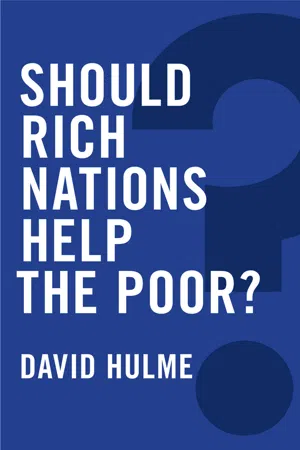
Should Rich Nations Help the Poor?
1
Why Worry About the Distant Poor?
Rich nations, and their citizens, are increasingly experiencing the consequences of living in a very unequal world. Much of this is to their advantage: cheap garden furniture from China, fashionable, low-cost clothing from Bangladesh and affordable petrol. But there is also a downside. Holidaymakers from Northern Europe are keeping away from some Mediterranean beaches as it spoils your fun when the bodies of refugees wash up. There are deep tensions in mainland Europe about the growing flows of migrants and refugees. These stretch from the west, where Britain and France have been at loggerheads about migrant camps around Calais, to the east, where EU and non-EU countries are erecting new iron curtains. Meanwhile, the last time I travelled from Mexico to the US, the queue to pass through the Tijuana border control snaked back more than a mile. Having so much poverty and inequality in an affluent world means that rich nations and their citizens have no choice but to think through how they relate to the distant poor.
Extreme poverty has reduced greatly in recent years, but poverty is a long way from eradication. Almost 3 billion people are deprived of at least one basic human need: lack of access to food, drinking water, shelter, basic health services, not to mention education – and dignity. Some 800 million people went to sleep hungry last night, and one billion experienced the indignity of having to defecate in the open. Even more shocking, 19,000 children will die today of easily preventable causes: one unnecessary child death every five seconds all day every day.
Our grandparents, and perhaps our parents, could accept such conditions. They believed that there were just not enough resources (and technology and organization) to provide for every human being. But we cannot use this excuse today – we live in an affluent world. Our agricultural systems produce enough food to feed all 7 billion of us. Low-cost medicines, basic health services and simple health practices (washing hands after using the toilet and sleeping under a mosquito net) would save millions of human lives every year. A reallocation of a mere 1% of global income to the poorest would entirely eradicate US$1.90-a-day income poverty.1
How is it that avoidable human suffering and preventable deaths occur on such a vast scale after 25 years of unprecedented global economic wealth creation? Newspaper headlines and media coverage create the impression that extreme poverty and destitution are caused by emergencies and disasters. These are both man-made and natural, ranging from violent conflict in Syria to hurricanes in the Caribbean, floods in Africa and earthquakes in Asia. But these humanitarian crises are only a part of the story. More thoughtful analyses find that the main causes are grounded in less dramatic, more mundane processes: low wages; lack of access to productivity-enhancing agricultural technologies; indebtedness to moneylenders; the profit margins and business models that corporations pursue; the investment decisions (and bonuses) that bankers take; poor-quality basic services; and the public policies that governments select and implement – or fail to implement.
From an early age I understood that there were very different ideas about how rich nations and better-off people could try to help poor people in faraway places. In the mid-1960s, from the relative comfort of a council house near Liverpool, my parents had very different responses when the BBC reported that India ‘faced famine’. My mother thought the UK government ‘should send them food’: if people were starving, then others with food should spare them some. By contrast, my father thought ‘they should all be sterilized’. The Indian government should do this, and should not be over-concerned about whether sterilization was voluntary. The UK government could assist the Indian authorities with finance and medical expertise. ‘Over-population’, not access to food, was the underlying problem.
Fifty years later, such contrasting positions are still argued out – not by my parents, but in the media. Charity fundraising advertisements on television encourage donations for poor children in poor countries. The BBC’s Children in Need programme goes beyond this focus on charity. It also reports on successful UK government aid projects that help girls complete primary and secondary schooling across Asia and avoid female genital mutilation in Africa. The message is clear: relatively small amounts of money can make a big difference at household and community levels. Less clear, but implicitly: isn’t it your moral duty (and your government’s) to help those who are poor? A contrasting position comes from the right-wing news media like Fox News in the US and the Daily Mail in the UK. These present aid programmes as inefficient and highlight that corruption in recipient countries means that aid money is ‘wasted’. Explicitly, they argue there is next to nothing that better-off outsiders can do to help poor people in poor countries beyond humanitarian work. Implicitly, they suggest that it is ‘not our job’ to provide help. Poor countries and poor people need to sort themselves out.
In this book I explore these contrasting viewpoints and ask: ‘Should rich nations help the poor?’ I argue that rich nations should help the governments and people of poor countries to achieve prosperity and human development. But the argument goes further: those of us who are ‘better-off’ would be stupid not to help the poor. Not only is this the morally right thing to do, but the pursuit of self-interest, indeed the future well-being of rich world citizens (our children and grandchildren), requires that we help poor people in faraway lands.
Migration, the focus of the opening paragraph, is not the only issue that makes global poverty and inequality topical in rich countries. The Ebola virus illustrates this vividly. In 2014, Ebola caused devastation across parts of West Africa, and health authorities across Europe, North America, China and Japan made detailed plans about how they would respond to the arrival of the disease – especially if the nightmare scenario occurred and it mutated into airborne transmission. But the rich world’s response to West Africa’s problem was tardy. This disease has been known about for decades, but research on medicines to prevent or treat it has been very limited: it only kills poor Africans, so who would pay for research? A similarly sluggish response to an emerging health problem in Africa 30 years ago permitted HIV/AIDS to become a global pandemic, killing millions in Europe, the US and other rich countries. And now we have the Zika virus.
Have we learned nothing? On a small, densely populated, highly connected planet a problem in a faraway place can soon become a problem anywhere. Unexpected population movements and health are not the only examples of our interconnectedness. Desperately poor people in Latin America opt to grow and/or transport cocaine to the US as the economic opportunities they have offer few alternatives. As a result, large parts of Central America have been destabilized and the chains of narco-violence spill over into US cities. In the Middle East, religious ideologies take root that legitimate violence and terrorism at home and abroad. The question we need to ask is not simply ‘Should rich nations help the poor?’ but ‘What are the best ways for rich nations to help the poor?’
Why things have to change
There are three main reasons why rich country support for the distant poor cannot go on the way it is today. First, it is not working: the underpinning idea that a set of developed countries can help a set of developing countries to ‘catch up’ is now untenable. Countries that were once classed as developing – Chile, Mexico and South Korea – are now members of the OECD, the club of rich nations. A whole set of others are holding talks about joining the OECD (Colombia, Costa Rica, Malaysia and Peru). Brazil, China and India are all recognized as emerging powers and have been running their own aid programmes (being donors) at the same time as they have been recipients of aid. The world is a complex multi-polar mosaic and not a Global North that needs to help a Global South.
Second, the idea that development can be achieved largely through foreign aid (government-to-government financial transfers) has been discredited. Countries that have experienced significant improvements in the well-being of their population in recent years have achieved this through engaging with markets/international trade and selectively participating in a set of processes commonly described as ‘globalization’. Interactions between the civil societies of different countries (the women’s movement, the environment movement, development and human rights NGOs, faith-based organizations, diaspora communities, etc.) have been an important part of these processes. Nation states remain crucial, but their role is at least as much about enabling development as about delivering development. By contrast, countries that have made little development progress often have high levels of political instability and/or violent conflict. These are commonly referred to as ‘fragile states’. In such circumstances the role of rich countries is about working out how to support domestic processes of state formation (getting governments to work more effectively and inclusively) rather than simply transferring foreign aid.
Third, the idea of ‘international development’ is being totally recast as the evidence grows that countries with large numbers of poor people cannot simply copy what the industrialized countries have done. Sustainable development is now the UN-agreed, global meta-goal. The high levels of carbon emissions that we take for granted in the West – from our factories, farms, transport and houses – have already created global warming. The material basis of ‘development’ has to be redefined if the world’s population – presently 7 billion but in the not too distant future 8 or 9, perhaps 10 billion – is to survive and have reasonable lives: what some Latin American thinkers are conceptualizing as buen vivir (living well). Living well will mean significantly improved material conditions for at least 3 billion poor and very poor people – better access to food, clean water, sanitation, shelter, health services, energy and other goods and services. But it will also have to mean living differently for elites and middle classes around the world (you and I included). The material- and energy-profligate lifestyles that rich nations and better-off people now have cannot continue in a world that is sustainable and socially just. Helping the world’s poor is no longer simply about changes in poorer countries: it is also about big changes in rich nations.
Helping the poor: a scorecard
The conventional way of deciding whether rich nations are concerned about people in poorer countries is to look at their foreign aid budgets (official development assistance or ODA). If one does this, then there is evidence that virtually all high-income countries have some concerns, as all allocate public funds for international development. In aggregate terms the US would appear to be the most concerned country, as it spent US$32.7 billion on official development assistance in 2014.2 However, it has the world’s biggest economy, and the more usual measure is share of gross national income (GNI) spent as foreign aid. From this perspective the US comes out as a poor performer, with only 0.19% of its GNI spent on development in other countries, compared to the OECD average of 0.29%. But it beats South Korea, which managed only 0.13%. At the top of the list for aid spending come Sweden (1.10%) and Norway (0.99%). The UK is the most improved, reaching the UN Millennium Development Goal (MDG) target of 0.70% in 2014.
However, foreign aid is only one of the ways in which rich nations can support poor countries and poor people. The Centre for Global Development asks the question ‘Which wealthy nations are helping poor ones the most?’ and computes a Commitment to Development Index (CDI).3 This index combines seven different ways in which support can be offered to poor countries: foreign aid; being open to trade; contributing to a global financial regime that helps ensure that poor countries get access to finance; allowing the citizens of developing countries to immigrate; taking responsibility for environmental impacts; contributing to improved security; and making technologies available to poorer nations. This is not a perfect measure, but it is much better than simply looking at aid levels.
Again, Scandinavian countries head this listing, with Denmark at 6.8 (out of a possible 10), Sweden at 6.6 and Norway at 6.2. The UK comes out as a good performer with a 5.6 score. The US does better than on the simple ODA measure, coming 19 out of 27 rich nations with 4.6. At the bottom end...
Table of contents
- Cover
- Title Page
- Copyright
- Acknowledgements
- 1 Why Worry About the Distant Poor?
- 2 The Limits of Foreign Aid
- 3 What Can Be Done?
- 4 Climate Change and Inequality
- 5 From Broken Promises to Global Partnership
- Further Reading
- End User License Agreement
Trusted by 375,005 students
Access to over 1.5 million titles for a fair monthly price.
Study more efficiently using our study tools.
Frequently asked questions
Yes, you can cancel anytime from the Subscription tab in your account settings on the Perlego website. Your subscription will stay active until the end of your current billing period. Learn how to cancel your subscription
No, books cannot be downloaded as external files, such as PDFs, for use outside of Perlego. However, you can download books within the Perlego app for offline reading on mobile or tablet. Learn how to download books offline
Perlego offers two plans: Essential and Complete
- Essential is ideal for learners and professionals who enjoy exploring a wide range of subjects. Access the Essential Library with 800,000+ trusted titles and best-sellers across business, personal growth, and the humanities. Includes unlimited reading time and Standard Read Aloud voice.
- Complete: Perfect for advanced learners and researchers needing full, unrestricted access. Unlock 1.5M+ books across hundreds of subjects, including academic and specialized titles. The Complete Plan also includes advanced features like Premium Read Aloud and Research Assistant.
We are an online textbook subscription service, where you can get access to an entire online library for less than the price of a single book per month. With over 1.5 million books across 990+ topics, we’ve got you covered! Learn about our mission
Look out for the read-aloud symbol on your next book to see if you can listen to it. The read-aloud tool reads text aloud for you, highlighting the text as it is being read. You can pause it, speed it up and slow it down. Learn more about Read Aloud
Yes! You can use the Perlego app on both iOS and Android devices to read anytime, anywhere — even offline. Perfect for commutes or when you’re on the go.
Please note we cannot support devices running on iOS 13 and Android 7 or earlier. Learn more about using the app
Please note we cannot support devices running on iOS 13 and Android 7 or earlier. Learn more about using the app
Yes, you can access Should Rich Nations Help the Poor? by David Hulme in PDF and/or ePUB format, as well as other popular books in Economics & Development Economics. We have over 1.5 million books available in our catalogue for you to explore.