We need a world trade organization. We just don't need the one that we have. By pitching unequally matched states together in chaotic bouts of negotiating the global trade governance of today offers - and has consistently offered - developed countries more of the economic opportunities they already have and developing countries very little of what they desperately need. This is an unsustainable state of affairs to which the blockages in the Doha round provide ample testimony.
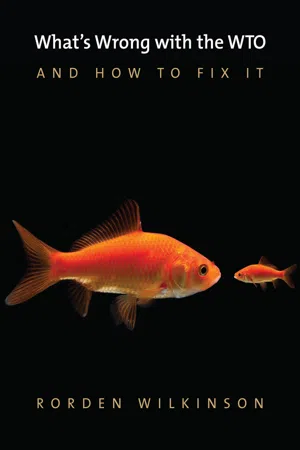
So far only piecemeal solutions have been offered to refine this flawed system. Radical proposals that seek to fundamentally alter trade governance or reorient its purposes around more socially progressive and egalitarian goals are thin on the ground. Yet we eschew deeper reform at our peril. In What's Wrong with the World Trade Organization and How to Fix It Rorden Wilkinson argues that without global institutions fit for purpose, we cannot hope for the kind of fine global economic management that can put an end to major crises or promote development-for-all. Charting a different path he shows how the WTO can be transformed into an institution and a form of trade governance that fulfils its real potential and serves the needs of all.
- English
- ePUB (mobile friendly)
- Available on iOS & Android
eBook - ePub
What's Wrong with the WTO and How to Fix It
About this book
Information
Part I
Problems
CHAPTER ONE
Why we govern trade in the way that we do
While Peter Singer reminds us that it is not possible to prove that the liberalization pursued under the GATT/WTO has made ‘the rich richer and the poor poorer’ (Singer, 2004: 91), the form of trade governance that we currently have – and with which we have persisted in the post-Second World War era – has presided over the exacerbation of precariousness in the poorest parts of the world and has undergone little more than a rearranging of the furniture reform-wise since it was established. This form of trade governance has produced a pattern of liberalization that has accorded the lion’s share of trade opportunities to the leading industrial states, offered others limited prospects, and for others still excluded them from openings in key economic sectors inhibiting their capacity to take advantage of the opportunities that trade-led growth could bring. As Jennifer Clapp and Kim Burnett (Clapp and Burnett, 2014: 79) put it:
Despite being shaped by ideas that trade liberalization will bring benefits to all, the regime in practice has locked in an imbal-anced set of rules and practices that have contributed to the vulnerability in the world’s poorest countries. This system has contributed to hunger and poverty, especially in a world that is facing ongoing volatility in food prices.
Exaggerated claims concerning the value of the benefits from GATT/WTO negotiations notwithstanding (see Scott and Wilkinson, 2011; Scott, 2008; Panagariya, 1999; Whalley, 2000), the outcome of successive trade rounds has produced neither significant value nor opportunity for the broad swathe of nonindustrial states. As Nelson Mandela (1998) put it, ‘the extent to which all parties have benefited [from international trade] has depended on the circumstances in which [trade has] taken place’.
The paradox here is that our belief in the inalienable good of freer trade has been such that we have seldom raised questions about the way we have pursued liberalization. What we have done instead is to fixate on applying modest advances designed to overcome moments of blockage and intransigence. In so doing, we have failed to see that the system is not only broken but it is complicit in the perpetuation of this sorry state of affairs. The problem– which we need to recognize and move quickly away from – is that what has passed for multilateral liberalization under the GATT/WTO has been treated, rather uncritically, as a synonym for free or freer trade, and not understood as a managed form of regulation strategically applied in pursuit of the specific and particular interests of the leading industrial states (Wilkinson, 2011). We need to undo this simple association, and to divorce the idea of greater universal prosperity through freer trade from the multilateral means by which we have pursued liberalization in the post-war era.
This point is worth dwelling on for a moment. It is not the idea of freer trade through multilateral means that is necessarily at issue here (though, equally, I am not arguing for unregulated markets – their capacity to work in an equitable fashion is far too limited to justify the omission of a regulatory apparatus designed to constrain some forms of behaviour, mitigate others, banish others still and to assist the poorest and most vulnerable); rather it is the way that this idea has been put into operation – that is, the manner in which liberalization has been pursued and economic openings and forms of protection safeguarded – in the post-Second World War era that is the problem. It is, as the next chapter argues, unimaginable that we would – given carte blanche – construct a fair and equitable system of freer trade on the basis of bargaining among states of vastly different capabilities. Yet this is exactly what we have let happen. It is equally unimaginable that we would withhold trade openings in sectors of key economic importance, principally agriculture, to the poorest producers in the pursuit of a meaningful development agenda – as we have done and are doing in the Doha round (a topic to which we return throughout this book). Moreover, it is difficult to imagine that we would persist with simplistic ideas and quasi-intellectual-cum-metaphorical ways of thinking and talking about trade that obscure what is actually going on if we sat down and seriously thought about the reasons why we think global trade governance might be a good thing in the first place– a topic that Chapter 3 explores. Yet this is exactly what we have done.
Before we can explore how the form of trade governance we currently have acts as a mechanism for distributing commercial opportunities, or the arcane manner in which we have tended to think and talk about trade, we first need to know something about the kind of trade governance that we actually have, how it has evolved, and what the consequences of that evolution have been. This is important not only because it helps uncover why we have persisted with one particular form of trade governance, it also adds substance to the claims of inequity that are the motivations driving the need to build a new global trade order.
The aim of this chapter is to explore the trade governance that we actually have (not the one we might imagine that we do). It begins at the formation of the multilateral trading system, moving through key moments, events, outcomes and decisions before arriving all too briefly at today. Its argument is that like most, but not all, international regimes and institutions the development of the multilateral trading system has been largely in keeping with the ideas and interests that were the alloy out of which it was forged; and it is this narrow and partisan institutional creation and evolution that accounts in large part for the problems we encounter today.
What trade governance we actually have
It is not unreasonable to ask why we govern trade in the way that we do and why we persist with a system that is clearly not delivering meaningful gains to those who need them most. The simple answer is that we govern trade in the way that we do because it is the way that we always have; and we have persisted with it because we treat the existing system as if it were a fact of nature and imagine that it cannot be fundamentally changed. Yet, rather than asking ourselves these questions we have resigned ourselves to carrying on with a system of trade governance that is not perfect but probably the best we think we can imagine; and we have merely tinkered at the margins as a result. In so doing, we have eschewed questions about whether (and how) trade could be governed more efficiently and equitably.
If we were to ask ourselves these questions, we would realize that we govern trade in the way that we do because we have persisted with an ad hoc form of liberalization that was put in place in an attempt to salvage something from a complex and protracted, but ultimately unsuccessful set of post-war trade negotiations; and because the result of that salvage operation spoke more pointedly to the economic interests of the leading powers at that time. This system has, in turn, survived precisely because it has continued to speak to a narrow set of commercial imperatives as well as through familiarity and habit. There were moments when its very existence was threatened, but challenges to its supremacy as the primary means of governing trade – most notably in the form of United Nations Conference on Trade and Development (UNCTAD, see Gardner, 1964) – were successfully countered. What has occurred instead has been a slow process of consolidation and legalization which has resulted in the embedding of a system salvaged from one project and designed for a specific post-war purpose that continues as the foundation around which contemporary trade is governed.
That it is no longer fit for purpose has been obvious for a con-siderable period of time. The degree of contestation that has developed over the course of consecutive trade rounds – which was present during the first post-war negotiations and has amplified since – provides ample illustration of this. The more visible challenges to contemporary trade governance that have taken place since the WTO was established, most notably during its biennial ministerial conferences, further reinforce the point. That the system needs fundamentally overhauling is equally obvious. Yet, the sunk costs – in terms of the amount of time, effort and energy that have been invested, not to mention the development of trade capacities and the construction of trade missions in Geneva as well as in national capitals designed to deal with the current system – are such that an exercise of the scale required is unappealing. It is nevertheless precisely what we should do. To understand why we should recapture that appeal, it is necessary to establish precisely what the nature of the system of trade governance that we have is as well as to explore what the consequences of its application in the post-Second World War period have been.
The creation and development of the multilateral trading system
As is recounted in most histories of the multilateral trading system, the origins of the WTO lie in the ill-fated wartime and post-war efforts to create an International Trade Organization (ITO) as the third of a triumvirate of institutions designed to manage the global economy – with the other two being the International Monetary Fund (IMF) and what was to become the World Bank. Yet, most of these accounts merely note that the WTO’s predecessor, the General Agreement on Tariffs and Trade (GATT), grew out of designs for an ITO and not the fact that the GATT was actually a response to blockages in the ITO negotiations. It is understanding why this response was necessary that holds the key to appreciating why the GATT developed in the way that it did and why we have the kind of trade governance that we currently have. This, in turn, requires an appreciation of the motivations of the institution’s lead architect (the United States), how these motivations (and the interests to which they spoke) were expressed in the GATT’s design, and how a multilateral forum (the ITO) proved insufficient and led a mini-lateral gathering (the GATT) to become the primary means of governing global trade. It is to that deeper narrative that we now turn.
By the end of the Second World War, US economic fortunes were almost the mirror opposite of what they had been in the depression of the 1930s. The United States ended the war in a position of unrivalled economic pre-eminence. It was, as Alan Milward (1979: 330) put it, ‘inevitable that [US] economic policy . . . would be the chief factor in determining the post-war international economy’. He continued, the problem for the United States was no longer one of ‘how to share out an inadequate level of income and employment by the cautious regulation of output [as it had been during the depression] but rather how to sustain the economy after the war at the new levels of output which it had attained’ (Milward, 1979: 330). By one measure the United States ended the war accounting for approximately one third of total world production and more than 50 per cent of total world output of manufactured goods (Wilcox, 1949a: 10). This, as Clair Wilcox remarked (1949a: 10–11), put the United States in a position to sell ‘everything to everybody’, while needing to buy very ‘little of anything from anybody’.
US pre-eminence did not, however, come without challenges. During the war, economic recovery had been fuelled by strong and stable demand for US products. Much of this demand stemmed from large-scale government contracts for everything from heavy machinery and weaponry to agricultural produce and dried foodstuffs (see Cooke, 2007 for an insightful account). These contracts were designed to support the US war effort as well as to supply the Allied powers with supplies under the Lend-Lease programme (Stettinius, 1944). Once the war was over, this demand evaporated. At home, government contracts for US produce dried up as the economy moved to a peacetime footing; internationally, demand shrunk as the financial circumstances of the Allies worsened with the end of US assistance and other programmes, such as the Canada’s provision of mutual aid to Britain and the Commonwealth (see Rooth, 1999). So, while it was the case that the United States ended the war in a position to supply just about anything to anyone, it quickly became clear that few were in a position to buy those goods.
The response of the United States was to pursue a post-war international economic policy that would stimulate demand for its goods overseas and which would, in turn, assist with European reconstruction. Four obstacles need to be overcome for US plans to be effective.1 First, the spread of depression in the inter-war years had caused many governments to implement trade-restricting and trade-diverting commercial policies in an effort to protect their national economies. Second, high tariff and other barriers lent foreign producers a measure of protection that enabled them to compete with US goods. Third, much of the colonized world was effectively closed to the commercial reach of the United States by imperial preference systems that guaranteed markets for products from the imperial powers and provided them with near exclusive access to vital raw materials. Fourth, and most significantly, the United States needed not only to ensure its goods entered foreign markets as competitively as possible, it also needed to ensure that there was sufficient capacity to pay for those goods.
Some of this demand could be stimulated by prising open imperial preference systems. This alone would not, however, have been sufficient. The United States also needed to stimulate demand in its most likely market: Europe. However, in the absence of a reconstruction package, European demand for both capital and consumer goods would have been minimal and certainly not enough to help stave off post-war depression. Moreover, for US producers to take advantage of any European demand, the means by which goods were purchased had to be fully convertible into dollars. The solution was to provide Europe with the wherewithal to purchase US goods through a programme of loans and grants known as Marshall Aid (officially the European Recovery Program) (see Hogan, 1987) and to put into place a mechanism for ensuring currency convertibility (see van Dormael, 1978).
US plans to liberalize trade in the post-war era did, however, have a significant caveat: agriculture. Price deflation during the 1920s and the 1930s had hit the US agricultural sector particularly hard and tariffs, production controls, price-support schemes, import quotas and export subsidies had been put in place in response (Evans, 1971: 61–3, 66–9). Moreover, the strength of the agricultural lobby in key US states made any attempt to pursue liberalization therein unlikely to succeed (Gardner, 1956: 3, 20–1). The result was that while the United States was willing to liberalize trade in those sectors where it could accrue economic gain (and wherein it faced little competition), it was not willing to do the same in areas of political and economic sensitivity. This liberal-mercantilist approach, particularly with regard to agricul-ture, became a cornerstone of the GATT.
The designs for what would have eventually become the ITO were what Robert Hudec (1990: 10) described as a résumé of ideas developed across myriad inter-war and wartime gatherings. Yet, in contrast to designs for the financial (IMF) and monetary (World Bank) aspects of the post-war economic architecture, the ITO negotiations proved particularly difficult. Although ‘approximately ninety per cent of the text of the charter’ (ITO Report, 1947: 361) had been agreed ahead of the 1947 Havana Conference on Trade and Employment (which was designed to finalize and agree the ITO), the outstanding 10 per cent covered areas particularly important to the United States (such as on rules governing balance of payments crises and imperial preference systems). Such were the disagreements over the content of the Charter that economic advisor to the US State Department Herbert Feis chose to comment (1948: 51) that ‘[a]lmost every one . . . [was] trying to re-write important sections of the [Charter], in the service of its special necessities, ideas, wishes or prejudices’. Feis suggested that the number of amendments ‘runs into hundreds’. Clair Wilcox (1949a: 47–9) put the figure at 800 and suggested that ‘among them as many as two hundred . . . would have destroyed the very foundations of the enterprise’. The US response was to look for a more effective means of securing trade gains; and it did so in the form of a much more focused, lither ‘mini-lateral’ agreement (the GATT).
The GATT was initially intended to be a stop-gap measure designed to kick-start post-war trade liberalization as well as a means of accelerating the conclusion of the ITO negotiations in much the same way the TPP and TTIP agreements are part of an attempt to force the pace and agenda of the DDA. The round of negotiations out of which it was created (the first round, 1947) resulted from strong pressure from a US delegation anxious to make the most of the president’s authority to negotiate tariff reductions prior to its expiry (Finlayson and Zacher, 1981: 562). The outcome was an agreement among a small group of contracting parties to begin the process of liberalizing trade in manufactures, semi-manufactured and capital goods, but not agriculture. And although the round was ‘successful’ in that it set post-war liberalization in motion, it was not without tension and almost collapsed2 over a dispute between the USA and UK over the latter’s imperial preference system (Kock, 1969: 70).
Disagreements notwithstanding, the Havana conference was eventually concluded and 53 states signed the Final Act of the United Nations Conference on Trade and Employment (UNCTE) comprising the ITO Charter. The conclusion of the conference was, however, the high point for the ITO. Of the 53 signatory states, only two sought its ratification – Australia and Liberia (ITO Report, 1950: 325). In December 1950 President Truman announced the decision to postpone indefinitely plans for US participation in the ITO stating that the Havana Charter would not be resubmitted to Congress for approval (New York Herald Tribune, 7 December 1950). This was followed in February 1951 with similar announcements from the UK and the Netherlands (ITO Report, 19...
Table of contents
- Cover
- Half Title
- Title Page
- Copyright
- Contents in brief
- About the Author
- Acknowledgements
- Tables
- Abbreviations
- Introduction: Starting from here
- Part I Problems
- 1 Why we govern trade in the way that we do
- 2 Bargaining among unequals
- 3 Talking trade
- Part II Solutions
- 4 Thinking differently?
- 5 Trade for all
- 6 Getting from here to there
- Conclusion: Moving beyond the state we are in
- Notes
- References
- Index
Trusted by 375,005 students
Access to over 1.5 million titles for a fair monthly price.
Study more efficiently using our study tools.
Frequently asked questions
Yes, you can cancel anytime from the Subscription tab in your account settings on the Perlego website. Your subscription will stay active until the end of your current billing period. Learn how to cancel your subscription
No, books cannot be downloaded as external files, such as PDFs, for use outside of Perlego. However, you can download books within the Perlego app for offline reading on mobile or tablet. Learn how to download books offline
Perlego offers two plans: Essential and Complete
- Essential is ideal for learners and professionals who enjoy exploring a wide range of subjects. Access the Essential Library with 800,000+ trusted titles and best-sellers across business, personal growth, and the humanities. Includes unlimited reading time and Standard Read Aloud voice.
- Complete: Perfect for advanced learners and researchers needing full, unrestricted access. Unlock 1.5M+ books across hundreds of subjects, including academic and specialized titles. The Complete Plan also includes advanced features like Premium Read Aloud and Research Assistant.
We are an online textbook subscription service, where you can get access to an entire online library for less than the price of a single book per month. With over 1.5 million books across 990+ topics, we’ve got you covered! Learn about our mission
Look out for the read-aloud symbol on your next book to see if you can listen to it. The read-aloud tool reads text aloud for you, highlighting the text as it is being read. You can pause it, speed it up and slow it down. Learn more about Read Aloud
Yes! You can use the Perlego app on both iOS and Android devices to read anytime, anywhere — even offline. Perfect for commutes or when you’re on the go.
Please note we cannot support devices running on iOS 13 and Android 7 or earlier. Learn more about using the app
Please note we cannot support devices running on iOS 13 and Android 7 or earlier. Learn more about using the app
Yes, you can access What's Wrong with the WTO and How to Fix It by Rorden Wilkinson in PDF and/or ePUB format, as well as other popular books in Politics & International Relations & Trade & Tariffs. We have over 1.5 million books available in our catalogue for you to explore.