- English
- ePUB (mobile friendly)
- Available on iOS & Android
eBook - ePub
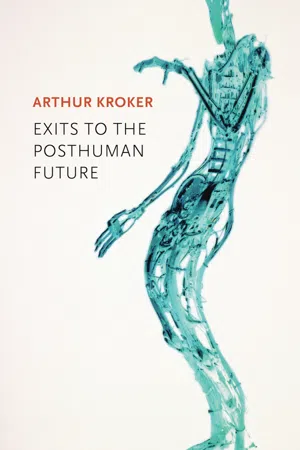
Exits to the Posthuman Future
About this book
Exits to the Posthuman Future is media theory for a global digital society which thrives, and sometimes perishes, at the intersection of technologies of speed, distant ethics and a pervasive cultural anxiety. Arthur Kroker's incisive and insightful text presents the emerging pattern of a posthuman future: life at the tip of technologies of acceleration, drift and crash. Kroker links key concepts such as "Guardian Liberalism" and Obama's vision of the "Just War" with a striking account of "culture drift" as the essence of real world technoculture. He argues that contemporary society displays growing uncertainty about the ultimate ends of technological innovation and the intelligibility of the digital future. The posthuman future is elusive: is it a gathering storm of cynical abandonment, inertia, disappearance and substitution? Or else the development of a new form of critical consciousness - the posthuman imagination - as a means of comprehending the full complexity of life? Depending on which exit to the posthuman future we choose or, perhaps, which exit chooses us, Kroker argues that a very different posthuman future will likely ensue.
Information
1
Introduction:
Trajectories of the Posthuman
Trolley to Tijuana and transit of Venus
I'm in downtown San Diego, just about to board the trolley to Tijuana, on a day, unlike most days, that is clearly marked by the spectral signs of cosmology because in far-off galactic space, Venus prepares to transit the sun and, in that transit, for the briefest of periods makes itself visible to the shielded human eye. This astronomical event last occurred in 1882 and will only occur again in 2117. And, so, I'm on a trolley to Tijuana, bracketed by astronomy between the past and the unknown, and certainly unknowable, future of the twenty-second century, with the spectral sign of Venus in transit across the fires of the sun and the earthbound signs of that trolley ride to the borderland following its own low visibility, perhaps even minoritarian, transit across the bright sunshine of the California technological way.
Following the Spanish philosopher José Ortega y Gasset's fateful insight that “I am I in the human circumstance and the human circumstance is I,” I ask myself this question enigmatic about my present circumstance on this day of cosmology: What is the connection, if any, between the trolley to Tijuana and the transit of Venus?
Now, the trolley to Tijuana is a down-to-earth story, about migrant workers from Tijuana who begin lining up at 4 am each morning in order to catch the trolley to the houses and stores and construction camps of San Diego. There's a lot of humiliated necessity in those early-morning border crossings. All the immense wealth, restless energy, and sheer disciplined willpower of the California Way pushed to the border, and just stopped with walls of surveillance running into the sea and pitilessness running into the heart. Like everything else on the border, the trolley to Tijuana is a kind of strange fold in the space-time of two cultures, a site of possible cultural intersections that don't really happen, broken mediations, and bodies on the move, some perhaps upward bound, but most disappearing into the routines of daily labor.
And the transit of Venus? That's a different (astronomical) matter altogether. Not just its rarity, although the event dazzles with the fact that it won't happen again for another century. A heavenly messenger linking the twenty-first and twenty-second centuries. Nor even the fact that the transit of Venus cannot be viewed directly, but only with a heavy filter to shield your eyes. But use that filter and the occasion is one of wonderment, that vision of the planet Venus tracking across the face of the sun. In this, the most scientific of times, the event has been stripped of its mystery, reduced to the language of scientific precision or perhaps to celestial celebrity status pumped up by the mass media as another passing interest story for the day – an astronomical punctuation, in this case, supposedly signifying nothing. But still, “I am I in the human circumstance and the human circumstance is I” and there's that irrepressible doubled sense of awe at being witness to the motion of the planets and the stars but also something else, an inexpressible, and certainly prohibited, feeling that what is really being witnessed is something less scientific than cosmological. The transit of Venus is an omen, but an omen of what?
Living at the tip of the posthuman
We are already living at the accelerating tip of the posthuman future. Seemingly everywhere, the highly experimental, definitely utopian language of technology has delivered us to a future that is unmistakably novel, from the hybrid experiments of genetic engineering, the viral growth of increasingly complex databases, the massive diffusion of social networking technologies to enthusiastic pronouncements that the layered world of virtual augmentation represents the next stage of the fully realized technological society. Yet, for all that, contemporary society is also marked by a growing uncertainty concerning both the ultimate ends of technological innovation and the ways of understanding – and negotiating – the uncertain digital future.
Digitally, the onrushing adventure of technology with its coding of seemingly every element of social existence and utopian ambitions towards global connectivity is met by a counterbalancing fascination with images of the abject, the uncanny, the liminal in popular imagination, accompanied by an increasing focus in mass media, with the spectral world of zombies, clones, avatars, and aliens. The real world of digital technology might pursue the aims of greater national security, economic austerity, and highly centralized corporate governance of networked communication, but the popular world of cultural imagination seems to be increasingly preoccupied with fantasy novels, stories of vampire love, and online battles among zombies, robots, and always-besieged defenders of a lost humanity.
Politically, the global sovereignty of virtual capitalism with its emergency programs involving economic austerity and the strengthening of the disciplinary state is met by the resurgence, in country after country, in city after city, of a politics of the street that challenges the economic contents of virtual capitalism, as well as its increasingly undemocratic modes of deployment. While the disciplinary state imposes strict austerity measures on the social economy of governance involving the young, the unemployed, the poor, and the vulnerable, the growing ambition of politics in the streets flows in the opposite direction towards a radical rethinking of the terms of political power and social justice with and against the fully realized technological society.
Economically, it is as if two warring visions are at work across the uncertain spectrum of political economy: one based on a technological intensification of the commodity-form according to the dictates of old-fashioned primitive capitalism with its global outsourcing of labor, destruction of labor organizations, and reliance on the extraction of fossil fuels; and the other an emerging vision of a new economy made possible by creative technological innovations, specifically new communicative forms of media, medicine, education, and labor, all motivated by a cultural preference for a green economy and a social preference for practically realizing the utopian benefits of technological creativity.
Ideologically, the uncertainties of the digital future with its pitched battles between official defenders of labor austerity, political discipline, and the security state and proponents of a new vision of social economy and public democracy has given rise to a global situation of considerable political complexity, namely the development of a growing legitimation crisis, first at the political level and now increasingly at the cultural and social levels. While street protests in Quebec, the Occupy Movement, Idle No More, the Arab Spring, and political resistance in the urban centers of Greece, Spain, Mexico, France, and Russia often focus on specific political demands, what we may be witnessing today is the rise of an alternative trajectory of the posthuman future that is born out of a fundamental crisis of legitimation, specifically the growing belief among the proponents of a progressive vision of civil society that the alliance between governments and large corporations that initially realized the corporate ends of technological innovation may be at odds with popular demands for rethinking the aims and means of the fully realized technological society. In essence, technology itself may, in fact, be experiencing a cascading series of legitimation crises, sometimes overtly at the level of politics in the streets but, at other times, implicitly but with no less intensity, at the level of popular imagination, artistic expression, and social concerns. In this case, while the fundamental drivers of the technological future remain a determined global alliance of virtual capitalism and the disciplinary state in favor of economic austerity and unrestricted access to the life-space of increasingly digital subjects, there has just as quickly emerged a counter-alliance, whether openly or by a particular conjunction of network circumstances, which calls into question the social, political, and economic destiny to which the future of technology delivers us.
Curiously, the global social revolts that mark the early years of the twenty-first century originate in that which was first deemed surplus to the requirements of virtual capitalism and the disciplinary state: revolts by the economic “remainder” that is the unemployed; revolts by a growing artistic counter-culture motivated by aspirations towards a future that is authentically “liminal”; and resistance by social environmentalists determined to reawaken the possibility of the “undecidability” of nature itself as the essence of the technological future. It is as if the dynamic drive to the technological mastery of social and nonsocial nature has awakened in its path not only the most powerful, consolidated, and recidivist of corporate, media, and political forces but has also called into active social and political being that which was originally designated as prohibited, excluded, and silenced by the awesome power of technology. Indeed, the quintessential definition of technological posthumanism may be as that site where the algorithms of virtual power and the liquid flows of the undecidable, the liminal, the remainder, and the prohibited combine in an increasingly complex world-picture. If it is the case that the sheer force of technological innovation quickly pushes traditional conceptions of humanism aside to make way for all the emerging signs of the posthuman – drift culture, recombinant technology, figural aesthetics, distributive consciousness – then it is true that something indispensably human, whether articulated by conscious political protest, mobilized by social unrest, or motivated by the persistence of human memory itself, remains as the phantasmagorical essence of the future of technological posthumanism.
For example, how are we to account for technological experimentalism and an increasing fascination with dead affect, this strangest of all apparent contradictions, as the essence of the emerging world of technological posthumanism? Not a culture of dead affect as a shadowy side effect of technology, but precisely the tangible hint of the return of the repressed as that which motivates technological society and on behalf of which technology functions to deliver us to a future that is distinctly posthuman in its radical undermining of all the previous markers of the “human” – unitary species-logic, private subjectivity, hierarchical knowledge – with human beings as the universal value-standard of all events. For the contemporary generation, the digital generation, this received framing of the primacy of human subjectivity has suddenly been swept away by the data storm and the genomic rapture of technological innovation. Confidence in unitary species-logic has been challenged not only by progressive perspectives concerning the equivalence of species multiplicity, but also by biotechnologies that literally reveal the vibrancy of the life of the object, the metal, the code. Ontological faith in private subjectivity has been successfully undermined by the objective appearance of technological media of communication based precisely on the exteriorization of the human nervous system, and with it the flipping inside out of the putatively opposed worlds of subject and object. Hierarchical knowledge has been effectively eclipsed by spectacular technological creations, including social networking technologies, mobile devices, and circulating loops of media information, that emphasize the diffuse, the fragmentary, the connected. Finally, the indisputably biblical regime of the supremacy of the human has now been rendered uncertain by genomic technologies that put into question the very markers of being human, effectively providing greater visibility to an emerging world of unexpected species-mediations – technological beings who are part code/part skin.
What renders posthumanism “posthuman” is the truly paradoxical nature of the fully realized digital universe. Indeed, the paradoxical, complex, and often contradictory implications of the posthuman condition have constituted the central focus of the most important intellectual explorations of the emerging episteme. For example, Katherine Hayles's eloquent theorization, How We Became Posthuman,1 situates the emergence of posthuman consciousness in direct relationship to the dynamic appearance of the “regime of computation,” investigating, in turn, the reductive and transformative possibilities of an era when “information loses its body” and consciousness itself is increasingly patterned by the language of codes. Equally, Cary Wolfe's landmark text, What is Posthumanism?,2 rethinks the future of the posthumanities under the sign of profound ecological consciousness involving respect for multiplicity (whether for species difference or for new transgenic remixes of animals, plants, objects, and humans). In Wolfe's vision, the posthuman condition contains, in equal measure, clashing tendencies towards a profound ethical breakthrough to a new way of reconciling relationships among diverse species, in the absence of which present tendencies towards anthropomorphism and hierarchical knowledge will only intensify. On the other hand, Francis Fukuyama's Our Posthuman Future3 understands the swiftly developing “biotech century” as an essentially dystopian fable of imminent genetic accidents and transgenic experiments gone wrong. Indeed, when the concept of posthumanism slips beyond the boundaries of theoretical discourse and becomes something else, becomes the dominant technopoeisis – the new material, cultural, political, and semiotic reality – of the technologically enabled twenty-first century, then the deeply paradoxical character of the posthuman finally begins to reveal itself. Neither solely utopian nor fatally dystopian, neither fully historically materialized nor inaugurating a culture of immateriality, the posthuman is that elusive, truly enigmatic gap that appears when the will to technology intersects the endlessly complex social-reality machine. In this case, reflecting upon the question of the posthuman would require, in the first instance, a form of thought that listens intently for the gaps, fissures, and intersections, whether directly in the technological sphere or indirectly in culture, politics, and society, where incipient signs of the posthuman first begin to figure. But it would also require a form of consciousness that is prepared to turn away from the strictly technological in order to make visible what has been lost with the coming-to-be posthuman future, not only in terms of Baudrillard's “terrorism of the code” but also of its flip side, specifically the boredom of the code.
Of course, it is customary to consider the human impact of technology in terms of its powers of facilitation as well as its costs, seeking to establish some ethical balance between regimes of technological intelligibility that sustain the digital code as well as the bio-genome and a critical appreciation of that which has been “disappeared” by the coming-to-be of technological society. The underlying argument of this book complicates this interpretation of contemporary developments by proposing a different understanding, namely that the essence of the posthuman axiomatic inheres in the fact that technology now eagerly seeks out that which was previously marginalized as simultaneously ways of mobilizing itself as it effectively recodes every aspect of social and nonsocial existence and ways of drawing attention to a greater technological seduction. In other words, the technological posthuman is that historical moment when the power of technology turns back on itself, effectively undermining traditional concepts such as subjectivity, privacy, and bounded consciousness in order to render all things truly uncertain and unknowable. Not necessarily intentionally, but for the reason that the dynamic drive that is revealed by technological interpellation can only succeed on the basis of making the familiar unknowable, the bounded liminal, the certain uncanny, the subjective a fatal remainder. While Heidegger understood this, he was still sufficiently modernist to claim a doubled vision at the heart of technology, specifically that technology contains a “danger” as well as a “saving power.” In this respect, Exits to the Posthuman Future is post-Heideggerian to the extent that it claims that the essence of technology today is that every technological innovation, every wrinkle of creativity in social networking technologies, every advance in mobility, every genomic redesign of the species-logic, draws together the danger and the saving power into co-equal and co-attractive magnets of technological seduction. What is liminal about technology is precisely that it is a field of undecidability, with its truly uncanny essence as a major cultural force-attractor. With this in mind, I would like to tell the following two stories concerning technological interpellation and the question of (human) remainders.
Synching your heart to the smartphone
There is a patent application for a new iPhone app that involves synching your heart to the smartphone. The immediate function of this app is to repurpose the iPhone as a mobile heart monitor (“seamlessly embedded heart rate monitor”).4 Dispensing with the need for medical infrastructure housing EKG machines, individuals would simply need to touch the side of their own mobile device, specifically an iPhone, thus transmitting their most vital biological data – heart rate, blood rhythm and velocity – directly to a central digital heart monitoring station. If the data flow suggests that your heart is about to go into frenzied hyperdrive or, at the other extreme, cease functioning, you will be immediately alerted to take your body to the nearest ER. And not only that but the inventors claim that the mobile heart monitor has a second important purpose. Since everyone has a distinctive heart signature, the mobile heart monitor opens up the possibility of a third major form of body recognition software. Not just iris scanners or fingerprint analysis, but in the future the mobile heart monitor will be a way of scanning the body to verify its authenticity. Since all hearts move to their own internal rhythm with their own electronic signature, what could be a better way of securing identity than the beat-beat of an often unruly heart? A world of instant biofeedback: everything is fine. There is a disturbance in the rhythm of your heart.
What does it mean when we literally synch our hearts to the iPhone? On the face of it, this is a useful medical app – social networking technology in the service of better health. In the context of contemporary cultural anxieties about fatal heart attacks and catastrophic strokes, who would not want to secure their good health with 24/7 monitoring of the often errant signature of the individual heart? With data uploaded onto a smart grid for hearts, there is also the added benefit that this stream of heart data will provide an organic basis for digital authentication with your heartbeat proving that you are the person whom your very singular heart rhythm says you actually are. Understood as a medical device facilitating health, the mobile heart monitor augments good health. Considered as an “extension of man,” this technological innovation suddenly provides global outreach to what was heretofore the private and unpredictable history of an individual heart. Considered as data, the history of the heart discovers that it has given birth to a digital echo, a duplicate reality in which individuals possess two hearts: one organic, the other virtual. Conceived as a technological device, the mobile heart monitor can be repurposed at will, from medical therapy to security requirements. However, it is when the heart intersects with the language of code that things become very interesting. We know that for more than fifty years, the electronic sensorium of the mass media have increasingly mimicked the logic of biology, first exteriorizing the human senses by way of the amplified senses of the electronic sensorium and then imitating the process of evolution itself. While McLuhan predicted in Understanding Media that the effect of accelerated technological change would be the triumphan...
Table of contents
- Cover
- Title page
- Copyright page
- Acknowledgments
- 1: Introduction: Trajectories of the Posthuman
- Accelerate
- Drift
- Crash: Slow Suicide of Technological Apocalypse
- Crash: Traversal Consciousness
- Index
Trusted by 375,005 students
Access to over 1.5 million titles for a fair monthly price.
Study more efficiently using our study tools.
Frequently asked questions
Yes, you can cancel anytime from the Subscription tab in your account settings on the Perlego website. Your subscription will stay active until the end of your current billing period. Learn how to cancel your subscription
No, books cannot be downloaded as external files, such as PDFs, for use outside of Perlego. However, you can download books within the Perlego app for offline reading on mobile or tablet. Learn how to download books offline
Perlego offers two plans: Essential and Complete
- Essential is ideal for learners and professionals who enjoy exploring a wide range of subjects. Access the Essential Library with 800,000+ trusted titles and best-sellers across business, personal growth, and the humanities. Includes unlimited reading time and Standard Read Aloud voice.
- Complete: Perfect for advanced learners and researchers needing full, unrestricted access. Unlock 1.5M+ books across hundreds of subjects, including academic and specialized titles. The Complete Plan also includes advanced features like Premium Read Aloud and Research Assistant.
We are an online textbook subscription service, where you can get access to an entire online library for less than the price of a single book per month. With over 1.5 million books across 990+ topics, we’ve got you covered! Learn about our mission
Look out for the read-aloud symbol on your next book to see if you can listen to it. The read-aloud tool reads text aloud for you, highlighting the text as it is being read. You can pause it, speed it up and slow it down. Learn more about Read Aloud
Yes! You can use the Perlego app on both iOS and Android devices to read anytime, anywhere — even offline. Perfect for commutes or when you’re on the go.
Please note we cannot support devices running on iOS 13 and Android 7 or earlier. Learn more about using the app
Please note we cannot support devices running on iOS 13 and Android 7 or earlier. Learn more about using the app
Yes, you can access Exits to the Posthuman Future by Arthur Kroker in PDF and/or ePUB format, as well as other popular books in Social Sciences & Popular Culture. We have over 1.5 million books available in our catalogue for you to explore.