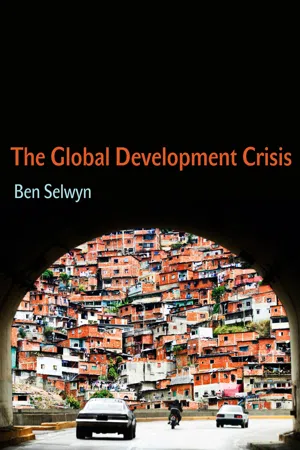
The central paradox of the contemporary world is the simultaneous presence of wealth on an unprecedented scale, and mass poverty. Liberal theory explains the relationship between capitalism and poverty as one based around the dichotomy of inclusion (into capitalism) vs exclusion (from capitalism). Within this discourse, the global capitalist system is portrayed as a sphere of economic dynamism and as a source of developmental opportunities for less developed countries and their populations. Development policy should, therefore, seek to integrate the poor into the global capitalist system.
The Global Development Crisis challenges this way of thinking. Through an interrogation of some of the most important political economists of the last two centuries Friedrich List, Karl Marx, Leon Trotsky, Joseph Schumpeter, Alexander Gerschenkron, Karl Polanyi and Amarta Sen, Selwyn argues that class relations are the central cause of poverty and inequality, within and between countries. In contrast to much development thinking, which portrays 'the poor' as reliant upon benign assistance, this book advocates the concept of labour-centred development. Here 'the poor' are the global labouring classes, and their own collective actions and struggles constitute the basis of an alternative form of non-elitist, bottom-up human development.
- English
- ePUB (mobile friendly)
- Available on iOS & Android
eBook - ePub
The Global Development Crisis
—1—
THE GLOBAL DEVELOPMENT CRISIS
The central paradox of the contemporary world is the simultaneous presence of wealth on an unprecedented scale, and mass poverty. Liberal ideology and practice, as propounded by international financial institutions (IFIs) and heads of trans-national corporations, state leaders and their intellectual supporters explains the relationship between capitalism and poverty as one based around the dichotomy of inclusion (into capitalism) vs exclusion (from capitalism). The global capitalist system, or ‘the world market’ or ‘the free market’, is portrayed as a sphere of economic dynamism, an arena where freedom to exchange prevails, and as a source of developmental opportunities for less developed countries.
Within such explanatory frameworks poor countries and their populations are held to be poor not because of the nature of the capitalist world system, but because of their effective exclusion from it. Policies such as trade liberalization and the deregulation of markets (in particular financial, commodity and labour markets) are designed to remove state ‘distortions’, and thus enable poor countries to harness the dynamism of the market. An example of this way of thinking is provided by Anthony Giddens, who argues that the main problems experienced by poor countries ‘don’t come from the global economy itself, or from the self-seeking behaviour on the part of the richer nations. They lie mainly in the societies themselves – in authoritarian government, corruption, conflict, over-regulation and the low level of emancipation of women’ (Giddens 2000, 129). In this way of thinking the world market is often portrayed as a ladder (of opportunity and wealth), where, once on the bottom rung, poor countries have the possibility of climbing further up and, by doing so, accelerating the human development of their population.
The inclusion/exclusion discourse reflects what Henry Bernstein (1992) labels a ‘residualist’ understanding of the relationship between capitalism and poverty, where ‘exclusion’ from ‘the market’ is the main cause of poverty. At the heart of this understanding is the assumption that ‘inclusion’ (into capitalism, or globalization, or the world market) brings economic growth and development, and improves the incomes and livelihoods of all participants. An example of a residualist perspective is UN Millennium project director Jeffrey Sachs’ defence of the proliferation of sweatshop labour across the global south. He argues that ‘rich-world protestors … should support increased numbers of such jobs’ and that ‘[t]he sweatshops are the first rung on the ladder out of extreme poverty’ (Sachs 2005, 11) (see chapter 5 for a direct critique of this argument).1
The ideological appeal of the residualist discourse to defenders of neoliberal globalization should be clear. It shifts our focus away from investigating how a particular type of economic system (capitalism) simultaneously generates poverty and wealth. It reframes the debate around the axiom that capitalism must, by definition, provide the solutions to the world’s poor, and that therefore, the problem of development is not the capitalist system itself, but exclusion from it. Through this discursive act capitalism remains a pristine non-object of analysis (Wood 1991, 1–11).
Neoliberalism represents the contemporary ideological defence and justification of capitalism, where markets are said to operate optimally when they are ‘freed’ from state and other forms of non-market interference. The ideological power of this definition of capitalism is that markets are portrayed as neutral arenas of exchange that do not favour any particular social group or class. However, behind the ideology, neoliberal policy relies heavily upon states to reshape class relations in favour of capital, in particular finance capital (Harvey 2005, Harman 2008, Panitch and Konings 2009). As shall be argued throughout this book however, capitalist markets are not neutral arenas of exchange, or benign spheres of developmental opportunity. Rather, they are sets of social relations that reproduce the subordination of the greater part of society (labourers) to the minority (owners of capital). Because markets are contested social relations, they are based upon rival interests and visions of how the ownership, control and consumption of of wealth should be organized. Neoliberal policy and ideology seeks to strengthen the social institutions that ‘advance the disciplinary power of markets’ over labouring classes (Taylor 2006, 7). Economic thought that understands markets as nonpolitical arenas of exchange logically precludes political economy analysis, as ‘politics’ are externalized from market activities.
The portrayal of capitalism as a benign sphere of human activity goes hand-in-hand with another firmly held axiom within development thinking – that development ‘policy’ consists of enlightened actors (states, entrepreneurs, international institutions and Non-Governmental Organizations) carrying out actions for the poor (or at best, constituting the leading ‘partner’ with the poor). The way ‘the poor’ are portrayed in much development discourse are as the ‘disempowered’ who need to be ‘empowered’ by benign assistance from above. At the sharp end of this mode of thought, the poor need to be forcefully liberated from oppressive state rulers through Western foreign military intervention and effective re-colonization (Collier 2007). Contrary to such paternalist conceptions of development policy this book argues for a conception of development that is undertaken by ‘the poor’ themselves – that is, a labour-centred conception of development. Such a conception is premised upon a fundamental critique of capitalism.
It is the argument of this book that if we are to understand the apparent paradox of immense wealth and mass poverty, then rather than following a residualist mode of analysis, we require a deep and sustained theoretical and empirical scrutiny of capitalist processes of development.
In opposition to residualist conceptions of development, Henry Bernstein proposes a relational conception, which
Investigate[s] the causes of … poverty in terms of social relations of production and reproduction, of property and power that characterize certain types of development, and especially those associated with the spread and growth of capitalism. A relational approach thus asks rather different questions [to the residualist approach]: are some poor because others are rich (and vice versa)? What are the mechanisms that generate both wealth and poverty as two sides of the same coin of (capitalist) development? (Bernstein 1992, 24, original emphasis)
What are the social relations to be conceptualized and investigated in a relational political economy of development? Again, Bernstein (2010, 22–4) provides us with a useful guide. Four key questions, or registers, that constitute such a political economy are: Who owns what? (the question of property rights); Who does what? (the question of the social division of labour); Who gets what? (the question of the social division of fruits of labour); and, What do they do with it? (the question of the social relations of consumption). These four registers exist and mutually constitute each other nationally and internationally.
Early in their political careers Marx and Engels recognized the paradox of the simultaneous expansion of global wealth and poverty. In the Communist Manifesto, written in 1848, they observed how:
The bourgeoisie, during its rule of scarce one hundred years, has created more massive and more colossal productive forces than have all preceding generations together. Subjection of Nature’s forces to man, machinery, application of chemistry to industry and agriculture, steam-navigation, railways, electric telegraphs, clearing of whole continents for cultivation, canalization of rivers, whole populations conjured out of the ground – what earlier century had even a presentiment that such productive forces slumbered in the lap of social labour?
They also noted how, in the periodic economic crises that beset capitalism since its birth:
… there breaks out an epidemic that, in all earlier epochs, would have seemed an absurdity – the epidemic of over-production. Society suddenly finds itself put back into a state of momentary barbarism; it appears as if a famine, a universal war of devastation, had cut off the supply of every means of subsistence; industry and commerce seem to be destroyed; and why? Because there is too much civilization, too much means of subsistence, too much industry, too much commerce. (Marx and Engels 1848, emphasis added)
While in this text Marx and Engels portray the phenomenon of excess surpluses as a product of periodic economic crisis, it will be argued in the following chapters that it represents a deeper, structural problem of capitalism itself.
It needs to be emphasized at the outset that the argument here is not that capitalist states and markets cannot achieve and deliver economic growth. As the above quotes make clear, Marx and Engels understood the immense dynamism of capitalism as dwarfing anything achieved in previous modes of production. Capitalist states and markets generate rapid rates of economic growth, technological innovation and wealth generation. The argument, which will be developed throughout this book, is that while capitalism’s productive dynamism represents a potential source of real human development, capitalism’s social relations, in particular the non-democratic ownership of wealth and means of creating wealth by a tiny percentage of the world’s population, preclude such possibilities.
The discrepancy between capitalism’s dynamism and widespread global poverty demands a fundamental questioning and re-thinking of what we understand by development. Does it mean economic growth? Does it mean the ending of global poverty? Does it mean economic ‘catch-up’, where previously poor states re-organize their resources (natural and human) and achieve rapid rates of economic growth, to become rich and stand alongside leading capitalist states in the world system? Amartya Sen rejects the reduction of development to economic measurements, arguing instead that development consists simultaneously of the ‘removal of various types of unfreedoms that leave people with little choice and little opportunity of exercising their reasoned agency’ and conjointly, ‘a process of expanding the real freedoms that people enjoy’ (Sen 1999, xii, 3). While I concur with Sen, I disagree with his understanding of how such a process of development can come about.
It is the argument of this book that capitalism precludes Sen’s vision, as it is founded upon the systemic exploitation and repression of the majority (the world’s labouring classes) by the minority (the world’s capitalist classes and states). Exploitation under capitalism is understood by institutions such as the International Labour Organization (e.g. ILO 1999) and by liberal economists, as, for example, the payment of below-market wages, of excessively long working hours or demeaning working conditions.2 This book argues that exploitation under capitalism is, rather, the pre-condition and basis of the capital–labour relation, and cannot, therefore, be ‘solved’ by benign state intervention (as advocated by the ILO) or of better functioning markets (as argued for by liberal economists). Rather, exploitation consists of capital’s ability to pay workers a ‘fair’ wage in the labour market, but then use workers’ labour power in the sphere of production to generate greater value (surplus value) than the price of the original wage. Capital can achieve this act based upon its ownership of social wealth and the means of producing that wealth (the ‘means of production’ in standard Marxist terminology) and worker’s need to sell their labour power in order to earn a wage. To be sure, the forms of exploitation that the ILO and liberal economists identify exist across the world (north and south), but even if these forms were eliminated labour would still be exploited by capital.
Capitalism’s dynamism, evidenced by its ability to propagate rapid economic growth, technical change and wealth generation is pursued and achieved in the interests of capital (firms) and states, and not in the interests of the majority of the world’s population. Capital’s ability to systematically and continually exploit labour requires a political-economic infrastructure to reproduce this unequal relationship. Democracy and freedom of choice are therefore limited, often to the sphere of electoral politics and to consumerism (itself determined by workers’ relatively limited purchasing power). However, while the relationship between capital and labour is based on an unequal, antagonistic and exploitative relationship, this does not preclude labouring classes from mobilizing to demand improvements in their pay and working conditions and over the extent of their democratic participation within society.
These mobilizations can force capitalist states to engage in progressive actions, such as the establishment of universal suffrage, welfare states and regulation of labour markets and workplaces in order to limit the kinds of exploitation identified by liberals and the ILO. These gains are a product of labouring-class struggles, real and potential, and their ability to threaten the stability of capitalist social relations.
Struggles between capital and labouring classes have short, and medium/long-term institutional and developmental outcomes. Short-term outcomes may reflect more or less concession to labour from capital (for example higher or lower wages). Medium and long-term outcomes become institutionalized in the form and extent of labouring-class representation (e.g. what kinds of actions trade unions can engage in), and in state formation, where labouring classes are more or less incorporated into the state structure (compare, for example, the Brazilian state’s structures in relation to labour before and after the 1964 military coup). These processes, in turn, reflect the balance of class power, which describes a situation where representatives of one class are able to formulate their own objectives and force other classes to concede to them (Cliff 1979, 1995; Harman 1984a). Shifts in the balance of power towards labouring classes can have positive institutional and developmental outcomes for labouring classes.
The above arguments about capitalism’s incompatibility with human development, and the balance of class power as a core variable in the developmental processes and outcomes of the world’s labouring classes, may strike many within the development studies community as counter-intuitive. In the following section I suggest that this is because the evolution of development studies and thinking about development more broadly has been characterized by an intellectual hollowing out, often resulting in explicit or implicit celebrations of capitalism, rather than in a systemic critique of the system itself.
The Rise, Fall and Re-Birth of Thinking about Development/Development Thinking
Reflection on the nature of development can be traced back at least as far as Aristotle’s concept of Eudaimonia (which is often understood to mean the process of human flourishing) or to Adam Smith’s conception of different phases of human development (the ages of hunters, of shepherds, of agriculture and finally of commerce).
The systematic and institutionalized study of development and its translation into national and international policy emerged, however, during the moment of de-colonization following the Second World War. The post-colonial moment represented a particular world historical conjuncture, entailing anti-colonial struggles and revolutions, the threat of the global expansion of soviet-style ‘communism’, the emergence of the United States as the hegemonic power of the economically more advanced Western hemisphere, and the successful Marshall Plan in Western Europe. It occurred in the midst of the Keynesian revolution (Keynes 1936), which, for a generation at least, overthrew established neoclassical ways of thinking.
Northern states and the international institutions that they created at the 1944 B...
Table of contents
- Cover
- Half Title
- Title Page
- Copyright
- Contents
- Figures and Tables
- Acknowledgements
- 1 The Global Development Crisis
- 2 Friedrich List and the Foundations of Statist Political Economy
- 3 Karl Marx, Class Struggle and Social Development
- 4 Trotsky, Gerschenkron and the Clash of Marxism and Statist Political Economy
- 5 Creative Destruction and Global Inequality: From Marx to Schumpeter, and Back
- 6 Class Struggle or Embedded Markets? Marx, Polanyi and the Meanings and Possibilities of Socialism
- 7 Development Within or Against Capitalism? A Critique of Amartya Sen’s Development as Freedom
- 8 Towards a Labour-Centred Development
- References and Further Reading
- Index
Trusted by 375,005 students
Access to over 1.5 million titles for a fair monthly price.
Study more efficiently using our study tools.
Frequently asked questions
Yes, you can cancel anytime from the Subscription tab in your account settings on the Perlego website. Your subscription will stay active until the end of your current billing period. Learn how to cancel your subscription
No, books cannot be downloaded as external files, such as PDFs, for use outside of Perlego. However, you can download books within the Perlego app for offline reading on mobile or tablet. Learn how to download books offline
Perlego offers two plans: Essential and Complete
- Essential is ideal for learners and professionals who enjoy exploring a wide range of subjects. Access the Essential Library with 800,000+ trusted titles and best-sellers across business, personal growth, and the humanities. Includes unlimited reading time and Standard Read Aloud voice.
- Complete: Perfect for advanced learners and researchers needing full, unrestricted access. Unlock 1.5M+ books across hundreds of subjects, including academic and specialized titles. The Complete Plan also includes advanced features like Premium Read Aloud and Research Assistant.
We are an online textbook subscription service, where you can get access to an entire online library for less than the price of a single book per month. With over 1.5 million books across 990+ topics, we’ve got you covered! Learn about our mission
Look out for the read-aloud symbol on your next book to see if you can listen to it. The read-aloud tool reads text aloud for you, highlighting the text as it is being read. You can pause it, speed it up and slow it down. Learn more about Read Aloud
Yes! You can use the Perlego app on both iOS and Android devices to read anytime, anywhere — even offline. Perfect for commutes or when you’re on the go.
Please note we cannot support devices running on iOS 13 and Android 7 or earlier. Learn more about using the app
Please note we cannot support devices running on iOS 13 and Android 7 or earlier. Learn more about using the app
Yes, you can access The Global Development Crisis by Benjamin Selwyn in PDF and/or ePUB format, as well as other popular books in Economics & Development Economics. We have over 1.5 million books available in our catalogue for you to explore.