The Middle East has long been fraught with tension and volatility. However, the recent Arab uprisings have intensified instability, turning this 'hot-spot' into a veritable tinderbox whose potential for implosion has far-reaching regional and global consequences.
In this short book, leading Middle East scholar Mohammed Ayoob argues that the Arab Spring has both changed and charged some of the region's thorniest problems - from the rise of political Islam to Iran's nuclear ambitions, the Israel-Palestine conflict to rivalries between key regional powers. Exploring the sources of conflict in the Middle East and their various linkages, Ayoob offers a thoughtful and balanced assessment of whether the region is indeed destined for implosion or whether political sagacity and diplomatic creativity can bring it back from the brink.
- English
- ePUB (mobile friendly)
- Available on iOS & Android
eBook - ePub
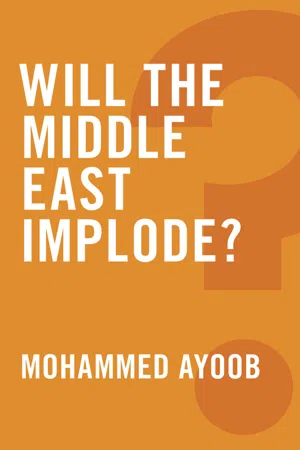
Will the Middle East Implode?
About this book
Information
1
After the Arab Spring
As the civil war in Syria continues to spill out of control, the security situation in Libya deteriorates further, the threat of secession in Yemen escalates, and the elected government in Egypt is overthrown by a military coup, it is hardly surprising that the legacy of the Arab Spring is hotly debated. But was the Arab Spring simply a mirage that will ultimately lead to disillusionment? Or were these uprisings really a harbinger of better times? So far the evidence would seem to give credence to the first interpretation, although enough of the spark of the original movements survives to make some analysts optimistic about the long-term future of the Arab world. What these discussions miss, however, is the real significance of the Arab uprisings: namely, the introduction of a huge amount of uncertainty in Middle Eastern politics that has upset the calculations of most regional and external actors and led to a highly fluid and potentially combustible state of affairs in this already volatile region.
Above all, the Arab uprisings have driven home the lesson that change in the Middle East not only is possible but also can occur with astonishing speed. The backlash that these upheavals have generated has also demonstrated the capacity of existing rulers, as in Syria and Bahrain, or recently overthrown regimes, as in Egypt, to mount counteroffensives that have effectively neutralized the early gains of the pro-change forces. This dialectic of revolution and counter-revolution witnessed since 2010, when combined with the existing challenges already facing the region, is capable of driving the Middle East toward not only greater instability but even possible implosion.
Despite the recent reversals faced by the proponents of regime transformation in the region, the Middle East, especially its Arab component, which had for decades appeared hide-bound and fossilized, is now galvanized as never before. Notwithstanding the fact that these upheavals occurred in discrete national contexts, they unfolded in the form of a chain reaction with uprisings in each Arab country acting as catalysts for similar upheavals in neighboring ones all the way from Tunisia to Bahrain. This pattern of events demonstrated the existence of an Arab “system” that transcends borders and is based on linguistic affinity and shared access to the Arab language media – in both its electronic and print forms. This phenomenon is very different from earlier attempts at unifying the Arab world under the banner of Arab nationalism that challenged existing borders of Arab states.
The current series of upheavals, while affirming the sense of affinity and empathy among Arab publics, has also affirmed the validity of state borders and existing sovereignties that divide the Arab world politically. There has been no attempt to unify the Arab world under the banner of the Arab Spring. In fact, there have been several discrete Springs: a Tunisian Spring, an Egyptian Spring, a Libyan Spring, and so on and so forth. Where the upheavals have threatened the territorial integrity of existing Arab states, for example Syria, it is because of the actions of certain elements of the population that are likely to lose out in the process of political transition and creation of new national orders.
Finer points apart, it is clear that things in the Middle East can no longer be considered immutable, whether it is the nature of regimes, intra-societal balances, or relationships among states. Moreover, since the three arenas of regimes, societies, and inter-state relations are not immune to mutual influences, change or the prospect of change in one arena is likely to have major impact on the others as well.
This is why it is important to analyze the Arab Spring in the context of the major problems facing the Middle East today, especially since the uncertainties introduced by the Arab upheavals can act as significant transforming agents in these problem areas, several of which are simultaneously coming to a boil. Given these interconnections and overlaps, there appears to be a serious danger of a chain reaction developing and leading to an implosion, or a number of mini-implosions, that could engulf much of the region. Such a domino effect could lead to state failure and sectarian warfare with region-wide implications in strategically important countries such as Syria and Iraq, the latter already de-stabilized by the American occupation and its violent aftermath. It could also lead to civil strife engendered by irreconcilable rifts on the nature of emerging political orders, as is already happening in the largest Arab state, Egypt. Inter-state conflict might also follow: for example, between Israel and Iran on Israel’s insistence on maintaining its regional nuclear monopoly and the Iranian pursuit of nuclear enrichment, which could have military implications.
All these scenarios have the capacity to draw external powers into regional conflicts and turn the latter into major global security issues. Some of this is happening already, as in the case of the Iranian nuclear program and the Syrian civil war. The fact that the Middle East, especially its Persian Gulf sub-region, is home to approximately 60 percent of the planet’s oil reserves and about 40 percent of its natural gas reserves makes the situation even more combustible thanks to a perennially energy-starved world that intimately ties the health of industrial and industrializing economies to issues of conflict and order in this volatile region.
Five key sources of potential combustion can be seen in the region today: (1) the growing role of political Islam and the anti-Islamist backlash; (2) the enduring Israel–Palestine conflict and its increasingly zero-sum nature; (3) Iran’s quest for nuclear capability, the potential challenge this poses to Israel’s nuclear monopoly in the Middle East, and the Israeli–American threat of military action against Iran’s nuclear facilities; (4) heightened rivalry among regional powers, especially Iran, Saudi Arabia, and Turkey, manifested starkly in their stance on the Syrian civil war; and (5) great power interests and involvement, clearly demonstrated by the American invasion and occupation of Iraq, which have the potential to turn regional conflagrations into global confrontations. As we will see, the conflict-potential of several of these issues has been amplified by the impact of the Arab uprisings and the uncertainties introduced by them.
The world had come to live with some of these problems (or so one thought until recently). The impasse between Israel and the Palestinians and the perennial issue of access to the energy resources of the Persian Gulf have been familiar causes of conflict for the past few decades. Others, such as the resurgence of political Islam and the stand-off between Israel and Iran on the former’s insistence that Tehran give up its nuclear enrichment program, are relatively new but ones which the international community has been struggling to address for the past several years. Yet others, especially those related to prospects of state debilitation if not state failure directly generated by the Arab Spring, although foreshadowed by the near-total collapse of the Iraqi state following the American invasion of 2003, are very new and the international community is still struggling to find ways of coping with them. The dramatic resurfacing of regional rivalries as a consequence of the Arab upheavals, most clearly apparent in the context of the Syrian civil war, has also caught the international community off-guard and heightened prospects of conflict and instability in this unstable part of the world.
But what is new even about the older issues, such as Israel–Palestine and the Iranian nuclear program, is that they are now coming to a head for a number of reasons, some regional, some global. Israel, ever more nervous about its future in a Middle East that is democratizing (or so it appeared until the military coup in Egypt in July 2013), has increasingly focused its paranoia on Iran’s nuclear enrichment program. It is also, one might contend, a convenient ploy to divert international attention from the plight of the Palestinians under occupation and the continuing Jewish colonization of Palestinian lands. Israeli leaders have become increasingly shrill in their insistence that Iran is about to cross an Israel-imposed “red line” by acquiring the technological capability to manufacture nuclear weapons and needs to be stopped, by war if necessary.
The American position on the issue, although more nuanced than its Israeli counterpart, basically supports the Israeli contention and has put Washington at odds with Tehran and with Muslim opinion (although not necessarily with Muslim regimes such as Saudi Arabia) not only in the Middle East but also around the world. An Israeli or an Israeli–American attack on Iran’s nuclear facilities is likely to have far-reaching consequences for the region and for the global economy, hardening Muslim animosity against the United States and dramatically raising energy prices, thus destabilizing the political as well as the economic equilibrium of an increasingly fragile international system.1
The Arab Spring has both charged and changed the atmosphere in the Middle East and breathed new life into the Palestinian resistance to Israeli occupation and colonization, thus reviving the need for a quick and just solution to the conflict before it embroils this part of the world in yet another region-wide war. The spirit of the Arab Spring is bound to reach occupied Palestine (probably in the form of the third intifada), and indeed, some argue, the Arab population of Israel itself, sooner rather than later. The Israeli policy of colonizing the West Bank, while ostensibly seeking a two-state solution, is increasingly turning the Israel–Palestine conflict into an irresolvable contradiction with momentous consequences for the Israeli polity itself. The extremely intransigent stand adopted by important members of the current Israeli government, advocating not only continuing Jewish settlement but also annexation of 60 percent of the West Bank and declaring that Palestinian statehood is at a “deadend,” make a third intifada almost inevitable.2
The Arab Spring has also re-ignited the debate about the role of political Islam in a democratizing Middle East, with protagonists arguing its positive and negative aspects. This is the case because Islamist parties, as in Tunisia and Egypt, are the best-organized political machines and, therefore, were able to come to power either by themselves or in coalition with others in post-authoritarian contexts. The fact that mainstream Islamist movements and parties, such as Ennahda in Tunisia, the Muslim Brotherhood in Egypt, and the PJD in Morocco, enthusiastically embraced the democratic process is seen as a very positive development by more optimistic commentators. More critical observers, however, argue that the impressive electoral performance of the Islamist parties is likely to have regressive implications for Arab societies and highly negative consequences for the Arab world’s relations with the West.3 No matter where one stands in this debate, it is clear that the transformation of Islamist movements into governing parties is likely to have major implications for the region. The removal of these parties from office by force, as happened in Egypt in July 2013, is likely to have even graver consequences both for the future of democracy and for the future of Islamist moderation in the Middle East.
The Arab Spring has had, and will continue to have, different outcomes in different countries of the region. While it appeared until recently that the Tunisian transition had gone somewhat smoothly, it has run into major obstacles thanks in great part to the intransigent nature of the secular opposition and the extremist proclivities of salafist elements in the Tunisian polity. The Egyptian transition not only created deep rifts within the country but also led to a counter-revolution in the form of a military coup that overthrew the country’s first elected President and was followed by a massacre of at least one thousand of his supporters. The coup and its aftermath have signaled that the most populous Arab state is likely to undergo instability and civil strife of a pretty high order for an extended period of time.
The Arab Spring has demonstrated that it is easier to overthrow old orders than to put new ones in their place. Libya almost descended into anarchy, from which it has been pulled back at least temporarily through the the sagacity of its leadership. However, the spillover of regime change in Libya on neighboring countries, such as Algeria and Mali, could turn out to be highly de-stabilizing. Syria has not been as fortunate as Libya. There is a better than even chance that if the Assad regime falls, Syria will be divided up into ethnic- and sectarian-based mini-states in constant conflict with each other. It is already becoming clear that the strife in Syria has had tremendous negative impact, especially in the arena of inter-sectarian relations, upon the neighboring states of Lebanon and Iraq, which are also fractured societies, and that this is turning the Fertile Crescent into a perpetual conflict zone.
So, as the following chapters will show, all or most of these sources of conflict in the Middle East are inter-related and the Arab uprisings have only served to bind them more tightly, with the various forms of conflict feeding upon each other and thereby pushing the entire region closer to implosion. Whether political sagacity and diplomatic creativity can bring the Middle East back from the brink remains to be seen.
2
The Islamist Challenge
Islamism and Islamists are broad umbrella terms that hide as much as they reveal. At the most general level, Islamism refers to a vague political ideology that asserts that Islam, in some shape or form, should guide the constitutional framework and policies of states with predominantly Muslim populations. Islamist parties and movements crystallized during the twentieth century largely as a result of Muslim societies’ interaction from a position of weakness with the West. Their diagnosis of the ills of Muslim societies that led to the latter’s domination by European powers was that these societies, and especially their elites, had moved away from the basic norms of Islamic behavior and that their weakness was the result of this fundamental shortcoming. Their prescription was that if Islamic codes of behavior could be reintroduced into the political lives of their countries, Muslim societies would regain their former strength and position of glory. Islamist movements were, therefore, as much products of modernity as they were reactions to it.
However, given the politically and socially fractured nature of the Muslim world, Islamist movements, where they arose, became prisoners of their own social and political contexts. Different leadership styles and intellectual convictions also added to the diversity of Islamist movements. Consequently, these movements and their leader-ships ended up interpreting the general Islamist dictum relating to the relevance of Islam to political life in manifold ways and covering a broad spectrum of convictions. Such diversity helped make Islamist movements and parties relevant in their national contexts but at the same time exploded the myth of the Islamist monolith.1
This broad spectrum of Islamist parties and movements includes mainstream political parties, such as the Ennahda (Renaissance) of Tunisia and the Muslim Brotherhood of Egypt and the latter’s offshoots in other Arab countries. These parties, like their post-Islamist cousin the Justice and Development Party (AKP) of Turkey, are primarily Islamically inspired political machines whose main objective is to build broad coalitions to capture political power in order to infuse the functioning of the state with Islamic societal values. Although some of them, such as the Muslim Brotherhood, are ostensibly committed to the introduction of sharia law, they are willing to make compromises that relegate this to the status of a long-term goal that may or may not attain fruition. Others, such as the AKP, have jettisoned this goal totally and publicly and committed themselves to upholding the values of the secular state while preserving Islamic societal norms. Ennahda of Tunisia seems to be moving in a similar direction.
Islamist movements also include the salafis, the Muslim equivalents of the Puritans or Fundamentalists of Christendom, who follow strict and literalist codes of Islamic conduct and pattern their behavior on the example set by the first generation of pious Muslims – the salaf-al-salih or righteous ancestors. Most of these groups are either apolitical or adopt peaceful methods of persuasion to change society and influence politics. Some of them, such as the al-Nour Party in Egypt, in a dramatic departure from earlier patterns of behavior, have lately entered the realm of competitive politics in the wake of the Arab upheavals.
At the fringes – and they form a minuscule part of the Islamist universe – Islamist movements include militant, extremist formations, many of whom are grouped under the term salafias well but diverge from the salafis in very important ways. They are Leninist organizations that are products of hybridization between social conservatism and political radicalism, whose primary objectives are political rather than religious or social. These militant groups are not averse to engaging in violent acts to achieve their political ends. They are popularly known as “jihadis,” a perversion of the term “mujahidin” (those who fight in the way of God), but one that has no Islamic significance whatsoever. However, it has become popular in journalistic and even academic discourse in the West. This category includes both national jihadis who aim at violently overthrowing local regimes, the “near enemy,” and transnational jihadis, above all al-Qaeda and its affiliates, who have global agendas and whose primary target is the “far enemy,” the United States and its Western allies.2
Western skepticism and suspicion
It is worth noting, however, that the history of even mainstream, non-radical Islamist parties’ relationship with the West, and especially with the United States, has been at best rocky and at worst hostile. This is why the emergence of mainstream Islamist parties in the wake of the Arab Spring as major political players and in some cases as leading members of governing coalitions, as in Egypt and Tunisia, set off alarm bells in many quarters, especially in the United States. These include conservative and staunchly pro-Israel segments of American opinion traditionally wary of Islamist parties and movements because they believe that anti-American and anti-Israeli sentiments are embedded in the Islamists’ genes.
Even liberal Western analysts of the Middle Eastern scene have expressed strong reservations about the Islamist parties because of what they see as the tendency among mainstream Islamists, epitomized by some of the policies of the Egyptian Muslim Brotherhood, to make compromises with elements of the old order, particularly the military top brass, to ensure the Islamists’ smooth accession to office at the cost of the revolutions’ objectives. While this strategy failed in Egypt, where the military overthrew the elected government in July 2013, it did leave the impression that the Muslim Brotherhood was willing to sacrifice long-term democratic goals for immediate political gain. Furthermore, segments of Arab populations that consider themselves secular and/or liberal as well as remnants of the old regimes displaced by the uprisings express strong skepticism about the objectives, intentions, and tactics of the Islamist parties as the latter move toward the centers of political power. It was this combination of holdovers from the Mubarak regime and liberal-secular elements in the Egyptian polity that led to the military coup against President Morsi’s government, with the liberals providing political cover for ...
Table of contents
- Cover
- Half Title
- Title Page
- Copyright
- Contents
- Acknowledgments
- 1 After the Arab Spring
- 2 The Islamist Challenge
- 3 Deadlock over Palestine
- 4 Regional and Global Rivalries
- 5 Iran and “the Bomb”
- 6 Will the Middle East Implode?
- Afterword
- Further Reading
- Notes
Trusted by 375,005 students
Access to over 1.5 million titles for a fair monthly price.
Study more efficiently using our study tools.
Frequently asked questions
Yes, you can cancel anytime from the Subscription tab in your account settings on the Perlego website. Your subscription will stay active until the end of your current billing period. Learn how to cancel your subscription
No, books cannot be downloaded as external files, such as PDFs, for use outside of Perlego. However, you can download books within the Perlego app for offline reading on mobile or tablet. Learn how to download books offline
Perlego offers two plans: Essential and Complete
- Essential is ideal for learners and professionals who enjoy exploring a wide range of subjects. Access the Essential Library with 800,000+ trusted titles and best-sellers across business, personal growth, and the humanities. Includes unlimited reading time and Standard Read Aloud voice.
- Complete: Perfect for advanced learners and researchers needing full, unrestricted access. Unlock 1.5M+ books across hundreds of subjects, including academic and specialized titles. The Complete Plan also includes advanced features like Premium Read Aloud and Research Assistant.
We are an online textbook subscription service, where you can get access to an entire online library for less than the price of a single book per month. With over 1.5 million books across 990+ topics, we’ve got you covered! Learn about our mission
Look out for the read-aloud symbol on your next book to see if you can listen to it. The read-aloud tool reads text aloud for you, highlighting the text as it is being read. You can pause it, speed it up and slow it down. Learn more about Read Aloud
Yes! You can use the Perlego app on both iOS and Android devices to read anytime, anywhere — even offline. Perfect for commutes or when you’re on the go.
Please note we cannot support devices running on iOS 13 and Android 7 or earlier. Learn more about using the app
Please note we cannot support devices running on iOS 13 and Android 7 or earlier. Learn more about using the app
Yes, you can access Will the Middle East Implode? by Mohammed Ayoob in PDF and/or ePUB format, as well as other popular books in Politics & International Relations & Middle Eastern Politics. We have over 1.5 million books available in our catalogue for you to explore.