Jean-Luc Nancy stands as one of the great French theorists of "deconstruction." His writings on philosophy, politics, aesthetics, and religion have significantly contributed to the development of contemporary French thought and helped shape and transform the field of continental philosophy. Through Nancy's immense oeuvre, which covers a wide range of topics such as community, freedom, existence, sense/ touch, democracy, Christianity, the visual arts and music, and writing itself, we have learned to take stock of the world in a more nuanced fashion.
In this collection, contemporaries of Nancy and eminent scholars of continental philosophy, including Giorgio Agamben, Étienne Balibar, Ginette Michaud, Georges Van Den Abbeele, Gregg Lambert and Ian James, have been invited to reflect on the force of Nancy's "deconstruction" and how it has affected, or will affect, the ways we approach many of the most pertinent topics in contemporary philosophy. The collection also includes Jean-Luc Nancy's previously unpublished 'Dialogue Beneath the Ribs', where he reflects, twenty years after, on his heart transplant.
Nancy Now will be of critical interest not only to scholars working on or with Nancy's philosophy, but also to those interested in the development and future of French thought.
- English
- ePUB (mobile friendly)
- Available on iOS & Android
eBook - ePub
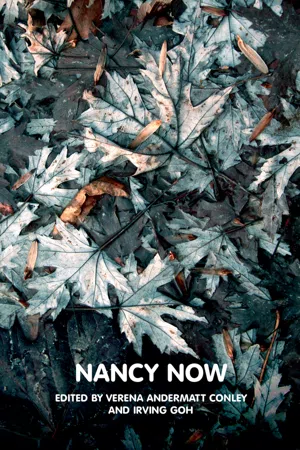
Nancy Now
About this book
Information
1
Introduction: Time in Nancy
Irving Goh and Verena Andermatt Conley
As with every great philosopher, there is something inexhaustible in Nancy’s writings. In that respect, one can immediately refer to his prolificacy: indeed, publishing his major philosophical writings since the 1970s, for example, La Remarque spéculative (1973), Le Discours de la syncope (1976), and Ego sum (1979), followed by what Derrida considers to be Nancy’s “most powerful works” – Corpus (1992), The Sense of the World (1993), The Muses (1994), and Being Singular Plural (1996)1 – Nancy shows no sign of stopping today, given the appearance of recent titles such as Tombe de sommeil (2007), Identité: fragments, franchises (2010), Dans quels mondes vivons-nous? (written with Aurélien Barreau, 2011), L’Équivalence des catastrophes (2012), and Ivresse (2013). This is not to mention the great breadth of his writings, which encompasses the history of philosophy (Hegel, Kant, Descartes), aesthetics, ontology, politics, literature, psychoanalysis, religion, and “deconstructive” engagements with philosophical topics such as subjectivity, community, sense, freedom, and the world. The inexhaustibility of Nancy’s writings also pertains to the fact that there always remains something to be explicated or elucidated further in his philosophy, which proves critical not only in making sense of contemporary issues, but also in suggesting political and ethical implications for the future of the contemporary world.
This present collection of essays testifies to that inexhaustible force. At the same time, we would also like to think that a certain preoccupation with time forms an implicit backdrop to this collection, thus setting it apart from other collections on the work of Nancy. That preoccupation can be said to exist on at least two counts. Firstly, it is almost inevitable to think of the time of mortality when we think of Nancy, who underwent a heart transplant operation more than twenty years ago. In light of that, we have a greater appreciation of Nancy’s prolificacy, reminding ourselves that the inexhaustibility of his writing is neither a given nor absolute: instead, it is always threatened by finitude and contingency. The second instance that gives us occasion to think about time is the collection’s title itself – Nancy Now. With the “now” of the title, one cannot help but expect this collection to touch in one way or another on the topic of time, especially that of the present. In effect, time is very much at the back of most of our contributors’ minds: most of them readily took the cue from the title, which they knew in advance, and evaluate the state of Nancy’s philosophy now, taking stock of how far-reaching his thoughts are, and assessing the stakes for philosophy and the world today. Or else, they foreground the philosophical motifs mobilized by Nancy in his recent publications and explore their future theoretical and empirical potentialities.
We will speak more about the individual essays later in this introduction. First, we would like to concern ourselves with giving an explication of time in Nancy, which is perhaps one of the most difficult aspects of his philosophy. Time, as a philosophical question, is already no doubt difficult in itself. The difficulty of speaking about time in Nancy becomes particularly striking when one takes into account his reservation in dealing with this topic in any explicit or extended manner in his writings, as compared to his sustained engagement with other topics such as community, sense, touch, corpus, and the world, not to mention that all of these apparently privilege the question of space. Symptomatic of this reservation before time is Nancy’s “Finite History”: there is indeed a discursion into the question of time there, but it is veiled by the question of history, which Nancy argues is still not really so much about time as about community or being-in-common. In that regard, one could say that the question of time constitutes some sort of limit in Nancy’s writings, as if one were approaching the impossible in his philosophy. And yet, the limit, as Nancy would say in The Sense of the World for example, is not where everything ends. Instead, it is where everything has the chance to begin again, differently. In that case, one could argue that if the question of time is indeed the limit of Nancy’s thought, it is perhaps also with the question of time that we could begin again, now, to look at Nancy’s philosophy anew.2
Time for Nancy is not just any time. It is not time past that is of interest to him; neither is it future time, especially not that which is already programmed or calculated beforehand. Time past and time future, according to Nancy, are but “categories […] relevant only to time already interpreted as social and historical.”3 In other words, they are but anthropological constructions, barely touching on time itself, or else concealing its very dimensions. Against such constructions, Nancy is preoccupied with present time, or more specifically, the time of the present, now, which is not of the order of chronology. Identifying this present that is of specific interest to Nancy does not alleviate the difficulty of speaking about time in Nancy, however. This is because, while Nancy appears, as we will see, to speak more favorably of the present in more recent texts, it is not quite the case earlier on. This is rather evident in the essay “Espace contre temps” (1991), whose title only immediately reinforces the impression that Nancy seems to privilege the concept of space over time. To be precise, though, the essay will make clear that if there is a disenchantment with time, it is not with time itself but exactly with how it has come to be understood and schematized, i.e. time as chronology, or time in endless succession, calculated, accumulated, and ordered, such that each second or even nanosecond must always be followed by the next second or nanosecond. Chronology is not time, according to Nancy: as chronology, time cannot take time, or it cannot have time to exist since it must always move on to the next chronological unit without delay. Time cannot breathe here: chronology or chronometry is “without respiration” or “irrespirable.”4 All this also means that the present in chronology has no real significance except as a step between the past and the future.5 The very singularity of the present then is always glossed over by an imposed chronometric operativity: it is subject to a passing from the past to the future, never allowed to dwell in itself and to see what happens to itself in that dwelling.6 It is this chronological present, which does not allow what arrives in the present as the present to take time to happen, that Nancy renounces, calling it even “a bad concept.”7 This is also where Nancy turns his back on (chronological) time and turns toward space instead, especially “free space,” where “free disposition of places, openings, circulations of perceptions, conceptions, affections, volitions, [and] imaginations” take place or happen.8
The reduction of the present to the “bad concept” of chronologic present does not mean that we should henceforth abandon all thoughts of time, especially not time of the present other than its chronological conceptualization. That other present must still be a subject of thought, except, in “Espace contre temps,” it is still articulated in spatial terms. As Nancy argues there, if (non-chronological) present time concerns the instantaneous, then “time itself is space.”9 This is because the instant, according to Nancy, is something spatial, circumstantial, contingent upon how things and beings gather themselves at a particular place: “The instant is not of time: but topical [topique], topography, circumstance, circumscription of a particular arrangement [agencement] of places, openings, passages.”10 Given the association between the instant and the non-chronological present, the latter then must also be thought of spatially, as a gap or opening-up, or simply an opening, where its coming-to-presence can happen: “there is only this opening-up [écartement] of the present, of its extemporaneous coming.”11 It is in that sense of space allowing the coming of time and the time of the present to take place that Nancy clarifies that “space is therefore against [contre] time only to free time,” to “let it happen” as a “spacious welcome,” while “refusing the duration, succession, the rule of causes, retentions, and propensities [propensions]” of “compact, unshakeable [inébranlable]” chronological time.12
But must the thought of non-chronological time, of non-chronological present time, be articulated in spatial terms, as if subordinated to the latter? Can it not be thought in terms closer to temporality, if not in its own terms? That possibility would take some time to materialize in Nancy’s writings, and it appears to take shape in his more recent texts. One such instance is in L’Équivalence des catastrophes (2012), where Nancy will say unequivocally: “what would be decisive […] would be to think in the present and to think the present.”13 As in the case of “Espace contre temps,” Nancy says this in response, or rather in reaction, to chronological time. In L’Équivalence des catastrophes, though, Nancy adds to the problematic of what mankind has made of chronological time, or more specifically, what it has projected for human “progress” along the linear, homogeneous trajectory of chronological time. Writing in the wake of the 2011 Fukushima nuclear accident, Nancy has in mind the problematic turn to nuclear power for the supposed greater efficiency in the running of cities. The drive for that power, however, and this is Virilio’s thesis as Nancy acknowledges, is only waiting for the general accident to happen, i.e. nuclear fallout, as testified not only by Fukushima in 2011 but also by Chernobyl in 1986. In other words, projecting “progress” in this way only risks sending cities with comparable nuclear ambitions toward similar, catastrophic ends. According to Nancy then, we live in such times where we let slip the present and project a supposed greater and better future, which, unfortunately, only awaits a catastrophe to happen. “Our time,” in that case, is but “time capable of an ‘end of time.’”14
Against such time, where the present is again chronologic, merely passing and therefore without its own temporality or dimension, Nancy calls for another thinking of the present. He calls for a present “in which something or someone presents itself: the present of a coming, an approach.”15 Initially, Nancy would still articulate this present in somewhat spatial terms, as “the element of proximity” or “the place of proximity – with the world, others, oneself,” in contrast to the thought of time predicated on ‘the end of time,’ which “is always distanced [éloignée].”16 This time, though, Nancy would go beyond spatial categories. The non-chronologic present must be thought of as “the non-equivalence of singularities: those of people and those of moments, of places, of a person’s gestures, those of the hours of day and night, those of locutions, those of passing clouds, of plants that grow with a learned slowness [lenteur savante].”17 We have then a more literary, or more precisely a Proustian, sense of the present. It is after all Proust who had written that “an hour is not just an hour, it is a vase filled with perfumes, sounds, projects, and climates.”18 The Proustian reference becomes explicit when Nancy goes on to say that this present of non-equivalence “exists by the attention attuned to these singularities – to a color, to a sound, to a perfume.”19 What we have effectively then is a present as a multiplicity of senses. It no longer restrictedly bears a chronometric sense, a chronologic unit awaiting its future projection. It now also bears visual, acoustic, and olfactory sensations, including sensations of touch and movement. One could even follow Nancy to say that the present, in short, is filled with the sense of the world. To be in touch with the non-chronologic present, the present where time is taken for singularities to come to presence, where singularities, including the singularity of the time of the present, have time to breathe, Nancy goes further, saying that it is all a matter of “a particular consideration, an attention, a tending [tension], a respect, what one can even go all the way to name an adoration turned towards singularity as such.” All this is not subjected to a certain obligation or duty, but moved by a voluntary or even spontaneous esteem for the coming of singularities.20 Only then can we have the present that “opens itself to the esteem of the singular and [which] turns away from general equivalence and its evaluation of time past and time future, and from the accumulation of antiquities and the construction of projects.”21
Clearly, we are still rather distant from articulating a non-chronologic present in more temporal terms. We get closer to that perhaps in Nancy’s interview with Pierre-Philippe Jandin, published as La Possibilité d’un monde (2013), when Jandin poses the question of the present in relation to the Japanese hanami, through which one takes time to admire the cherry blossoms, and to which Nancy, following Haruki Murakami, makes reference in L’Équivalence des catastrophes. In the interview, Jandin asks Nancy to speak a little about the sense of the ephemeral that one attains through the contemplation of the cherry blossoms, and Nancy’s response here touches on the present in more temporal terms. The ephemeral, for Nancy, is not that “which only passes,” or which “ends once and for all by conferring everything to a projection of the future that essentially renders it present in advance.”22 Rather, it is something rhythmic, of “moments of absence and presence,” close to the quotidian rhythm of sleeping and waking, “a rhythm that is also of day and night,” by which “we absent ourselves from the world and return to it.”23 According to Nancy, such a rhythm brings one away from chronological time: “one is no longer in succession […].”24 In other words, it is a rhythm by which one takes leave from regulated time and from the ordered routine of a life productive of future projects, so as to experience the ephemeral that is op...
Table of contents
- Cover
- Half Title
- Title Page
- Copyright
- Contents
- Notes on Contributors
- Prelude: The Silhouette of Jean-Luc Nancy
- 1 Introduction: Time in Nancy
- 2 Nancy’s Inoperative Community
- 3 “Literary Communism”
- 4 Monograms: Then and “Now”
- 5 Extended Drawing
- 6 Differing on Difference
- 7 (Mis)Reading in Dis-Enclosure
- 8 Sovereignty Without Subject
- 9 Dialogue Beneath the Ribs
- Notes
- Index
Trusted by 375,005 students
Access to over 1.5 million titles for a fair monthly price.
Study more efficiently using our study tools.
Frequently asked questions
Yes, you can cancel anytime from the Subscription tab in your account settings on the Perlego website. Your subscription will stay active until the end of your current billing period. Learn how to cancel your subscription
No, books cannot be downloaded as external files, such as PDFs, for use outside of Perlego. However, you can download books within the Perlego app for offline reading on mobile or tablet. Learn how to download books offline
Perlego offers two plans: Essential and Complete
- Essential is ideal for learners and professionals who enjoy exploring a wide range of subjects. Access the Essential Library with 800,000+ trusted titles and best-sellers across business, personal growth, and the humanities. Includes unlimited reading time and Standard Read Aloud voice.
- Complete: Perfect for advanced learners and researchers needing full, unrestricted access. Unlock 1.5M+ books across hundreds of subjects, including academic and specialized titles. The Complete Plan also includes advanced features like Premium Read Aloud and Research Assistant.
We are an online textbook subscription service, where you can get access to an entire online library for less than the price of a single book per month. With over 1.5 million books across 990+ topics, we’ve got you covered! Learn about our mission
Look out for the read-aloud symbol on your next book to see if you can listen to it. The read-aloud tool reads text aloud for you, highlighting the text as it is being read. You can pause it, speed it up and slow it down. Learn more about Read Aloud
Yes! You can use the Perlego app on both iOS and Android devices to read anytime, anywhere — even offline. Perfect for commutes or when you’re on the go.
Please note we cannot support devices running on iOS 13 and Android 7 or earlier. Learn more about using the app
Please note we cannot support devices running on iOS 13 and Android 7 or earlier. Learn more about using the app
Yes, you can access Nancy Now by Verena Conley, Irving Goh, Verena Conley,Irving Goh in PDF and/or ePUB format, as well as other popular books in Philosophy & Philosophy History & Theory. We have over 1.5 million books available in our catalogue for you to explore.