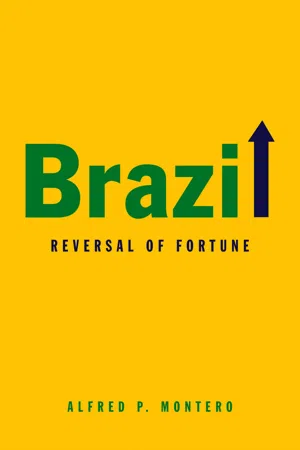
Once deemed a "dysfunctional" democracy with a "feckless" set of political institutions and a "drunk" economy, today's Brazil has undergone a complete reversal of fortune. Now in its third decade of democracy, the economy is blossoming and large-scale development projects are underway, including the exploitation of massive, off-shore oil reserves, a nationwide effort to modernize infrastructure, and preparations for the hosting of the 2014 World Cup and the 2016 Olympics. Inequality and poverty are reducing and even Brazil's political institutions are more governable and are producing a higher-quality democracy than most observers once thought possible.
Alfred P. Montero's timely and wide-ranging book explores Brazil's amazing "turnaround" - from improvements to the working of its political institutions and judiciary, to the renewal of economic growth, the advent of innovative social policy, and the emergence of a new foreign policy agenda. Unpacking both overly optimistic as well as pessimistic views of Brazilian politics and development, Montero offers illuminating insights into the country's transformation and its increasing significance on the international stage.
- English
- ePUB (mobile friendly)
- Available on iOS & Android
eBook - ePub
About this book
Information
CHAPTER ONE
A Reversal of Fortune?
Brazil has always been a study in contrasts – a puzzle of contradictions that lends truth to legendary composer Tom Jobim's famous line “Brazil is not for beginners.” As the world's sixth largest economy (just ahead of the United Kingdom) and the fourth largest democracy by population, Brazil is a country of continental size with world-class ambitions. At the same time, its economic and political development is fraught with difficulties that have on occasion made observers wonder if the country would ever meet its own expectations. Any visitor to Brazil, especially to the major cities of São Paulo and Rio de Janeiro, will notice the country's most obvious problems: inequality and poverty. Despite its modern cityscapes and advanced technology, as well as the sophistication of its educated middle and upper classes, as many as 60 percent of the country's citizens are poor. The distribution of wealth is tremendously unequal, even though the country has remained a democracy since 1985. To use one traditional indicator of inequality – the ownership of arable land – 1.6 percent of farms control 43.8 percent of all land for agriculture.1 Such statistics underscore that Brazil is a country of sharp contrasts, a democracy with uneven distribution of wealth and income, and a developing, industrial economy of immense potential, but burdened by equally immense social obligations to its poorest citizens.
After enduring twenty-one years of military-led, authoritarian rule from 1964 until 1985, Brazil enjoyed a transition to democracy that raised hopes that fundamental political and socio-economic changes were around the corner. Yet, during the first ten years of this new democracy, the country seemed to veer off course. The first democratic government, known as the “New Republic,” came to be headed by José Sarney, a friend of the outgoing military governments. Sarney's rise was a result of a series of unfortunate events – notably, the failure of democratic forces to install direct elections for the first president and then the death of the indirectly elected Tancredo Neves on the eve of his inauguration. Sarney's coming to power reflected a transition to democracy that was designed to produce less than fundamental change. To the disappointment of Brazilians who thirsted for a return to democracy, the new president was to be elected through an electoral college, specifically the national congress elected in 1986. The new political class of the early democratic period did not differ much from the figures that participated in the semi-open congress sanctioned by the armed forces between 1965 and 1985. The economy of the New Republic would prove even more disappointing. Shortly after Sarney's government had tempered inflation during its first year in office, price instability returned, generating inflationary and, periodically, hyperinflationary spirals reaching more than 50 percent per month during the next nine years. Sarney's successor, Fernando Collor (1990–2), proved spectacularly even less successful. Not only did his efforts to curb inflation fail, but he was found to have engaged in corruption and was impeached before he could serve out his term.
The travails of the first ten years of democracy in Brazil generated sustained and unflinching criticism from observers of the country's political system and economic policies. Scholars such as Scott Mainwaring described its democratic institutions as “feckless,” while others went so far as to call them “pathological.”2 Economic policy fared no better with critics. During the early 1990s, Rudiger Dornbusch, a well-known macro-economist from the International Monetary Fund (IMF), called the Brazilian economy “drunk” and likely to suffer a “putsch,” which was rumored during the summer of 1993 to be in the planning stages (Amaral, Kingstone, and Krieckhaus 2008: 140).3 The hyperinflationary context inspired some observers to compare the “New Republic” to the fragile democracy of Weimar Germany (cf. Fritsch and Franco 1993: 10–11). If Dornbusch's comment about a coming putsch did not carry so much resonance in 1993, the comparison would have seemed ridiculous. Yet, after two unsuccessful presidencies and as many as seven failed anti-inflation plans, Brazilian political-economic institutions appeared incorrigibly dysfunctional. The developmental state, which had forged an impressive period of industrialization during the 1940s through the 1970s, was described by neoliberal observers as obsolete and exhausted, while more sympathetic voices opined that it had become overly fragmented and internally incoherent, making a return to the halcyon days of high growth with statism a fantasy (Weyland 1998). Even public security seemed to be eroding rapidly, a sense that was underscored by the slaughter of eight street children in front of the Candelária Cathedral in Rio de Janeiro by off-duty police and hired gunmen on July 23, 1993.
This author visited Brazil during the North American summer/Brazilian winter of 1993, and, at the time, it was easy to feel that rumors of a coup against the government of Itamar Franco and the massacre at the Candelária Cathedral represented the moment that democratic Brazil was touching bottom. But, just ten years after observers such as Mainwaring and Dornbusch issued their pessimistic assessments of Brazil, the country seemed to have engineered a rather stunning turnaround. Fueled by a commodity boom and a growing domestic market, economic growth picked up, averaging 4.5 percent between 2004 and 2010 with relatively low inflation. Brazil's economic success in the past decade has been so acute that the country has become a capital exporter. By 2009, it was on the US Treasury Department's list of the largest foreign government holders of American sovereign debt. As of January 2013, Brazil is number four on the list, with US$253 billion, just behind all oil exporters, Japan, and China.4 The social implications of this new economic status were evident by the middle of the decade, when observers began to note that Brazil was enjoying falling poverty rates and improving measures of income equality.
These tendencies, albeit slowed due to declining growth throughout much of the world after 2009, continued through the writing of this book, so one might say with some degree of confidence that Brazil has turned an important corner. Despite its fragmentation, with numerous major parties and the dominance of personalistic rather than programmatic organizations, Brazil's political system has become more governable since the “feckless” label was first applied. Indeed, at no other time in its history has the country been able to enjoy for so long growth, lower inequality, lower poverty, and stable, democratic government. Brazil's success in recent years can even be compared with China's and in terms that place it ahead of that country. For example, Marcelo Neri (2009: 229) has made this argument with reference not only to high levels of growth but also to declining inequality and a strengthening democracy in Brazil, whereas China's growth has coincided with increasing inequality and the continuation of authoritarianism. Properly understanding the dimensions and the causes of this stunning reversal of fortune – which I refer to as “the Brazilian turnaround” – is the subject of this book.
Brazil's success in recent years continues to have its detractors. Concerning the country's economic performance, the chief criticism is that aggregate growth is too dependent upon sustainable increases in demand for commodities and higher prices for these exports. Not only is this dependency not sustainable, since commodity booms by definition end with busts, but the overall pattern of development based on such exports is itself a kind of regressive specialization that can only take resources and policy attention away from industry. So some scholars have seen the commodity export economy as a symptom of a larger “de-industrialization” of Brazil (Santana 2012: 217).
Although concerns about the sustainability of commodity booms are warranted, Brazil's turnaround is hardly due exclusively to economic factors, nor is its improved economic performance completely dependent on a commodity boom. Most of its economic expansion since 2002 has been the result of growth in aggregate demand in the domestic market, not in international demand for soy, iron ore, and other resource-based commodity exports, and that owes much to income-enhancing social programs that have boosted the expansion of household consumption (Santana 2012; Singer 2012: 179–80). Export growth has itself been driven by non-commodity exports, including consumer durables and manufactured inputs that have composed a growing share of the export bundle since 1998 (Suzigan, Negri, and Silva 2007; Almeida 2011). A central finding of this book is that social and economic policies have created the conditions for the turnaround even when economic fundamentals did not privilege a positive outcome.
A more compelling and justified concern about the turnaround is that it has done less for the quality of Brazil's democracy than it has for social and economic development. Even after enjoying democratic freedoms for twenty-seven years, surpassing the time of military rule, Brazilian citizens in various surveys continue to report, and in shockingly large proportions, a disappointment with democracy. Just about half of all respondents to the annual Latinobarómetro surveys report an appreciable level of dissatisfaction with the way democracy works in Brazil, and a fifth of those polled entertain the idea that an authoritarian regime might be preferable.5 Brazilians express regularly their opinions between elections, engaging in protests such as those that stunned the political class in June 2013. Hundreds of thousands of protesters in several cities manifested against a litany of concerns: high transport costs, corruption, not enough spending on schools and hospitals, and too much spending on soccer stadiums in preparation for the 2014 World Cup and the 2016 Summer Olympic Games. These attitudes reflect what much scholarship on Brazil sees as the persisting contradictions between the existence of liberal democratic institutions and the continuation of clientelistic and oligarchical forms of doing politics (Ames 1994; Hagopian 1996; Bezerra 1999). Even as formal institutions governing the accountability of elites have hardened, clientelism and patronage politics continue to be the lifeblood of how politics are practiced and how policy is shaped. And, despite periodic corruption scandals, fundamental and lasting institutional reforms are too infrequently pursued and are inadequate even when they are implemented. So regular Brazilians tend to be realists in seeing politics as a game for insiders and democracy as something that benefits those who are already on the inside. Ironically, as the economy and social welfare have improved during the last decade and a half, citizens have raised more and more concerns about democracy and the political class.
These concerns have merit, but they do not diminish the overall impression that the Brazil of today is very different from the one that was mired in political and economic crisis for ten years following the transition to democracy. The turnaround is more than a commodity boom, and, despite the problems of popular disaffection with democracy, democratic institutions work better today than they did even a few years after the transition. Of course, no turnaround of the scale engineered by Brazil is possible without some shortcomings. And the shortcomings do beg the question of how profound and sustainable the changes have been. Are the improvements to governability, patterns of economic growth, social inequality, and poverty simply ephemeral and skin-deep, or are they everlasting and substantial? Scholars embracing optimistic and pessimistic lenses on Brazil have debated back and forth throughout the democratic period. While the pessimists had the upper hand during the first ten years, the last fifteen have witnessed a stunning reversal in favor of more optimistic views. This author prefers a more cautiously optimistic perspective and a careful analytical approach that takes into account the insights produced by contending views of Brazilian democracy and economic and social development.
The Purpose of the Book
This book is focused on explaining Brazil's turnaround on three dimensions: governability, good policy (also known as good policy governance), and the quality of democracy. These are large, multilevel concepts that require a look at an array of indicators. But each can be understood as hinging on certain core questions. Governability asks to what extent the policy-making process works efficiently and effectively to generate legislative change. The key word is “process,” as this concept is less concerned with the effects of policy or the quality of voting and elite accountability. Governability asks how political leaders and their organizations cooperate (or not) to make policy. The main venues for the governability of the political system are the presidency and the legislature, but also relations between the federal government and the states and cities. Major scholars of Brazilian political institutions such as Scott Mainwaring (1999), David Samuels (2003b), and Barry Ames (2001) have produced excellent work on the inability of political parties, the executive and the legislature, and the federal system to govern the policy-making process effectively. Their central claims are that political organizations in Brazil are typically vacuous, driven by personalist leaders focused on the distribution of material rewards for themselves and for their associates, with little devotion to programmatic government or even consistent ideology. The opposite view has gained more traction since the mid-1990s given improved conditions since the presidency of Fernando Henrique Cardoso. More scholars of Brazilian political institutions have come forth to contest the pervasive view of the party system as “feckless” and the legislative process as mired in personalism and clientelism (e.g., Figueiredo and Limongi 1999; Lyne 2005; Hagopian, Gervasoni, and Morães 2009). This debate has coincided with more empirical evidence showing that the capacity of major political actors to forge compromise has improved, making this the first dimension of the turnaround.
Improved governability has made possible the diffusion of new policy ideas that address major goals of socio-economic and institutional change. A centerpiece of the turnaround has been the capacity of major political actors to develop and implement economic and social policies, many of them innovative, which have, over time, changed fundamentally the development of Brazil's democracy. I refer to this dimension of the turnaround as good policy governance, or simply good policy, to differentiate it more neatly from governability. New industrial policies associated with the National Development Bank (Banco Nacional de Desenvolvimento Econômico e Social, BNDES) and poverty-alleviating conditional cash transfers are among the most notable in recent years. But even more fundamental has been Brazil's commitment to price stability under Cardoso's Real Plan (Plano Real), which ended bouts of hyperinflation in 1994, and numerous efforts to stave off a fiscal crisis through stopgap legislation during the 1990s that limited subnational debt and capped spending on the civil service. Most notably, the commitment to macro-economic orthodoxy has not contradicted efforts to improve social distribution. Of course, these policy achievements have not been perfect, but they have gone far enough to reinforce and even take advantage of the improvements in governability noted by scholars of political institutions. The subsequent chapters focus on the most prominent of these, noting how they have generated substantial changes in social and economic development in contemporary Brazil. As a whole, the impression one has is that the Brazilian political system has generated meaningful policy changes during the democratic period, although much is left to do in key areas.
The final dimension of the turnaround is the quality of democracy. One of the indicators of improvements in governability and policy-making is that scholars have moved away from more fundamental questions on whether the Brazilian political system could function democratically to the issue of the quality of its democracy. The quality of democracy focuses on the accountability of elites to one another and to the electorate, the effectiveness of the vote in exercising oversight on the political class, and the responsiveness of government to the will of the people (Levine and Molina 2011; Diamond and Morlino 2004). Of these aspects, the accountability of elites to citizens, defined as the answerability of these representatives to the public for institutionally inappropriate or illegal actions, is the core of democratic quality. Elite accountability also reflects the responsiveness of governments to popular preferences and the participation of citizens in the political process. Like governability, the quality of democracy is concerned with process, but it addresses arenas that move well beyond the realm of political society (i.e., the relations between the presidency and the congress, and the behavior of political parties) to encompass the judiciary, elections and campaigns, popular participation by groups and non-governmental organizations, and official institutions that are responsible for the oversight of the political class and the bureaucracy. It is regarding the quality of democracy that the Brazilian turnaround has produced its most ambiguous results. Since this is a multidimensional concept, it is possible to break it down in subsequent chapters and analyze the areas in which democracy has advanced notably and areas that have seen much less improvement.
The three dimensions of governability, good policy, and the quality of democracy are the objects of study in this book. In that sense they are treated as “dependent variables” in the chapters that follow. How have these dimensions changed in Brazil to produce the turnaround? This question implies that the three dimensions have correlated with larger improvements in economic performance and social development, making them “independent variables” as well. Ultimately, in trying to explain changes of such broad scale, causes and consequences can mix, but understanding causal sequences requires that we unpack these relationships carefully. It also requires that the takeaway lessons from the analysis be highlighted clearly.
I make several recurring claims that are supported in the chapters that follow. Each of these claims elaborates further on the causal description of improved governability, good policy, and enhanced democratic quality to identify specific factors and conditions that animated these dimensions of the turnaround and made them possible, including how change on one dimension affected the others.
My first claim is that the direction of change on governability, good policy, and democratic quality has been towards improvement since 1993–4, but it has been uneven and contradictory in certain areas. The political system is far more predictable and routinized than it was during the first decade of democracy. But the reasons for improved governability are in tension with other aspects of the political system that are intended to strengthen the quality of democracy, especially elite accountability, the responsiveness of government, and the quality of the vote. Regarding good policy, improvements in areas of economic and social policy are genuine, especially since the advent of inflation control under the Real Plan. Yet while innovative policy-making in areas such as economic and social reform may make governments popular, they also deflect responsibility for not addressing other nagging problems, such as the need to make the economy more efficient or the need to reform the political system to reduce the use of patronage in the creation of legislative alliances. Another caveat of the turnaround, referred to above, is that the improvements to the quality of democracy have been the most difficult to engineer and maintain. Despite stronger forms of oversight of elites, voters and civil society as a whole remain too disconnected from the political class to exert the kinds of consistent pressure a more vibrant democracy requires. This partly explains periodic and unexpected outbursts of protests such as those that captured the attention of the world in 2013. The persistence of clientelism, pro-incumbent bias, and the occasional corruption scandal are some of the indicators that suggest that the turnaround has proven weakest on the dimension of Brazilian democracy's overall quality.
My second claim is that political governability and policy-making have improved in particular due to the fact that the ideological polarization of the past has largely faded from the scene. After 1994, Brazil's democracy matured in ways that reduced the differences between right and left that once ended what the historian Thomas Skidmore called the country's “experi...
Table of contents
- Cover
- Dedication
- Title page
- Copyright page
- Tables and Figures
- Abbreviations
- CHAPTER ONE: A Reversal of Fortune?
- CHAPTER TWO: Democracy and Economy from Bust to Boom
- CHAPTER THREE: Improving Governability
- CHAPTER FOUR: Accountability, Participation, and Good Governance
- CHAPTER FIVE: The Renewed Developmental State
- CHAPTER SIX: Welfare and Class Mobility
- CHAPTER SEVEN: Brazilian Foreign Policy
- CHAPTER EIGHT: Prospects for the New Brazil
- References
- Index
Trusted by 375,005 students
Access to over 1.5 million titles for a fair monthly price.
Study more efficiently using our study tools.
Frequently asked questions
Yes, you can cancel anytime from the Subscription tab in your account settings on the Perlego website. Your subscription will stay active until the end of your current billing period. Learn how to cancel your subscription
No, books cannot be downloaded as external files, such as PDFs, for use outside of Perlego. However, you can download books within the Perlego app for offline reading on mobile or tablet. Learn how to download books offline
Perlego offers two plans: Essential and Complete
- Essential is ideal for learners and professionals who enjoy exploring a wide range of subjects. Access the Essential Library with 800,000+ trusted titles and best-sellers across business, personal growth, and the humanities. Includes unlimited reading time and Standard Read Aloud voice.
- Complete: Perfect for advanced learners and researchers needing full, unrestricted access. Unlock 1.5M+ books across hundreds of subjects, including academic and specialized titles. The Complete Plan also includes advanced features like Premium Read Aloud and Research Assistant.
We are an online textbook subscription service, where you can get access to an entire online library for less than the price of a single book per month. With over 1.5 million books across 990+ topics, we’ve got you covered! Learn about our mission
Look out for the read-aloud symbol on your next book to see if you can listen to it. The read-aloud tool reads text aloud for you, highlighting the text as it is being read. You can pause it, speed it up and slow it down. Learn more about Read Aloud
Yes! You can use the Perlego app on both iOS and Android devices to read anytime, anywhere — even offline. Perfect for commutes or when you’re on the go.
Please note we cannot support devices running on iOS 13 and Android 7 or earlier. Learn more about using the app
Please note we cannot support devices running on iOS 13 and Android 7 or earlier. Learn more about using the app
Yes, you can access Brazil by Alfred P. Montero in PDF and/or ePUB format, as well as other popular books in Politics & International Relations & Global Politics. We have over 1.5 million books available in our catalogue for you to explore.