Unde malum from where does evil come? That is the question that has plagued humankind ever since Eve, seduced by the serpent, tempted Adam to taste the forbidden fruit of the tree of knowledge of good and evil. Throughout history the awareness of good and evil has always been linked to the awareness of choice and to the freedom and responsibility to choose this is what makes us human. But the responsibility to choose is a burden that weighs heavily on our shoulders, and the temptation to hand this over to someone else be they a demagogue or a scientist who claims to trace everything back to our genes is a tempting illusion, like the paradise in which humans have at last been relieved of the moral responsibility for their actions.
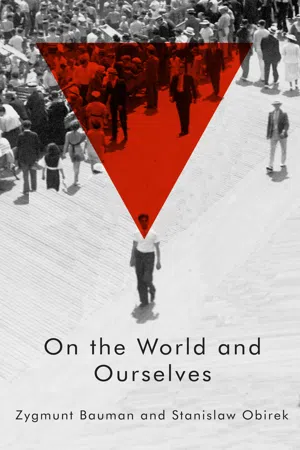
In the second series of their conversations Zygmunt Bauman and Stanislaw Obirek reflect on the life challenges confronted by the denizens of the fragmented, individualized society of consumers and the form taken in such a society by the fundamental aspects of the human condition - such as human responsibility for the choice between good and evil, self-formation and self-assertion, the need for recognition or the call to empathy, mutual respect, human dignity and tolerance.
- English
- ePUB (mobile friendly)
- Available on iOS & Android
eBook - ePub
On the World and Ourselves
About this book
Information
1
Reveries of Solitary Walkers
Zygmunt Bauman Unde malum – whence evil? That is the question that plagued our human brethren and sisters since Eve, seduced by the serpent, the grandmaster of spin, tempted Adam (about whose appetite for spin we know next to nothing), to taste the fruit of the tree of knowledge of good and evil and thus to begin the history of humanity.
This was indeed (still is, and will continue to be, let's hope, for a long time to come) a human story; it was, is and will remain a human story for as long as it's lived in the awareness of the possibility of goodness and evil in all things and all actions. Awareness of good and evil was, is and continues to be the awareness of choice; an awareness that things and deeds do not have to be the way they always have been – that they can be different from how they are. And so it is also an awareness of the possibility of living and acting differently from the way we have been doing in the past, from the way we are doing it now and from the way we intend to do it in the future. In conclusion: awareness of good and evil is the awareness of alternatives.
Awareness of alternatives is an awareness of the necessity of choice. Awareness of that necessity is, in turn, consciousness of freedom. Consciousness of freedom is, furthermore, a consciousness of responsibility for choice. And consciousness of responsibility is what makes us human.
Since that fateful bite of the forbidden fruit, Adam and Eve's descendants are free, and cannot stop being free since they are conscious that things could be different from how they are, that they could act differently from how they do – that they could choose differently.
They know, what is more, that their awareness of the difference between good and evil, their very freedom of choice, makes them responsible for that choice. From freedom of choice comes responsibility for its consequences. To be free is to be responsible for one's choices. And choice – as we know and cannot forget – is the choice between good and evil, between a greater or lesser good, greater or lesser evil. Responsibility and freedom are therefore like Siamese twins, impossible to prise apart even for the most skilful of surgeons. Responsibility comes with freedom, and, as long as freedom lasts, responsibility remains.
The anguish of the unde malum question is ultimately the anguish of inalienable responsibility. It is the price that a free man must pay for his freedom. It is an anguish that can only be taken away along with freedom. But a return to the blissful state of ignorance of the difference between good and evil (the bliss of the unawareness of bliss!) is, as we know, once and for all denied to the descendants of Adam and Eve. Cherubim, an angel's flaming sword, but, above all, awareness of the difference between good and evil – once acquired, never forgotten – guard the gates of ideal bliss. And yet the bliss of forgetting and/or discarding that awareness, and with it its eternal, for better or worse, companion – responsibility – smacks of bondage. Having tasted freedom, a man deprived of it will feel as if he has been thrown into the burning sulphur-filled cauldrons of hell. To sum up: return to the bliss of paradise is once and for all denied to us; some of us may dream of it from time to time, but we can do so (as we find out sooner or later – unfortunately, mostly too late) only at our own peril.
What can I say? It is hard to go through life with the weight of responsibility on your shoulders – it weighs you down and constrains your movements. It can hold you back from fulfilling even the most ardent wishes and, if it fails to do so, it will only add to your burden before capitulating. There is no escape from responsibility; and it is more rigorous in its search for truth, as well as harsher in its judgments, than even the most consummate, the most erudite and pedantic of high court judges. Judges presiding over earthly tribunals may be persuaded of your innocence, sometimes even bribed to acquit you, but your conscience, that tireless police constable in your mind and heart, stationed there by your responsibility from the moment you became aware of it, will not be swayed by even the most persuasive arguments or handsomest bribes – will not so much as take a nap, close its eyes for a moment or look the other way … People may be naive or corrupt, but not morality.
My dear Staszek, I cannot help suspecting – though I have no ‘scientific’ evidence for this – that both our continued fascination with the question unde malum and our ineptitude in finding a definitive answer to it, stem ultimately from our resistance to and protest against the state of affairs outlined above – be they explicit or covert, intentional or unintentional, conscious or subconscious – our intransigence towards the non-negotiability of the absolute, and thus exceptionless, moral responsibility. Wordy evasions, ploys and ruses are as common as they are useless: they can beguile our listeners (especially since we tend to surround ourselves with like-minded, sympathetic interlocutors who are not only willing but also grateful to be thus beguiled) but not the police constable within us. So we need something more. Philosophers, for instance, or scholarly and auratic sages, or demagogues with charisma.
Certain philosophers, and in particular biogeneticists, biochemists or biopsychologists who recently came to their support with their latest research, search for the sources of evil outside the sphere subject to human choices – under a common ‘It's Nature, stupid!’ banner. It is nature, they suggest, that made us able to do evil and to resort to it under certain circumstances. But is it really ‘us’ who resort to evil? Although we use this pronoun in our lay language grounded on the illusion of free will, in a language purified of fanciful terms – and so scientifically correct – we should be saying that this ability is set in motion by biochemical processes taking place in our nervous system: processes over which ‘we’ have no control. Those processes can be investigated, documented, described in detail, even set in mathematical formulae – but they cannot, at least not in the current state of knowledge and technology, be changed or prevented. In other words: it can't be helped.
Are you, like me, struck by the continuity of such reasoning, unbroken even by a radical change of idiom? Whether it's the devil or biochemical processes that are charged with the true authorship of evil, the conclusions are strikingly similar: it is possible (indeed necessary) to pass the blame for evil, hitherto erroneously attributed to human will, to non-human factors independent of human choice. As a matter of fact, both the intention behind such inquiry and the message contained in its results in fact benefited from the change of idiom: after all, it was possible to reason with the devil, to outsmart him or to chase him away by sprinkling him with holy water; sometimes the devil even had to ask his human acolytes for a signed consent to his deeds. There are no such methods, at least not at present, for tackling what the nerves and biochemical processes are doing.
Demagogues are more practical, and ultimately probably more effective, than philosophers and biopsychologists; at least if their effectiveness is to be measured by the numbers of recruits keenly pricking up their ears to their messages and hurrying to join the ranks of combatants in battle. Not many will delve into the deliberations of philosophers; even fewer will understand what biochemists are talking about. In any case, both address their message to those few thirsty for knowledge and craving a deeper understanding.
When I speak of the advantage of demagogues over philosophers or biochemists, I have in mind politicians, who turn not to those few, but to all the rest – in the hope of exploiting their confusion, fear and anxiety for the benefit of whatever cause they are advancing; relying mostly on their ignorance and helplessness.
Demagogues don't go in for subtle and sophisticated argument. They cut across, take shortcuts, go for the jugular. They get directly to the crux of the matter. Because the crux of the matter, let me remind you, is the torment of carrying the unendurable burden of one's own responsibility. There can be no better recruitment slogan, to those who are thus burdened, than the promise to have that burden taken away: the offer of making responsibility collective – or an invitation to hand it over to someone else who promises to cope with the burden better, to lock it in the safety of an unbreakable strong-box, or else have it cashed in a pawn shop. All such proposals and their like have one characteristic in common – they promise an end to the agony of personal responsibility: ‘Trust me, give me power, listen to what I say, do as I tell you – and you will be rid of worry and fear of being excluded or of falling out of line. No one will reproach you for not doing enough of this or too much of that. No one will scold, humiliate, oppress or offend you. It will be I, from now on, who will carry on my shoulders the full responsibility for what you – yes, you here, and you in the second row, and you over there by the window, and all of you together following my commands – will do.’ Sometimes the haranguer will assume the garb of a messenger or an emissary, speaking not so much in his own name as in that of ‘The Cause’, bypassing thereby the issue of command and submission. He will most probably adopt the personal pronoun of ‘we’ rather than ‘I’, and will supplement each order with the reminder that together we stand and together fall. The effect, however, is the same: the offer of an a-priori absolution for any sinful act and transgression, on the condition that those acts be the outcome of his orders (in some cases) or the demands of the just cause (in others).
This is a tempting proposition, a proposition difficult to reject – almost like a vision of paradise in which no spectre of responsibility for evil deeds haunts us; one especially difficult to ignore for those many who learned from their own experience that refraining from harming others brought them no good whatsoever; those many frustrated by taking moral responsibility for a recipe for gaining human respect and a gratifying life.
Stanisław Obirek I am trying to think when I first repeated Eve's or Adam's gesture. When I first felt embarrassment or stinging shame, thus becoming aware of the sense of moral responsibility. Such a moment of awakening from the blissful state of innocence must surely have taken place at some point. I ponder and I ponder but nothing comes to mind.
Monsters and strange imaginings took root and nestled in my mind – as with St Anthony before me – from my earliest childhood. A clear case of unde malum. Catechism, the contents of which have been poured into my mind and heart since my pre-school days, gives a clear and unequivocal answer: peccatum originale as formulated by St Agustine and undoubtedly refined by scholars as peccatum originale originans (thus, giving rise to sin), or peccatum originale originatum (i.e., sin which had been initiated). Whatever he may have called it, it was the concept and not its name that mattered, since it presented the possibility of defeating the snake-headed Hydra. Ever since sin was given a name and its consequences made known to all, a remedy could be found too – an effective measure for overcoming this evil. All we had to do was make use of it. As for the fact that doubts swirled in the mind, and those dispensing means of salvation did not always inspire confidence … a solution was found for that too – ex opere operato! It is not man and the quality of his moral stance, but the act itself, through the secret decree of God, which will make everything all right. It is enough to submit meekly to the healing treatment and everything will become clear. And so everything should be simple, all doubts dispersed, all anxiety calmed. Polish language (I am not sure how close it is to its Latin source) informs us of an irrevocable rupture, a tearing apart. It took place at the moment of sinful conception (how else could the said St Augustine have referred to this secret event?) and the equally accursed childbirth, when I left my mother's blissful womb and was thrown into a hostile world. Those two events irrevocably marked my existence. No one and nothing could bring me out of the unfathomable depths of original sin, like the waters of the baptismal font to which my parents, like their parents before them, submitted me. With baptism barely over and the world beginning to open itself up to my curious eyes, it was the turn of confession and First Communion to appease my childish heart. Should that not be enough, there was also the confirmation and endorsement of my chosen path. Finally, priesthood, that ultimate dream of a Christian, who not only gains an open path to heaven but is able to encourage and help others onto it. I had answers to the problems and dilemmas you mention, Zygmunt, at hand, ready-made. In fact I needed to do nothing but submit to the beneficial remedies guaranteed by the Church from my earliest days. Yet not everything rang true, and my heart searched out other laws. And so I did not give in completely to the magical, miraculous power of the sacraments promising salvation. Perhaps I had too little faith and too much reasoning and doubt, as my closest friends used to tell me.
And so a fundamental question arises: what is one to do should the sacrament fail to fulfil hopes vested in it? Because it is rupture and tearing apart that haunts me still, not the beneficial bliss promised at baptism. And so, dear Zygmunt, you have touched upon the essence of our civilization, which, for the last two millennia – certainly since Augustine, mentioned above – solved the matter by introducing the concept of the original sin, and pointing to ways of eliminating it. So what does it mean if the man who baptized Plato and Socrates, the greatest thinker for Christians of all denominations, was in fact the one to make the matter worse and push it into an ever deeper abyss? How else can we explain the ever-lengthening dialogue of the deaf, first begun in paradise, with which you began your still essentially unanswered question. I am skipping the first verses of chapter 3 of Genesis – remarkable for the brevity with which they describe the original sin so reviled by Augustine – to stop as it were on the final chord. Thus, concerned about the strange behaviour of Adam and Eve, God turns to the former and asks whether he has eaten fruit from the forbidden tree. Adam confesses that that is what has happened, but at the same time lays the blame on his life companion. She too has an explanation: ‘and Adam said: the Woman you put in front of me, she gave me of the tree and I ate. And Eternal God said to the woman: what have you done! And the woman said: the serpent tempted me and I ate’ (Genesis 3:12–13). Surely this is a record of escape from responsibility, which takes on the now-familiar form of laying the blame at someone else's door – it wasn't me, she tempted me! Moreover, it is God himself who is guilty, having made Adam unhappy by the presence of Eve the temptress. Eve does not accept responsibility and blames the serpent, also God's creation. And all comes back to the beginning: we are how you created us! And yet this is neither a full nor a correct interpretation of the biblical text. Feminists sensitized us to the role of Eve, praising her for that first bite which opened our eyes and made possible the distinction between good and evil.
And so it is to our ancestral mother to whom we owe moral awareness and the ability to assess our actions. Without Eve, we would be as thoughtless as cows in a meadow, only searching for the tastiest pastures without a thought for the consequences of our choices. Here, in turn, theology comes to the rescue by singing the praises of felix culpa – that is to say, fortunate mistakes and deviations, which give the Almighty an opportunity to act and gladden the repentant soul. Yet repentance is hard to come by, and so mercy is not granted as freely as we would like, and the consequences of mistakes remain. But, resolutely following feminist interpretation, I will be grateful to Eve for her courage and maturity in facing the question of what is good and what is evil. As for the temptation? The serpent probably tempted Adam too; he, however, chose to remain in a state of thoughtless bliss and it took Eve's initiative to shake him out of his stupor, lamented much later by the loner of König...
Table of contents
- Cover
- Title page
- Copyright page
- Preface
- 1: Reveries of Solitary Walkers
- 2: Tangled Identities
- 3: Hic et Nunc
- Instead of a Conclusion
- Index
- End User License Agreement
Trusted by 375,005 students
Access to over 1.5 million titles for a fair monthly price.
Study more efficiently using our study tools.
Frequently asked questions
Yes, you can cancel anytime from the Subscription tab in your account settings on the Perlego website. Your subscription will stay active until the end of your current billing period. Learn how to cancel your subscription
No, books cannot be downloaded as external files, such as PDFs, for use outside of Perlego. However, you can download books within the Perlego app for offline reading on mobile or tablet. Learn how to download books offline
Perlego offers two plans: Essential and Complete
- Essential is ideal for learners and professionals who enjoy exploring a wide range of subjects. Access the Essential Library with 800,000+ trusted titles and best-sellers across business, personal growth, and the humanities. Includes unlimited reading time and Standard Read Aloud voice.
- Complete: Perfect for advanced learners and researchers needing full, unrestricted access. Unlock 1.5M+ books across hundreds of subjects, including academic and specialized titles. The Complete Plan also includes advanced features like Premium Read Aloud and Research Assistant.
We are an online textbook subscription service, where you can get access to an entire online library for less than the price of a single book per month. With over 1.5 million books across 990+ topics, we’ve got you covered! Learn about our mission
Look out for the read-aloud symbol on your next book to see if you can listen to it. The read-aloud tool reads text aloud for you, highlighting the text as it is being read. You can pause it, speed it up and slow it down. Learn more about Read Aloud
Yes! You can use the Perlego app on both iOS and Android devices to read anytime, anywhere — even offline. Perfect for commutes or when you’re on the go.
Please note we cannot support devices running on iOS 13 and Android 7 or earlier. Learn more about using the app
Please note we cannot support devices running on iOS 13 and Android 7 or earlier. Learn more about using the app
Yes, you can access On the World and Ourselves by Zygmunt Bauman,Stanislaw Obirek in PDF and/or ePUB format, as well as other popular books in Scienze sociali & Sociologia. We have over 1.5 million books available in our catalogue for you to explore.