Mass protests have raged since the global financial crisis of 2008. Across the world students and workers and environmentalists are taking to the streets. Discontent is seething even in the wealthiest countries, as the world saw with Occupy Wall Street in 2011.
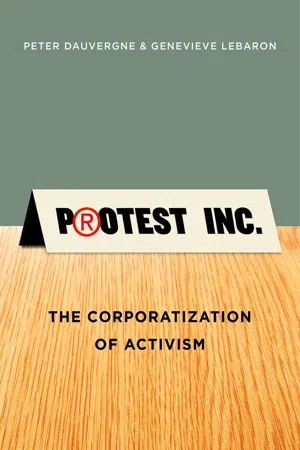
Protest Inc. tells a disturbingly different story of global activism. As millions of grassroots activists rally against capitalism, activism more broadly is increasingly mirroring business management and echoing calls for market-based solutions. The past decade has seen nongovernmental organizations partner with oil companies like ExxonMobil, discount retailers like Walmart, fast-food chains like McDonald's, and brand manufacturers like Nike and Coca-Cola. NGOs are courting billionaire philanthropists, branding causes, and turning to consumers as wellsprings of reform.
Are "career" activists selling out to pay staff and fund programs? Partly. But far more is going on. Political and socioeconomic changes are enhancing the power of business to corporatize activism, including a worldwide crackdown on dissent, a strengthening of consumerism, a privatization of daily life, and a shifting of activism into business-style institutions. Grassroots activists are fighting back. Yet, even as protestors march and occupy cities, more and more activist organizations are collaborating with business and advocating for corporate-friendly "solutions." This landmark book sounds the alarm about the dangers of this corporatizing trend for the future of transformative change in world politics.
- English
- ePUB (mobile friendly)
- Available on iOS & Android
eBook - ePub
About this book
Information
CHAPTER ONE
Where are the Radicals?
Over the last two decades activist organizations have increasingly come to look, think, and act like corporations. You may well find this claim upsetting. Yet we go even further, arguing that the corporatization of activism is deepening and accelerating across all causes and cultures. Rarely now do “career” activists call for a new international economic order, or a world government, or an end to multinational corporations. Only a select few on the fringes, in the words of Greenpeace cofounder Bob Hunter, still struggle to “mindbomb” the world to form a new “global consciousness.”
More and more activists, especially those toiling inside large advocacy organizations, are instead speaking in market-friendly language. They are calling for a gentler capitalism – for fair trade, for certification, for eco-markets. The buzz is about the aid of rock stars and the benevolence of billionaires. Solutions to global problems involve campaigns for ethical purchasing: to brand social causes and sell feelings of “doing good” to the “cappuccino class.”
Without a doubt most activists still want to speak truth to power. But nowadays they are entangled in this power. Unthinkable a few decades back, partnerships with big-brand companies – Walmart, McDonald’s, Nike – are now common, even expected. The global WWF Network of activists, as just one example among many, receives funding from and works closely with the Coca-Cola Company. WWF leaders do not hide the reason for joining forces. “Coke,” explains Gerald Butts, who at the time was the president and chief executive officer of WWF Canada, “is literally more important, when it comes to sustainability, than the United Nations.”1
A Coca-Cola World
Why is this happening? Why is corporatization affecting some advocacy organizations more than others? What are the consequences for the nature and power of activism? The answers, as we reveal, are complex, with many activists fighting back. Still, looking across the surface of global activism, we see three processes that are interacting with markets and politics to corporatize activism: the securitization of dissent (chapter 3); the privatization of social life (chapter 4); and the institutionalization of activism (chapter 5).
Together, these interlocking processes are reconfiguring power and resistance globally, as firms engage social forces through corporate social responsibility, as governments cut social services and devolve authority to companies, as consumerism spreads, and as states suppress public dissent. The result is a seismic shift in the nature of activism worldwide. Not only are more and more corporations financing and partnering with activist groups, but activists are increasingly communicating, arguing, and situating goals within a corporatized frame. And more and more activists are seeing corporate-friendly options as logical and effective strategies for achieving their goals.
This does not mean that activists have capitulated to corporations: corporate malpractice continues to draw their ire. Within every movement, many activists are challenging the values and institutions of capitalism. And many examples exist of successful efforts to slow or reverse corporatization. Worldwide, both organized and spontaneous uprisings remain common too, with social media tools such as Facebook and Twitter rallying hundreds of thousands of people to oppose rigged elections, decaying dictatorships, and corporate pillage. If anything, because social unrest tends to cluster and come in waves, in the future we would expect even more – and larger – public protests as the world population rushes toward 10 billion people, as communication technologies and economies continue to globalize, and as citizens react angrily to the hardships of an ever adjusting world economy.
Nonetheless, although it is a contested, uneven, and in no way inevitable process, the overall trend, we argue in this book, is toward a corporatization of activism, where the agendas, discourse, questions, and proposed solutions of human rights, gender equality, social justice, animal rights, and environmental activist organizations increasingly conform with, rather than challenge, global capitalism. Some of this reflects self-censorship under threat of government audits, business retribution, and the pressures of austerity; but much also arises from self-evaluation by activists of what is feasible and what is effective.
Working for the Establishment
The corporatization of activism is not a simple business takeover of activism. Business is seeking out advocacy organizations for legitimacy and marketing opportunities. But activists are courting companies for funds and partnerships with as much, if not more, enthusiasm.
Their eagerness is understandable. Partnering with business is enhancing the influence of advocacy groups within ruling political and economic institutions. Activists are gaining seats on corporate boards and at international negotiating tables. And they are raising more funds to run even more programs. Without a doubt, access to the real corridors of power remains highly restricted. Still, compared to those outside of the establishment, activists on the inside are more likely to be able to shape corporate governance or prod a policy reform.
A natural desire for influence, then, partly explains why so many advocacy groups are readily, even keenly, embracing corporatization. Advocacy groups are using this influence to do much good. Achieving this good requires a big sacrifice, however: groups must work within the confines of global capitalism and put aside thoughts of transforming the world order.
One consequence for world politics is that activism is now less “radical” than it was forty or fifty years ago, at least in terms of demanding systemic and far-reaching change. Another consequence, as we document in chapter 2, is that, with each passing year, activist fundraising, projects, and goals are becoming more entwined with corporate interests. Unraveling corporatism from activism is getting progressively harder. Meanwhile, the corporatization of activism is marginalizing more critical ideas and people.
The intensity and speed of this process is stronger within the global North and among large nongovernmental organizations (NGOs) with home offices in Western Europe and North America than among community-based, grassroots, and bottom-up movements in Asia, Africa, Eastern Europe, or Latin America. Across both the global South and the global North, many community groups and grassroots movements are resisting and rejecting corporatization; nevertheless, corporatization is altering the context within which such groups organize, raising the financial and legal stakes of tactics such as direct action. Those NGOs striving to reform capitalist institutions seem especially prone to corporatization. At first this finding may seem counterintuitive. Yet, in many ways, it is perfectly logical given the power of capitalism to assimilate criticism and dissent. Multinational corporations are keen to partner with large, global NGOs in particular, not only to mold the nature of criticism and pressure but also to legitimize business growth, gain efficiencies and competitive advantages, and earn profits.
Once again, the story here is not one of firms coopting or duping activists. Only a rare few activists are selling out for Fleet Street salaries or jet-setting lifestyles.2 Just about all are dedicated, and they deserve praise for sacrificing income and professional status to work for a cause they believe in. Most genuinely want to make things better: to stop deforestation in South America or help those with HIV/AIDS. Let us be crystal clear. Our book is not waging a war on activists; nor is it a lament for the activism of the 1960s or 1970s. We are sounding a loud alarm, however, about the consequences of the corporatization of activism for the possibilities of transformative change in world politics.3
From Protest to Activism
The long history of public uprisings is not just one of rebellions and revolutions against tyrants. Nor is it just one of grand symbolic protests, such as the dumping of tea into Boston Harbor in 1773 to spark the American Revolution. Seemingly trivial and often forgotten protests can combine for lasting influence, as E. P. Thompson reminds us in his article “The Moral Economy of the English Crowd in the Eighteenth Century.” Thompson reveals how, as the English commons were enclosed and the numbers of landless peasants grew during the takeoff of capitalism in the eighteenth century, “crowds” in times of hunger would on occasion storm a baker’s shop and demand a lower price for bread. Such action was not only a reaction to soaring prices and hunger. The crowd was defending the customs and rights of the community – thus enforcing the boundaries of “legitimate” and “illegitimate” behavior. In this way, individuals drew on the “moral economy of the poor” to restrain the profit impulse of capitalists.4
Crowds still wield startling power today, as is proved by the Arab Spring uprisings beginning in late 2010 and, in a different way, the worldwide protests following Occupy Wall Street in 2011. Student protests in Britain in 2011 and Quebec in 2012–13 also expose the rage of many of even the world’s best-off youth. Nothing suggests much, if any, corporate control or influence over these kinds of protests – most people, for instance, credit the anti-corporate organization Adbusters with launching the Occupy movement.
We are not arguing that such protests are corporatized. Nor are we suggesting that public protest as a form of political action is waning. Nostalgia in the West for the 1960s (just think May 1968 in Paris) leads some writers to portray this period as the heyday of popular protest as a political tool. Yet protest recurs across generations, with the intensity rising and falling over time. Protests remain common today. In many countries, even Western ones such as Germany, we have seen more, not fewer, protests since the 1960s.5
Much of this popular protest survives for only a few days or weeks – after perhaps it is crushed by the police or the military, or perhaps after protestors reverse a rigged election. Our focus is not on the first days or weeks of a protest but rather on what happens after activists start making consistent and repeated claims, with long-term strategies and formal organizations. It is during this process of sustaining a campaign for change that we see activists, especially over the last decade, coming under the increasing influence of corporations, consumerism, and capitalism. Like so many governments, many activists have come to accept the value of opening economies to private investors, deregulating state services, legalizing private property and land ownership, “freeing” up trade, and allowing markets and corporations to “self-regulate.” It is in this globalizing market economy that we see activists partnering with big business, moderating strategies, and advocating for market solutions. It is here that we see what was once Protest become Protest Inc.
What is Activism?
Most “protestors” are activists, and many belong to, dip into and out of, or later join a social movement – for civil rights or global justice or human rights; for sustainability or animal rights; for gender equality or gay and lesbian rights. A few people no doubt join protests in search of friendship or thrills or mischief, with no real political purpose. But most protestors are (or soon become) activists, making claims and pursuing a public goal.
Activism, as we define it, includes protests; yet most activism emerges out of and takes place between protests. Activists seek change that at least to some extent challenges the established order. Some want better treatment of animals or people or nature. Others want to cure a disease or lessen poverty or promote development. The degree of change called for varies widely. So do the tools. These can range from poetry to strikes to blockades to running a nonprofit organization.6 Some analysts prefer to focus the concept of activism exclusively on unrest such as Occupy Wall Street or on grassroots networks such as the World Social Forum or on advocacy campaigns such as the ones to end whaling and child labor. Doing so, however, misses much of the world’s behind-the-scenes, quieter efforts of activists, which arguably comprise the bulk of today’s activism.
So understood, activism does not need to begin life as a protest; nor does protesting ever need to be part of it. Activism requires sustained collective action with a political purpose: to stop strip mining of indigenous territory; to prevent human rights abuses; to stop trade in endangered species; to block college tuition hikes. Individual action to change personal conditions, such as a sustained protest about one’s own salary, does not qualify as activism. Nor do the actions of organizations born out of the private sector and family philanthropy, such as the Bill & Melinda Gates Foundation. Also beyond our definitional scope are neo-fascist, racist, and terrorist groups. Conflating “racism” or “terrorism” with “activism” (so, for instance, terrorism becomes an example of “radical” activism) would do an extreme disservice to understanding the changing nature of today’s global activism.
The tactics of activism as we define it can be theatrical and playful – singing in solidarity, banging pots and pans, a gay pride parade – or revolve around hunger strikes, occupying city squares, lawsuits, or hacking the Internet. Or they can focus on educating citizens or fundraising for research. For us the tactics can also involve violence: burning cars, smashing windows, self-immolation. The common thread is a collective challenge of the priorities – and often the authority – of companies and states. Thus, in our meaning, the tactics of activism always have a political purpose, however small.
Our broad understanding of activism has the advantage of allowing us to capture a great diversity of civic action and reaction across all social movements. Concretely, this lets us include in our analysis a wide range of advocacy groups, from the World Social Forum, Greenpeace, and Amnesty International to the United Way, the Nature Conservancy, and Susan G. Komen for the Cure. Defining activism so inclusively does have a downside: it softens the meaning to embrace groups that accept, and in some cases are even part of, prevailing power structures. Yet any narrower meaning would miss too much of the story of the corporatization of activism.
Scholarship on activism is vast and deep, mapping important differences among organizations, coalitions, and grassroots movements across time, campaigns, and settings (among other factors). We take a different tack, treating activism as a single category and analyzing the processes of corporatization in broad strokes. Our goal is to evaluate what is happening to the capacity of activism as a whole to transform the world order. Surprisingly few people are discussing this; our hope is to spark a much bigger conversation.
The Politics of Corporatization
“It is easier to imagine the end of the world than to imagine the end of capitalism,” social theorists Fredric Jameson and Slavoj Zˇizˇek have both quipped at different times. Mark Fisher extends this idea in his 2009 book Capitalist Realism to explore the power of capitalism to present itself as the only viable economic order.7
To some extent the corporatization of activism is a symptom of capitalism. Or, put differently, it reflects what the Italian Marxist Antonio Gramsci (1891–1937) saw as a reason why so many of the downtrodden were not rebelling a hundred years ago: for the masses, the rules and customs of the ruling powers had become “normal” and “natural,” even “common sense.” Capitalism today continues to contort what people think is true and workable – what Gramsci called the “limits of the possible.”8 Only some things even appear changeable. Gramsci’s insight helps to explain the how ...
Table of contents
- Cover
- Half Title
- Title Page
- Copyright
- Contents
- Acknowledgments
- 1 Where are the Radicals?
- 2 Seeing Like a Corporation
- 3 Securitizing Dissent
- 4 Privatizing Social Life
- 5 Institutionalizing Activism
- 6 A Corporatized World Order
- Notes
- Index
Trusted by 375,005 students
Access to over 1.5 million titles for a fair monthly price.
Study more efficiently using our study tools.
Frequently asked questions
Yes, you can cancel anytime from the Subscription tab in your account settings on the Perlego website. Your subscription will stay active until the end of your current billing period. Learn how to cancel your subscription
No, books cannot be downloaded as external files, such as PDFs, for use outside of Perlego. However, you can download books within the Perlego app for offline reading on mobile or tablet. Learn how to download books offline
Perlego offers two plans: Essential and Complete
- Essential is ideal for learners and professionals who enjoy exploring a wide range of subjects. Access the Essential Library with 800,000+ trusted titles and best-sellers across business, personal growth, and the humanities. Includes unlimited reading time and Standard Read Aloud voice.
- Complete: Perfect for advanced learners and researchers needing full, unrestricted access. Unlock 1.5M+ books across hundreds of subjects, including academic and specialized titles. The Complete Plan also includes advanced features like Premium Read Aloud and Research Assistant.
We are an online textbook subscription service, where you can get access to an entire online library for less than the price of a single book per month. With over 1.5 million books across 990+ topics, we’ve got you covered! Learn about our mission
Look out for the read-aloud symbol on your next book to see if you can listen to it. The read-aloud tool reads text aloud for you, highlighting the text as it is being read. You can pause it, speed it up and slow it down. Learn more about Read Aloud
Yes! You can use the Perlego app on both iOS and Android devices to read anytime, anywhere — even offline. Perfect for commutes or when you’re on the go.
Please note we cannot support devices running on iOS 13 and Android 7 or earlier. Learn more about using the app
Please note we cannot support devices running on iOS 13 and Android 7 or earlier. Learn more about using the app
Yes, you can access Protest Inc. by Peter Dauvergne,Genevieve LeBaron in PDF and/or ePUB format, as well as other popular books in Politics & International Relations & Politics. We have over 1.5 million books available in our catalogue for you to explore.