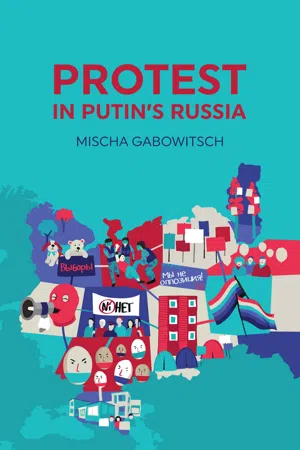
The Russian protests, sparked by the 2011 Duma election, have been widely portrayed as a colourful but inconsequential middle-class rebellion, confined to Moscow and organized by an unpopular opposition. In this sweeping new account of the protests, Mischa Gabowitsch challenges these journalistic clichés, showing that they stem from wishful thinking and media bias rather than from accurate empirical analysis. Drawing on a rich body of material, he analyses the biggest wave of demonstrations since the end of the Soviet Union, situating them in the context of protest and social movements across Russia as a whole. He also explores the legacy of the protests in the new era after Ukraine?s much larger Maidan protests, the crises in Crimea and the Donbass, and Putin?s ultra-conservative turn.
As the first full-length study of the Russian protests, this book will be of great value to students and scholars of Russia and to anyone interested in contemporary social movements and political protest.
- English
- ePUB (mobile friendly)
- Available on iOS & Android
eBook - ePub
Protest in Putin's Russia
About this book
Information
Chapter 1
Introduction: March of Millions
On 7 May 2012, Vladimir Putin was to be inaugurated for a third term as president of the Russian Federation. He had been head of state between 2000 and 2008, then spent four years as prime minister while the presidency was in the hands of his friend and long-standing collaborator Dmitry Medvedev. The elections to which he owed his return had taken place in unfair conditions and were accompanied by large-scale fraud. Activists of the extra-parliamentary opposition announced a demonstration to challenge his legitimacy, to take place on 6 May. The city authorities approved Bolotnaya Square as the venue for the rally – the place where the first massive protest against electoral fraud in the recent parliamentary election had taken place on 10 December 2011. The sprawling, park-like square is located in central Moscow, in plain view of the towers and spires of the Kremlin, normally a short walk away across the Great Stone Bridge. Its name literally means Swamp Square. In order to drain the swamps that would form there every spring when the snow melted, Moscow’s governor-general Count Zakhary Chernyshev and his successor, Count Yakov Bryus (James Bruce), had a canal dug between 1783 and 1786. The Drainage or Water Bypass Canal created an elongated, boomerang-shaped island roughly parallel to the Moskva River’s bend; Bolotnaya Square is located on the western half of that island. To the left, as one gazes from the south across the Great Stone Bridge towards the Kremlin, the legendary, now closed Udarnik cinema comes into view. The cinema is part of a monumental constructivist edifice, the House on the Embankment, which served as a luxurious abode to Communist Party functionaries after its completion in 1931, although many of them fell victim to Stalin’s Great Terror just a few years after moving in.1
Its central yet isolated and readily surveyable location makes Bolotnaya Square easy to police. The city administration therefore frequently reroutes opposition, civil rights and other protests there, often from more symbolic spots along Tverskaya Street in central Moscow, which starts opposite Manege Square in front of the Kremlin, intersects Pushkin Square on the Boulevard Ring, and reaches the Garden Ring at Triumph Square.
Causing dissent and derision among the protesters, not to mention their critics, the formal organizers had titled the demonstration the ‘Million-Strong March’ or ‘March of Millions’, in reference to events in Cairo on 1 February 2011 (rather than Washington, DC, in 1995). It was the first time since mass protests against electoral fraud began in December that citizens from provincial Russia were actively encouraged to come to Moscow instead of organizing parallel events at home. Participants came to Moscow by train, coach or plane, shared rides or hitchhiked, some of them from distant parts of Russia, all the way to Petropavlovsk-Kamchatsky, 6,000 kilometres away.2 Their primary means of communication was vkontakte or vk, a Facebook clone whose reach in the Russian-speaking world surpasses that of the original. Using vk, some participants organized cross-country motorcades to the capital. One such motorcade, titled ‘I want to see for myself what has become of the Motherland’, reportedly drew drivers from 55 cities, mostly supporters of the politician, esoteric folk healer and conspiracy theorist Svetlana Peunova.3
As early as April, an initiative had been set up in Samara on the Volga that collected donations online to enable volunteers from across Russia to travel to Astrakhan in the Volga Delta in support of mayoral candidate Oleg Shein, who had declared a hunger strike to protest against electoral fraud there. Shortly before the March of Millions the initiative was revived, this time in order to buy train tickets to Moscow for provincial dwellers.4 Many residents offered free accommodation to outside protesters, who often used regional networks to establish first contact with Muscovites originally hailing from their own cities. Even at the march itself people from the same region would find each other through posters or chance conversation. During and after the march, one could occasionally see elderly ladies with signs offering accommodation to non-Muscovites. There were regular reports of protesters from provincial Russia being intimidated by state bodies or their employers, prevented from travelling – with or without explanation – before they even set out, or stopped or shadowed by the police along the way. Drug checks often served as pretexts. There were also reports of men between the ages of 18 and 27 being drafted into the army immediately upon their arrest.5
The largest Moscow protests between December and March had been officially registered by a group that included many journalists and writers, who had formed a non-partisan Voters’ League in January. The discussions of the committee that had organized the mass rally on 24 December 2011 had been broadcast live online, and their correspondence with the authorities was also published. This time, only activists of the extra-parliamentary opposition acted as formal organizers.6 There was disagreement as to the purpose of the demonstration. An alliance titled ‘Campaign for Just Power’ had called for the occupation of Manege Square on the eve of the inauguration in order to prevent the ‘thief’ from even entering the Kremlin: real protest, the activists argued, should refuse to be squeezed into a policed reservation.7 A number of prominent figures, including members of the legal opposition parties, had declared that they would stay away from the march. The previous mass demonstrations, they said, had failed to attain the desired results, and now it was important to focus on other forms of protest, on painstaking everyday efforts or on forthcoming elections.8 The flamboyant writer and seasoned protester Eduard Limonov, leader of the unregistered Other Russia party, called the protest half-hearted and belated. Its bourgeois leaders, he wrote, had stolen and ‘flushed’ the revolution, giving the police enough time to seal off Manege Square and prevent a tent camp.9 The Communist Party, nostalgic for the Soviet Union, and several smaller left-wing groups focused on events for 1 May (Labour Day) or 9 May (Victory Day). A group of croppy-haired ultranationalists staged their own protest on Theatre Square on 6 May; as they exited the metro station, the police were already expecting them with a prison van.10 On Friday night, two days before the March of Millions, the All-Russian Popular Front had declared that it would celebrate its one-year anniversary on the same day on Poklonnaya Hill. This union of pro-Putin organizations, which largely existed on paper and had yet to hold its inaugural congress, had been founded the previous year as a potential replacement for the increasingly unpopular ruling United Russia party. It countered the protesters’ miting (meeting, or rally) with a tightly organized and policed Puting, which the news on state-controlled TV presented as the larger event and which included paid or coerced participants in addition to volunteers.11
Nevertheless, the March of Millions drew a great deal of attention. The formal organizers had applied to hold a 5,000 person rally for purely technical reasons: that is how much the square was supposed to hold according to the official density restrictions then in place. Inevitably, a number war broke out regarding the actual number of participants. The police spoke of 8,000; the BBC quoted 20,000 according to the organizers. The land surveyor Nikolai Pomeshchenko, who had come to specialize in calculating participant numbers at mass events over the course of the protest wave, counted approximately 60,000.12 What makes a high estimate plausible is that regular protest participants, organizers and the police all expressed surprise at the high turnout.13 After all, the date of the inauguration, as has been the tradition since Putin first acceded to the presidency in 2000, was two days before the Day of Victory in the Great Patriotic War of 1941–45, de facto Russia’s most important national holiday.14 The period starting on 1 May is traditionally seen as a holiday week, allowing those who can afford it to relax at the Turkish Riviera or spend time at their dacha. Pointing to forthcoming rehearsals for the Victory Day parade, Moscow’s city government had approved the protest only two days before 6 May. This caused speculation that the march could be cancelled or moved – which, according to many protesters, was exactly why the decision had taken so long.
Most of the participants who had assembled outside Oktyabrskaya metro station since mid-morning were not affiliated with any of the political groups represented by the organizers. Using banners, flags, posters, buttons, balloons, leaflets and costumes, they identified as residents of specific cities, as environmentalists, human rights defenders, LGBT rights advocates, supporters of social justice, left-wing activists, anti-WTO or anti-NATO protesters, ultranationalists and members of a wide range of mostly small political parties and associations. As at previous marches, there were a number of ultranationalists sporting black-gold-and-white tricolours; about 100 members of the fringe Great Russia party left in protest after making a quick appearance at the beginning of the march and shouting anti-liberal slogans.15 The majority, however, brought no distinguishing signs, or wore only the white ribbon that had become the main symbol of the electoral protests since December, and, for some, the black-and-orange St George’s Ribbon for Victory Day. The signs, too, overwhelmingly featured individually worded messages rather than standard slogans. There were many elderly protesters, some children, and several disabled people in wheelchairs. In addition to dozens if not hundreds of journalists with professional equipment, there were thousands of citizen reporters with cameras or mobile phones. Many of them started posting images on Facebook, vk or twitter at the beginning of the march, or offered live broadcasts on UStream. On the platform inside the metro station, social scientists were trying to determine the ratio of lone protesters and groups during a given period in the stream of those arriving. Professional ethnographers, political scientists and sociologists, myself among them, as well as amateur researchers mingled with the crowd or stood at the roadside – observing, counting, comparing; taking pictures, notes and interviews. Several hundred policemen clad in the riot gear of the OMON special units accompanied the march; many of them were stationed in closed ranks on the island, backed by soldiers of the Internal Troops with armoured vehicles blocking the Great Stone Bridge. Officers in plain clothes were instructing the police, and some of them positioned themselves at the start and end points of the march.16 Some policemen were also equipped with cameras or small camcorders. A helicopter was circling above the crowd.
Following a shower of rain, the sky turned a brilliant shade of blue. At 20 degrees centigrade, the weather was almost summery. The procession filtered through a battery of metal detectors before walking almost two kilometres down Yakimanka and Bol’shaya Polyanka Street to Bolotnaya Square, recreating the non-confrontational atmosphere that had become the hallmark of the protest movement since the previous winter. Small provocations could not sully the mood: thus, someone had paid a group of drunk homeless people to bawl loudly in front of TV cameras near the rallying point, but marchers hardly paid them any attention. The ‘march’ resembled a giant spring stroll. Some groups would repeatedly break into chanting. Popular slogans included ‘Thieves and crooks, you have five minutes to pack your things!’ and ‘We are the power!’ – allusions to well-known quotes by the national-liberal anti-corruption blogger Aleksey Navalny. A group of nationalist temperance activists chanted ‘Russian means sober’. A neighbouring column of LGBT activists shouted ‘F...
Table of contents
- Cover
- Dedication
- Title Page
- Copyright
- Acknowledgements
- Note on the English edition
- 1 Introduction: March of Millions
- 2 Putin’s Regimes
- 3 Insurgent Observers
- 4 Scenes and Solidarities: Opposition and Grassroots Protesters Before 2011–13
- 5 Crossed Purposes: Opposition and Grassroots Protesters in the 2011–13 Protest Wave
- 6 Pussy Riot and Beyond: Art, Religion and Gender Regimes in Russian Protest
- 7 Cognitive Spaces of Protest
- 8 The Transnational Dimension
- 9 Conclusion: Protest in Putin’s Third Term
- Bibliography
- Index
- End User License Agreement
Trusted by 375,005 students
Access to over 1.5 million titles for a fair monthly price.
Study more efficiently using our study tools.
Frequently asked questions
Yes, you can cancel anytime from the Subscription tab in your account settings on the Perlego website. Your subscription will stay active until the end of your current billing period. Learn how to cancel your subscription
No, books cannot be downloaded as external files, such as PDFs, for use outside of Perlego. However, you can download books within the Perlego app for offline reading on mobile or tablet. Learn how to download books offline
Perlego offers two plans: Essential and Complete
- Essential is ideal for learners and professionals who enjoy exploring a wide range of subjects. Access the Essential Library with 800,000+ trusted titles and best-sellers across business, personal growth, and the humanities. Includes unlimited reading time and Standard Read Aloud voice.
- Complete: Perfect for advanced learners and researchers needing full, unrestricted access. Unlock 1.5M+ books across hundreds of subjects, including academic and specialized titles. The Complete Plan also includes advanced features like Premium Read Aloud and Research Assistant.
We are an online textbook subscription service, where you can get access to an entire online library for less than the price of a single book per month. With over 1.5 million books across 990+ topics, we’ve got you covered! Learn about our mission
Look out for the read-aloud symbol on your next book to see if you can listen to it. The read-aloud tool reads text aloud for you, highlighting the text as it is being read. You can pause it, speed it up and slow it down. Learn more about Read Aloud
Yes! You can use the Perlego app on both iOS and Android devices to read anytime, anywhere — even offline. Perfect for commutes or when you’re on the go.
Please note we cannot support devices running on iOS 13 and Android 7 or earlier. Learn more about using the app
Please note we cannot support devices running on iOS 13 and Android 7 or earlier. Learn more about using the app
Yes, you can access Protest in Putin's Russia by Mischa Gabowitsch in PDF and/or ePUB format, as well as other popular books in Politics & International Relations & Politics. We have over 1.5 million books available in our catalogue for you to explore.