- English
- ePUB (mobile friendly)
- Available on iOS & Android
eBook - ePub
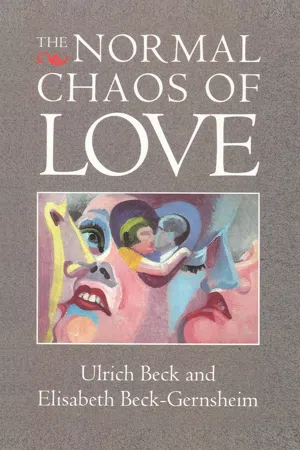
The Normal Chaos of Love
About this book
This is a brilliant study of the nature of love in modern society. Ulrich Beck and Elisabeth Beck-Gernsheim argue that the nature of love is changing fundamentally, creating opportunities for democracy or chaos in personal life.
Information
1
LOVE OR FREEDOM
Living together, apart or at war
Freedom, equality and love
One can love all sorts of things and people: Andalusia, one’s grandmother, Goethe, black fishnet stockings against white skin, cheese sandwiches, the warm smile of a bosomy woman, fresh rolls, the movement of clouds and legs, Erna, Eva, Paul, Heinz-Dietrich – and one can do all this simultaneously, successively, excessively, silently, with hands, teeth, words, looks and great intensity. But sexual love (whatever form it takes) is so overwhelmingly powerful, so engrossing that we often reduce the vast range of our loving potential to longing for a caress, a word, a kiss – need I go on?
The everyday battle between the sexes, noisy or muted, inside, outside, before, after and alongside marriage is perhaps the most vivid measure of the hunger for love with which we assault each other. ‘Paradise now!’ is the cry of the worldly whose heaven or hell is here or nowhere. The cry echoes in the rage of the frustrated and those in pursuit of freedom, knowing that freedom plus freedom does not equal love, but more likely means a threat to it or even its end.
People marry for the sake of love and get divorced for the sake of love. Relationships are lived as if they were interchangeable, not because we want to cast off our burden of love but because the law of true love demands it. The latter-day tower of Babel built on divorce decrees is a monument to disappointed, overrated love. Even cynicism sometimes fails to conceal that it is an embittered late variant of love. People raise the drawbridges of their longings because this seems the only, the best way of protecting themselves against unbearable pain.
A lot of people speak of love and family as earlier centuries spoke of God. The longing for salvation and affection, the fuss made over them, the unrealistic pop-song truisms hidden deep in our hearts – all this smacks of religiosity, of a hope of transcendence in everyday life (see the extensive discussion on this point in chapter 6 below).
This residual and new secular religion of love leads to bitter religious controversies between two sides determined to defend their individuality, fought out in the privacy of the home or in the offices of divorce lawyers and marriage counsellors. In these modern times our addiction to love is the fundamentalist belief to which almost everyone has succumbed, especially those who are against fundamentalist creeds. Love is religion after religion, the ultimate belief after the end of all faith (this analogy is elucidated in chapter 6 below). It fits in with our environment about as well as the Inquisition would with an atomic power station, or a daisy with a rocket to the moon. And still love’s icons blossom in us, watered by our deepest wishes.
Love is the god of privacy. ‘Real socialism’ may have vanished with the Iron Curtain, but we are still living in the age of real pop lyrics (see ‘Romanticism now: love as a pop song’ in chapter 6 below). Romanticism has won and the therapists are raking it in.
The meaning of existence has not been lost; life is not hollow, at least under the lure and pressure of daily life. Some powerful force has pushed its way in and filled up the gap where, according to previous generations, God, country, class, politics or family were supposed to hold sway. I am what matters: I, and You as my assistant; and if not You then some other You.
Love however should on no account be equated here with fulfilment. That is its glowing side, the physical thrill. Even Eros’s powerful allure, its hidden promises awakening our lust, suggesting delights both novel and familiar, does not mean fulfilment, or even require it. Achieving the goal often turns the sight of the flesh which seemed so delightful a moment ago into an alien white mass shorn of any appeal with the clothes so perfunctorily stripped off it.
How easily having one’s hopes fulfilled can turn into a chilly gaze! Where only a moment ago overwhelming urgency made a knotted tangle of two walking taboos, merging me and you, all boundaries gone, now we are staring at one another with critical eyes, rather like meat inspectors, or even butchers who see the sausages where others see cattle and pigs.
Anyway there is little hope for anyone who confuses storming the heights with living on the plains, surrounded by the bogs and pitfalls of love. Love is pleasure, trust, affection and equally their opposites – boredom, anger, habit, treason, loneliness, intimidation, despair and laughter. Love elevates your lover and transforms him/her into the source of possible pleasures where others only detect layers of fat, yesterday’s stubble and verbosity.
Love knows no grace, however, nor does it stick to vows or keep contracts. Whatever is said, intended or done is no more inevitably linked than the movements of mouth or hands are with other parts of the body. In what court can a spurned or misunderstood lover sue for his/her rights? Who says what is just or true or right in matters of love?
Previous generations hoped and believed that if both sexes were given a sense of freedom and equality then true love would blossom in all its radiance, heartbreak and passion; love and inequality are after all as mutually exclusive as fire and water. Now that we seem to have caught hold of at least the tip of this ideal, we find ourselves faced with the opposite problem: how can two individuals who want to be or become equals and free discover the common ground on which their love can grow? Among the ruins of outdated lifestyles freedom seems to mean breaking out and trying something new, following the beat of one’s own drum, and falling out of step with the rest.
Perhaps the two parallel lines will eventually meet, in the far distant future. Perhaps not. We shall never know.
The current situation in the gender struggle
It took two thousand years for people to even begin to suspect the consequences of that mighty message, ‘all men are equal.’ Only a second later in historical terms, after two decades they are beginning to realize to their horror: ‘and so are women.’
If only it were just a question of love and marriage. But one cannot any longer define the relationships between the sexes just in terms of what they seem to involve – sex, affection, marriage, parenthood and so on: one has to include everything else such as work, profession, inequality, politics and economics. It is this unbalanced conglomeration of so many disparate elements which makes the issue so complicated. Anyone discussing the family has to include jobs and income, and anyone talking about marriage has to look into education, opportunities and mobility, and in particular into how unevenly these are distributed, despite the fact that by now women often have the same qualifications as men.
Looking at the state of inequality between men and women from various angles, can one discern any changes over the past decade or two? The findings are ambiguous. On the one hand there have been great upheavals, especially where sex, law and education are concerned. On the whole the changes, except the sexual ones, are discernible more as attitudes and on paper than as facts. On the other hand there is a striking lack of change in the way men and women behave, particularly on the job market and in their insurance and pension cover. The result is somewhat paradoxical: the more equal the sexes seem, the more we become aware of persistent and pernicious inequalities between them.
This mixture of new attitudes and old conditions is an explosive one in a double sense. Better educated and informed young women expect to be treated as partners in professional and private life but come up against the opposite tendencies in the labour market and their male colleagues. Conversely, men have glibly preached equality without matching their words with deeds. The ice of illusion is wearing thin on both sides; the sexes are equally well qualified and enjoy the same legal rights, yet the inequalities are on the increase, all of us realize this, and there is no longer the slightest legitimation for this state of affairs. There is a sharpening contradiction between women’s ambitions to live as equals with their mates and colleagues and the actual conditions confronting them, between male slogans on mutual responsibility and their unwillingness to alter their daily routine a jot. We seem to be right at the very beginning of a breakaway from the old feudal patterns, with all the antagonisms, openings and contradictions such a move implies. Women’s awareness is far ahead of the actual conditions; it is very unlikely that anyone can turn this clock back. The prognosis is that we are in for a long and bitter battle; in the coming years there will be a war between men and women. Here are some data from widely different fields to illustrate the current situation, and some theoretical considerations.
Sex and marriage
In almost all Western countries there are signals in the form of high divorce figures. Although Germany still has relatively low figures compared, say, with the USA, even here almost every third marriage ends in divorce (in large cities almost every second marriage, and in small towns and rural areas roughly every fourth). While the statistics for divorce rates show a slight drop since 1985,1 divorces in long-standing marriages have increased considerably.2 At the same time the divorce rate for second marriages is rising, as is that for couples with children. The jungle of parental relationships is growing accordingly: my children, your children, our children, with all the different rules, reactions and battlegrounds for everyone concerned.
The official divorce figures are, however, far exceeded by the sharp rise in ‘informal marriages’. Estimates speak of 2.5 to 3 million people living ‘in sin’ in (then West) Germany in 1989.3 The increase in the numbers of illegitimate children points in the same direction; in 1967 they constituted 4.6% of all children; by 1988 this figure had risen to 10% (in Sweden it had reached 46%).4 There are however no statistics on divorce for such informal unions available. And it is not just that the proportion of people choosing to live together in this way has quadrupled over the past decade. What is astonishing is how widely accepted this ‘common law marriage’, so vehemently opposed right up to the 1960s, has become. The tempo of change is perhaps indicated less in the phenomenon in itself than in the fact that an unofficial, untraditional living pattern has been established.
In the 1960s family, marriage and job were still regarded as solid cornerstones for constructing a proper biography. In the meantime questions and choices have emerged at every turn. It is no longer clear whether one should get married or live together, whether one should conceive and raise a child inside or outside the family, whether the father is the man one should live with or the man one loves who is living with someone else or whether one should do any of these things before, after or while concentrating on one’s career.
All such agreements can be cancelled and therefore depend on both parties legitimating them and the more or less unequal burdens they imply. This can be understood as a decoupling and differentiation of behaviours and attitudes which used to belong to marriage and family life. As a result it is becoming more and more difficult to relate the concepts to reality. Using uniform terms such as family, marriage, parenthood, mother, father and so on disguises the growing diversity of the lives concealed behind them (divorced fathers, fathers of only children, single fathers, fathers of illegitimate children, foreign fathers, stepfathers, house-keeping fathers, flat-sharing fathers, weekend fathers, fathers with a working wife, and so on; see Rerrich 1989, and chapter 5 below).
The direction in which society is developing is also shown by the composition of the households; more and more people are living alone. The proportion of single-person households in Germany already exceeds one in three (35%). In urban centres such as Frankfurt, Hamburg or Munich the proportion is around 50% and still rising. In 1900 there were five or more people in 44% of all private households; that group accounted for only 6% in 1986. By contrast, two-person households increased from 15% in 1900 to 30% in 1986. In the late 1980s, then, in Germany some 9 million people (roughly 15% of the population) were living alone – and the increase continues. Only slightly more than half of these are people who fit the stereotype ‘single’ – young, unmarried professional. The rest are elderly surviving spouses, mainly women.5 It would be a mistake to interpret such tendencies along simple lines as growing anarchy and fear of commitment in the relationships between men and women. There is also the opposite trend. The divorce figures of one in three means that two in three ‘normal marriages’ and families still exist (whatever may be concealed behind the term). It is true that there have been astounding changes in sexual behaviour in a single generation, especially among girls and women. It used to be only the young men who were allowed to ‘sleep around’ and then only unofficially, and accompanied by a smirk. Today well over half of all girls (61%) think it is important for women to try out sex. Half of them see a certain attraction in having two boyfriends at the same time (Seidenspinner and Burger 1982: 30). But these figures should not deceive us; in fact the new codes of behaviour have their own strict norms. The majority of young people – even though they reject marriage and the family as a model for their own lives – seek emotional commitment. Even nowadays a stable partnership is their ideal and aim, ‘faithfulness often seems to be taken for granted, without the official pressures of laws and religious beliefs’ (Allerbeck and Hoag 1985: 105). So it is not clear where all this is leading to, and the answer to that popular question ‘Is the family on its way out?’ is a mixture of yes and no.
Education, the job market and employment
Although the constitution of the Federal Republic of Germany guaranteed women full legal equality with men, some important forms of discrimination against them were removed only in 1977 when the new marriage and family laws came into force. On paper there are now no reasons whatsoever for treating men and women differently. Women are permitted to retain their maiden names; their responsibility for the family and children, previously laid down by law, has been abolished, and who runs the household is a matter of discussion between the spouses. Likewise, both are entitled to work outside the home. Care of the children is the responsibility of both father and mother, who ‘must attempt to reach an agreement’, as the law puts it, in the event that they differ on this matter (see Beyer, Lamott and Meyer 1983: 79).
Alongside these far-reaching reforms on behalf of women’s rights probably the most striking change in post-war Germany, an almost revolutionary development, is that girls and young women have access to all forms of education and training. Right up to the 1960s discrimination against women in the educational field was self-evident (surprisingly, it was more pronounced in the upper classes). By 1987 the girls had virtually caught up with the boys and were in the majority as secondary school-leavers (53.6%).
Some changes however run counter to this trend. Vocational training still shows a strong gender bias (early in the 1980s 40% of female workers but only 21% of male workers had no official qualifications). The willingness of girls leaving secondary school to go on to university has also declined over the past ten years from 80% to 63% (for young men the figures have declined from 90% to 73%).6 Female students continue to prefer certain disciplines (almost 70% choose the humanities, languages or pedagogy) and women entering teaching tend to qualify for ‘lower’ schools.7
Nevertheless, compared with circumstances twenty years ago it is no exaggeration to say that the field of education has become feminized. The trouble is that this educational revolution has not been followed by one in the labour market or the employment system. On the contrary, the doors opened by better education are ‘slammed shut again … in the employment and labour market’ (Seidenspinner and Burger 1982: 11). The slight rise in the numbers of women in ‘male’ professions contrasts with their massive displacement in all other areas. The integration of women into careers which was demanded (and encouraged) in the 1970s continues to follow the ‘feudal gender pattern’ of an inverted hierarchy: the more central to a society an area is defined to be, the less women are represented in it, and conversely, the more marginal an activity is considered to be and the less influential a group is, the higher the probability that women have taken over positions within it. The relevant data show this to be true in all areas – politics, business, higher education, the mass media and so on.
It is still exceptional to find a woman in a top position in politics. While the representation of women in all decision-making bodies has increased since 1970, the proportion of women decreases the closer one gets to the centres of policy-making. The Social Democratic Party’s rules on quotas for women aim at circumventing just this phenomenon; it remains to be seen whether it will have any effect. So far women have most easily gained access to party committees (from roughly 14% in 1970 to 20.5% in 1982). The proportion of women in parliaments has increased from top to bottom; it is highest at the municipal level (the proportion of women in provincial parliaments varies between 6% and 15%; women represent between 9.2% and 16.1% of the members of town and county councils).
In business there are very few women in positions of real influence, while their representation in less influential jobs (personnel offices, for instance) is much larger. The picture in the legal system is quite similar, if at a slightly higher level. The proportion of women is much higher here (in 1979, for instance, 10% of the public prosecutors were women, in 1987 16% (Federal Office of Statistics 1988: 30). But in the federal courts, ‘the places where the significant legal decisions are made, where society’s course is charted for the next decades, women have (almost) no place’ (Wiegmann 1979: 130).
In higher education women are still the exception at the top of the salary pyramid; in 1986 out of a total of 9956 top-ranking and highest-paid professorships only 230 were occupied by women. Further down the scale the proportion steadily increases, and is considerably higher in less well-paid teaching posts, the insecure mid-level positions and among academic assistants, especially in ‘marginal fields’.8 The same picture can be found in the mass media; the higher one climbs, the less say women have. If they are active in television, then it is primarily as assistants and in light entertainment departments, and less in the important political and economic ones, and hardly ever in the upper echelons where policy is made (Feder...
Table of contents
- COVER
- CONTENTS
- TITLE PAGE
- COPYRIGHT
- AUTHORS’ NOTE
- INTRODUCTION
- 1 LOVE OR FREEDOM
- 2 FROM LOVE TO LIAISON
- 3 FREE LOVE, FREE DIVORCE
- 4 ALL FOR LOVE OF A CHILD
- 5 EVE’S LATE APPLE
- 6 LOVE, OUR SECULAR RELIGION
- NOTES
- BIBLIOGRAPHY
- INDEX
Trusted by 375,005 students
Access to over 1.5 million titles for a fair monthly price.
Study more efficiently using our study tools.
Frequently asked questions
Yes, you can cancel anytime from the Subscription tab in your account settings on the Perlego website. Your subscription will stay active until the end of your current billing period. Learn how to cancel your subscription
No, books cannot be downloaded as external files, such as PDFs, for use outside of Perlego. However, you can download books within the Perlego app for offline reading on mobile or tablet. Learn how to download books offline
Perlego offers two plans: Essential and Complete
- Essential is ideal for learners and professionals who enjoy exploring a wide range of subjects. Access the Essential Library with 800,000+ trusted titles and best-sellers across business, personal growth, and the humanities. Includes unlimited reading time and Standard Read Aloud voice.
- Complete: Perfect for advanced learners and researchers needing full, unrestricted access. Unlock 1.5M+ books across hundreds of subjects, including academic and specialized titles. The Complete Plan also includes advanced features like Premium Read Aloud and Research Assistant.
We are an online textbook subscription service, where you can get access to an entire online library for less than the price of a single book per month. With over 1.5 million books across 990+ topics, we’ve got you covered! Learn about our mission
Look out for the read-aloud symbol on your next book to see if you can listen to it. The read-aloud tool reads text aloud for you, highlighting the text as it is being read. You can pause it, speed it up and slow it down. Learn more about Read Aloud
Yes! You can use the Perlego app on both iOS and Android devices to read anytime, anywhere — even offline. Perfect for commutes or when you’re on the go.
Please note we cannot support devices running on iOS 13 and Android 7 or earlier. Learn more about using the app
Please note we cannot support devices running on iOS 13 and Android 7 or earlier. Learn more about using the app
Yes, you can access The Normal Chaos of Love by Ulrich Beck,Elisabeth Beck-Gernsheim in PDF and/or ePUB format, as well as other popular books in Social Sciences & Sociology. We have over 1.5 million books available in our catalogue for you to explore.