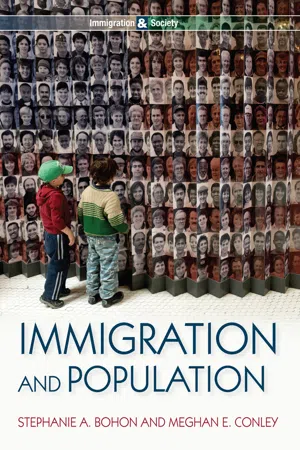
Immigration is the primary cause of population change in developed countries and a major component of population change in many developing countries. This clear and perceptive text discusses how immigration impacts population size, composition, and distribution. The authors address major socio-political issues of immigration through the lens of demography, bringing demographic insights to bear on a number of pressing questions currently discussed in the media, such as: Does immigration stimulate the economy? Do immigrants put an excessive strain on health care systems? How does the racial and ethnic composition of immigrants challenge what it means to be American (or French or German)?
By systematically exploring demographic topics such as fertility, health, education, and age and sex structures, the book provides students of immigration with a broader understanding of the impact of immigration on populations and offers new ways to think about immigration and society.
Reyna works at a grocery store in a small town in the Appalachian Mountains. An immigrant of Turkish descent, she entered the United States about 10 years ago. Although her foreign accent is unmistakable, Reyna speaks fluent English, and she is polite and pleasant to her customers. Having worked her way up from an entry-level position, she is currently training to manage her own store in the grocery’s chain, and she has just purchased her first home.
Much about Reyna’s story epitomizes the classic stereotype of the hardworking immigrant striving for a better life in a new country. At the same time, her story also illustrates today’s complicated global web of international migration, in which place of birth and ethnic identity often differ and immigrants sometimes have experiences of living in three or more countries. For example, Reyna often returns to Turkey to visit relatives, but she was not born in Turkey, nor has she ever lived there. Reyna was born in Germany, where Turks are the largest ethnic minority and comprise about 5 percent of the German population (Şen 2003). Reyna is one of nearly 43 million immigrants living in the United States and one of nearly 49 million Americans who are associated with German–US immigration either by immigrating directly from Germany or by being the descendants of German immigrants. Yet, she is not German. She is one of only a relatively small number of US immigrants of West Asian / Middle Eastern descent (United Nations 2011).
The story of people like Reyna underscores that there is no universal “immigrant experience” in today’s globalized world; rather, there are as many immigrant experiences as there are immigrants. Despite this, there are important trends in immigration, and immigrants share several characteristics. First, many people today live in a country other than the one where they were born. Most of these immigrants reside in the developed world (nearly 128 million in 2009) in the 34 wealthiest countries that comprise the Organization for Economic Co-operation and Development (OECD). OECD countries are home to nearly 60 percent of all immigrants. In fact, about 9 percent of the population of OECD countries is comprised of immigrants, although immigrants comprise only 3 percent of the world’s total population (United Nations 2011). Most immigrants migrate to developed countries from other developed countries; increasingly, however, immigrants are also migrating to developed countries from developing countries (OECD 2007). The developing world is also home to a smaller but still sizable number of immigrants (just over 86 million in 2009: United Nations 2011). This book focuses exclusively on immigration to developed countries, especially emphasizing the United States, which is the world’s biggest immigrant receiver.
Second, immigration typically flows along network lines shaped by cultural, geographic, and historical conditions (Gurak and Caces 1992; McKenzie and Rapoport 2010). Thus, many people from the Middle East immigrate to the European Union, especially France and Germany, but far fewer Middle Easterners immigrate to the United States (Foad 2010). At the same time, many Asian immigrants settle in English-speaking countries, and there are large East and Southeast Asian populations in the United Kingdom, United States, Canada, and Australia. Network migration also explains why immigrants end up in some parts of a host country instead of others. For example, in the early 1900s, the demand for sheepherders resulted in the migration of many people from the Pyrenees Basque Country of Spain and France to southern Idaho; today, Idaho is home to the largest population of Basque people outside of their homeland (Bieter and Bieter 2004).
Third, immigrants are not the same as those they leave behind (Kennedy, McDonald, and Biddle 2006; Belot and Hatton 2012). The process of immigration is difficult and it requires considerable financial, intellectual, and physical capital, as well as a willingness to take risks. For example, immigrants tend to be slightly better educated than the non-immigrants they leave behind (Feliciano 2005). Also, the further immigrants migrate, the greater the selection effect (ibid.). A selection effect is a term social scientists use to describe groups who behave differently from others because they are different (Jasso 1988; Rumbaut 1997a). Among immigration scholars, selection refers to systematic differences between the group of people from a country who emigrate and those who stay at home. These differences include measurable qualities, such as educational attainment and income, as well as traits that are difficult to quantify, such as ambition, risk-aversion, and optimism. For example, few young people in India have a college education (World Bank 2012), whereas 80 percent of Indian immigrants and their descendants living in the United States do (KewalRamani et al. 2007).
Fourth, differences in the liberalness of immigrant laws results in some countries receiving large populations of immigrants, while other countries are home to relatively few. Germany, for example, hosts as many immigrants (nearly 11 million in 2009) as eight of its border countries (Netherlands, Denmark, Poland, Czech Republic, Austria, Switzerland, Luxembourg, and Belgium) combined (United Nations 2011). Still, Germany has far fewer immigrants than the United States and Russia (Freeman 2006). The United States – the world’s largest immigrant-receiving country – was home to more than 40 million immigrants in 2010 (Grieco et al. 2012). In contrast, Japan and Korea accept relatively few immigrants (United Nations 2011).
Although the United States has more foreign-born residents than any other country in the world (United Nations 2013), it does not have the highest proportion of immigrants relative to the general population. About 13 percent of US residents are immigrants, outpacing the foreign-born percentages in France and Italy, where immigrants account for 11.1 and 8 percent, respectively, of the total population (Vasileva 2011). Still, more than 16 percent of Germany’s population is foreign-born, while a whopping 42.4 percent of Luxembourg’s population is foreign-born (OECD 2013). In fact, as a percentage of the total population, the foreign-born population of the United States is comfortably in the middle of the OECD countries. Luxembourg, Australia, Switzerland, Israel, New Zealand, Canada, Belgium, Spain, Ireland, Germany, Estonia, Austria, and Sweden all have a greater proportion of foreign-born residents than the United States (ibid.). The biggest immigrant receivers – in terms of their proportion in the general population – are in the Middle East, and some Middle Eastern countries have more immigrants than natives (United Nations 2011). The biggest proportionate receivers are, in order, Qatar (87 percent immigrant), the United Arab Emirates (70 percent), Kuwait (69 percent), Jordan (46 percent), and the occupied Palestinian territory (44 percent).
Types of immigration
Although “immigrant” refers generally to those who live in a country outside of their country of origin, some countries identify a broad array of immigrant statuses. For example, immigrants in the United States can be lawful permanent residents – those who are allowed to reside and work permanently in the United States; conditional permanent residents – those who have applied for, but not yet received, lawful permanent residence; and refugees and asylees. The United States also offers several types of non-immigrant visas – such as student, visitor, and certain employment visas – which temporarily authorize people to study, visit, or work in the country under certain circumstances, but not to remain for long periods of time. In some countries, including the United States, some immigrants have the opportunity to become citizens. This process is known as naturalization.
Immigrants can also be unauthorized or irregular, meaning that they lack permission to be in their host country. The term unauthorized is the official term used by US government agencies; the United Nations uses the term irregular in its publications, but the two terms are synonyms. In 2011, the unauthorized population in the United States totaled an estimated 11.1 million people – including approximately 1 million children under the age of 18 – and comprised 3.7 percent of the total US population (Hoefer, Rytina, and Baker 2012). In contrast, countries in the European Union host approximately 1.9 to 3.8 million irregular immigrants (Morehouse and Blomfield 2011), despite the fact that the European Union is more populous than the United States. The vast majority of unauthorized immigrants in the United States originate from Latin America. As of 2010, approximately 58 percent (6.5 million) of unauthorized immigrants in the United States originated from Mexico, while another 23 percent came from other countries in Latin America (Hoefer, Rytina, and Baker 2012). In contrast, the vast majority of irregular migrants to Europe in recent years have originated from Afghanistan, Albania, Iraq, the Palestinian territories, and Somalia (Morehouse and Blomfield 2011). Although the sending countries have not changed, in recent years, the numbers of unauthorized or irregular status migrants have declined in both the United States and Europe.
Table 1.1 Type of immigrants by legal status and motivation to migrate
Legal status
Authorized
Naturalized
An immigrant who has been granted citizenship in his/her host country
Lawful permanent resident
An immigrant who is allowed to work and reside permanently in his/her host country
Conditional permanent resident
An immigrant who has applied for, but not yet received, lawful permanent residence or asylum
Non-immigrants
Immigrants holding visas to visit, study, or engage in work in their host country for a specified period of time
Unauthorized
Irregular
An immigrant who does not have permission to reside in his/her host country
Motivation
Voluntary
Economic
A person who immigrates for reasons of work
Family reunification
A person who immigrates in order to form a family or to join family members
Involuntary
Refugees
A person seeking shelter in a host country in order to escape political violence, environmental devastation, or other life-threatening conditions
Asylees
A person living in a host country who has been granted permission to do so based on meeting refugee criteria
Trafficked
A person coerced or forcibly taken into a host country for illicit purposes
Countries admit immigrants for three reasons: labor market needs, the perceived value of family reunification, and humanitarian concerns (Cobb-Clark 2003). These criteria are prioritized differently across time and place, so the type and number of immigrants received can differ considerably from country to country and over time. Immigrants contribute to foreign economies by filling vacant jobs. Thus, many countries design immigration policies to give preferential admission to immigrants who can provide labor for jobs that natives cannot fill. For example, many chemists working in the United States, including many who received advanced degrees from US universities, are from countries such as China, Germany, and the Philippines (National Research Council 2007). The majority of immigrants moving from developing to developed countries are economic (or labor) migrants (Martin, Abella, and Kuptsch 2006). These are people whose decision to immigrate is primarily motivated by the desire to improve their economic situation by obtaining a better or higher-paying job. Most immigration between developed countries is also labor migration; transnational corporations may move workers overseas or white-collar workers might take advantage of opportunities abroad in their field.
Legal consequences of unauthorized status in the United States and Europe
In the United States, unauthorized status is largely treated as a violation of civil immigration law, rath...
Table of contents
Cover
Title Page
Copyright
Dedication
Acknowledgements
1 The Demography of Immigration
2 Assimilation, Adaptation, and Integration
3 Immigrants in the Economy
4 Immigration and the Environment
5 The Fertility of Immigrants
6 Replacement Migration to Offset Population Aging
7 Immigrant Health
8 Educating Children in Immigrant Families
9 Conclusions
References
Index
End User License Agreement
Trusted by 375,005 students
Access to over 1.5 million titles for a fair monthly price.
Study more efficiently using our study tools.
Frequently asked questions
Yes, you can cancel anytime from the Subscription tab in your account settings on the Perlego website. Your subscription will stay active until the end of your current billing period. Learn how to cancel your subscription
No, books cannot be downloaded as external files, such as PDFs, for use outside of Perlego. However, you can download books within the Perlego app for offline reading on mobile or tablet. Learn how to download books offline
Perlego offers two plans: Essential and Complete
Essential is ideal for learners and professionals who enjoy exploring a wide range of subjects. Access the Essential Library with 800,000+ trusted titles and best-sellers across business, personal growth, and the humanities. Includes unlimited reading time and Standard Read Aloud voice.
Complete: Perfect for advanced learners and researchers needing full, unrestricted access. Unlock 1.5M+ books across hundreds of subjects, including academic and specialized titles. The Complete Plan also includes advanced features like Premium Read Aloud and Research Assistant.
Both plans are available with monthly, semester, or annual billing cycles.
We are an online textbook subscription service, where you can get access to an entire online library for less than the price of a single book per month. With over 1.5 million books across 990+ topics, we’ve got you covered! Learn about our mission
Look out for the read-aloud symbol on your next book to see if you can listen to it. The read-aloud tool reads text aloud for you, highlighting the text as it is being read. You can pause it, speed it up and slow it down. Learn more about Read Aloud
Yes! You can use the Perlego app on both iOS and Android devices to read anytime, anywhere — even offline. Perfect for commutes or when you’re on the go. Please note we cannot support devices running on iOS 13 and Android 7 or earlier. Learn more about using the app
Yes, you can access Immigration and Population by Stephanie A. Bohon,Meghan E. Conley in PDF and/or ePUB format, as well as other popular books in Social Sciences & Demography. We have over 1.5 million books available in our catalogue for you to explore.