eBook - ePub
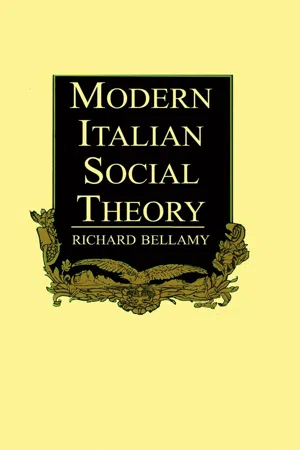
Modern Italian Social Theory
Ideology and Politics from Pareto to the Present
- English
- ePUB (mobile friendly)
- Available on iOS & Android
eBook - ePub
About this book
This text provides a clear and systematic introduction to the development of social and political theory in modern Italy. It gives particular attention to relating the main traditions of Italian thought to the history of the country since unification. The work concentrates on six major thinkers, examining how their theoretical ideas influenced their analysis of political behaviour. The thinkers concerned are Pareto, Mosca, Labriola, Croce, Gentile and Gramsci. In discussing the respective theories of each author, the book situates them within the intellectual and social contexts to which they were addressed. The concluding chapter focuses on the recent debates between Bobbio, della Volpe and others about the validity of the Italian road to socialism and its compatibility with the liberal values and institutions of Western democracies.
Information
1
INTRODUCTION
The unification of Italy – making the ideal real
The unification of Italy – making the ideal real
The Italian state existed as a theoretical ideal long before it became a practical reality. Nineteenth-century Italian social and political theorists concentrated on constructing and agitating for an ideal Italian state united more by a shared culture than by common political institutions. They blamed the social and economic differences between classes and regions on the largely foreign-backed regimes which governed the various parts of the peninsula. When unification was achieved finally in 1861, it seemed to many intellectuals that, in the words of Carducci, ‘the epoch of the infinitely great had been followed by the farce of the infinitely small …’1 Disillusionment and dissatisfaction with the reality of the political settlement linked thinkers of all ideological and methodological persuasions. For the earlier ideal continued to inspire the ideas and actions of Italian social theorists, although they had to turn their attention to finding new explanations to account for its failure to materialize. Thus fifty years later, when the editor of the Florentine journal La Voce sought a phrase representative of the diverse aspirations of his contributors,2 he chose the words of Giovanni Amendola – ‘The Italy of today does not please us’ (L’Italia com’è oggi non ci piace).3 As I shall show below, the divergence between ‘the higher concept of life and individual morality’ of the intellectual elite and the values governing Italian political life formed a constant theme in the culture of modern Italy,4 and the tension between theory and practice became the main preoccupation of political thinkers from the Risorgimento to the Second World War.
I
This book provides an outline of the principal texts of the six main social and political theorists of this period: Pareto, Mosca, Labriola, Croce, Gentile and Gramsci, and a chapter on a discussion between two philosophers writing after 1945, della Volpe and Bobbio, concerning the policies of the Italian Communist Party. As such, I cannot pretend to offer a complete history of modern Italian social theory.5 However, I have not restricted myself simply to giving an account of the major works of the thinkers under consideration either. Some people conceive social theory as timeless ruminations on the eternal problems of political organization. Others, whilst acknowledging recurrent themes in the history of social thought, regard it as addressing a particular set of issues arising out of a given society at such-and-such a time.6 In adopting this latter approach, I consider two factors which served to place a range of problems on the agenda of Italian social theorists. The first is the social and economic condition of contemporary Italy, and the development of political institutions since 1870. The second is the intellectual tradition in which they thought and wrote. The questions they posed themselves were constrained and in part constituted by the norms of current political discourse. As a result, issues and difficulties which seem central to us today often did not arise for them, whilst they concentrated on many areas peripheral to or ignored by current social theorists. Reconstructing the political and intellectual contexts of the principal writings examined here has made it necessary to advert to more ephemeral literature, both by the chief protagonists and other, lesser, figures. A more complex history of Italian politics and ideology, therefore, underpins the analysis of the classic texts.
This dual perspective will, I hope, help in the examination of the key issue of the Italian political tradition – namely the relations between theory and action. The methodology outlined above is particularly relevant here, since the political intent of a given work can be inferred from the manner in which the author manipulated prevailing ideological assumptions concerning a particular practical context.7 Thus for some writers, notably Pareto, the connection between ideology and political behaviour was purely instrumental, presenting an ex post facto justification of action performed for quite different, usually irrational, motives. Others, like Gramsci, regarded the relationship between the two less cynically – they specifically sought to develop a critique of erroneous forms of thought and to elaborate an alternative political culture as the basis for a new politics. Both projects exploited similar ideological conventions to different political purposes – in Gramsci’s case with Pareto’s work and that of similarly-minded thinkers, such as Michels, in mind. In spite of their differences, both Gramsci and Pareto shared a common concern with a certain set of problems: the relationship of elites to masses, the role of ideology in legitimating political power, the organization of parties, the rational arrangement of productive forces; and divided a similar lack of interest in other problems, such as constitutional and institutional questions. Thus whilst they challenged conventional wisdom on these issues, they were also subtly constrained by contemporary definitions of the political sphere. Understanding either theorist, therefore, involves an appreciation of the interrelationship between shifting political relations and alterations in intellectual conventions, not just to explain one by the other, but because of the mutual dependence and internal dynamics of both.
Finally, this method may shed light on the kind of political and intellectual environments which have generated some of the concepts and approaches of current social thought, revealing their contingent and necessary elements.8 The historical approach to social and political theory had often been charged with foreclosing the possibility of investigating the theoretical or conceptual validity of past bodies of thought, and thus of advocating antiquarianism.9 This characterization trivializes and misrepresents the relationship of social theory to its past. When we turn to the history of thought it is naturally and inevitably with our present concerns in mind. However, to learn from any thinker one must first try as far as possible to understand what they are saying in a historical context, and only then decide which issues we find relevant and reject others with little bearing on our own societies. Thus the ideas of the Levellers on liberty, property and democracy are still believed pertinent by some people today, but nobody, as far as I know, wants us to return to the framework of ancient constitutionalism within which they were originally developed. Yet it is because salient aspects of these theories only make sense within their original context that they have a limited application for us today – a fact revealed by an historical approach rather than a conceptual analysis which applies anachronistic and parochial standards.
Whilst knowledge of the origins of these ideas aids our understanding of their true force and limitations, to base our criteria of relevance solely on whether or not they echo our own beliefs and judgements would prevent our learning from the past. History renders an important service because it makes us aware both of the varieties of political discourse and of the evaluative assumptions implicit in our own. We can locate, for example, the different social and linguistic contexts to which political terms such as justice, liberty or democracy have referred in earlier times, perhaps forcing us to change or expand our ideas on the subject. The relevance of a previous body of thought not infrequently derives from its dissimilarity to contemporary theories, helping us avoid incarceration within a present school of philosophy. The study of social and political concepts, in sum, is not a self-sufficient study, but requires history as its natural accompaniment. For these concepts change as social life changes; the two processes are inextricably linked. Thus in providing a historical survey of these thinkers, I wish neither to immure them in a museum, nor to provide a parentage for some pet theory of my own concerning the ills of modern society or their cure. Rather it is an investigation of a particular tradition of social and political thought, which by presenting familiar ideas on unfamiliar terrain will perhaps make us less confident to pronounce on the ‘invariant’ and ‘omnipresent … central features of our social experience’. Herein lies the ‘important educative task of intellectual history.’10
II
The above discussion risks becoming over-generalized and too programmatic. I shall therefore briefly describe the main elements of the socio-political and ideological contexts prevailing in 1860, and highlight a number of the core themes which recur in the six main thinkers explored in the rest of this book.
The social and political problems facing the new state were twofold. They consisted essentially of cultural and economic divisiveness between both the educated classes and the unschooled masses, and between the different Italian territories, particularly the developing north and the underdeveloped south.11 In 1861, 75% of the population were illiterate, and barely 8 per thousand head of population spoke the national language. Only 418,696, 1.9% of the population, had the right to vote, and of those just 57.2% exercised it in the elections. Provincial differences provided a further source of difficulty. The growing industrial zones of the north, around Turin and Milan, contrasted sharply with the declining peasant communities of the south, and the very different urban development of Naples and Palermo. This situation placed grave obstacles in the way of a unified and participatory political system. Regional interests inevitably prevailed over national ones, with the bulk of the population tied by tradition, language and economic necessity to the local sources of political power. This was especially true of the south, where landlords controlled the livelihood of the peasants so completely that few could afford to take an independent stance. The ‘southern question’ came to epitomize these problems, and, with the exception of Pareto, it is significant that all the thinkers examined here came from the peripheral, mainly agricultural, areas of the mezzogiorno and Sardinia. As a group of writers, known as the meredionalisti or ‘southernists’, were at pains to show, unification had simply legalized the local oppression of the peasants by landowners and mafia bosses, and extended their ominous influence into national politics into the bargain. Indeed, more Italian troops died suppressing the groups of ‘brigands’ formed amongst southern peasants than in expelling the Austrians from the north.
Although the Italian parliament contained two broad groupings of deputies, the ‘Right’ and the ‘Left’, neither constituted real parties with the ideological and bureaucratic structures we expect today. The Right tended to come from amongst the aristocratic, landowning class, who formed the liberal establishment and had engineered Italian unification. Principally from the north, with a traditional allegiance to the Savoy monarchy, they also had many prominent spokesmen amongst southern thinkers – not least the Neapolitan Hegelians De Sanctis and Silvio Spaventa, and subsequently Mosca and Croce. Their wealth and background gave them a reputation for disinterested service to the community, which contrasted strongly with the common view of the Left, as ‘unscrupulous manipulators and common fixers, with no personal convictions and no dignity.’12 Lawyers rather than landowners, the Left’s foremost concerns were local and personal. Thus, whilst the Right favoured a more centralized government, somewhat inconsistently combined with a commitment to free trade and balanced budgets, the Left devised schemes which, by channelling central funds through to their friends in the municipalities, increased their local power base. Given the lack of party organization and the relations between national and local politics, the descent into clientalism seemed inevitable. In 1876 the parliamentary majority grouped around the Right finally broke down. Thereafter, governments rose and fell by the manipulation of state patronage to gain the support of different factions, whose only allegiance was to the highest bidder. The policy of trasformismo, as it came to be known (transforming an erstwhile opponent into a supporter by bribery and corruption), dominated the contemporary political scene, having its heyday under Giolitti, who effectively held office from 1900 to 1914 by means of this procedure.
All the theorists under discussion condemned this system, although Mosca and Croce revised their opinion following the rise of fascism. However the problem appeared insoluble. The two most frequently canvassed reforms were to widen the suffrage and decentralize local government. But, as the Left’s frequent support for such measures suggests, in the Italian context these schemes merely exacerbated the problem. Until the rise of organized labour, which many of these thinkers saw as just another interest group subjugating the rights of the individual, the electorate hardly had a will of its own. For they remained economically dependent on the only groups with the resources to seek office – the landowners and businessmen. Since no clash of interests or ideologies around which rival parties could form divided them, they remained what Gramsci termed ‘an historical block’ constituted of the dominant economic and social classes, which no extension of the vote could shift.13 Economically, the rural south provided a cheap source of materials and labour, and a market for the industrialized north. Politically the peasantry were in the pockets of the landowners, who traded their votes to the northern businessmen to maintain their respective power bases. As long as this system remained mutually beneficial, democratic procedures were little more than a facade behind which the dominant groups exploited the mass of the population.
The Risorgimento – the nineteenth-century movement for national unity – bequeathed a distinct intellectual legacy to the thinkers confronting this situation. Both the Giobertian catholic-liberal school and the republican democrats inspired by Mazzini had professed essentially eschatological ideologies, in which the unification of Italy was conceived as the realization of a national destiny. Both movements had placed great emphasis on the role of the people as carriers of this national consciousness – they constituted the ‘real’ nation in contrast with the largely foreign-backed regimes then governing various parts of the country. Whilst effective as a means of legitimizing the revolt against the de facto governments of the time, it had profound drawbacks once unity was achieved. As we have seen, the cultural and social cohesiveness such theories required was plainly lacking. They had attempted to gain the people’s allegiance to the new state by invoking nationalism as a quasi-secular religion. Yet the vast majority of the populace remained faithful to the Catholic Church, which did not recognize the united Italy until after the First World War, and forbade participation in elections. In D’Azeglio’s famous phrase, the Risorgimento had made Italy, but it had not made Italians. The intellectuals found themselves an isolated group, politically conscious yet rarely holding power, so that the divide between social theory and action seemed unbridgeable.
Basically two strategies developed for analysing society, reflecting the two main schools of nineteenth-century Italian thought – Positivism and Idealism. The latter seemed particularly compromised by the reality of the new state, since they had explicitly adopted the Hegelian theory of the ‘national spirit’, or Volkgeist, as the basis of their political demands. ‘The ideal of nationality’, according to Silvio Spaventa, ‘has been either the express subject or the intimate and vital material of the Italian movement.’ It constituted the ‘living consciousness of the state, because it is the intimate reflection of its own material in which human association is brought about, that is to say, the complex of the universal and distinctive characteristics of the people.’14 Once in government, as a member of the Right, Spaventa was confronted with the awesome task of ‘making Italians’, thereby reversing the original Hegelian formula of the nation creating the state.15 The ‘heroic age’ had passed, and a ‘realist idealism’ was called for, which would give practical content to the Hegelian’s ideas by recognizing the ‘limits’ of the present. Machiavelli joined Hegel as a patron saint of their creed.16 The ideologues of the idealist school saw their chief task as residing in the creation of a native cultural tradition, believing ‘political unity is not possible where there is no ethnic and linguistic homogeneity.’17 The chief products of this project were Bertrando Spaventa’s studies on Italian philosophy,18 and Francesco De Sanctis’ magisterial History of Italian Literature.19 Both works sought to prove tha...
Table of contents
- Cover Page
- Title Page
- Copyright
- Dedication
- Contents
- Preface and acknowledgements
- 1. Introduction The unification of Italy – making the ideal real
- 2. Vilfredo Pareto
- 3. Gaetano Mosca
- 4. Antonio Labriola
- 5. Benedetto Croce
- 6. Giovanni Gentile
- 7. Antonio Gramsci
- 8. Bobbio, della Volpe and the ‘Italian road to socialism’
- 9. Conclusion Social theory and political action
- Glossary
- Notes
- Select bibliography
- Index
- Back Cover
Trusted by 375,005 students
Access to over 1.5 million titles for a fair monthly price.
Study more efficiently using our study tools.
Frequently asked questions
Yes, you can cancel anytime from the Subscription tab in your account settings on the Perlego website. Your subscription will stay active until the end of your current billing period. Learn how to cancel your subscription
No, books cannot be downloaded as external files, such as PDFs, for use outside of Perlego. However, you can download books within the Perlego app for offline reading on mobile or tablet. Learn how to download books offline
Perlego offers two plans: Essential and Complete
- Essential is ideal for learners and professionals who enjoy exploring a wide range of subjects. Access the Essential Library with 800,000+ trusted titles and best-sellers across business, personal growth, and the humanities. Includes unlimited reading time and Standard Read Aloud voice.
- Complete: Perfect for advanced learners and researchers needing full, unrestricted access. Unlock 1.5M+ books across hundreds of subjects, including academic and specialized titles. The Complete Plan also includes advanced features like Premium Read Aloud and Research Assistant.
We are an online textbook subscription service, where you can get access to an entire online library for less than the price of a single book per month. With over 1.5 million books across 990+ topics, we’ve got you covered! Learn about our mission
Look out for the read-aloud symbol on your next book to see if you can listen to it. The read-aloud tool reads text aloud for you, highlighting the text as it is being read. You can pause it, speed it up and slow it down. Learn more about Read Aloud
Yes! You can use the Perlego app on both iOS and Android devices to read anytime, anywhere — even offline. Perfect for commutes or when you’re on the go.
Please note we cannot support devices running on iOS 13 and Android 7 or earlier. Learn more about using the app
Please note we cannot support devices running on iOS 13 and Android 7 or earlier. Learn more about using the app
Yes, you can access Modern Italian Social Theory by Richard Bellamy in PDF and/or ePUB format, as well as other popular books in Social Sciences & Social Theory. We have over 1.5 million books available in our catalogue for you to explore.