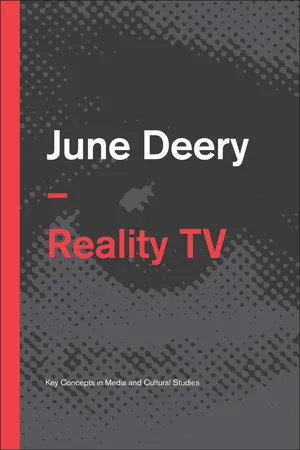
Reality TV has changed television and changed reality, even if we are not among the millions who watch. Written for a broad audience, this accessible overview addresses questions such as: How real is reality TV? How do its programs represent gender, sex, class, and race? How does reality TV relate to politics, to consumer society, to surveillance? What kind of ethics are on display? Drawing on current media research and the author's own analysis, this study encompasses the history and evolution of reality television, its production of reflexive selves and ordinary celebrity, its advertising and commercialization, and its spearheading of new relations between television and social media.
To dismiss this programming as trivial is easy. Deery demonstrates that reality television merits serious attention and her incisive analysis will interest students in media studies, cultural studies, politics, sociology, and anyone who is simply curious about this global phenomenon.
eBook - ePub
Reality TV
About this book
Information
1
Introduction: Definitions, History, Critiques
I’m not here to make friends. The tribe has spoken. You’re fired! I believe in being honest. She has no class. He’s not being real. She just threw me under the bus. Move that bus! I can’t believe it’s me/my living room/my car. I’ve learned a lot about myself. She is not here for the right reasons. Will you accept this rose? I did it for the experience. I have a friend who’s an expert. Make it work. It’s my day! Is this your dress? Watch out bitches! This isn’t the last you’ll hear from me …
These catchphrases are heard day after day on screens around the world. Many would recognize them as the voices of reality TV, a type of programming that whether enjoyed or criticized or both has affected television in each of the areas of production, distribution and consumption. So how did this happen and why is it important?
Reality TV is important in the most basic terms because it pervades TV schedules around the world and has, as a consequence, entered all kinds of popular and elite discourse, from personal blogs to presidential politics.1 To dismiss reality TV because of its often trivial content would be to miss its significance. Some individual programs are of high quality, are well-conceived, or are provocative in important ways; most, on the other hand, are not. Nevertheless, it is impact, tenacity, and cultural resonance, not profundity of content, that make reality television worth analyzing. Even if it were to disappear tomorrow, it would be worth knowing why it arose and was so popular. But for so prominent a cultural form, reality TV is not often or easily defined. What is it, and just as interestingly why is it, are questions worth asking. In this study, I offer an overview for those who are looking for a broad assessment of where we are with this attention-grabbing phenomenon. Based on current critical scholarship, I have selected what I believe are the main topics and questions reality TV (RTV) poses for students of the media and of contemporary culture.
Among academics, reality TV is becoming one of the most thoroughly analyzed areas of media production. It brings to the fore issues such as: What is real or fictional, how can we recognize either, and is it disturbing if we can’t? What does it mean to represent the self and what self are we encouraged to represent? How does watching ordinary people on TV relate to surveillance and governance? Is everything in contemporary culture commodifiable? Is the private still a meaningful designation? Is celebrity ordinary? And what is the role of television in a digital, mobile environment? This programming allows us to think about a cluster of contemporary concerns, including the requirement that we all perform – because of surveillance, because of the marketization of everyday life, because of the demand for individual impression management. Reality TV has become emblematic of a contemporary monitoring and commercialization of performed and mediated identities. It grew in a time of transparency, with people posting intimate information about themselves on social media and conducting loud phone conversations in public. But this is also a time when many are spooked at the discovery of governmental and commercial surveillance. People are giving away privacy but are disturbed when it is not their choice. RTV works through some of these tensions and betrayals.
The nature and novelty of reality TV content also invites fundamental questions about genre, production methods, and motive. Few professional commentators make claims about reality shows being “quality TV,” but their popularity and durability have earned them attention and even grudging respect as something deserving analysis. Some reality formats such as the Big Brother and Idol franchises are the most successful in television history and are significant both for their national and global reach. In many instances, reality TV producers have changed the nature of television and a generation of viewers is growing up that regards unscripted TV as the norm. There are so many reality shows on American and British schedules alone that they are difficult to count: whole channels are devoted to reality programming or are dominated by it.2 Then, too, a show’s impact often extends beyond those who view it and is widely referenced even by people who would bristle at the suggestion that they ever watched it. It is likely that people underreport or underestimate how much reality TV they watch because they don’t recognize that what they watch is considered reality TV or, also likely, they underreport because of social stigma – for nothing is easier to criticize in polite society than reality TV. This consensus, too, is noteworthy.
Certainly category identification is not an insignificant problem. “Reality TV” has emerged as a catchall phrase used to describe a wide range of programming but it is to some extent a floating signifier possessing different meanings for different people in different historical moments. One somewhat glib definition of reality TV that I enjoy is “non-fiction television of which I personally disapprove” (Poniewozik 2012: ix). However, I will be using as a basis for discussion the following more specific parameters: pre-planned but mostly unscripted programming with non-professional actors in non-fictional scenarios. This is very close to Misha Kavka’s initial description of “unscripted shows with non-professional actors being observed by cameras in preconfigured environments” (2012: 5). But as she, too, recognizes, one can soon think of exceptions; for example, the environments aren’t always preconfigured, there are different degrees of scripting, and there is even some use of professional actors or certainly aspiring actors. These factors will be examined in more detail later when I propose that reality programming is best defined not according to topic but according to the relations between the camera, the participants, and the viewers. For now, I consider the label reality TV useful even when it does not entail precise or agreed on borders. What is included within this category will depend upon which shows are selected as core examples: other programs will have varying strengths of membership. The most reasonable approach is to acknowledge that “reality television” overlaps with other categories of programming and itself contains distinct but overlapping sub-categories that nevertheless share some common characteristics.

Figure 1 Overlap between reality TV and prior genres
Without engaging in extended comparisons, we can see that reality TV bears some resemblances to prior genres (Fig. 1.1). A large and commercially vital block on most TV schedules is sports programming and this is similar to RTV in that it films actual events (“scripted” only by rules and rituals) and, like some RTV, entertains through the drama of suspenseful competition. Like reality TV also, sports events often happen at all or become important because they will be televised and this mediation shapes content. However, sports broadcasts are typically live (with some limited pre-planned content such as statistical information) and they focus on skills and action more than personalities and interpersonal drama. There is little attention to the emotions or opinions of players who are cast not for their telegenic appearance or acting ambitions but for their athletic performance. The focus is on the extraordinary, but in the sense of being excellent rather than freakish or shameful.
Reality TV also shares with documentary programming certain filmic techniques, but it appears to have different goals: most notably, RTV aims to entertain more than inform and happily embraces the sensationalism that many documentarians avoid. There is on RTV no authoritative, objective exposition backed up by extensive research and rarely any advocacy or push for political reform. So if both types of programming portray intimate lives or everyday circumstances, it is generally for different ends. Their borders, however, are not clear and sometimes documentary is preserved as an evaluative rather than a logical distinction, whereby higher quality or more serious programming is accorded this status.
Finally, news programming might fairly be said to bear many resemblances to both RTV (on its infotainment and sensationalized end) and to documentary (when it comes to informing and addressing politics). The main contrast with reality TV would have to be that professional and reputable journalism eschews manipulation of material: whether it be staging, paying for contributions, or distortive editing – though it may be that the rise of reality TV problematizes and weakens the claims to objectivity of both documentary and news programming.
Is reality TV a genre?
Reality TV can be regarded as a recognizable category for purposes of discussion, marketing, and scheduling without it being a definite or universally agreed upon genre. The genre question has continued ...
Table of contents
- Cover
- Dedication
- Title Page
- Copyright
- Acknowledgments
- 1. Introduction: Definitions, History, Critiques
- 2. Reality Status
- 3. Social Television: Reality TV and New Media
- 4. Advertising and Commercialization
- 5. Gender and Race
- 6. Class
- 7. Politics
- References
- Index
- End User License Agreement
Trusted by 375,005 students
Access to over 1.5 million titles for a fair monthly price.
Study more efficiently using our study tools.
Frequently asked questions
Yes, you can cancel anytime from the Subscription tab in your account settings on the Perlego website. Your subscription will stay active until the end of your current billing period. Learn how to cancel your subscription
No, books cannot be downloaded as external files, such as PDFs, for use outside of Perlego. However, you can download books within the Perlego app for offline reading on mobile or tablet. Learn how to download books offline
Perlego offers two plans: Essential and Complete
- Essential is ideal for learners and professionals who enjoy exploring a wide range of subjects. Access the Essential Library with 800,000+ trusted titles and best-sellers across business, personal growth, and the humanities. Includes unlimited reading time and Standard Read Aloud voice.
- Complete: Perfect for advanced learners and researchers needing full, unrestricted access. Unlock 1.5M+ books across hundreds of subjects, including academic and specialized titles. The Complete Plan also includes advanced features like Premium Read Aloud and Research Assistant.
We are an online textbook subscription service, where you can get access to an entire online library for less than the price of a single book per month. With over 1.5 million books across 990+ topics, we’ve got you covered! Learn about our mission
Look out for the read-aloud symbol on your next book to see if you can listen to it. The read-aloud tool reads text aloud for you, highlighting the text as it is being read. You can pause it, speed it up and slow it down. Learn more about Read Aloud
Yes! You can use the Perlego app on both iOS and Android devices to read anytime, anywhere — even offline. Perfect for commutes or when you’re on the go.
Please note we cannot support devices running on iOS 13 and Android 7 or earlier. Learn more about using the app
Please note we cannot support devices running on iOS 13 and Android 7 or earlier. Learn more about using the app
Yes, you can access Reality TV by June Deery in PDF and/or ePUB format, as well as other popular books in Social Sciences & Media Studies. We have over 1.5 million books available in our catalogue for you to explore.