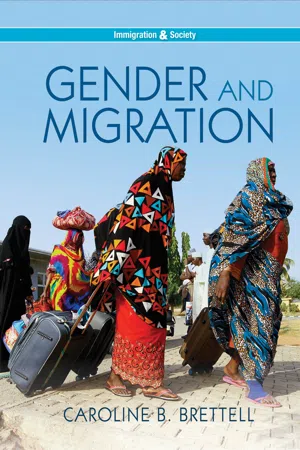
Gender roles, relations, and ideologies are major aspects of migration. This timely book argues that understanding gender relations is vital to a full and more nuanced explanation of both the causes and the consequences of migration, in the past and at present. Through an exploration of gendered labor markets, laws and policies, and the transnational model of migration, Caroline Brettell tackles a variety of issues such as how gender shapes the roles that men and women play in the construction of immigrant family and community life, debates concerning transnational motherhood, and how gender structures the immigrant experience for men and women more broadly.
This book will appeal to students and scholars of immigration, race and ethnicity, and gender studies and offers a definitive guide to the key conceptual issues surrounding gender and migration.
- English
- ePUB (mobile friendly)
- Available on iOS & Android
eBook - ePub
Gender and Migration
About this book
Information
1
The Gendered Demography of US Immigration History
Beginning in the mid nineteenth century, when whale oil was a valuable commodity and a source of fuel for light, whaling ships used to depart from Massachusetts ports. They would make their way to the Cape Verdean and Azorean Islands, Portuguese overseas territories situated in the Atlantic Ocean. There they would pick up all-male sailing crews. After a few months of whaling, the ships would return to New England, including ports like New Bedford, Massachusetts. There the male crews would spend the winter. Some returned to the ships in the spring while others found alternative occupations. It was through whaling that a Portuguese immigrant presence was established in New England and that New Bedford gained its name as the Portuguese capital of the United States.1 Eventually women and children joined the settler population and by the dawn of the twentieth century the Portuguese represented 16 percent of New Bedford’s inhabitants. But by this time the whaling industry was no more and the Portuguese, men and women, had found work in factories, fisheries, and the cranberry bogs of southeastern Massachusetts and Cape Cod.2 In Providence, Rhode Island, Portuguese men, including Cape Verdeans, could be found working in coal and brick yards, as longshoremen and dockhands, pork packers in slaughter houses, and as operators in oyster and screw companies. Portuguese daughters found employment in lace factories, cotton mills, and laundries.3
More than a century later, with the Immigration and Nationality Act of 1965 and the re-opening of the United States to immigrants, a new generation of Portuguese arrived in New England. This migration brought families, largely from the Azores, who found work in the still-operating textile mills. These immigrants made the transition from being rural agriculturalists to industrial wage workers. Wives took work outside the home to supplement the low wages earned by their husbands. In comparing this more recent migration experience with that of the beginning of the twentieth century, anthropologist Louise Lamphere (1987) describes a shift from working daughters to working mothers. This shift had a direct impact on the division of labor within the family, with men contributing more to childcare and other domestic chores.
The history of US immigration is often told through the lens of particular immigrant groups – the Portuguese, the Irish, the Jews, the Italians, the Chinese, the Vietnamese, the Mexicans. But how do we tell this story through a gendered demographic lens? In one sense the tale has already been told, largely based on the uninvestigated assumption that in the past the majority of immigrants were men and that if women moved it was as the dependants of men. However, once the question of how precisely women might be involved in migratory movements was directly posed, and data more closely examined, it quickly became apparent that women and girls accounted for close to half (47 percent) of all international migrants as early as 1960 and that by 2000 the proportion was 49 percent (for a total of 85 million female migrants and 90 million male migrants). By 2005, the proportion had risen to very close to 50 percent and in 2006 the United Nations reported 94.5 million international female migrants (United Nations 2006). In developed countries female migrants made up a larger portion of migrant stock (51 percent) in 2000 than in the developing world where they comprised 46 percent (Zlotnik 2003; see also Sharma 2011). These data, demonstrating that women as well as men are on the move globally, have generated debates about the “feminization of migration” (Castles and Miller 2009; Morrison et al. 2008; Zlotnik 2003) in the late twentieth- and early twenty-first centuries.
Characteristic of this process of “feminization” is an increasing number of women, both married and unmarried, who migrate by themselves or with other unrelated migrants. This is distinctly different from historical migrations where women primarily moved for marriage or as part of a family reunification process (United Nations 2006: 22). The so-called feminization of migration has been explained by a range of factors including the absence of opportunities for paid work in sending countries; the awareness of, if not recruitment for paid work in receiving societies; the desires of women for more independence and autonomy; marital instability, including political violence, divorce and separation, that often leave women as sole breadwinners for their families; and a relaxation in the restrictions that are placed on the geographical mobility of women, whether within families and communities (in accordance with changing gender ideologies) or by sending states.
Despite a label that suggests dramatic change, some scholars have argued that an increase from 47 percent to 50 percent in the proportion of female migrants among all migrants seems minimal (Donato 2012a; Moya 2012), leading them not only to propose the phrase “shift toward gender balance” as an alternative to “feminization” (Donato et al. 2011), but also to delve more deeply into the historical record to render a more accurate assessment of the gendered demographics of population mobility (Donato and Gabaccia 2015). The result is not only a reconsideration of statistician Ernest George Ravenstein’s (1885) original and famous formulation of the gendered nature of short (more female-dominated) versus long (more male-dominated) distance moves (Alexander and Steidl 2012), but also new evidence of wide variations in the proportions of men and women who have participated in migration across time and space.
Historians Donna Gabaccia and Elizabeth Zanoni (2012) offer a useful and more nuanced typology by which to categorize gendered migration flows in demographic terms (Table 1.1). They argue that the shift to more gender-balanced flows for some migration streams most likely occurred before and not after 1960. They also point us to the right kinds of questions to ask of any migration flow in relation to gender: “how international migrations have been gendered, when transitions in the gendering of migration have occurred, why they have occurred, and what their consequences may have been” (p. 199).
Table 1.1Typology of Gendered Migrations
Source: Adapted from Gabaccia and Zanoni (2012)
| Types of Gendered Migrations | Proportion of Females in the Migration Flow % |
| Heavily Male Dominant | 25 |
| Male Pre-dominant | 25–47 |
| Gender Balanced | 47–52 |
| Female Pre-dominant | 53–75 |
| Heavily Female Dominant | 75 |
What then is the story of the respective participation of men and women (the gendered demographics) of international migration flows to the US over time? In the middle of the nineteenth century, just over 40 percent of immigrants to the United States were female, while for the rest of the nineteenth century the proportion dropped to approximately 38 percent and to 30 percent in the first decade of the twentieth century – thus verging on being heavily male dominant.4 Table 1.2 presents the gender ratio of immigrants to the US between 1870 and 2012.5 After 1930, a period when immigration was restricted as a result of the National Origins Quota Act of 1924, the proportion of female immigrants began to rise. In the 1940s in particular, the proportion of women among US immigrants rose to over 60 percent, impacted no doubt by the 1945 War Brides Act which made it possible for non-Asian spouses and children of American military personnel to enter the country. Historian Suzanne Sinke (2006b: 300) points to this period as the greatest female majority immigration in US history, but also emphasizes that the War Brides Act actually reinforced the gendered intentions of immigration policy which have always tended to classify women as dependants. I return to the issue of policy in the next chapter. However, it is worth noting here that the 1940s was also a time when overall immigration waslow, something that would statistically impact the proportion of women in the immigrant population.
Table 1.2 Males/100 Females Ratio among Immigrants to the US, 1870–2012
Source: Adapted from http://www.migrationpolicy.org/programs/data-hub/charts/males-100–females-ratio-among-immigrants-1870–present

By 1960 and through until 2000 women comprised more than half of the foreign-born population in the US – 53 percent in 1980 and 51 percent in 1990. While in 2000 there were an equal number of immigrant women and immigrant men, thereafter the figures have hovered just over 50 percent.6 In 2008 women were granted 54 percent of all the green cards issued in that year and accounted for 56 percent of all naturalizations. In that same year there were almost 19 million immigrant women (18.9 million) in the US, comprising 12 percent of all women in the country. Close to eighty percent (78.2) of these immigrant women were of working age – between eighteen and sixty-four – compared with 82.5 percent of foreign-born men but there were more foreign-born women over sixty-five than foreign-born men. The comparable working age figures for native-born women and men were 59.8 percent and 61 percent. Twenty-seven percent of the immigrant women in the US toward the close of the first decade of the twenty-first century were born in Mexico. Of the 19.1 million immigrant men in the country at that time, 33.5 percent were from Mexico. The median age of foreign-born women (forty-two years) was higher than that of native-born women (thirty-seven) and higher also than foreign-born men and native-born men. Finally, foreign-born women over age twenty-five were less likely to have a bachelor’s degree than foreign-born men (9.5 percent compared with 12.6 percent) but slightly more than two-thirds (68.4 percent) had a high school degree compared with 66.6 percent of foreign-born men (Batalova 2009: 2–4).
In summary, the story of the gendered demography of immigration to the US is one of change over time, moving from patterns that were male-predominant to almost heavily male dominant, to female pre-dominant to gender balanced. Such changes over time are worthy of further exploration and explanation. One explanation can be found in late-twentieth-century immigration policy rooted in family reunification. Thus, Linda Gordon (2005: 806) observes that the “trends and levels in the gender ratio of the US immigrant population are now determined in large part by the spouse categories, specifically spouses of citizens (who may enter without numerical limitation) and lawful permanent residents (who are subject to an annual ceiling).”7 Another explanation can be found in labor markets, something discussed in a later chapter. Gendered mobility patterns are also influenced by the economic and political conditions in the homeland, by marital status, and by gender ideologies and the overall status of women in both sending and receiving contexts (Tyree and Donato 1985; Donato 1992, 2010; Kanaiaupuni 2000). These too are issues that will be explored more fully later in this book. However, demographically, it is important to address the impact of national origins on the proportion of males to females (the gender ratio) in specific migration streams.
Migration, Gender Ratios, and National Origins: Then and Now
Scholars have observed that if Mexican migration to the US toward the end of the twentieth century were removed from consideration, the analysis of the overall composition of the immigrant population would look decidedly more “feminized” than gender-balanced (Donato et al. 2011). In the nineteenth century, as today, the gender ratios of immigration and hence of immigrant populations have varied by national origins. For example, the absence of opportunities in their home country resulted in high rates of outmigration for single Irish women, who went to England or America. While only a third of Irish emigrants in the period between 1815 and 1844 were women, in the aftermath of the Great Famine (1845–1851) women left in numbers equal to those of men. “Famine created an environment that marginalized women economically and reduced their status in society. The virtual ending of partible inheritance, the eradication of the poorer classes among whom female labor was particularly important, the spread of arranged marriages and the dowry system, and the reduced opportunities for female wage earning combined to spur emigration” (Mageean 1997: 96).8
By the end the nineteenth century women made up more than half of all Irish emigrants. Between 1885 and 1920 close to 700,000 young and mostly unmarried Irish women left their homeland (Nolan 1989). “They were the only significant group of foreign-born women who outnumbered men; they were the only significant group of women who chose to migrate primarily in female cliques. They also accepted jobs that most other women turned down” (Diner 1983: xiv). Historian Donna Gabaccia (1994: 30) has observed that in 1910 only 17 percent of Irish women came to the US with nuclear families. In fact, it was common for young unmarried Irish women to be sponsored by a female sibling and then, when they had saved up enough to marry, to in turn send passage for another sibling or relative to emigrate to America.
Women came to represent 52.9 percent of the Irish immigrant population in America. By contrast, the Jews who were pushed out of Eastern Europe and Russia by pogroms and other forms of discrimination and persecution were more likely to leave in nuclear family units, although men still outnumbered women. During the first decade of the twentieth century, women comprised 43 percent of all Jewish immigrants to the US (Joseph 1914). For these Jews, their de...
Table of contents
- Cover
- Title Page
- Copyright
- Preface
- Introduction: Engendering the Study of Immigration
- 1 The Gendered Demography of US Immigration History
- 2 The Gendering of Law, Policy, Citizenship, and Political Practice
- 3 Gendered Labor Markets
- 4 Gender and the Immigrant Family
- Concluding Thoughts: A Gendered Theory of Migration
- References
- Index
- End User License Agreement
Trusted by 375,005 students
Access to over 1.5 million titles for a fair monthly price.
Study more efficiently using our study tools.
Frequently asked questions
Yes, you can cancel anytime from the Subscription tab in your account settings on the Perlego website. Your subscription will stay active until the end of your current billing period. Learn how to cancel your subscription
No, books cannot be downloaded as external files, such as PDFs, for use outside of Perlego. However, you can download books within the Perlego app for offline reading on mobile or tablet. Learn how to download books offline
Perlego offers two plans: Essential and Complete
- Essential is ideal for learners and professionals who enjoy exploring a wide range of subjects. Access the Essential Library with 800,000+ trusted titles and best-sellers across business, personal growth, and the humanities. Includes unlimited reading time and Standard Read Aloud voice.
- Complete: Perfect for advanced learners and researchers needing full, unrestricted access. Unlock 1.5M+ books across hundreds of subjects, including academic and specialized titles. The Complete Plan also includes advanced features like Premium Read Aloud and Research Assistant.
We are an online textbook subscription service, where you can get access to an entire online library for less than the price of a single book per month. With over 1.5 million books across 990+ topics, we’ve got you covered! Learn about our mission
Look out for the read-aloud symbol on your next book to see if you can listen to it. The read-aloud tool reads text aloud for you, highlighting the text as it is being read. You can pause it, speed it up and slow it down. Learn more about Read Aloud
Yes! You can use the Perlego app on both iOS and Android devices to read anytime, anywhere — even offline. Perfect for commutes or when you’re on the go.
Please note we cannot support devices running on iOS 13 and Android 7 or earlier. Learn more about using the app
Please note we cannot support devices running on iOS 13 and Android 7 or earlier. Learn more about using the app
Yes, you can access Gender and Migration by Caroline B. Brettell in PDF and/or ePUB format, as well as other popular books in Social Sciences & Gender Studies. We have over 1.5 million books available in our catalogue for you to explore.