- This is the first time all of the surviving correspondence between Adorno and Benjamin has appeared in English.
- Provides a key to the personalities and projects of these two major intellectual figures.
- Offers a compelling insight into the cultural politics of the period, at a time of social and political upheaval.
- An invaluable resource for all students of the work of Adorno and especially of Benjamin, extensively annotated and cross-referenced.
- English
- ePUB (mobile friendly)
- Available on iOS & Android
eBook - ePub
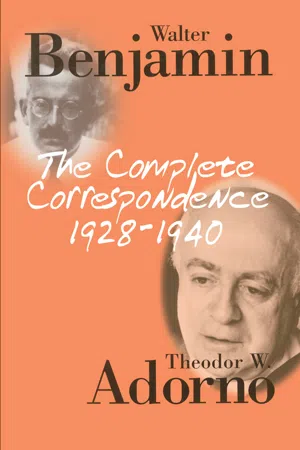
The Complete Correspondence 1928 - 1940
About this book
The surviving correspondence between Walter Benjamin and Theodor W. Adorno.
Information
1 BENJAMIN TO WIESENGRUND-ADORNO BERLIN, 2.7.1928
Dear Herr Wiesengrund,
Your cordial lines1 have encouraged me in the pleasant anticipation of receiving your ‘Schubert’ manuscript.2 For that is surely what you allude to. I can only hope that in the meantime you have brought the piece to a successful conclusion. Might I request in advance your permission to communicate the manuscript to Bloch3 as well? It would be a great advantage for me if I could read the text with him.
You showed so much friendliness and support for my friend Alfred Cohn4 that time in Berlin that I feel I really have to inform you about how matters have turned out, or more unfortunately and more precisely, about the liquidation of the business in which he is employed and the consequent loss of his position there. None of this is as yet official – the liquidation of the business is still a commercial secret. But by October his situation will certainly have become extremely difficult, unless his friends are able to intervene on his behalf. In this connection I must and shall now do my best: but that can only succeed if I speak to you again concerning my friend. Naturally I understand that the suggested Berlin arrangement is impossible. Do you not feel there may now be certain possibilities for him in Frankfurt?
I know I have said enough for you to express your friendship and influence once again, if you think there is any prospect of success in the matter.
Here I am, commencing with a request, and then it strikes me that I may seem to have forgotten my intention of inviting Fräulein Karplus5 to drop in on me. But this is not a case of forgetfulness on my part. It is simply that during the last few weeks I have felt so preoccupied with various tasks and predicaments, which have all become dreadfully entangled with one another,6 that I have not had the opportunity to approach her.
As soon as things are better here, very shortly I hope, you will hear from me through her.
With warmest regards for the present,
Yours,
Walter Benjamin
Walter Benjamin
2 July 1928
Berlin-Grunewald
Delbrückstr. 23
1 Your cordial lines: Adorno and Benjamin had first got to know each other in Frankfurt in 1923 and had subsequently met up once again in Frankfurt, and possibly – in September 1925 – in Naples, to continue their discussions. However, the correspondence between them apparently only began to lead to greater intimacy and communication in the summer of 1928, after Adorno had spent some weeks in Berlin in February of that year – The letters Adorno wrote to Benjamin prior to 1933 were left behind in Benjamin’s last apartment in Berlin when he was finally forced to leave Germany in March 1933 and have all disappeared.
2 your ‘Schubert’ manuscript: cf. Adorno, ‘Schubert’, in Die Musik 21, Issue 1 (October 1928), pp. 1–12; now in GS 17, pp. 18–33. – No manuscript of the essay has survived.
3 your permission to communicate the manuscript to Bloch: Ernst Bloch, whom Benjamin had known since 1919, had been shown a draft and sketches for the Schubert piece by Adorno and had strongly encouraged the author to complete the essay. (cf. Briefwechsel Adorno/Krenek, p. 70.)
4 my friend Alfred Cohn: for Alfred Cohn (1892–1954), a very close school friend of Benjamin, cf. Briefe, p. 866. – Since the beginning of 1928 Benjamin had been attempting to help Cohn, a businessman by profession, to find a new position: ‘He [sc. Benjamin] is also pursuing his aim of getting one of his friends employed in the same business as Gretel [Karplus], and it seems to be working out.’ (Unpublished letter from Adorno to Siegfried Kracauer of 28.2.1928.) The attempts which Adorno made in Frankfurt and Gretel in Berlin – the suggested Berlin arrangement – came to nothing in the end.
5 my intention of inviting Fräulein Karplus: Margarete Karplus (1902–1993), later Adorno’s wife, had got to know Benjamin at the beginning of 1928.
6 various tasks and predicaments … dreadfully entangled with one another: Benjamin is probably referring here to the resumption of work on the ‘Goethe’ article for the Great Soviet Encyclopaedia (cf. GS II [2], pp. 705–39.) – The heart attack suffered by Benjamin’s mother in July also contributed substantially to the increasing difficulties of Benjamin’s personal situation, largely determined by the conflict between his planned journey to Palestine (cf. Gershom Scholem, Walter Benjamin – die Geschichte einer Freundschaft, 2nd ed. (Frankfurt a.M. 1976), pp. 185–90) and his renewed intimacy with Asja Lacis (cf. ibid., p. 187).
2 BENJAMIN TO WIESENGRUND-ADORNO BERLIN, 1.9.1928
Dear Herr Wiesengrund,
It would prove truly difficult to find an excuse for my long silence. Therefore please take these few lines as a word of explanation. But first I must properly thank you for your manuscript.1
As it happened, I was with Bloch when it arrived and he was so impatient to take the material home with him that, contre cœur, I let him have it. And then, owing to circumstances which suddenly took him away from Berlin, he was unable to find an opportunity to study it or, unfortunately, to return it to me.
And that is why it is only in the last few days that I have managed to reclaim it. But since I should not like to compound this misfortune with another, namely that of reading your ‘Schubert’ all too hastily, I have decided simply to let you know in brief that you may expect a substantive response in a week, together with what I hope will be a rather less formal thank you.
But to deal with the whole humiliating business all at once: the editorial board of ‘The Literary World’ had responded immediately and enthusiastically to my suggestion that they should approach you for the planned contribution to the journal’s George issue.2 They assured me that they would be in contact with you directly. I was foolish enough to believe the whole matter was settled, without reckoning with the infinite incompetence of such organizations. In this regard too I must tender my apologies.
Anticipating more fortunate auspices for the future,
and with cordial regards for now,
Yours,
Walter Benjamin
Walter Benjamin
1 September 1928
Berlin-Grunewald
Delbrückstr. 23
Many thanks for everything you have done for my friend.3 Since the matter is still in progress I shall come back to it if the opportunity arises.
1 your manuscript: the manuscript of the ‘Schubert’ essay and the series of aphorisms ‘Motive III’ (cf. Musikblätter des Anbruchs 10, issue 7 (August/September 1928), pp. 237–40; now in GS 16, pp. 263–5 and GS 18, pp. 15–18. The version which Benjamin probably had before him was entitled ‘Neue Aphorismen’.
2 the editorial board of ‘The Literary World’ … contribution to the journal’s George issue: on the occasion of Stefan George’s 60th birthday the weekly journal ‘Die literarische Welt’, edited by Willi Haas for the Rowohlt publishing house, had commissioned a survey, the results of which were published in the issue of 13.7.1928. Benjamin had obviously attempted to get Adorno accepted as one of the respondents to whom the survey was directed. – On the George issue and Benjamin’s contribution to it, cf. GS II [2], pp. 622–4 and GS II [3], pp. 1429f.
3 everything you have done for my friend: nothing further is known about the steps taken by Adorno to assist Alfred Cohn.
3 BENJAMIN TO WIESENGRUND-ADORNO BERLIN, 29.3.1930
Dear Herr Wiesengrund,
Please forgive me for disturbing you, but I was careless enough to forget the name of one of the authors you mentioned1 amongst those who had written about Kraus. I think I was even somewhat amazed by the name when you mentioned it. I remember Liegler,2 Haecker,3 Viertel4 – but there was also another one. If I am not mistaken, you referred to him as a student of Kraus.
Would you be so kind as to let me know by postcard as soon as possible?
With sincere thanks!
Yours,
Walter Benjamin
Walter Benjamin
29 March 1930
Berlin W
Friedrich Wilhelm Str. 15III
1 one of the authors you mentioned: apart from the authors mentioned in the letter, Benjamin also cites works by Robert Scheu and Otto Stoessel in his ‘Kraus’ essay (cf. GS II [1], pp. 334–67), on which he was working around this time; whether one of these two was the author whose name Benjamin had forgotten – and if so, which one – can no longer be determined.
2 Liegler: Leopold Liegler (1882–1949), Secretary of the Austrian Academy of Sciences, was also secretary to Karl Kraus until 1924; Benjamin is quoting from the book Karl Kraus und sein Werk (Vienna 1920).
3 Theodor Haecker: Haecker (1879–1945) was a principal contributor to the journal ‘Brenner’; there is a passage about Kraus in his book Kierkegaard und die Philosophie der Innerlichkeit (Munich 1913). – In his letter Benjamin had spelt the author’s name as Hecker, presumably confusing it with that of the famous philologist Max Hecker.
4 Berthold Viertel: Kraus had published poems by Berthold Viertel (1885–1953), poet, writer, dramatist and director, in the journal ‘Fackel’; Viertel’s book Karl Kraus. Ein Charakter und seine Zeit had been published in Dresden in 1921.
4 BENJAMIN TO WIESENGRUND-ADORNO BERLIN, 10.11.1930
Dear Herr Wiesengrund,
My mother passed away a few days ago,1 which is why I have delayed in writing. I regret that I shall have to be briefer than I would have wished. Your letter touched upon so much that is important to me that I would dearly like to respond in detail, but I have so much urgent work to do.2 Your thoughts upon the subject I proposed for Frankfurt3 correspond closely to my own reservations. I am therefore particularly happy to adopt your formulation: ‘On the Philosophy of Literary Criticism’. I am writing about it to Horkheimer4 in the next few days. But it would be very nice if you could communicate this new formulation to him right away, and suggest further in the same connection that, in view of the recent bereavement I have mentioned, I would be particularly grateful if my address could be postponed to some time after Christmas – like the middle of January perhaps.
You should be very pleased to learn that your gently insistent remarks about ‘The Old Curiosity Shop’5 have finally defeated my external inhibitions on the subject, and that I have been absorbed in the book for some days now; awareness of the way in which you have already read it makes me feel as though someone with a lamp were guiding me along these dark passageways. I have seen the most astonishing veins of silver light up before me.
How much I would like to communicate my thoughts to you in something written of my own, since the resounding echo of the extended and extremely stimulating conversations I am currently enjoying – in my meetings with Brecht6 – has yet to reach you. I was rather relying on the Frankfurter Zeitung – I am thinking especially of my Kästner article7 here – but things are proving extremely difficult with them. It is obvious that they are busy considering every option.
I have read Korsch’s Marxism and Philosophy.8 Rather faltering steps – so it seems to me – in the right direction.
Please let me know the fate of your own work9 as soon as possible. I will also ask Fraulein K...
Table of contents
- Cover Page
- Contents
- Title Page
- Copyright
- Abbreviations
- The Correspondence 1928–1940
- Editor’s Afterword by Henri Lonitz
- Textual Notes and Source References
- Bibliographical Index
- Name Index
Trusted by 375,005 students
Access to over 1.5 million titles for a fair monthly price.
Study more efficiently using our study tools.
Frequently asked questions
Yes, you can cancel anytime from the Subscription tab in your account settings on the Perlego website. Your subscription will stay active until the end of your current billing period. Learn how to cancel your subscription
No, books cannot be downloaded as external files, such as PDFs, for use outside of Perlego. However, you can download books within the Perlego app for offline reading on mobile or tablet. Learn how to download books offline
Perlego offers two plans: Essential and Complete
- Essential is ideal for learners and professionals who enjoy exploring a wide range of subjects. Access the Essential Library with 800,000+ trusted titles and best-sellers across business, personal growth, and the humanities. Includes unlimited reading time and Standard Read Aloud voice.
- Complete: Perfect for advanced learners and researchers needing full, unrestricted access. Unlock 1.5M+ books across hundreds of subjects, including academic and specialized titles. The Complete Plan also includes advanced features like Premium Read Aloud and Research Assistant.
We are an online textbook subscription service, where you can get access to an entire online library for less than the price of a single book per month. With over 1.5 million books across 990+ topics, we’ve got you covered! Learn about our mission
Look out for the read-aloud symbol on your next book to see if you can listen to it. The read-aloud tool reads text aloud for you, highlighting the text as it is being read. You can pause it, speed it up and slow it down. Learn more about Read Aloud
Yes! You can use the Perlego app on both iOS and Android devices to read anytime, anywhere — even offline. Perfect for commutes or when you’re on the go.
Please note we cannot support devices running on iOS 13 and Android 7 or earlier. Learn more about using the app
Please note we cannot support devices running on iOS 13 and Android 7 or earlier. Learn more about using the app
Yes, you can access The Complete Correspondence 1928 - 1940 by Theodor W. Adorno,Walter Benjamin in PDF and/or ePUB format, as well as other popular books in Filosofia & Filosofia sociale. We have over 1.5 million books available in our catalogue for you to explore.