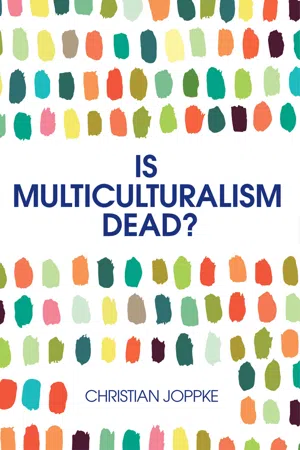
Multiculturalism is controversial in the liberal state and has frequently been declared dead, even in countries that have never had a policy under that name. This authoritative book reviews the different meanings multiculturalism has acquired across theories, countries, and domains to evaluate the extent of its demise and the ways in which it lives on.
Christian Joppke intriguingly argues that, beyond the ebb and flow of policy, liberal constitutionalism itself bears out a ?multiculturalism of the individual? that is not only alive but necessary in a liberal society. Through a provocative comparison of gay rights in the United States and the accommodation of Islam in Europe, he shows that liberal constitutionalism constrains majority power, requiring the state to be neutral about people?s values and ethical commitment. It cannot but give rise to multiple ways of life or cultures, as people are endowed with the freedom to embrace them. Accordingly, impulses toward multiculturalism persist, despite its political crisis, but with a new accent on the individual, rather than group, as the unit of integration.
Tightly argued and clearly written, this book provides a judicious assessment of multiculturalism in the West and will be of interest to a broad readership across the social sciences and legal studies.
eBook - ePub
Is Multiculturalism Dead?
Crisis and Persistence in the Constitutional State
- English
- ePUB (mobile friendly)
- Available on iOS & Android
eBook - ePub
About this book
Information
1
What is Dead and What is Alive
Long before the age of religious terror, multiculturalism had been declared dead. In the 1990s, “too many Asians” was the battle-cry against Australian multiculturalism (see Joppke 2005: 80–90). It did not amount to much, and a kind of nationalist multiculturalism, which Australia shares with Canada, persisted. The more recent death-notices are Western European, like those pronounced in rapid succession by the political leaders of Germany, Britain, and France, in late 2010 and early 2011. There was immediately a lively debate about whether this was merely symbolic or indicative of a real change of law and policy. The answer depends on one's definition of multiculturalism. This is notoriously difficult. If even countries that never had an explicit multiculturalism policy as Canada or Australia know it announce the death of multiculturalism, what exactly is being declared dead? Certainly not gay marriage and the liberalization of homosexuality, which are marching on at the very moment that a retreat of multiculturalism has been diagnosed for Europe. And, of course, there is no questioning of the self-government rights of indigenous people, like the First Nations (in Canadian parlance), or of national minorities, like Scots, Basques, Catalans, and so on, which long predate the age of multiculturalism. This suggests that it is not cultural pluralism in general that is put in question, but mostly the ethnic or religious variant that stems from international migration. Here a closer look reveals that not any migration, but particularly Muslim migration, is central to the crisis of European multiculturalism – each of the three mentioned death-notices by German Chancellor Merkel, British Prime Minister Cameron, and French President Sarkozy, was a commentary on specific difficulties, perceived or real, surrounding Muslim and Islamic integration in their respective societies. But, to repeat the above question, what is it that is being declared dead if it cannot be a law or policy that never was?
The answer is that a non-policy of not intervening or laissez-faire in what is perceived as immigration-caused, ethnic fragmentation of society, more specifically the rise of an unassimilable counterculture of Islam, is no longer deemed sufficient. Instead, the new, post-multicultural dictum is that if there is policy on part of the state, it should not reinforce the centrifugal tilt of multi-ethnic immigrant societies (as multiculturalism is suspected of doing). On the contrary, policy should contain this tilt through centrist policy that binds newcomers and their offspring into mainstream institutions and values. In Paul Collier's (2013) concise formula, the task of the day is diaspora absorption. This policy turn is registered under the rubric of civic integration, which has become the main approach in Western Europe toward immigrant integration. Civic integration constitutes the one policy that signals a real (not only rhetorical) departure from a “multicultural” past (even one that never was).
However, it would be mistaken to conclude from civic integration that multiculturalism is “dead.” The nature of the new policy is disputed, partially reflecting its different appearance in different countries. From a Canadian perspective, civic integration is no alternative to but complementary to multiculturalism. This is because Canadian multiculturalism itself has a nationalist hue, having become part of Canadian self-definition. In Europe, the constellation is different. Nowhere in Europe has multiculturalism become part of national self-definition. On the contrary, it is everywhere perceived as the property, or privilege, of immigrants and ethnic minorities, and this is why it has come under fire here. For Europe, there are two alternative views on civic integration. In one view, it is a convergent policy of post-multiculturalism, which expects liberal norms and values to be accepted, if not even liberal identities to be adopted by newcomers as the price for admission (Joppke 2007a). Indeed, in its emphasis on instilling liberal values and principles, the new policy would not be comprehensible unless brought against a putative “illiberal” minority, which Muslims are suspected to be. In an alternative view, civic integration is a way of “fortifying” nationally distinct citizenship regimes and traditions (Goodman 2012, 2014); or it is even seen as a “cultural defense of nations” (Orgad 2015), in which majorities besieged by predominantly non-Western (and thus extra-alienating) immigration reclaim the right to an identity that in a multicultural past was the privilege of minorities. Despite their different nuances, both views are not that far apart. That civic integration, with its centrist touch, differs from, or is even opposed to, multiculturalism seems incontrovertible, even to Canadian eyes (which, after all, are capable of distinguishing between civic integration and multiculturalism). In any case, the vexed relationship between multiculturalism and civic integration is to be centrally addressed in this book.
But the main argument is that, underneath the ebb and flow of (civic) integration policy, multiculturalism is necessary in a liberal society. While the term may have fallen into disrepute, the fact that there are other terms to do much of its work, such as “interculturalism” or “diversity,” signals that there is a persistent reality that will not go away, despite a change of fashion. That persistent reality is one of multiple ways of life (or “cultures,” as a shorthand) that cannot and should not be contained by a state that is to be neutral about people's ultimate values and ethical commitments, unless third parties or social peace are harmed or put in danger. The test case for this is the liberalization of homosexuality, which – I shall argue – should be considered a multicultural issue, and which is advancing unabated despite the loud retreat from multiculturalism in the immigrant domain. One may object that these policies relate to different groups and issues (ethnic v. ethical) and thus cannot be meaningfully paired. But the liberalization of homosexuality gives an insight into a deeper transformation (or, rather, maturing) of the “liberal” state, which has lost the capacity to impose a thick public morality over all members of society. There still is a public morality, an ethic, in the liberal state. But it is becoming tantamount to the protection of the individual and her or his rights. The individual is the true motor of multicultural claims-making, even if it is couched in the groupist hue of “gays” or “Muslims” or others. Hence what I shall advocate in this book is a “multiculturalism of the individual”. This may appear absurd, a contradiction in terms or yet another vacuous exercise in name-branding. But it is derived from observation of what is happening on the ground.
Multiculturalism is necessary in a liberal society, and its main source (apart from markets that satisfy and amplify the needs of pluralized lifestyles and groups) is constitutional law. I thus come to a rather opposite conclusion from James Tully (1995: 58), who had influentially denounced “modern constitutionalism” as imposing an “empire of conformity…designed to exclude or assimilate cultural diversity.” Far from it: constitutionalism protects structural minorities from democratic majorities. Since John Hart Ely (1980), this has been the dominant understanding of modern constitutionalism, and it corresponds closely to actual state practice, not only in America, but in Europe also. As long as constitutionalism is in place, we live in societies that are set to become more and more multicultural. A case in point is the emancipation of gays in America and of Muslims in Europe, which is an unusual but effective pairing in this respect. Gays have become a part of America, I concede, above all through cultural change preceding legal change – there has been an astounding shift among younger people toward accepting unconventional sexuality and family forms (see Rosenfeld 2007). But in the end the American Constitution's freedom (“due process”) clause, aided by its equality (“equal protection”) clause, were instrumental. Unaided by popular sympathies, to put it mildly, Muslims have become a part of Europe in a much more direct way through state constitutions and a regional human rights convention that all protect religious freedoms. Importantly, there was no need for a multiculturalism policy in much of Europe because the individual rights clauses in liberal state constitutions and in the European Convention of Human Rights, as well as a general principle in the secular state to treat all religions equally, have done most of the necessary work.
So this book will argue that, while multiculturalism may be under attack at the level of policy, with centrist policies of civic integration as intended moving away from a (most often imagined) “multicultural” past, at the level of liberal-constitutional law there is no alternative to multiculturalism. Will Kymlicka (1995) has got it right: liberalism requires multiculturalism. But he unnecessarily pairs normative justification (liberal justice as requiring “multicultural citizenship”) with explicit policy under the heading of “multiculturalism.” He thus ignores or downplays the legal-constitutional infrastructure of individual rights, particularly rights to freedom, which propels multiculturalism even when it falls short of that name.
The story is more complicated in the context of antidiscrimination law and policy, which revolves around a second key liberal value, equality. There is no multiculturalism theory or policy that would not claim to fend off discrimination against minorities. However, the relationship between antidiscrimination and multiculturalism is not straightforward. Antidiscrimination is about eliminating difference, to the degree that it causes disadvantage; multiculturalism is about protecting and perpetuating difference, understood as a matter of identity. So there is tension between the two. However, there is an opening from within the logic of antidiscrimination to move toward multiculturalism. This is because antidiscrimination may be either formal or substantive, protecting everyone or only specific groups (“minorities”) that have been victimized in the past and continue to be so in the present. So, antidiscrimination may (to be effective, perhaps even should) go multicultural, as an inherently group-focused project to bring about substantive equality for disadvantaged minorities. Note that in the context of equality law, multiculturalism is in a much stronger sense “groupist” than in the constitutional law of liberty. However, “multicultural” is not the way in which antidiscrimination is currently understood and practiced, either in America or in Europe. On both sides of the Atlantic, a formalistic and individualistic approach to antidiscrimination predominates, with a fight in the United States, and quite without one in Europe.
Overview
Chapter 2, “Multiculturalism: Not One but Many Things,” points to the instability and changeability of the concept of multiculturalism, which notoriously impairs its analytical value. At the level of theory, different approaches have given different meanings to it: a “communitarian” defense of group over individual claims, with an ambiguous relationship to liberalism (Taylor 1994); a “radical” critique of the false universalism of individual rights and citizenship that masks particularistic group power (Young 1990); and, most persuasively, a “liberal” complementing of individual rights with minority rights (Kymlicka 1995). Even if one agrees on a minimal definition of multiculturalism, as a politics of identity, the latter plays out differently across its typical markers: sexual orientation, language, religion, and race. Finally, multiculturalism means different things in different parts of the world, from a nation-building device in Canada and Australia to an increasingly contested, if not repudiated, migrant policy in Western Europe.
Chapter 3, “Retreat of Multiculturalism and Civic Integration,” tackles head-on the question what in the most recent “retreat” of multiculturalism in Western Europe is real and what is more in the realm of rhetoric. Undoubtedly, problems of Muslim and Islamic integration are central to multiculturalism's sinking star. However, to varying degrees, the impulse of accommodating difference lives on in the substitutes of “interculturalism” and “diversity,” though with a new accent on the individual as the unit of integration. The clearest instance of real policy change is civic integration for immigrants, which I conceive of as a liberal policy of diaspora absorption (following Collier 2013). While civic integration is national-level policy, at the local level, particularly in heavily immigrant-populated cities, multiculturalism tends to persist, in a pragmatic key, and often under a different name.
Chapter 4, “Why Multiculturalism is Necessary: Liberal Law and the Empowerment of Gays and Muslims,” presents the central argument of this book, which is that liberal constitutionalism naturally generates multiculturalism. The pairing of gays and Muslims in this respect is unusual, because the real world has seen both groups in conflict with one another. But the dynamic of their respective emancipation is similar. Constitutions constrain majority power, protecting in turn structural minorities that have lesser chances to use the political process in their favor. However, apart from the national minority problematic (which is outside the scope of this book1), constitutions mostly do so not through group protections but through individual rights (especially freedom) clauses. At least, it has been so in our two cases. Again, the individual is posited as the unit of integration. This is not to deny that liberal law is more complexly involved in the Muslim case, where it may also function as a constraint on certain “illiberal” claims; there is interestingly no equivalent to this on the gay side.
Chapter 5, “Multiculturalism v. Antidiscrimination,” is about the ambiguous relationship between multiculturalism and antidiscrimination, with a comparative look at the United States and Europe. Antidiscrimination builds on the principle of equality (not freedom), which naturally tilts in a group-recognizing direction. The groupist impulse has been especially strong in America...
Table of contents
- Cover
- Table of Contents
- Series page
- Title page
- Copyright page
- Preface
- 1: What is Dead and What is Alive
- 2: Multiculturalism
- 3: Retreat of Multiculturalism and Civic Integration
- 4: Why Multiculturalism is Necessary
- 5: Multiculturalism v. Antidiscrimination
- 6: What Remains
- References
- Index
- End User License Agreement
Trusted by 375,005 students
Access to over 1.5 million titles for a fair monthly price.
Study more efficiently using our study tools.
Frequently asked questions
Yes, you can cancel anytime from the Subscription tab in your account settings on the Perlego website. Your subscription will stay active until the end of your current billing period. Learn how to cancel your subscription
No, books cannot be downloaded as external files, such as PDFs, for use outside of Perlego. However, you can download books within the Perlego app for offline reading on mobile or tablet. Learn how to download books offline
Perlego offers two plans: Essential and Complete
- Essential is ideal for learners and professionals who enjoy exploring a wide range of subjects. Access the Essential Library with 800,000+ trusted titles and best-sellers across business, personal growth, and the humanities. Includes unlimited reading time and Standard Read Aloud voice.
- Complete: Perfect for advanced learners and researchers needing full, unrestricted access. Unlock 1.5M+ books across hundreds of subjects, including academic and specialized titles. The Complete Plan also includes advanced features like Premium Read Aloud and Research Assistant.
We are an online textbook subscription service, where you can get access to an entire online library for less than the price of a single book per month. With over 1.5 million books across 990+ topics, we’ve got you covered! Learn about our mission
Look out for the read-aloud symbol on your next book to see if you can listen to it. The read-aloud tool reads text aloud for you, highlighting the text as it is being read. You can pause it, speed it up and slow it down. Learn more about Read Aloud
Yes! You can use the Perlego app on both iOS and Android devices to read anytime, anywhere — even offline. Perfect for commutes or when you’re on the go.
Please note we cannot support devices running on iOS 13 and Android 7 or earlier. Learn more about using the app
Please note we cannot support devices running on iOS 13 and Android 7 or earlier. Learn more about using the app
Yes, you can access Is Multiculturalism Dead? by Christian Joppke in PDF and/or ePUB format, as well as other popular books in Social Sciences & Sociology. We have over 1.5 million books available in our catalogue for you to explore.