In 1949 Simone de Beauvoir asked, "What does it mean to be a woman?" Her answer to that question inaugurated a radical transformation of the meaning of "woman" that defined the direction of subsequent feminist theory. What Beauvoir discovered is that it is impossible to define "woman" as an equal human being in our philosophical and political tradition. Her effort to redefine "woman" outside these parameters set feminist theory on a path of radical transformation. The feminist theorists who wrote in the wake of Beauvoir's work followed that path.
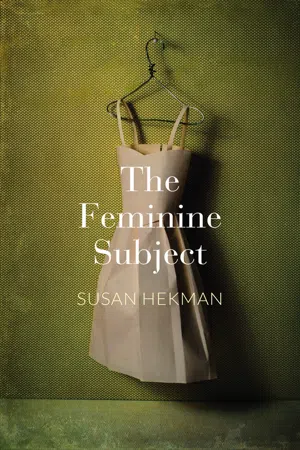
Susan Hekman's original and highly engaging new book traces the evolution of "woman" from Beauvoir to the present. In a comprehensive synthesis of a number of feminist theorists she covers French feminist thinkers Luce Irigaray and Helene Cixous as well as theorists such as Carol Gilligan, Carole Pateman and Judith Butler. The book examines the relational self, feminist liberalism and Marxism, as well as feminist theories of race and ethnicity, radical feminism, postmodern feminism and material feminism. Hekman argues that the effort to redefine "woman" in the course of feminist theory is a cumulative process in which each approach builds on that which has gone before. Although they have approached "woman" from different perspectives, feminist theorists has moved beyond the negative definition of our tradition to a new concept that continues to evolve.
The Feminine Subject is a remarkably succinct yet wide-ranging analysis which will appeal to all feminist scholars and students as well as anyone interested in the changing nature of feminism since the 1950s.
- English
- ePUB (mobile friendly)
- Available on iOS & Android
eBook - ePub
The Feminine Subject
About this book
Information
1
Simone de Beauvoir and the Beginnings of the Feminine Subject
I. Introduction
The recent re-translation of Simone de Beauvoir's The Second Sex begins with a simple declarative sentence: in 1946 Simone de Beauvoir began to outline what she thought would be an autobiographical essay explaining why, when she tried to define herself, the first sentence that came to mind was “I am a woman” (Thurman 2010: ix). In the course of writing the book Beauvoir soon discovered that trying to explain what it meant to be a woman was far from simple. Somewhat to her surprise, what started as an autobiographical essay turned into a two-volume, nearly 800-page analysis that ranges widely over a disparate group of elements that define “woman” in society. It made Simone de Beauvoir both famous and infamous, and is commonly described as launching the contemporary feminist movement.
It is hard to imagine that anything new can or should be written at this point either on Simone de Beauvoir or The Second Sex. The book and its author excited intense interest, both positive and negative, after its initial publication. Since then its reception among feminists has gone through several phases. From the outset feminists recognized the book as the first radical statement of the situation of women. As the feminist movement matured, however, many feminists had second thoughts about Beauvoir. She was accused of masculinism, blind acceptance of Sartrean existentialism, even a rejection of the female body and maternity. Then, beginning in the late 1980s, a spate of books and articles re-evaluating Beauvoir and The Second Sex brought the book back into the feminist limelight. Many of these works are attempts to define Beauvoir's philosophical orientation and to place her work in a more positive light than that of the previous commentaries.
My goal in the following is not to evaluate, one more time, Beauvoir's work in general and The Second Sex in particular. Nor is it to refute all the previous interpretations of her work. It is, rather, to go back to Beauvoir's original question and evaluate her work in light of the answer that she gave to it. Beauvoir asked the question that has and must orient feminist theory: what, really, does it mean to say “I am a woman”? How do we go about answering that question and where does that answer lead us? What I want to emphasize in the following is that the question of the identity of “woman” is the central question in the tradition of feminist theory that has evolved in the wake of Beauvoir's work. Beauvoir, obviously, has much to say about this question. And so do all the feminist theorists that follow her. The identity of “woman” is at the center of all the feminisms that have developed in the 60 years since The Second Sex. From liberal to psychoanalytic, to socialist, to postmodern, to the current rage, material feminism, “woman” hovers over each one of them. Each begins and ends with an understanding of the identity of woman both philosophically and socially. In other words, Beauvoir asked the question that would define the tradition of feminist theory that she quite literally initiated.
It is misleading, however, to characterize feminist theory since Beauvoir as a simple linear development following in the footsteps of her theory. It would be more accurate to describe feminist theory since Beauvoir as attempts to get “woman” right and, in the process, to show the errors of previous theories. As feminism evolved, the proponents of each new iteration of “woman” claimed that previous attempts to define “woman” were, at the very least, seriously flawed and that the definition of “woman” now being advanced has, finally, gotten it right. I think that this approach is seriously wrong-headed. It is much more productive and, I would argue, incumbent on feminist theorists to look at the last 60 years of theories about “woman” as a positive cumulative enterprise, each theory building on the one that went before and adding to our understanding of “woman.” I do not think that feminist theorists should be in the business of refuting previous feminist theorists but should, rather, be looking for elements in their work that have added to our understanding of “woman.” Our goal, in other words, should not be to, finally, get “woman” right but, rather, to explore in contemporary terms what we can contribute to our understanding of this central concept, an understanding grounded in previous theories.
Much of the commentary on Beauvoir and The Second Sex revolves around placing her philosophically, examining her reliance, or lack thereof, on the philosophical currents of her time. I am going to advance a different thesis here. Although it is undeniable that Beauvoir was deeply influenced by the philosophies of her day, I will argue that in taking on the question of “woman” Beauvoir encountered an obstacle that effectively exploded the boundaries of these philosophies. The question of “woman” did not fit into the vocabularies of any of the philosophical positions that were available to her. As a consequence she had to make her own way, to forge a new method in order to deal with the unique question of woman, a question that the tradition of western philosophy had hitherto avoided. I am not going to claim that Beauvoir's method was flawless or even that she articulated her rejection of previous philosophies clearly. But I am going to claim that what Beauvoir proposes is unique and, most importantly, that she articulated a position that would define feminist theory in the aftermath of The Second Sex: the introduction of “woman” into the philosophical tradition requires a radical change in method, a change that alters the tradition of philosophy as we know it.
Another way of putting this is that many feminist theorists have lost sight of the radical nature of Beauvoir's thought. We tend to get caught up in the heated arguments between the proponents of different approaches. Those who espouse a particular approach to the subject spend too much of their theoretical energy trying to prove their opponents wrong. We do not see the forest but get lost in the trees. What we lose sight of is that Beauvoir invites us to enter, in Althusser's words, a new continent of thought. Although throughout the course of feminist theory we have approached this project from different perspectives, our goal is the same: transforming “woman.”
In subsequent chapters this understanding of Beauvoir's work will ground my examination of the evolving tradition of feminist theory. In chapter 2, I look at the French feminists that came after Beauvoir. I interpret them not, as they sometimes claim, as repudiating her conception of “woman,” but as continuing to explore how “woman” explodes the categories of philosophical thought. Despite the differences between the work of Beauvoir and that of Irigaray, Cixous, and Kristeva, and their differences from each other, they are continuing Beauvoir's legacy. Irigaray's concept of “jamming the theoretical machinery” summarizes not only her work, but the course of feminist theory that is emerging. In chapter 3, I interpret the emphasis on difference that characterizes radical feminism and the relational self in the same light. The “difference feminists” were, in a Beauvoirian spirit, exploring a definition of “woman” outside the boundaries of the masculine paradigm and, in so doing, adding new dimensions to the concept. I focus specifically on the work of Carol Gilligan, a theorist who has been, I think, unfairly pushed to the sidelines in contemporary feminism. Gilligan accomplishes an amazing feat: redefining the basis of western moral theory. I do not believe she has received full credit for this. In addition, her work on the development of adolescent girls is pathbreaking. Beauvoir suggested that it is in adolescence that girls acquire the sense of inferiority that characterizes the feminine. Gilligan's research proves this to be the case.
In chapter 4 I take a different tack. I argue that feminists who attempted to fit “woman” into the traditions of liberalism or Marxism effectively proved Beauvoir's thesis that “woman” does not fit into masculine traditions. Despite the valiant efforts of these feminists, they failed in their attempts to find a common ground with these theories. In both cases, introducing “woman” into these theories necessarily changes their fundamental assumptions. We have learned an important lesson from the efforts of these theorists: no tweaking of the tradition will suffice; we have to move beyond the parameters of western thought to redefine “woman.”
The era of differences I examine in chapter 5 presents distinctive challenges. Previous feminists, including Beauvoir, assumed that they were trying to define a unitary conception of “woman.” Postmodern feminists, theorists of race and ethnicity, and those who embrace intersectional analysis challenged this assumption. They argued that “woman” is multiple, that no one definition will fit all women. For some feminists this was a difficult transition, but it soon became clear that it was necessary to accommodate the diversity of women's lives. It also became clear that there was no going back to the era of difference.
I conclude with a discussion of the present era in which feminists are returning to the material after the linguistic turn of postmodernism. A widespread understanding of this approach is that it corrects the over-emphasis on the linguistic that defines postmodernism. Although this is not inaccurate, it also over-simplifies the relationship. A better characterization is that the turn to the material brings in issues, most notably the body and biology, that were sidelined in the linguistic turn. This approach has made a significant contribution to feminist theory. It has opened up new avenues of research that will enhance our understanding of the feminine subject.
My analysis of all of these theorists is driven by three theses. First, our exploration of the subject is a radical project that explodes the boundaries of previous theories. Beauvoir began this project by asking “what is ‘woman’ ”? and we are still exploring this question. Second, our effort is cumulative – each theory builds on what has gone before rather than repudiating previous theories. My third thesis is closely related: we should not assume that our goal is to, once and for all, get “woman” right. Looking for essences is a central aspect of masculinist thought that we should abandon. The search for “woman” is an ongoing process begun by Beauvoir that continues to evolve.
II. The Ethics of Ambiguity
Beauvoir first expresses the ideas that will guide her discussion of women in The Second Sex in her collection of essays, The Ethics of Ambiguity.1 Her concern in these essays is to get at the essence of the human subject, what it means to be a human being. At the beginning of the first essay she states that:
This privilege, which he alone possesses, of being a sovereign and unique subject amidst a universe of subjects, is what he shares with all his fellow men. In turn an object for others, he is nothing more than an individual in the collectivization on which he depends. (1948: 7)
She goes on to assert that as long as men have lived they have felt this “tragic ambiguity of their condition” (1948: 7), ambiguity that, she later asserts, we must assume (1948: 9). To attain his truth, man must not attempt to dispel the ambiguity of his being, but, on the contrary, accept the task of realizing it (1948: 13).
These statements set the tone for the analysis that follows, an analysis that, at least initially, follows the lines of Sartrean existentialism. The first implication of man's ambiguous status is that there are not “foreign absolutes,” no “inhuman objectivity” but, rather, it is human existence that makes values spring up in the world (1948: 14–15). Another way of expressing this ambiguity is that the fact of being a subject is a universal fact; the Cartesian cogito expresses both the most individual experience and the most objective truth, but the ethics of ambiguity denies that separate existents can be bound to each other and their individual freedom can forge laws valid for all (1948: 17–18).
So far so good. Life, and particularly ethics, is ambiguous in that we are both separate and collective beings. But, as Beauvoir works through her theory, this ambiguity gets more complicated. Freedom is the source from which all signification and values spring. To will oneself moral and to will oneself free are one and the same decision. This theory places all human beings on a moral plane as seekers of freedom. But, as Beauvoir develops her theory, problems arise for this neat formulation. There are, Beauvoir asserts, exceptions to this principle. There are beings whose life slips by in an infantile world because, having been kept in a state of servitude and ignorance, they have no means of breaking the ceiling which is shielded over their bodies. Beauvoir first cites the example of women and slaves to illustrate her point, but as her argument progresses she turns her attention exclusively to women. Women in western countries, she asserts, lack an apprenticeship in freedom and, what is worse, consent to their servitude (1948: 37–8).
Women, in short, present a problem for the theory she is advancing. They do not fit neatly into the parameters of the ethics of ambiguity. In this context, however, Beauvoir seems unwilling to deal with this problem and pulls back from the difficulties it poses. Instead she plunges into the issue of freedom and what it means for this theory. Freedom, she asserts, must project itself toward its own reality through a content whose value it establishes. It is not necessary for the object to seek to be, but it must desire that there be being. To will oneself free is to will that there be being as one and the same choice; they both imply the bond on each man with all others. It follows that “To will that there be being is also to will that there be men by and for whom the world is endowed with human significations…To make being ‘be’ is to communicate with others by means of being” (1948: 71). Freedom cannot will itself without aiming at an open future.
It follows, Beauvoir asserts, that existentialism is not solipsism: “Man can find a justification in his own existence only in the existence of other men” (1948: 72); “To will oneself free is also to will others free” (1948: 73). It also follows that there is a concrete bond between freedom and existence. To will man free is to will there to be being; it is to will the disclosure of being in the joy of existence (1948: 135).
In later years, Beauvoir described The Ethics of Ambiguity as the book that irritated her the most (Moi 2008: 168). Reading the book today from the perspective of The Second Sex is irritating because the position she articulates here lacks the clarity she will achieve in TSS. A number of things, however, are clear at this stage. First, Beauvoir is distinguishing her position from the implicit solipsism of early Sartrean existentialism. As many commentators have pointed out, Beauvoir's concept of subjectivity and freedom in The Ethics of Ambiguity is specifically social; we cannot be without the being of others (Kruks 1990: 93; Tidd 1999: 15). Second, it begins to emerge that the key to this social identity of “man” is his existence, the specifics of his individual place in the society that gives him his being and his freedom. This point will become a major focus of the analysis in The Second Sex. What will then be identified as “situation” will take center stage in the analysis, whereas here it is still on the margins.
What is not clear, however, is how women fit into this scenario. In her commentary on The Ethics of Ambiguity, Toril Moi claims that for Beauvoir the human condition is characterized by ambiguity and conflict and that women embody this more than men. Thus, women incarnate the human condition more fully than men (2008: 195). I agree, but I think that the problem goes deeper than this. I think that what Beauvoir is beginning to realize is that women change everything. Yes, women do not fit into the philosophical position she is developing, but at this point she does not realize what follows from this. The philosophical position she is espousing cannot be adjusted to meet this problem. Women lack an apprenticeship in freedom. They cannot fit into the definitions of freedom and existence that Beauvoir is so carefully laying out in The Ethics of Ambiguity. And the reason for this failure lies in women's unique situation, what she here calls their “infantile world.” In The Ethics of Ambiguity Beauvoir essentially sidesteps this problem. She mentions women, makes her central point regarding the sociality of human existence, and moves on. It is not until The Second Sex that she is forced to confront the problem of women directly. And there it becomes clear that the “ambiguity” of women's situation is of an entirely different order from that of men. It also becomes clear that dealing with the “problem” of women will necessitate a radically different approach.
III. The Second Sex
Following in the footsteps of many feminist critics of Beauvoir, I initially dismissed her approach as masculinist and epistemologically inconsistent. Focusing on her concept of the Other as it is presented in The Second Sex, I argued that Beauvoir's claim that the One/Other relationship is primordial and that the One is gendered masculine precludes women from full subjectivity. Women cannot be the One, the fully human transcendent subject, and therefore Beauvoir in effect denies woman full subjectivity (Hekman 1999).
It is very easy to read Beauvoir this way. The first few pages of The Second Sex present the One/Other relationship as a fund...
Table of contents
- Cover
- Title page
- Copyright page
- Acknowledgments
- 1: Simone de Beauvoir and the Beginnings of the Feminine Subject
- 2: Difference I: The “French Feminists”
- 3: Difference II: Radical Feminism and the Relational Self
- 4: Continuing the Tradition: Liberalism and Marxism
- 5: From Difference to Differences: Postmodernism, Race, Ethnicity, and Intersectionality
- 6: The Material Subject
- Bibliography
- Index
Trusted by 375,005 students
Access to over 1.5 million titles for a fair monthly price.
Study more efficiently using our study tools.
Frequently asked questions
Yes, you can cancel anytime from the Subscription tab in your account settings on the Perlego website. Your subscription will stay active until the end of your current billing period. Learn how to cancel your subscription
No, books cannot be downloaded as external files, such as PDFs, for use outside of Perlego. However, you can download books within the Perlego app for offline reading on mobile or tablet. Learn how to download books offline
Perlego offers two plans: Essential and Complete
- Essential is ideal for learners and professionals who enjoy exploring a wide range of subjects. Access the Essential Library with 800,000+ trusted titles and best-sellers across business, personal growth, and the humanities. Includes unlimited reading time and Standard Read Aloud voice.
- Complete: Perfect for advanced learners and researchers needing full, unrestricted access. Unlock 1.5M+ books across hundreds of subjects, including academic and specialized titles. The Complete Plan also includes advanced features like Premium Read Aloud and Research Assistant.
We are an online textbook subscription service, where you can get access to an entire online library for less than the price of a single book per month. With over 1.5 million books across 990+ topics, we’ve got you covered! Learn about our mission
Look out for the read-aloud symbol on your next book to see if you can listen to it. The read-aloud tool reads text aloud for you, highlighting the text as it is being read. You can pause it, speed it up and slow it down. Learn more about Read Aloud
Yes! You can use the Perlego app on both iOS and Android devices to read anytime, anywhere — even offline. Perfect for commutes or when you’re on the go.
Please note we cannot support devices running on iOS 13 and Android 7 or earlier. Learn more about using the app
Please note we cannot support devices running on iOS 13 and Android 7 or earlier. Learn more about using the app
Yes, you can access The Feminine Subject by Susan J. Hekman in PDF and/or ePUB format, as well as other popular books in Philosophy & Philosophy History & Theory. We have over 1.5 million books available in our catalogue for you to explore.