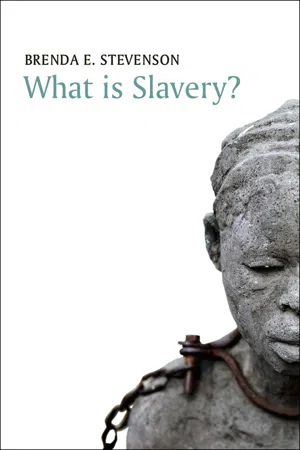
What is slavery? It seems a simple enough question. Despite the long history of the institution and its widespread use around the globe, many people still largely associate slavery, outside of the biblical references in the Old Testament, to the enslavement of Africans in America, particularly the United States. Slavery proved to be essential to the creation of the young nation's agricultural and industrial economies and profoundly shaped its political and cultural landscapes, even until today.
What Is Slavery? focuses on the experience of enslaved black people in the United States from its early colonial period to the dawn of that destructive war that was as much about slavery as anything else. The book begins with a survey of slavery across time and place, from the ancient world to the beginning of the Atlantic slave trade and then describes the commerce in black laborers that ushered in market globalization and brought more than 12 million Africans to the Americas, before finally examining slavery in law and practice.
For those who are looking for a concise and comprehensive treatment of such topics as slave labor, culture, resistance, family and gender relations, the domestic slave trade, the regionalization of the institution in the expanding southern and southwestern frontiers, and escalating abolitionist and proslavery advocacies, this book will be essential reading.
- English
- ePUB (mobile friendly)
- Available on iOS & Android
eBook - ePub
What is Slavery?
About this book
1
Slavery across Time and Place Before the Atlantic Slave Trade
“From the first written records in ancient Sumeria, the concept of slavery has been a way of classifying the most debased social class.”
David Brion Davis, Inhuman Bondage1
Slavery has existed across time and place as one of the most enduring institutions and conditions found among peoples. Many of the examples of enslavement, bondage, unfree labor, debt peonage, concubinage, and so on that will be surveyed here, however, occurred in a society that one would not define as a slave society – that is, one in which the presence of slaves had a defining impact on one or more significant societal characteristics that influenced the lives of many, if not most, of its inhabitants. These affected societal traits typically protected the rights and privileges of slaveholders and others invested in the institution, not the slaves. As one will quickly conclude from perusing this chapter, the numerous forms of slavery found around the globe were, and still are, quite varied, not just between political boundaries, but within them as well. Slavery rarely has remained the same in any particular area. Its means of implementation, the characteristics of those who could be enslaved and those who could enslave, its influence on political, social, economic, and cultural structures and customs, the “rights” of the enslaved, the measure of state support, the ways in which the enslaved gained freedom and, indeed, what that “freedom” meant for the emancipated and their descendants produced an impressively diverse institution. Still, the reader will also quickly come to understand that some characteristics of slave status carry across time and place, or at least often repeat themselves. Noted slavery scholar David Brion Davis is absolutely correct in his association of slavery with social “debasement.” The hierarchies that slavery helped to created, and operated within, situated the “slave” at the bottom, with rare exception. This is a fundamental similarity hereby persisted across an array of power relationships labeled as slavery. Other similarities include the means whereby persons came to acquire this status, the kinds of labor they performed, and the impact of slave ownership on a master's status. The most singular characteristic of the slave in post-contact America was that he or she was “black”; therefore, a racialized basis for slavery was quite unique previous to the New World institution coming into its own. Before, persons were much more likely to be enslaved because they were impoverished, war captives, criminals, kidnap victims, or were of a specific religion than because they were “black” or African.
Slavery in the Ancient World
In the ancient world, Egypt, Mesopotamia, Greece, Palestine, Rome, and Asia had slaves. So too did early societies in the Americas, Europe, Africa, and the Pacific. There were slaves in Babylon as early as the eighteenth century bce and in Mesopotamian cities by 6800 bce. The Babylonian Code of Hammurabi (c. 1790 bce), for example, contains numerous guidelines related specifically to slavery. Slaves in Mesopotamia typically originated as war captives, criminals, and debtors, and they worked in agriculture, construction, and as domestics. Slave ownership there reached its peak in the first century bce.2 Documentation of slavery in Greece indicates that it existed at least from 1500 bce onward, but was particularly important during the Hellenistic period (332–330 bce) and especially in Athens, Delos, and Delphi. Fifth-century bce Athens had more enslaved residents than free people; and Greece employed tens of thousands of slaves in its silver mines during the same era. Slavery in the Roman Republic was fully institutionalized by 450 bce, and was incorporated into the Twelve Tables legal code (451–450 bce). Indeed, close to 700,000 prisoners of war were enslaved between 297 and 167 bce in the Roman Empire.3 Altogether, millions of slaves inhabited ancient Rome, claiming 15–25 percent or even 35 percent of its population.4
What did it mean to be a slave in the ancient Greco-Roman world? Slaves had to be away from their original “nation” and “cultures” – an “other” in the society where the “free” did not regard him or her as a “person,” and certainly not as an equal. A slave had no recognizable ties to nation, state, or lineage.5 Roman slaves, for example, arrived from across Rome's vast empire that included Germany, Italy, the Balkans, Britain, Syria, Spain, Greece, Turkey, Somalia, North Africa, Jewish territories, and even India.6 Slaves were chattel or property, and provided their masters with labor and status. It was understood, by slaves and their owners alike, however, that they still were human and, therefore, capable of emotion and even intelligence.7 Nonetheless, a slave belonged physically and, at least outwardly, emotionally to his/her owner who could choose to use, clothe, feed, punish, designate an occupation, or have sexual relations with him or her largely at will. The vast majority of Roman slaves had few privileges and their status was passed on to their descendants. As enslaved people, they could not own property, marry, or have a family over which they could claim control.8
The origins of this status – inherited, war spoil, purchased chattel, kidnap victim, debtor, and orphaned, abandoned, or sold child of an impoverished family – also led to enslavement in China, Egypt, and other places in both the ancient and early modern world. Enslaved persons in the Roman Empire were found in all realms of society and were essential, in many ways, to various sectors of the economies of the ancient world. The largest numbers were domestics or agricultural workers. Indeed, although wealthy slaveholders could have hundreds of domestic slaves, most had much smaller numbers. Slaves also worked as skilled artisans, gladiators, in mining, and in administrative positions. As in societies throughout the western ancient world, domestic and skilled slaves had higher status than agricultural workers.9 Slavery in the ancient Greco-Roman world meant, as it did in the Americas, that enslaved men, women, and children did not have control over their bodies. Physical and sexual control of a slave was a given right of owners and anyone the owner allowed access to his property. Owners also could choose to punish their slaves as they pleased, usually without state interference. Punishments could range from whipping and branding to imprisonment or even death.10
There was a consensus regarding the alienated social and political status of slaves, but there often was visible status diversity among the slave population that affected their labor and treatment. In the Greco-Roman world, certain prized slaves belonging to wealthy and powerful masters, therefore, had relatively significant power vis-à-vis other slaves, as well as some low-status free men and women.11 As such, some enslaved persons actually found themselves on the border between “slave” and “free,” due to their owners' great status. Others gained status, and some useful “freedoms,” if they acquired important skills or an impressive education. A few, no doubt, actually could inspire the envy of very low-status free pe...
Table of contents
- Cover
- Series page
- Title page
- Copyright page
- Figures and Tables
- Acknowledgments
- Introduction: What is Slavery?
- 1: Slavery across Time and Place Before the Atlantic Slave Trade
- 2: African Beginnings and the Atlantic Slave Trade
- 3: African People in the Colonial World of North America
- 4: Slavery and Anti-slavery in Antebellum America
- Conclusion
- Index
- End User License Agreement
Trusted by 375,005 students
Access to over 1.5 million titles for a fair monthly price.
Study more efficiently using our study tools.
Frequently asked questions
Yes, you can cancel anytime from the Subscription tab in your account settings on the Perlego website. Your subscription will stay active until the end of your current billing period. Learn how to cancel your subscription
No, books cannot be downloaded as external files, such as PDFs, for use outside of Perlego. However, you can download books within the Perlego app for offline reading on mobile or tablet. Learn how to download books offline
Perlego offers two plans: Essential and Complete
- Essential is ideal for learners and professionals who enjoy exploring a wide range of subjects. Access the Essential Library with 800,000+ trusted titles and best-sellers across business, personal growth, and the humanities. Includes unlimited reading time and Standard Read Aloud voice.
- Complete: Perfect for advanced learners and researchers needing full, unrestricted access. Unlock 1.5M+ books across hundreds of subjects, including academic and specialized titles. The Complete Plan also includes advanced features like Premium Read Aloud and Research Assistant.
We are an online textbook subscription service, where you can get access to an entire online library for less than the price of a single book per month. With over 1.5 million books across 990+ topics, we’ve got you covered! Learn about our mission
Look out for the read-aloud symbol on your next book to see if you can listen to it. The read-aloud tool reads text aloud for you, highlighting the text as it is being read. You can pause it, speed it up and slow it down. Learn more about Read Aloud
Yes! You can use the Perlego app on both iOS and Android devices to read anytime, anywhere — even offline. Perfect for commutes or when you’re on the go.
Please note we cannot support devices running on iOS 13 and Android 7 or earlier. Learn more about using the app
Please note we cannot support devices running on iOS 13 and Android 7 or earlier. Learn more about using the app
Yes, you can access What is Slavery? by Brenda E. Stevenson in PDF and/or ePUB format, as well as other popular books in History & World History. We have over 1.5 million books available in our catalogue for you to explore.