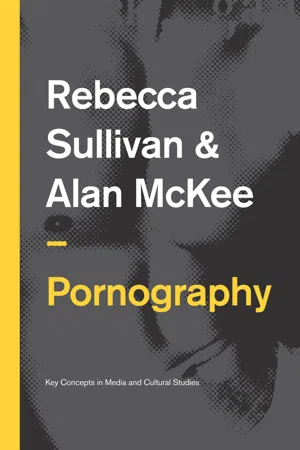
Written for a broad audience and grounded in cutting-edge, contemporary scholarship, this volume addresses some of the key questions asked about pornography today. What is it? For whom is it produced? What sorts of sexualities does it help produce? Why should we study it, and what should be the most urgent issues when we do? What does it mean when we talk about pornography as violence? What could it mean if we discussed pornography through frameworks of consent, self-determination and performance?
This book places the arguments from conservative and radical anti-porn activists against the challenges coming from a new generation of feminist and queer porn performers and educators. Combining sensitive and detailed discussion of case studies with careful attention to the voices of those working in pornography, it provides scholars, activists and those hoping to find new ways of understanding sexuality with the first overview of the histories and futures of pornography.
- English
- ePUB (mobile friendly)
- Available on iOS & Android
eBook - ePub
About this book
Information
1
The Global Creative Industry of Pornography
How does pornography get made? What institutions are involved and how are they structured? Who pays for pornography to be made and consumed? How is money distributed to those involved in its production? Pornography is big global business and a significant player in the media entertainment matrix. Every year, tens of thousands of people around the world produce millions of pornographic images and videos for hundreds of millions of consumers. We start this book by focusing particularly on the production and distribution of pornography, and its relationship with other media entertainment industries. It is our contention that pornography is, like almost all other media entertainment, transforming into a global creative industry. What that means in terms of profitability, organizational structure, and labour relations are important questions, made more so by the stigmas many porn performers face.
Pornography can be produced within either professional or amateur systems of production and consumption. It is not a form of culture that is commonly state-produced. Governments typically provide funding for the production of particular kinds of culture – ballet, opera, visual arts and so on – but there is little state-produced pornography (McKee 2001). Usually, when it is revealed that a state-run cultural fund has provided support to pornography production, a moral panic erupts and the state must quickly claw back funding or promise to review its programme to ensure that no public money goes into explicit sexual media. For example, after the Canada Council funded the 1999 film Bubbles Galore, a feminist soft-core porn film starring Nina Hartley and Annie Sprinkle, then Culture Minister Sheila Copps vowed to ensure no more such ‘ridiculous grants’ would happen. Similar outcry happened in Sweden over the film Dirty Diaries, a feminist porn film funded by the Swedish Film Institute in 2009.
In this opening chapter we look at the business of producing commercial pornography, that is pornography produced for profit. As the production of pornography is an important issue, we revisit it at various points in the book. In Chapter 5 we discuss the governance of pornography production. We consider amateur and not-for-profit pornography in more detail in chapters on performance and technology. But to begin our story, we focus on the commercial world of pornographic production as a global creative industry – the mainstream, traditional, ‘legacy’ materials (a term for ‘old’ media before the Internet) that many people think of when they hear the word ‘pornography’.
Estimates of the global worth of the pornography industry range widely. In the United States alone, in 2010, some quoted the size of the pornography industry as ranging from $8 billion to $13 billion (Szalai 2010). Globally, in 2002, the worth of the pornography industry on the Internet was calculated as $31.2 billion (Perdue 2004, 263); while in 2007, it was estimated at a substantially smaller $4.9 billion (Jeffreys 2009, 66). Forbes magazine claimed the entire global pornography market in the early 2000s, across all sectors, was $56 billion (Whisnant 2004, 16). As Coopersmith notes, ‘many of the numbers proffered are estimates, often by people or institutions with a vested interest – or an axe to grind’ (Coopersmith 1998, 120n24; see also McNair 2002, 6).
Both producers and critics of pornography have an interest in making it seem as big as possible. Porn companies seek to position themselves as mainstream by arguing for their importance to the economy. Critics of the industry, such as Sheila Jeffreys, Diane Russo or Gail Dines, look at the financial profits as proof of a crisis overwhelming modern societies. We say that the actual size does not matter as much as understanding how the pornography business actually operates as industry. In this chapter, we examine multiple forms of industrial organization to produce and distribute pornography, distinguishing between large commercial enterprises and smaller DIY efforts. We are particularly interested in the organization of creative labour on the pornography set, including for non-performers, and in the unique occupational health and safety issues that affect performers.
Pornography as a creative industry
Globalization of labour is growing. Right or wrong, governments increasingly commit to free trade agreements and see the globalization of markets as a desirable way to raise living standards in countries around the world. Innovations in communication technologies have increased the globalization of the production, distribution and consumption of a wide range of products and services, including pornography. Despite the widening network of capital exchange, it currently remains the case (although maybe only in the short term) that supply and distribution are mostly controlled by a small network of Western-dominated companies and concentrated in major global urban centres like Los Angeles and Amsterdam (Jacobs 2007, 30). We start this chapter therefore by looking at what Melinda Tankard Reist and Abigail Bray call ‘Big Porn Inc.’ (Tankard Reist and Bray 2011) – large-scale commercial pornography producers who distribute transnationally but are still often based in wealthy Western countries. These companies prioritize profits and growth, the same as any vast commercial media enterprise.
For example, Vivid Entertainment LLC is one of the biggest pornography producers in the world, with an estimated annual revenue of $100 million (Reuters 2006; Szalai 2010). For a period from about the mid twentieth century (the launch of Playboy) to the early twenty-first (the maturation of the Internet), commercial pornography companies like Vivid were able to work with high profit margins from the production and distribution of sexually explicit materials across a wide range of platforms. The business model was simple. Pornographic materials were produced as physical objects – first as photographs and magazines, then as film loops, then video cassettes, and then DVDs. These would be sold to a distributor, who could either distribute them by direct mail, or sell them on to a wholesaler who would then sell them on to a retailer. Every step of the process saw a substantial mark-up and every agent in the supply chain made a profit. There was little paid advertising, or subscription models. It was a straightforward model of selling a product for more than it costs to make with lots of middlemen along the chain (Coopersmith 1998, 104).
However, as digital technologies become increasingly accessible and interactive, the situation is no longer so rosy for these legacy pornography companies. New business models have emerged with smaller economies of scale: direct sale or hire of product (videos and DVDs), advertiser-supported websites, and website subscriptions. Internet pornography has also led the way in business model innovations such as ‘affiliate networks, performance-based advertising, traffic sharing and even those pop-up console advertising windows that are annoying but highly effective’ (Perdue 2004, 262). Furthermore, the Internet makes possible virtual hubs so that independent performers can upload their work and receive payment based on ‘clicks’, the number of times their work is viewed either by streaming or downloading. For example, the PornHub network includes PornHub, YouPorn, Tube8, PornMD, SpankWire, XTube, Extreme Tube, Peeperz and others. Much of the work on these sites is available free of charge. The company earns its revenue through advertising and premium memberships. Furthermore, there are persistent allegations of pirated material and poor payment systems that have severely compromised the earning potential of performers and producers. We discuss this emerging landscape in more detail in the Technologies chapter of this book. At this point we note that the traditional business models of ‘Big Porn Inc.’ are facing severe challenges from these new competitors
Who works in pornography, and what are their experiences of the industry? Those questions tend to be sidetracked when dealing with the size or profitability of the industry. Whether we are talking about major corporate enterprises, or about one of the alternative business models promoted by technological innovation, pornography – like all of the so-called ‘creative industries’ (film and television, publishing, music, advertising and so on) – involves a delicate balancing act between creative performance and industrial labour. In pornography – as in Hollywood, and indeed all entertainment media systems around the world – most of the money in pornography is made by the producers and distributors (Spark Tech Talk 2012). Between them they make the biggest money in the pornography industries (Jacobs 2007, 12; see also Jeffreys 2009, 67; Russo 1998, 23; Reeve 2010; Ray 2010). The exception is a tiny margin of performers or media personalities who achieve stardom and command extraordinarily high salaries. Producers are the people who come up with ideas, raise finance, put teams together and oversee the production of content (Collis, McKee and Hamley 2010, 922). Distributors ‘solicit content from companies and prepare it for global distribution’. Coopersmith notes that in the days of legacy media, both producers and distributors could easily make 100 per cent profit on every tape sold (Coopersmith 1998, 104). Several large-scale commercial pornography companies continue to make profits – although in increasingly challenging circumstances (Campbell 2014). But it is rarely performers, and almost never the rest of the crew, who make good money working in pornography. Thus it is worthwhile to investigate the working conditions of both performers and ancillary workers in trying to make a living from the pornography industry.
Working hard for the money: Support players in the pornography industry
It is important to recognize the host of different workers engaged in pornography to see it as one sector of the creative industries, albeit a particularly unique and occasionally fraught one. More attention is being paid to those who work in the pornography industry not as performers but as technical and administrative support staff. Their stories help to reveal the way that pornography is either celebrated as a liberating and progressive career or denounced as exploitative and abusive. As Laura Agustin points out, the sex industry includes large numbers of ‘non-sexual employees’: ‘drivers, accountants, lawyers, doctors … newspaper and magazine editors [and] Internet entrepreneurs’ (Agustin 2005, 618). In our consideration of the pornography industry in particular we can add to that list camera operators, sound engineers, designers, advertising sales people, office managers and so on. These are either administrative support staff or ‘below-the-line’ workers – a film and television industry term that includes all production workers except for actors, producers, directors and writers. The labour of below-the-line workers is often nomadic, casualized, demanding and poorly compensated. Once again, this is true across the creative industries and not only in the pornographic industry. Vicki Mayer’s ethnographic account of camera operators who produce footage for ‘soft-core reality video’ shows like Girls Gone Wild emphasizes the precariousness of this work:
Typically men spent twelve to eighteen hours on their feet … Spilt beer, flying confetti and whizzing beads … potentially damaged equipment … Given levels of intoxication on the streets, fights and shouting were common … [and t]he actual material compensation for this labor was also questionable. Men talked about receiving far less than they were promised or expected. (Mayer 2008, 104)
For Mayer, the situation of these camera operators is not specific to pornography – in fact, she argues that their situation is typical of television more generally. In John Caldwell’s account of mainstream film and television ‘production culture’ he similarly notes that key elements of creative labour are lack of job security, periods of intense overwork, and lack of overall creative control on projects. In a ‘more flexible post-Fordist industrial economy’ (Caldwell 2008, 156), the creative industries tend to ‘outsourc[e] … creative work’ (Caldwell 2008, 119). A lack of job security – or ‘Nomadic labor systems’ – means that ‘even after a [creative] worker has obtained employment … they must still hustle for every new production they hope to work on …’ (Caldwell 2008, 113).
Mayer notes that many of the camerapeople she spoke to emphasized that despite the lack of material reward the work was their ‘dream job’: ‘I mean, I love tits’; ‘I just wanted to be part of the action’; ‘I thought, wow, this is going to be fun’ (Mayer 2008, 102). This sort of hyperbole is generic across the creative industries. In order to compensate for the lack of material reward, these jobs tend to oversell the idea of intrinsic benefits such as gratifying labour, career flexibility, democratic management, and workaholism as creative forms of self-fulfilment (Caldwell 2008, 33). For example, PornHub’s FAQ ends with the question, ‘Is working for PornHub the coolest job ever?’ and answers, ‘Yes. Yes it is’. This is not to say that such rewards are unimportant. For example, weighing up the pros and the cons of working as the managing editor of online pornography site Danni’s Hard Drive, Taylor Marsh emphasizes the pleasure of working in the creative industries:
Although the time I spent at DHD was often chaotic, and even though our business relationship would never be stable, one of the things that kept me enthused about being managing editor for DHD, especially in the beginning, was my periodic creative meetings with Danni … For hours we would hash out ideas and possibilities for new content, both of us excited about what was happening on the site. (Marsh 2004, 255–6)
It cannot be denied that some workers may find working in the pornography industry creatively and professionally satisfying. Yet, with the popularity of ‘docuporn’ – documentary and reality series offering behind-the-scenes peeks at the making of pornography – the idea of working in pornography as a pathway to an authentic, fulfilling work life is increasingly oversold. The Canadian documentary television series Webdreams (2005–8), or the German documentary film 9 to 5: Days in Porn (2008), provides insight into the everyday lives of workers and performers, while companies such as Playboy and Vivid offer their own soft-core documentary series on their business with The Girls Next Door (2005–10) and Pornovalley (2005), to name a few. All these examples draw on pre-existing genre work in contemporary docu-entertainment and reality television that seeks, in essence, to shift political and economic critique of the creative industries into the realm of subjective experience and personal validation. You might have no job security and the pay might be terrible – but see how much fun the work is!
We discuss pornography as performance in more detail in Chapter 6, but in this chapter we look specifically at pornography performance as a job. A study by Sharon Abbott found that performers enter the industry for a number of reasons: money, fame and glamour; freedom and independence; opportunity and socia-bility; and being naughty and having sex (Abbott 2010, 50–8). The first seven of these are generalizable for aspiring actors across the creative industries; this is less the case with the desire to be naughty or to have sex. In terms of the desire for money, the vast majority of pornography performers do not make as much from their work as do producers and distributors. For professional pornography actors, Abbott finds that ‘annual incomes generated … typically approximate middle-class earnings’. Usually, performers are paid by sexual act. So, for example...
Table of contents
- Cover
- Title Page
- Copyright
- Acknowledgments
- Introduction
- 1. The Global Creative Industry of Pornography
- 2. Pornography and Communication Technologies
- 3. Pornography and Violence
- 4. Pornification and Sexualized Bodies
- 5. Pornography Governance and Sexual Citizenship
- 6. Performing Pornography, Practising Sexual Politics
- Conclusion
- References
- Index
- End User License Agreement
Trusted by 375,005 students
Access to over 1.5 million titles for a fair monthly price.
Study more efficiently using our study tools.
Frequently asked questions
Yes, you can cancel anytime from the Subscription tab in your account settings on the Perlego website. Your subscription will stay active until the end of your current billing period. Learn how to cancel your subscription
No, books cannot be downloaded as external files, such as PDFs, for use outside of Perlego. However, you can download books within the Perlego app for offline reading on mobile or tablet. Learn how to download books offline
Perlego offers two plans: Essential and Complete
- Essential is ideal for learners and professionals who enjoy exploring a wide range of subjects. Access the Essential Library with 800,000+ trusted titles and best-sellers across business, personal growth, and the humanities. Includes unlimited reading time and Standard Read Aloud voice.
- Complete: Perfect for advanced learners and researchers needing full, unrestricted access. Unlock 1.5M+ books across hundreds of subjects, including academic and specialized titles. The Complete Plan also includes advanced features like Premium Read Aloud and Research Assistant.
We are an online textbook subscription service, where you can get access to an entire online library for less than the price of a single book per month. With over 1.5 million books across 990+ topics, we’ve got you covered! Learn about our mission
Look out for the read-aloud symbol on your next book to see if you can listen to it. The read-aloud tool reads text aloud for you, highlighting the text as it is being read. You can pause it, speed it up and slow it down. Learn more about Read Aloud
Yes! You can use the Perlego app on both iOS and Android devices to read anytime, anywhere — even offline. Perfect for commutes or when you’re on the go.
Please note we cannot support devices running on iOS 13 and Android 7 or earlier. Learn more about using the app
Please note we cannot support devices running on iOS 13 and Android 7 or earlier. Learn more about using the app
Yes, you can access Pornography by Rebecca Sullivan,Alan McKee in PDF and/or ePUB format, as well as other popular books in Social Sciences & Media Studies. We have over 1.5 million books available in our catalogue for you to explore.