The concept of sex addiction took hold in the 1980s as a product of cultural anxiety. Yet, despite being essentially mythical, sex addiction has to be taken seriously as a phenomenon. Its success as a purported malady lay with its medicalization, both as a self-help movement in terms of self-diagnosis, and as a rapidly growing industry of therapists treating the new disease. The media played a role in its history, first with TV, the tabloids and the case histories of claimed celebrity victims all helping to popularize the concept, and then with the impact of the Internet.
This book is a critical history of an archetypically modern sexual syndrome. Reay, Attwood and Gooder argue that this strange history of social opportunism, diagnostic amorphism, therapeutic self-interest and popular cultural endorsement is marked by an essential social conservatism: sex addiction has become a convenient term to describe disapproved sex. It is a label without explanatory force.
This book will be essential reading for those interested in sexuality studies, contemporary history, psychology, psychiatry, sociology, media studies and studies of the Internet. It will also be of interest to doctors and therapists currently working in this and related fields.
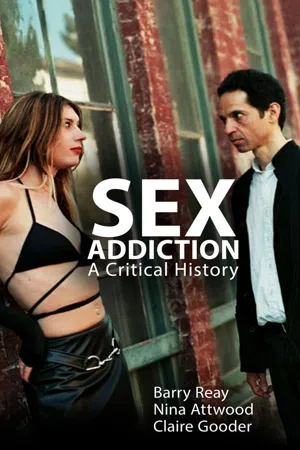
- English
- ePUB (mobile friendly)
- Available on iOS & Android
eBook - ePub
Chapter 1
Introduction
In America, if your addiction isn't always new and improved, you're a failure.
Chuck Palahniuk, 20021
Daddy's Secret Cedar Chest (2013) is for the ‘children of sex addicts’. An unnamed boy discovers a huge box in Daddy's bedroom (the cedar chest of the book's title) full of magazines and DVDs with ‘pictures of women with no clothes on!’ The dad (we are not told why he has his own bedroom unless Mummy's bedroom is called Daddy's bedroom too) also spends too much time with his computer in his home office. ‘Everything Daddy did was a secret.’ The boy tells his mother, and his parents argue about his father's ‘habit’. The boy becomes unsettled – ‘I was feeling scared.’ He has bad dreams: ‘A big hairy lady monster was crawling out of the humongous cedar chest. She stood up on her big hairy legs and opened up her big empty black hole of a mouth.’ In the dream this rather clumsy metaphor swallows his father. The boy's concerned mother takes him to a therapist. Daddy moves out to seek help for his ‘habit’ and then returns home to an improved family environment. The big hairy lady monster and the chest have gone.2
Why have we come to a stage in our history and culture where it is even conceivable that ‘children ages 6 to 12’ might have to be told ‘that they are not alone in their suffering, that help is available to them, and…that they did not cause their parent's sex addiction’?3
The aim of the book that follows is to trace the history of a new sexual concept, a modern sexual invention called sex addiction, and its sufferer the sex addict. Though we will discuss definitional complexities in due course, the sex addict has usefully been described as ‘a person who is obsessed with some type of sexual behavior, and whose behavior is compulsive and is continued despite significant adverse consequences’.4 Aviel Goodman characterized it to the readers of the Journal of Sex & Marital Therapy as ‘simply the addictive process being expressed through sex, the compulsive dependence on some form of sexual behavior as a means of regulating one's feelings and sense of self’.5
The idea's beginnings are somewhat imprecise. One possible origin at a practical level was in the self-help or recovery culture of the 1970s (we will discuss the link between sex and alcohol addiction later). Sex and Love Addicts Anonymous grew out of a local Alcoholics Anonymous support group in Boston in 1976 and other national sexual-addiction recovery fellowships were utilizing the Twelve-Step programme by the late 1970s and early 1980s. Sex Addicts Anonymous (1977) had its headquarters in Minneapolis; Sexaholics Anonymous (1978) was centred in Simi Valley, California; while the New York and Los Angeles Sexual Compulsives Anonymous was operational by 1982 as were gay and bisexual sexually compulsive support groups in New York.6
We know that a linkage between sex and addiction was informally entertained in popular culture in the late 1950s and 1960s. Pulp fiction during that period included Don Elliott's Love Addict (1959) and Curt Aldrich's Love Addict (1966) (see Figure 1). The latter was about a promiscuous man so the term ‘addict’ referred to lust rather than affection.7 But it was William Donner's The Sex Addicts (1964) that can actually claim first usage of the precise words ‘sex addict’ in the correct context (see Figure 2). It was about a couple of womanizers on a cruise ship: ‘It's the way he is…Compulsive. He can't stay with a woman more than a single night, he says. At least, not if others are available…He's slept with almost nine hundred women.’8 One friend observed of the other, ‘You're compulsive. You've got a monkey on your back’, and suggested analysis. Later the man, who was close to his nine hundred, admitted ‘Monkey on my back is right. Only I'm a sex addict, not a drug fiend.’9
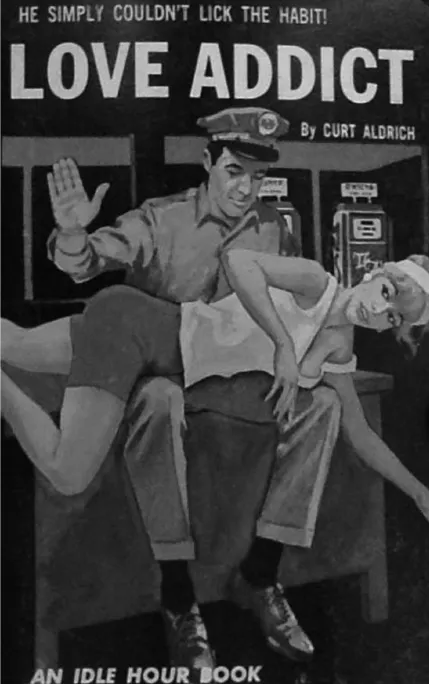
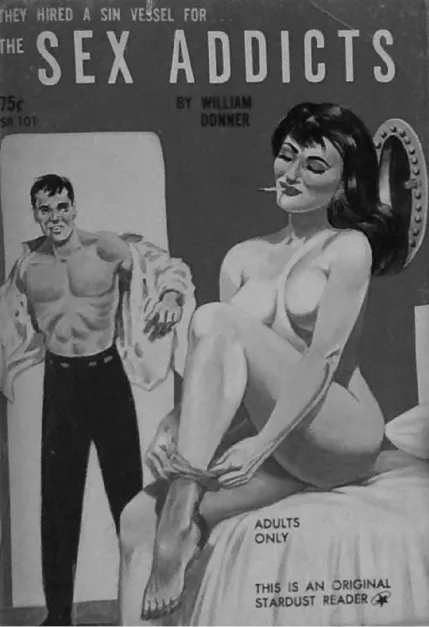
Pulp fiction aside, we also know that homosexual psychotherapy patients were referring to ‘sex heads’ – in the sense of addicts – in the 1960s: ‘I'm not only a pot head…I'm a sex head…it's completely eaten into everything.’ In short, the term may have arisen independently at a more grassroots level.10 When we later discuss the intellectual origins and viability of the concept, it is worth recalling this evidence for its humble origins.
Conceptually, as we will see, Lawrence Hatterer and Stanton Peele in the US and Jim Orford in Britain played roles in the malady's history. The New York sex therapist Avodah Offit mentioned ‘sex addicts’ in 1981 (immediately after a discussion of nymphomania and hypersexuality), citing a link between sex and the release of endorphins: ‘Thus sex, in addition to whatever else it does, may actually reduce pain and promote euphoria in much the same fashion as small doses of the morphinelike drugs. The sex addict, then, may literally be a junkie, in one sense.’11 However, the actual term ‘sex addiction’ is most clearly associated with the work of the US psychologist Patrick Carnes and his book The Sexual Addiction (1983), republished as Out of the Shadows: Understanding Sexual Addiction (1983). Carnes's centrality, for better or for worse, will become clear in the pages that follow.
The idea of sexual addiction enjoyed varied reception in these early years, and there was already an indication that endorsements might vary. It appeared in the ‘Current Trends’ section of the journal Medical Aspects of Human Sexuality in 1985.12 A comment in the British Journal of Sexual Medicine in 1986 by a Chicago psychiatrist ind...
Table of contents
- Cover
- Title page
- Copyright page
- Figures
- Epigraph
- Chapter 1: Introduction
- Chapter 2: Beginnings
- Chapter 3: Addictionology 101
- Chapter 4: Cultural Impact
- Chapter 5: Sexual Stories
- Chapter 6: Diagnostic Disorder
- Chapter 7: Sexual Conservatism
- Chapter 8: Conclusion
- Index
- End User License Agreement
Trusted by 375,005 students
Access to over 1.5 million titles for a fair monthly price.
Study more efficiently using our study tools.
Frequently asked questions
Yes, you can cancel anytime from the Subscription tab in your account settings on the Perlego website. Your subscription will stay active until the end of your current billing period. Learn how to cancel your subscription
No, books cannot be downloaded as external files, such as PDFs, for use outside of Perlego. However, you can download books within the Perlego app for offline reading on mobile or tablet. Learn how to download books offline
Perlego offers two plans: Essential and Complete
- Essential is ideal for learners and professionals who enjoy exploring a wide range of subjects. Access the Essential Library with 800,000+ trusted titles and best-sellers across business, personal growth, and the humanities. Includes unlimited reading time and Standard Read Aloud voice.
- Complete: Perfect for advanced learners and researchers needing full, unrestricted access. Unlock 1.5M+ books across hundreds of subjects, including academic and specialized titles. The Complete Plan also includes advanced features like Premium Read Aloud and Research Assistant.
We are an online textbook subscription service, where you can get access to an entire online library for less than the price of a single book per month. With over 1.5 million books across 990+ topics, we’ve got you covered! Learn about our mission
Look out for the read-aloud symbol on your next book to see if you can listen to it. The read-aloud tool reads text aloud for you, highlighting the text as it is being read. You can pause it, speed it up and slow it down. Learn more about Read Aloud
Yes! You can use the Perlego app on both iOS and Android devices to read anytime, anywhere — even offline. Perfect for commutes or when you’re on the go.
Please note we cannot support devices running on iOS 13 and Android 7 or earlier. Learn more about using the app
Please note we cannot support devices running on iOS 13 and Android 7 or earlier. Learn more about using the app
Yes, you can access Sex Addiction by Barry Reay,Nina Attwood,Claire Gooder in PDF and/or ePUB format, as well as other popular books in History & World History. We have over 1.5 million books available in our catalogue for you to explore.