eBook - ePub
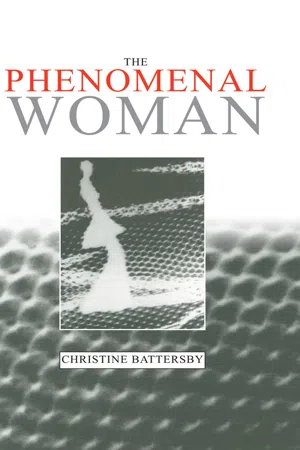
The Phenomenal Woman
Feminist Metaphysics and the Patterns of Identity
- English
- ePUB (mobile friendly)
- Available on iOS & Android
eBook - ePub
About this book
This original book enters the undeveloped territory of feminist metaphysics and offers a bold and unusual contribution to debates about identity, essence and self. Using a diverse range of theories - from Kant to chaos theory, from Kierkegaard to Deleuze, Irigaray, Butler and Oliver Sachs - this book challenges the assumption that metaphysics can remain unchanged by issues of sexual difference.
Information
1
Introduction: Fleshy Metaphysics
PHENOMENAL: extraordinary, exceptional, prodigious, unnatural, marvellous, amazing; often used hyperbolically in reference to some object or person of extraordinary power, gifts or other quality which excites wonder.
PHENOMENAL: in philosophy, that which has the nature of a ‘phenomenon’ (pl. ‘phenomena) and is the object of sense experience; applied to that which only seems to exist but which is a mere illusion of the senses; often opposed to that which is ‘real’, ‘objective’ or ‘noumenal’.
In the history of western metaphysics ‘woman’ is phenomenal in a double sense. She’s something wonderful, amazing, astonishing, peculiar. But she’s also just a surface deviation; mere ‘appearance’; unrepresentative of that distinctive, underlying ‘essence’ of humanity that philosophers have associated with ‘truth’. She falls outside ‘essence’ – or the defining characteristics of a species or thing – in ways that have been supposed to make it a mistake to look for an essence of female nature or experience.
I write from within a post-Kantian tradition of philosophy, analysing the philosophical concepts of the transcendental ego, ‘personhood’ and related notions of spatial and temporal self-identity. However, since the subject of woman has always only ever been at the margins of philosophical discourse, I move between two conceptual and experiential registers. On the one hand, there are the language and traditions of philosophy in which the ‘real’ world has been constituted as the merely ‘phenomenal’ world. On the other hand, there is also the language of women’s singularity and the need to talk of that ‘real’ or ‘phenomenal’ female body which has fallen outside the universals of philosophy.
In my current project I am seeking to use the antinomies of the female subject-position to think identity anew. I am not positing an ‘other’ form of subjectivity which is that of the ‘feminine’ or ‘female’ subject. Instead, I am asking what happens if we model personal and individual identity in terms of the female. Rather than treating women as somehow exceptional, I start from the question of what would have to change were we to take seriously the notion that a ‘person’ could normally, at least always potentially, become two. What would happen if we thought identity in terms that did not make it always spatially and temporally oppositional to other entities? Could we retain a notion of self-identity if we did not privilege that which is self-contained and self-directed?
Immanuel Kant’s ‘Copernican revolution’ sought to rewrite philosophical tradition by placing man – instead of God or the object – at the centre of the reality which we inhabit. My own feminist philosophical turn displaces the apparently gender-neutral Kantian self at the centre of the knowable world. However, instead of dispensing with the self in ways now fashionable in the postmodern tradition, I am attempting to construct a new subject-position that makes women typical. In effect, this means dispensing with the (Kantian) notion that the ‘I’ gives form to reality by imposing a grid of spatio-temporal relationships upon otherwise unformed ‘matter’. Focusing on the female subject involves treating humans as non-autonomous, and instead thinking relationships of dependence (childhood/weaning/rearing) through which one attains selfhood. It also involves thinking the process of birthing as neither monstrous nor abnormal. Mothering, parenting and the fact of being born need to become fully integrated into what is entailed in being a human ‘person’ or ‘self’.
In 1994, as I started to write the opening chapters of this book, I sat looking at the sunset over the sea, and chatting with one of the villagers from the obscure Cornish village which I had decided to make my base. He was in his mid-forties, had not been to college, and had instead worked on boats, as well as at a variety of clerical jobs. Now on long-term sick-leave, he was embarked on a programme of distance learning, and this included some Philosophy courses. As I started to talk about my project for a feminist metaphysics, and the need to think through a philosophy that deals seriously with birth, the man became excited and uneasy. He then suddenly offered the following unexpected remark:
‘It’s odd. Philosophers say that it is not really possible to understand and accept the idea of one’s own death. However, that is not what I find hard; it’s rather to believe that I was born. Indeed, when I try to think of my own birth, my brain goes all red and I feel sick and dizzy. I once tried to tell my mother that I could not accept that I had been born. But she told me I was just being silly.’
Of course, as the man knew well, it is absurd not to accept that one has been born. But this man’s remark is also acute, in that it reveals a central failure in our culture. Philosophers have notably failed to address the ontological significance of the fact that selves are born. Furthermore, there is also a more general inability to imaginatively grasp that the self/other relationship needs to be reworked from the perspective of birth – and thus in ways that never abstract from power inequalities, or from issues relating to embodied differences. We carry on idealizing autonomous ‘individuals’ who have equal rights and-duties, and look away from the fact that ‘persons’ only become such by first moving out of a state of foetal and childhood dependency on others. Just thinking about being born made this (fiercely independent) man’s ‘brain go all red’. And yet this man’s illness made his continued existence as an embodied self intimately dependent on the care of others: doctors, home-helps, social-workers, family, friends, neighbours.
In so far as we focus on these issues, we do it primarily in terms of ethical and political dilemmas. We see the failures in modern western philosophy and in our modes of imagining most clearly in current debates about abortion and about medical technology, for example, or in the current row over the ‘identity’ of a Europe that is made up out of individual states. However, this book does not deal with the question of identity on such overtly ethical or macro-political levels. Instead, it works more abstractly – and explores an ontology in which ‘self’ and ‘other’ intertwine in ways that allow us to think identity alongside radical novelty, power-dependencies, singularity and birth. In so doing, I will offer a critique of the metaphysical pessimism implicit in much poststructuralist and postmodernist feminist theory. But my conclusions are not just relevant for those immersed in the complexities of contemporary feminist discourse.
The response of my friend from Cornwall shows that even though this book starts from a feminist perspective – and asks how we need to rework notions of identity if we are to take the female human as norm – the conclusions that I reach are also relevant to males. Indeed, I would suggest that the model of identity that I put forward is more adequate for men (as well as women) than the classical philosophical understanding of the subject, substance and identity. There are imaginative and conceptual gaps – places where the ‘brain goes red’ – even for males who attempt to think the continuity of their lives in apparently more ‘commonsensical’ terms.
‘Common’ sense is pretty strange if it leaves this man from Cornwall unable to think his own birth. Although some of the arguments in this book might seem counter to ‘common’ sense and at odds with some of our most ‘intuitive’ certainties about the nature of ‘subjects’ and also of ‘objects’, the arguments are no more strange than some of the models adopted in recent science. And, indeed, some of the underlying metaphysical schemas of the ‘new’ physics will be used in chapter 3 in support of the metaphysics of sexual difference argued for in this book. I write about embodied selves that are paradigmatically female; but I would nevertheless hope that the male reader can overcome this barrier (which, after all, a female reader has to negotiate most of the time) and follow the development of the argument. There are important consequences for him – as well as for her – as I explore the theoretical grounding for a self which is born, and which is gradually shaped as it negotiates and renegotiates otherness, registering the resonances and echoes that the repeated movements produce.
As far as my female readers are concerned, I am only too aware that many of them will be distinctly uneasy with a feminist metaphysics that includes an emphasis on birth. Women have very good reasons to feel uncomfortable with any attempt to link female identity to reproductive capacities. I will need to return to this point later, in order to emphasize that ‘sex’ (one’s identity as a ‘female’) is no more a brute ‘given’ than is one’s ‘gender’: the ‘femininity’ – or ‘masculinity’ – that a woman’s behaviour might reveal. But perhaps it is enough to point out here that the hypothetical link between ‘woman’ and ‘birth’ that matters is ‘If it is a male human, it cannot give birth’, not ‘If it is a female human, it can give birth’. I will be suggesting that the dominant metaphysics of the West have been developed from the point of view of an identity that cannot give birth, so that birthing is treated as a deviation of the ‘normal’ models of identity – not integral to thinking identity itself.
Metaphysics Defined
Many feminist theorists would also object to my starting point on the grounds that any feminist metaphysics involves a contradiction in terms. In subsequent chapters I will argue that some of the most powerful critiques of metaphysics emanating from within feminism are only effective because these feminists keep Aristotelian parameters for metaphysics in place. In fact, the term ‘metaphysics’ came from the way that Aristotle’s writings were ordered by his followers. Thus, Aristotle’s analysis of being (ousia) and substance came after or beyond (meta) his writings on natural sciences (physica). As a consequence, the word came to stand for the branch of study (ontology or the science of existence) that was treated in these writings and that was supposed linked with, but ulterior to, the sciences proper. ‘Metaphysics’ became synonymous with that which transcends the physical, and with the study of ‘being’, ‘substance’, ‘time’, ‘space’, ‘cause’, ‘essence’ and ‘identity’. Furthermore, ontology was regarded as necessarily bound up with the study of a ‘primary’ and separable substance or ‘being’ that is fundamental, non-relational and that remains constant through change.
What will be argued in this book is that other approaches to being, substance, time, space, cause, identity, and so on, are possible, and those who refuse to accept this are clinging to an Aristotelian tradition of ‘metaphysics’ that philosophers before me have also rejected. Thus, with Immanuel Kant in the eighteenth century it became possible to distinguish two kinds of metaphysical enterprise. There was, on the one hand, ‘speculative’ metaphysics that dealt with an ‘unknowable’ and immaterial substrate of things-as-they-really-are. This ‘noumenal’ realm is Kant’s equivalent of Aristotelian ‘being’, but any speculation about it is rendered illegitimate – at least as far as knowledge is concerned. For Kant there was, on the other hand, ‘descriptive metaphysics’, which analyses what it is to ‘exist’ within the parameters of this space-time world: a world that was for Kant collectively structured via the underlying framework of human understanding, senses, imagination and reason. Descriptive metaphysics was, therefore, implicitly relational – and the ‘substance’ that was posited in respect of the space-time world reflected the relationality between ‘self’ and ‘not-self’.
This book develops a kind of ‘descriptive’ metaphysics, and thus operates within a post-Kantian tradition of metaphysics. But it departs radically from Kant in that it seeks to add sexual difference to the Kantian frame by querying the space-time structures and subject–object relationships that Kant viewed as both universal and necessary for any subject that could think itself as a persisting self. In particular, it is argued that considering the question of sexual difference – and taking the embodied female as norm – makes it possible to focus on other possible modes of ‘descriptive’ metaphysics apart from the one necessary and ‘transcendental’ structure laid down by Kant as necessary to ‘all’ human understanding whatsoever. Thus, my own feminist metaphysics rejects those parts of Kant which retain – and rework – Aristotelian ‘substance’. I argue that to think a persisting self it is not necessary to posit a permanent, underlying substrate that persists beneath matter and that remains always the ‘same’.
In effect, those who argue against any feminist metaphysics are blocking the imagination of an ontological alternative to those substances that the Aristotelian tradition posits as the bearers of qualities and attributes. In subsequent chapters I will be developing a relational model of identity that can deal with the specificities and paradoxes of the female subject-position. However, since within feminist theory metaphysics is an underdeveloped field, a relational model of identity is more strongly associated with various forms of ‘feminine’ ethics than with a concern with an ontology that can take the female human as norm. In particular, Carol Gilligan’s In a Different Voice (1982) is often positioned as fitting with a model of the self as always in-relation. Given that I have strong objections to Gilligan’s ‘ethics of care’ – and given that I also need to discuss relationships of ‘care’, community and dependence in discussing the ontological constitution of selves – it is important to insist that a model of identity that works with relationality does not entail an ethics of care. Some further comments on this will be found in the conclusion to this book.
Indeed, this is a book of feminist metaphysics, not a feminist ethics. Although I do not give up on notions of ‘female identity’, I will argue throughout this book that there is not one dominant ‘feminine’ response to the paradoxes and predicaments of the female subject-position in western modernity. Women’s predicaments are infinitely variable – and so are women’s experiences. The identities of individual women are scored by a variety of forces and disciplinary structures. Not all of these scorings relate to issues of sexual difference. Race, nation, religion, education, family-background, neighbourhood, class, wealth – all contribute to configuring and patterning the individualized self that persists through time. My analysis does not, therefore, start with the ‘inner’ experience of feminine modes of consciousness or of ‘feminine’ subjectivity. It is not another contribution to the ongoing debates about feminist epistemology, ‘ways of knowing’ or problems about epistemological (or ethical) ‘objectivity’. Indeed, Adorno’s attack on epistemology considered in chapter 7 is, in part, endorsed.
Instead, I am interested in models of identity for ‘the object’ – and, in particular, for a body that is capable of generating a new body from within its ‘own’ flesh and from within the horizons of its ‘own’ space-time. In other words I treat ‘woman’ as ‘object’, in order to find new models of the self/other relationship and new ways of thinking ‘identity’ – and, in particular, persistence of an embodied self through mutation, birth and change. The argument of this book will focus on the ‘female’, rather than on the ‘feminine’: on ‘sexual difference’ rather than on ‘gender difference’, but ...
Table of contents
- Cover
- Contents
- Title
- Copyright
- Dedication
- Acknowledgements
- 1 Introduction: Fleshy Metaphysics
- 2 Essentialisms, Feminisms and Metaphysics
- 3 Her Body/Her Boundaries
- 4 Kantian Metaphysics and the Sexed Self
- 5 Feminist Postmodernism and the Metaphysics of Absence
- 6 Antigones of Gender
- 7 Flesh with Trimmings: Adorno and Difference
- 8 Kierkegaard, Woman and the Workshop of Possibilities
- 9 Scoring the Subject of Feminist Theory: Kierkegaard and Deleuze
- 10 Coda
- Notes
- Bibliography
- Index
- End User License Agreement
Trusted by 375,005 students
Access to over 1.5 million titles for a fair monthly price.
Study more efficiently using our study tools.
Frequently asked questions
Yes, you can cancel anytime from the Subscription tab in your account settings on the Perlego website. Your subscription will stay active until the end of your current billing period. Learn how to cancel your subscription
No, books cannot be downloaded as external files, such as PDFs, for use outside of Perlego. However, you can download books within the Perlego app for offline reading on mobile or tablet. Learn how to download books offline
Perlego offers two plans: Essential and Complete
- Essential is ideal for learners and professionals who enjoy exploring a wide range of subjects. Access the Essential Library with 800,000+ trusted titles and best-sellers across business, personal growth, and the humanities. Includes unlimited reading time and Standard Read Aloud voice.
- Complete: Perfect for advanced learners and researchers needing full, unrestricted access. Unlock 1.5M+ books across hundreds of subjects, including academic and specialized titles. The Complete Plan also includes advanced features like Premium Read Aloud and Research Assistant.
We are an online textbook subscription service, where you can get access to an entire online library for less than the price of a single book per month. With over 1.5 million books across 990+ topics, we’ve got you covered! Learn about our mission
Look out for the read-aloud symbol on your next book to see if you can listen to it. The read-aloud tool reads text aloud for you, highlighting the text as it is being read. You can pause it, speed it up and slow it down. Learn more about Read Aloud
Yes! You can use the Perlego app on both iOS and Android devices to read anytime, anywhere — even offline. Perfect for commutes or when you’re on the go.
Please note we cannot support devices running on iOS 13 and Android 7 or earlier. Learn more about using the app
Please note we cannot support devices running on iOS 13 and Android 7 or earlier. Learn more about using the app
Yes, you can access The Phenomenal Woman by Christine Battersby in PDF and/or ePUB format, as well as other popular books in Philosophy & Philosophy History & Theory. We have over 1.5 million books available in our catalogue for you to explore.