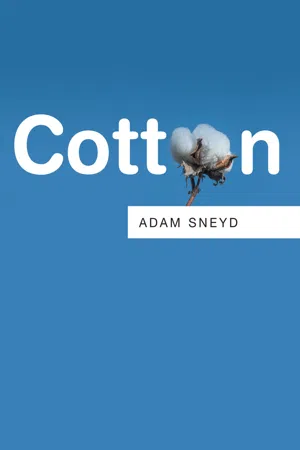
Whether we are out on the streets or between the sheets, cotton is our constant companion. But behind this ubiquitous fibre prized for its softness lies a darker story of exploitation and hardship. In this penetrating analysis, Adam Sneyd explores the power politics that envelop cotton as major corporate players and countries across Africa, Asia and the Americas compete to control it.
In the aftermath of sweatshop scandal exposés and factory collapse disasters, merchants and retailers have called for ?better? cotton farming practices. But in seeking to prevent the next transnational media circus, will companies simply end up cementing business-as-usual? Corporate public relations strategy now competes directly with the voices of an alternative global community that seeks to fundamentally transform the way that cotton is farmed. Yet these demands for cotton to work better for people and the planet have flown under the radar as media attention has focused instead on farmer subsidies and prices. From the local to the global, this book takes the reader on an illuminating journey through the multifaceted and often grubby politics of the fluffy white stuff in the world economy. The pile of political laundry it uncovers is voluminous but, as Sneyd argues, must be aired in the interests of sustainability and development.
eBook - ePub
Cotton
About this book
Information
CHAPTER ONE
Spinning a Fibrous Tale
Resources like cotton are all about economics. Right? Think about it. Many daily newspapers and weekly news magazines give us good reason to believe that commodities are simply a humdrum piece of the economic system that enables modern consumer life. In print publications, stories about resources are often buried deep at the back of the business section. Online, the story tends to be much the same: typically, you have to go digging to find out what’s going on in gold. Neoclassical economists, for their part, have convinced many media consumers and aspiring students that economics is the best discipline through which commodities like uranium can be understood. This radioactive viewpoint has had a significant half-life. And the fallout is evident every day on campuses around the world where or when students assert that abstract mathematical models are the sole route to “hard” knowledge about oil, pork bellies or other greasy commodities.
And the good news is that it is relatively easy to cut through this slick perspective. As commodity prices, resource exploration and investments boomed in the early 2000s, global resources became big academic business. Thereafter, when the global commodity bubble burst in 2014, an army of analysts stood at the ready to clean up the mess. Part of this clean-up crew rejected conventional neoclassical views on resource economics. They argued that analysts needed to foreground resource politics. In this light, commodity politics was seen to be too consequential to cover up or assume away. In putting politics at the center of their analyses, researchers working on raw materials as diverse as coffee and diamonds embraced a foundational premise of classical political economy. Their works – including all contributions to Polity’s Resources Series – underscore the fundamental inseparability of politics and economics at all levels. Under this influence, political analysts in the clean-up crew do not consider the economics of global resources in isolation from their domestic, international, or global politics. Here, the shared understanding is that politics were as much a part of the story of guano in nineteenth-century Peru as they are of coltan in present-day Democratic Republic of Congo.
A big part of the challenge of wresting control over serious analysis and commentary on commodities from neoclassical economics relates to the language we still use to describe these goods. As a descriptor, perhaps “raw materials” best captures what people intend to do with the stuff that is used to make up other products. As such, on purely economic grounds, it makes sense that we continue to refer to bulk quantities of undifferentiated raw materials as primary commodities. But in drawing our focus only to those standard characteristics, the language we use every day can obscure more than it reveals. Through directing our attention solely to these goods themselves, users and abusers of the term “commodities” can effectively sanitize or “disappear” the processes that underpin the production of materials as diverse as timber and sugar. There are a great many companies and individuals around the globe that have deep interests in presenting commodity “stories” to be primarily about market movements. Up-to-date knowledge about financial and commercial developments related to the lifeblood of industrial business-as-usual is assuredly a corporate essential. But the raw deals that plantation workers and forests have reaped are equally a part of the commodity politics status quo. In the interest of getting those broader stories out more often, it might be helpful if we all took a cue from the slogan of Cotton Incorporated, the US-based cotton promotion agency. After all, resources or commodities are absolutely the “fabrics of our lives.”
And the curious thing about cotton is that this fabric of our lives has flown largely under the radar. Unlike tea or peanuts, few people get to see the unadulterated raw stuff. There is also little doubt that most fans of the hit 1990s sitcom Seinfeld are blissfully unaware that Julia Louis-Dreyfus, one of the leads in that series, bears the family name of the leading global cotton merchant. Louis Dreyfus Commodities to this day remains a seemingly inoffensive family-run affair. And, truth be told, an extended discussion of the intricacies of that firm’s daily operations could easily glaze the eyes of both ardent Seinfeld fans and critics alike the world over. But stay tuned: those activities are unquestionably coated in layers of political intrigue.
Sticking with another cultural product of the United States for a moment then – American college football – cotton has been similarly banal. The annual Cotton Bowl Classic had for years featured teams of marginal significance to the national rankings, and was only recently resuscitated by Goodyear, a tire and rubber company. In the heartland of the United States, this fiber has been so ostensibly bland that many Americans colloquially refer to confections spun from sugar as “cotton candy.” In so doing, they have put a stamp of sweetness on a fiber with an otherwise unflattering flavor profile. Cotton candy does have a better ring to it than the reality – that this inedible fiber in raw form tastes atrociously bitter.
Activists, academics, and students have also contributed in their own small ways to the relative obscurity of cotton itself. Some of the biggest global campaigns of the past twenty years on issues linked directly to globalization and your T-shirts have missed this crop by a figurative “micronaire.” The latter term is industry jargon for the measurement of just how thick the cell walls of cotton fibers are. Quality experts consider the thickness of the micronaire to be a key indicator of fiber quality. So, to be blunt, when it came to cotton, anti-sweatshop activism was then a little thin. Without a doubt, the hard work of labor activists to expose pay and workplace health and safety scandals in Indonesia, China, and elsewhere has been spot on and effective. In the 1990s, Jeffrey Ballinger and other leading lights in the clean clothes movement achieved fantastic results when they pushed the big branded clothing retailers to develop and introduce new standards for their suppliers.1 And they did so once again in the aftermath of the factory fire and collapse scandals in Bangladesh, and also after many of the initial supplier codes failed to yield the hoped-for textile and garment worker benefits and protections.
But for every ounce of sweat shed by those devoted to making shop floors better for people and the planet, it can still seem that only a few drams have been shed in the service of making cotton work better for those that grow it. Given the persistent prominence of sweatshops in the global mediascape, that would be a reasonable surface-level impression. However, the reality revealed through research is strikingly different. High-level transnational political dramas have played out on cotton specifically over the past decades. This book will detail many of the consequential machinations and maneuvers that have recently changed the world order for cotton. Today, civil society groups, big businesses, and governments have latched onto the idea that the world needs cotton that is farmed and traded more ethically and sustainably. And a broadly shared understanding on how to best facilitate the realization of those noble objectives has not emerged. As such, there has been a profusion of high-stakes politics. This politics provides especially gripping material for political junkies because many industry insiders continue to deny its existence. Some directly reject the proposition that the cotton business is fundamentally political. And their denials are as political as they are ridiculous.
My task in writing this contribution to the Resources Series is to convince you that the geopolitics of cotton is anything but the stuff of a staid global commodity trade.2 The transnational politics associated with this fiber is also not an impenetrable thicket. This tangled mass of high-level interrelationships and low-level chicanery can be unwound. And it should be in the interest of enhancing the uptake of fashionable and enduring principles, including informed global citizenship and ethical consumption.
Take for example some of the politics of cotton on the land. One of the biggest and most long-standing farmer dilemmas with this crop is enveloped in politics. The perennial question that hangs over every individual farmer and the global industry as a whole is rather straightforward. Should we plant cotton, or should we plant something else? Politics often bears directly on this choice where and when legislation or policy offers support to those that choose to grow it. It also comes into play in places where individual farmers do not get to make that choice directly. Owing to their status as tenants, workers or disempowered family members, sometimes the principal farmers of cotton tend not to be the ones that hold the power to make decisions about whether or not they should go with it.
The derivative questions linked to the choice to plant cotton are equally political. If we do plant cotton, how will we feed ourselves? And if we do not plant cotton, how will we feed ourselves? The idea of cottonseeds fried in cottonseed oil with a side of mashed cotton plant might have quirky appeal to comfortable people that do not confront this dilemma. But the food question is serious for those that face it. Farmers must be convinced that they can navigate the trade-off between cotton in the ground and their capacity to make food available or to access food at the market. For some producers with full bellies, this is a marginal consideration. But for the vast majority of those involved with cotton globally, there is no doubt that the food issue is overarching. And many powerful voices with an interest in keeping cotton on the land seek to influence farmer answers to the food question.
The politics of securing cotton for the country is perhaps better known. Many states that produce cotton, or that rely on it for industry, have for centuries attempted to control the fiber at home and abroad.3 Where national interests have been linked to the availability of cotton, and business and high-level politics have become intertwined, many world-changing stocks and flows have emerged and become entrenched. For instance, when business interests in securing cheap cotton and furthering the industrial development of cotton were equated with the national interest in Britain, imports of finished fabrics from the Empire were curtailed. Subsequently, after the stock of textile firms was bolstered at home, British fabrics flooded the realm where the sun never set on British exports. Moreover, as demands for cheaper cotton from industry grew, the total global stock of enslaved people simultaneously rose. Cross-border flows of slaves and cotton fueled “economic growth” and industrialization in Britain, and then in the rest of Europe and the United States. Along with sugar, cotton underpinned this hideous system. And controlling cotton for the country has also been a dirty business for “free” farmers at home. Many smallholders around the globe have suffered in the name of national industrial development. In a range of diverse places, cotton farmers have been seriously exploited. Over the course of the last century and down to today, many have been short-changed via the payment of artificially low prices.4 Where governments have intervened to keep farm-gate prices low or businesses have colluded to reduce payouts, farmers have faced effective taxes on their outputs. And these “taxes” have sometimes lined the pockets of industry insiders. At other times, they have been used to subsidize the emergence of employment-generating spinning and weaving manufacturing operations of varying quality and durability.
On another front, cotton in company hands is a persistent source of political rhetoric and controversy. Corporations involved in the buying and processing of cotton to remove the seeds might seem to be pretty remote from big politics. At first glance, it could easily appear to be the case that company politics is of limited consequence beyond this industry. A political bribe here to get a standard shipping container there, for example. But the reality could not be more contrasting. Cotton company actions have considerable global political spillovers. For starters, domestic buyers and the transnational merchants that move cotton across borders are engaged in an activity that since the 1980s has become much more financially complex. Put simply, tools that enable companies to manage financial risks associated with cotton, such as futures contracts, have now become a really big part of this business. And the politics of futures and derivatives market regulation, or the lack thereof, and of financialization more generally, are matters of serious concern at the highest levels. Jennifer Clapp’s must-read analysis of developments in this area appears in the Resources Series in her wonderful book Food.5
Beyond the politics of finance, company control over cotton has yielded negative externalities that have accelerated global environmental change.6 The demand for ultra-white cotton that continues to emanate from some quarters has encouraged farming practices that, to put it mildly, have been far too intensive. As alternative approaches to cotton that rely less on agrochemicals have been successfully tested, companies that advance new ideas about cotton have emerged. These upstarts now challenge the old view that more chemicals and more water are necessary to grow quality fiber successfully. In the new order for cotton, companies can and do clash openly and politically over best practices.
Finally, the global cotton trade itself has animated renewed inter-state geopolitical conflict. Some states that export cotton and that are members of the World Trade Organization (WTO) have used WTO rules to challenge the cotton support policies of other WTO members.7 Brazil and a group of African countries that depend on cotton have pushed back against US cotton policies that they have deemed unfair. The former launched a trade dispute and ultimately ...
Table of contents
- Cover
- Title Page
- Copyright
- Acknowledgments
- 1 Spinning a Fibrous Tale
- 2 The World Cotton (Dis)Order
- 3 Cotton on the Land
- 4 Cotton for the Country
- 5 Cotton in Company Hands
- 6 Beyond the Dirty White Stuff
- Afterword: A Learner in the World Cotton Order
- Selected Readings
- Index
- End User License Agreement
Trusted by 375,005 students
Access to over 1.5 million titles for a fair monthly price.
Study more efficiently using our study tools.
Frequently asked questions
Yes, you can cancel anytime from the Subscription tab in your account settings on the Perlego website. Your subscription will stay active until the end of your current billing period. Learn how to cancel your subscription
No, books cannot be downloaded as external files, such as PDFs, for use outside of Perlego. However, you can download books within the Perlego app for offline reading on mobile or tablet. Learn how to download books offline
Perlego offers two plans: Essential and Complete
- Essential is ideal for learners and professionals who enjoy exploring a wide range of subjects. Access the Essential Library with 800,000+ trusted titles and best-sellers across business, personal growth, and the humanities. Includes unlimited reading time and Standard Read Aloud voice.
- Complete: Perfect for advanced learners and researchers needing full, unrestricted access. Unlock 1.5M+ books across hundreds of subjects, including academic and specialized titles. The Complete Plan also includes advanced features like Premium Read Aloud and Research Assistant.
We are an online textbook subscription service, where you can get access to an entire online library for less than the price of a single book per month. With over 1.5 million books across 990+ topics, we’ve got you covered! Learn about our mission
Look out for the read-aloud symbol on your next book to see if you can listen to it. The read-aloud tool reads text aloud for you, highlighting the text as it is being read. You can pause it, speed it up and slow it down. Learn more about Read Aloud
Yes! You can use the Perlego app on both iOS and Android devices to read anytime, anywhere — even offline. Perfect for commutes or when you’re on the go.
Please note we cannot support devices running on iOS 13 and Android 7 or earlier. Learn more about using the app
Please note we cannot support devices running on iOS 13 and Android 7 or earlier. Learn more about using the app
Yes, you can access Cotton by Adam Sneyd in PDF and/or ePUB format, as well as other popular books in Technology & Engineering & Agriculture. We have over 1.5 million books available in our catalogue for you to explore.